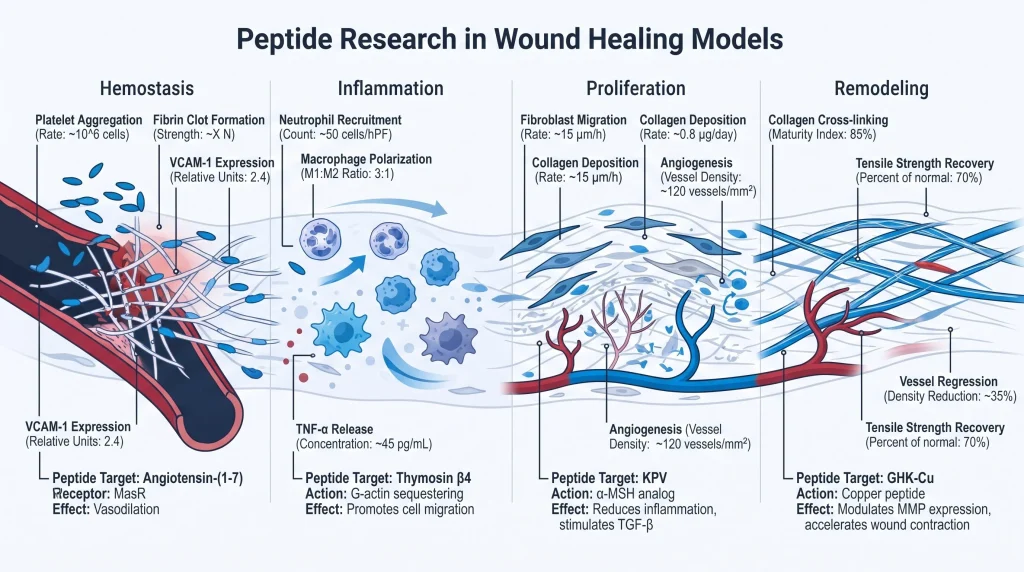
Peptide Research in Wound Healing Models

Last updated: July 2026
A peptide wound healing research model is a lab system that tests how small protein chains affect tissue repair pathways. Wounds move through four overlapping stages: hemostasis, swelling, cell growth, and tissue remodeling. Researchers study peptides that act at each stage. BPC-157, TB-500, GHK-Cu, and KPV are four compounds studied in these models. According to PubMed (2018), BPC-157 has been studied across many tissue repair models and shows activity at multiple stages of the repair process.
Next Level Pharm supplies research-grade peptides for wound healing studies. Every vial is HPLC-tested and ships with a certificate of analysis (COA). Average purity across recent batches is 99.4%.
Wound healing research gives labs a controlled way to study tissue repair at the cell level. Each peptide in this space targets a different part of the repair process. Knowing those targets helps researchers design cleaner, more focused studies.
Key Takeaways
- Four Repair Stages: Wound repair moves through hemostasis, swelling, cell growth, and tissue remodeling. Research peptides may act at one or more of these stages in lab models.
- BPC-157 and Angiogenesis: BPC-157 is a 15-amino-acid peptide studied for its role in new blood vessel formation and collagen cross-linking in tissue repair models.
- TB-500 and Cell Migration: TB-500 (thymosin beta-4) binds actin filaments. It promotes cell movement and tissue regeneration in wound healing assays.
- GHK-Cu and Collagen: GHK-Cu is a copper-binding tripeptide. It promotes collagen synthesis and matrix remodeling. Labs study it in both skin and deeper tissue models.
- KPV as an Anti-Swelling Tool: KPV is a tripeptide that blocks NF-kB signaling. This cuts cytokine output and reduces swelling markers in tissue repair assays.
- COA and Batch Testing: All wound healing peptides are lyophilized and batch-tested. Lot numbers link to purity records for each vial.
These six points set up the sections below. Each section covers one compound or one repair stage in detail.
What Are the Four Stages of Wound Repair?
Wound repair starts with hemostasis. Blood vessels tighten and clot factors form a plug to stop blood flow. Next comes the swelling stage. Immune cells clear debris and release cytokines to signal the repair process. The third stage is cell growth. Fibroblasts move into the wound site and lay down new collagen. The final stage is remodeling. The collagen matrix is reshaped over weeks to months.
Research peptides can act at any of these four stages. Some target the cell growth stage by promoting fibroblast activity. Others reduce swelling signals or promote new blood vessel growth (angiogenesis). Labs use in vitro scratch assays and animal wound models to track how peptides change the repair timeline.
What Does BPC-157 Do in Wound Research?
BPC-157 is a 15-amino-acid stable fragment of body protection compound. It is studied for promoting angiogenesis and collagen cross-linking in wound repair models. In lab assays, BPC-157 promotes new blood vessel growth. Better blood supply helps the wound site receive more repair cells and oxygen. This is a key step in the cell growth stage of healing.
BPC-157 also has a known effect on nitric oxide (NO) signaling. NO widens blood vessels and helps new capillaries form. According to PubMed (2018), BPC-157 modulates NO pathways in tissue repair models, which may explain its angiogenic activity. Labs studying BPC-157 can browse BPC-157 research vials for COA-verified supply.
What Is the Role of TB-500 in Repair Models?
TB-500, also called thymosin beta-4, is a 43-amino-acid peptide. It binds actin filaments inside cells. Actin is a protein that forms the internal skeleton of cells and drives cell movement. TB-500 helps cells migrate to the wound site by modulating the actin network. This cell migration is a key part of the cell growth stage in wound repair.
In scratch assays, TB-500 increases the speed at which cells close a gap on a culture dish surface. This is a common in vitro model for wound closure. Labs also study TB-500 for its role in reducing swelling after acute tissue stress. According to PubMed (2012), thymosin beta-4 promotes actin-driven cell migration in repair assay systems. Browse TB-500 research vials for COA-verified, lyophilized supply.
How Does GHK-Cu Support Collagen Research?
GHK-Cu is the tripeptide glycine-histidine-lysine bound to a copper ion. It is one of the most studied peptides in skin and connective tissue repair research. GHK-Cu promotes fibroblast activity in cell culture models. Active fibroblasts lay down more collagen. Labs use this property to study matrix remodeling in wound and skin repair assays.
GHK-Cu also activates matrix metalloproteinases (MMPs). MMPs break down old or damaged collagen. This clears the way for fresh collagen to form. According to PubMed (2015), GHK-Cu can reset gene output patterns linked to tissue repair and collagen turnover in lab studies. Browse GHK-Cu research vials for COA-verified, HPLC-tested supply.
What Does KPV Do in Swelling Models?
KPV is a tripeptide made of lysine, proline, and valine. It is derived from alpha-MSH (alpha-melanocyte-stimulating hormone). KPV acts by blocking the NF-kB signaling pathway. NF-kB controls the genes that make pro-swelling cytokines. By blocking NF-kB entry into the cell nucleus, KPV cuts cytokine output.
Labs study KPV in gut tissue and skin models where swelling is a key variable. Reducing cytokine output in these models allows researchers to observe how lower swelling affects repair rates. KPV is also studied in combination with BPC-157 and GHK-Cu to map multi-peptide repair responses. Browse KPV research vials for batch-tested supply.
How Do These Wound Peptides Compare?
Each wound healing peptide targets a different part of the repair process. Labs choose compounds based on which repair stage they want to probe.
| Peptide | Primary Target | Mechanism | Main Research Model |
| BPC-157 | Cell growth stage | Angiogenesis and NO signaling | Tendon, gut, skin wound assays |
| TB-500 | Cell migration | Actin binding, cell motility | Scratch assay, muscle, cardiac models |
| GHK-Cu | Remodeling stage | Collagen synthesis, MMP activation | Skin, connective tissue assays |
| KPV | Swelling stage | NF-kB blockade, cytokine cut | Gut mucosa, skin swelling models |
Using more than one compound in a study allows labs to cover multiple repair stages. All four are available as COA-verified, lyophilized research peptides.
Frequently Asked Questions
What is peptide wound healing research?
Peptide wound healing research uses lab models to study how small protein chains affect tissue repair. These models include in vitro scratch assays, cell culture studies, and animal wound models. Researchers track how peptides change collagen production, cell migration, angiogenesis, and swelling markers at each stage of the repair process. BPC-157, TB-500, GHK-Cu, and KPV are common compounds used in these assays. All research is conducted in controlled lab settings and is not for human use.
How does BPC-157 work in wound healing models?
BPC-157 is a 15-amino-acid peptide studied for its role in angiogenesis and nitric oxide signaling in tissue repair models. It promotes new blood vessel formation, which brings more repair cells to the wound site. According to PubMed (2018), BPC-157 modulates NO pathways and collagen cross-linking in preclinical repair assays. It is active across multiple wound model types including skin, tendon, and gut tissue in lab settings.
What is TB-500 and how is it studied in repair models?
TB-500 is thymosin beta-4, a 43-amino-acid peptide that binds actin filaments inside cells. Actin drives cell movement, so TB-500 is studied for its role in cell migration to wound sites. In scratch assays, it increases the rate of gap closure on culture dish surfaces. It also modulates swelling markers after tissue stress. Labs use TB-500 in scratch assay, muscle, and cardiac repair models to study its actin-driven migration effects.
How does GHK-Cu promote collagen synthesis in lab models?
GHK-Cu binds copper and activates fibroblasts in cell culture models. Active fibroblasts produce more collagen, which is the main structural protein in wound repair. GHK-Cu also activates matrix metalloproteinases (MMPs) that clear old or damaged collagen before new collagen forms. According to PubMed (2015), GHK-Cu resets gene output patterns linked to tissue repair and collagen turnover. It is studied in skin and connective tissue assays.
What is the NF-kB pathway and why is KPV studied for it?
NF-kB is a protein complex that controls genes for pro-swelling cytokines. When activated, NF-kB enters the cell nucleus and switches on cytokine genes. This increases swelling signals. KPV blocks NF-kB from entering the nucleus, which cuts cytokine output. Researchers use KPV to model reduced-swelling conditions in wound repair assays. Lower swelling levels allow labs to observe how the repair process changes when the swelling phase is dampened.
What are scratch assays and how are they used in wound research?
A scratch assay is an in vitro wound model. Researchers grow a layer of cells on a dish, then scratch a gap through the layer. They measure how fast cells close the gap over time. This models the cell migration step in wound repair. TB-500 and BPC-157 are often tested in scratch assays to see how they change gap-closure speed. The assay is simple, reproducible, and does not require animal models for initial screening runs.
Why is angiogenesis important in wound repair research?
Angiogenesis is the formation of new blood vessels. Without new vessels, a wound site cannot receive enough repair cells, oxygen, and nutrients to heal. BPC-157 is one of the most studied peptides for its angiogenic activity in lab models. New vessel growth supports the cell growth stage of repair. Labs measure angiogenesis by tracking vessel density, tube formation in Matrigel assays, and blood flow markers in animal wound models.
Can multiple wound healing peptides be studied together?
Yes, labs often use more than one compound in a single study. Combining BPC-157 with TB-500, for example, covers both angiogenesis and cell migration in the same model. Adding GHK-Cu covers the collagen synthesis and remodeling stages. This multi-peptide approach gives a fuller picture of how the repair cascade changes under peptide input. All compounds must be COA-verified and HPLC-tested to ensure purity and lot consistency across a multi-compound study.
What animal models are used in wound healing peptide research?
Common animal models include rodent excision wound models, where a defined area of skin is removed and healing is tracked over days. Tendon injury models test peptide effects on fibrous tissue repair. Gut mucosal models study repair in digestive tissue. Each model gives data on a specific tissue type. Labs also use zebrafish models for rapid in vivo screening before moving to mammalian models. All peptides must be research-grade with lot-specific purity data.
Summary
Wound healing research uses lab models to study how peptides affect tissue repair at each stage. BPC-157 targets angiogenesis and NO signaling in the cell growth stage. TB-500 targets actin-driven cell migration. GHK-Cu promotes collagen synthesis and matrix remodeling. KPV blocks the NF-kB pathway to cut swelling marker output.
Each compound acts at a different repair stage. Labs choose peptides based on which stage they want to probe. Multi-compound designs let researchers cover the full repair cascade in a single study.
What Should You Do Next?
Researchers should define the repair stage and assay endpoint before selecting a peptide. Match the compound mechanism and stability profile to the planned model. Confirm HPLC purity, mass spec identity, and the lot number on the COA before each run. Researchers sourcing these lab peptides can browse Next Level Pharm for full COA and lot traceability.
Related research: BPC-157 vs TB-500 research comparison, anti-inflammatory peptide research (BPC-157, KPV, ARA-290), and how peptides stimulate collagen synthesis.
People Also Read
- BPC-157 Research Peptide: Lab-Grade Vials for Tissue Research
- TB-500 Research Peptide: Thymosin Beta-4 for Lab Use
About the Author
Next Level Pharm Research Team
Alex M covers peer-reviewed findings in peptide science for Next Level Pharm, a US-based supplier of research-grade peptides verified to ≥99% purity via HPLC and mass spectrometry on every batch.
Disclaimer: For research purposes only. Not intended for human consumption. Next Level Pharm products are not intended for diagnostic, therapeutic, or medicinal use. This content does not constitute medical advice. Always consult a licensed healthcare professional before making any health-related decisions.