
Recovery Peptides Comparison: BPC-157, TB-500, KPV, GHK-Cu

Last updated: May 2026
A recovery peptides comparison looks at four lab-grade peptides studied in tissue and cell models. BPC-157, TB-500, KPV, and GHK-Cu each act on a different cell path. In lab studies, they show effects on growth factor signals, cell movement, immune markers, and collagen production. All findings here come from lab and animal studies. No human use data is presented.
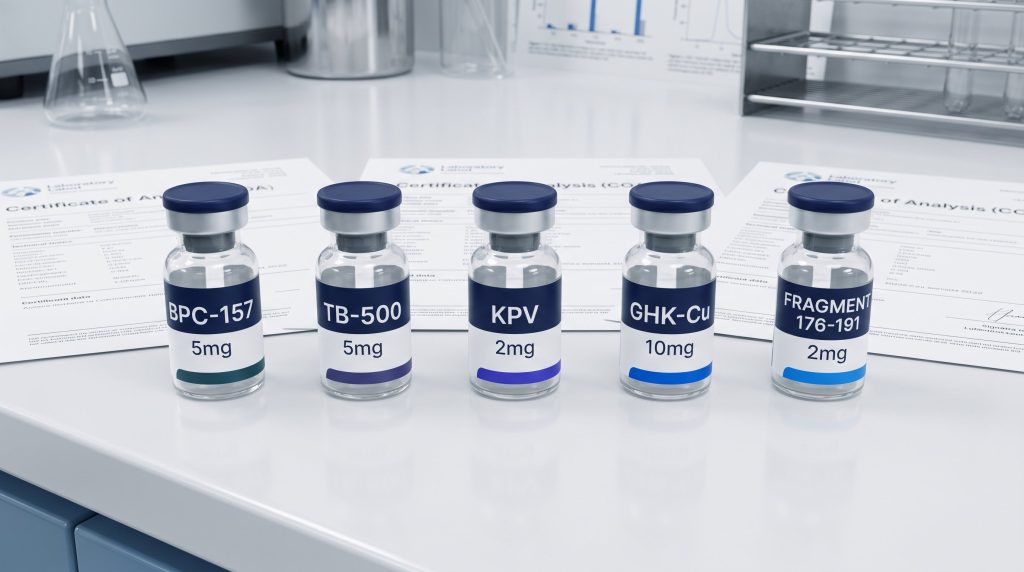
Next Level Pharm supplies each of these peptides as a COA-verified, lyophilized research compound. A certificate of analysis (COA) with a lot of ships with every order. Every batch is tested to ≥99% purity via HPLC and mass spec.
Researchers working in tissue and cell repair models often ask how these four peptides differ. Each targets a different cell path. The sections below break down the research on each compound.
Key Takeaways
- BPC-157: A 15-amino-acid synthetic peptide. Lab models show effects on growth factor paths and new vessel formation.
- TB-500: A synthetic fragment of thymosin beta-4 (Tb4). Studies link it to actin binding and cell movement in wound models.
- KPV: A tripeptide (Lys-Pro-Val) from alpha-MSH. Research shows effects on immune signal paths in gut and skin models.
- GHK-Cu: A copper-binding tripeptide. Lab studies show effects on collagen production and wound repair signals.
- Purity Standard: All four peptides ship at ≥99% purity with HPLC and mass spec verification on every batch.
- Research Context: All findings come from lab and animal models. None of this data reflects human use or clinical results.
These four peptides are common subjects in cell repair research. Their distinct structures make them useful tools in separate study contexts.
What Are These Four Recovery Peptides?
BPC-157, TB-500, KPV, and GHK-Cu are four synthetic peptides used in lab research. Each has a unique structure and a separate set of study models. They do not share the same cell targets or research contexts. All four are sold as lyophilized (freeze-dried) research powders at ≥99% purity. Each ship with a lot number linked to a full COA.
Each peptide has a different size and origin. BPC-157 comes from gastric juice protein. TB-500 is a synthetic version of thymosin beta-4 (Tb4). KPV is a tripeptide from the C-terminal end of alpha-MSH (alpha-melanocyte-stimulating hormone). Its three amino acids are lysine, proline, and valine. GHK-Cu is a copper-binding tripeptide (glycine-histidine-lysine) found in blood plasma, saliva, and urine. Lyophilized powders stay stable at room temperature during shipping.
How Does BPC-157 Work in Tissue Models?
BPC-157 affects growth factor signal paths. In lab models, it promotes new blood vessel formation. Researchers call this process angiogenesis. Studies include tendon, muscle, bone, and gut tissue models. BPC-157 is a 15-amino-acid sequence from gastric juice protein. It ships at ≥99% purity, confirmed by HPLC and mass spec on every batch.
According to Curr Pharm Des (2018), BPC-157 activates growth factor paths in tissue models. These include GHR (growth hormone receptor) and VEGF (vascular endothelial growth factor). VEGF is linked to cell survival and new vessel growth. In rat and cell culture models, BPC-157 has shown effects on tendon and gut tissue repair signals. Researchers study how growth factor paths respond to injury signals at the cell level. HPLC confirms peptide identity. Mass spec confirms molecular weight.
How Does TB-500 Affect Cell Migration?
TB-500 binds actin, a protein that drives cell movement. Lab studies link this binding to faster cell movement toward wound sites. TB-500 is a synthetic version of thymosin beta-4 (Tb4). It is studied in skin, cardiac, and blood vessel wound models. Each batch ships at ≥99% purity via HPLC and mass spec.
According to Nature (2004), Tb4 promotes actin polymerization (the linking of actin proteins into chains). This drives cells to move toward wound sites. In animal wound models, TB-500 has been studied for effects on skin, cardiac tissue, and blood vessel repair signals. It is one of the most studied Tb4 fragments in cell movement research. Results from these studies help researchers understand how actin paths affect repair at the cell level.
What Does KPV Research Show?
KPV is a small, water-soluble tripeptide. Lab studies show it affects immune signal paths. Research focuses on gut lining and skin tissue models. KPV binds to immune cell receptors, including the melanocortin-1 receptor (MC1R). MC1R is a receptor found on immune and skin cells. KPV from Next Level Pharm ships at ≥99% purity with a COA on every order.
According to Molecules (2019), KPV reduces immune activation markers in gut lining and skin models. In mouse colitis models, KPV reduced key immune markers, including interleukin-6 (IL-6) and tumor necrosis factor-alpha (TNF-alpha). Researchers also study KPV in skin barrier models. Its small size (three amino acids) lets it pass through cell barriers more easily than larger peptides. This makes it a useful tool in cell-based immune signal studies.
What Does GHK-Cu Research Show?
GHK-Cu is a copper-binding tripeptide found in blood plasma, saliva, and urine. Lab models show effects on collagen production and wound signal paths. The copper ion (Cu2+) plays a role in enzyme activation in these studies. GHK-Cu is often studied with AHK-Cu, a related copper peptide. See AHK-Cu Research for more on that compound.
GHK-Cu (glycine-histidine-lysine copper) affects collagen and elastin production in lab models. Collagen and elastin are two key proteins in skin and connective tissue. GHK-Cu also affects signals linked to wound repair, blood vessel growth, and antioxidant enzyme paths. Studies look at how the copper ion interacts with enzyme systems in skin cell models. These findings help researchers understand how copper-binding peptides affect skin and tissue repair signals at the cell level.
How Do These Peptides Compare?
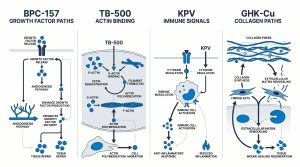
Each of the four peptides works through a different primary cell path. Researchers choose among them based on study context. BPC-157 and TB-500 suit tissue and wound models. KPV suits gut and skin immune studies. GHK-Cu suits collagen and skin repair research. No single peptide covers all four of these research areas. The table below summarizes key structural differences.
| Peptide | Structure | Primary Research Focus | Key Path |
| BPC-157 | 15-amino-acid synthetic | Tissue and vessel repair models | VEGF, GHR |
| TB-500 | 43-amino-acid Tb4 fragment | Cell migration and wound models | Actin polymerization |
| KPV | 3-amino-acid alpha-MSH fragment | Gut and skin immune models | MC1R, IL-6, TNF-alpha |
| GHK-Cu | Copper-binding tripeptide | Collagen and wound signal models | Collagen, elastin paths |
Researchers in connective tissue biology often compare BPC-157 and TB-500. Both are studied in wound models, but through separate paths. KPV and GHK-Cu are more common in skin and gut research.
Next Level Pharm stocks all four in its recovery peptide catalog. Browse the BPC-157 product page to see lot numbers and COA links. For the full catalog, visit the shop.
Frequently Asked Questions
What is BPC-157 used for in research?
BPC-157 is studied in lab and animal models for effects on tissue repair signals. Research focuses on tendon, muscle, bone, and gut tissue models. It affects growth factor paths, including VEGF and GHR. These paths link to cell survival and new blood vessel formation. All findings come from lab and animal models. BPC-157 is a research compound. It is not approved for human use. It ships at ≥99% purity with a COA on every order.
What is TB-500 and how does it differ from thymosin beta-4?
TB-500 is a synthetic version of the active part of thymosin beta-4 (Tb4). Tb4 is a protein found in most human and animal cells. The key part of Tb4 is the LKKTET sequence, which binds actin and drives cell movement. TB-500 isolates this active fragment. In lab studies, TB-500 shows effects similar to full Tb4 in wound and cell movement models. It is a common subject in tissue repair research.
What is KPV and where does it come from?
KPV (lysine-proline-valine) is a tripeptide from the C-terminal end of alpha-MSH (alpha-melanocyte-stimulating hormone). Alpha-MSH is a natural peptide that affects immune signals. KPV keeps the immune-signal properties of alpha-MSH in a smaller, stable form. It is water-soluble and can pass through cell barriers. Lab studies focus on KPV in gut lining and skin immune models. It ships as a lyophilized powder at ≥99% purity.
How does GHK-Cu differ from other copper peptides?
GHK-Cu (glycine-histidine-lysine copper) is the most studied copper peptide. Its close relative, AHK-Cu (alanine-histidine-lysine copper), has a similar structure. The main difference is the first amino acid: alanine in AHK-Cu vs. glycine in GHK-Cu. Both bind copper and are studied for effects on collagen and elastin production. GHK-Cu has a longer research record. AHK-Cu is a newer research subject. Both are available as COA-verified research compounds.
Can these four peptides be used in the same study?
Stack research (studying two or more peptides in the same model) is an active area of lab science. Next Level Pharm sells BPC-157 and TB-500 as part of its GLOW Stack and KLOW Stack products. These are separate SKUs for researchers who want both compounds in one order. Lab protocols vary widely for stack studies. Each compound must follow its own storage and reconstitution guidelines. All stack products ship at ≥99% purity with separate COAs.
What does HPLC testing confirm for these peptides?
HPLC (high-performance liquid chromatography) is a lab method that separates compounds in a solution. It confirms peptide identity by comparing retention times to reference standards. Mass spec (mass spectrometry) confirms molecular weight. Together, HPLC and mass spec give researchers two data points. They verify that a peptide matches its label and is free from major impurities. Every batch from this catalog is tested by both methods before shipping.
How are these peptides stored and shipped?
All four peptides ship as lyophilized (freeze-dried) powders. Lyophilization removes water from the peptide and extends shelf life. Lyophilized peptides are stable at room temperature during shipping. They do not need cold-chain transport. Long-term storage at -20°C is standard after receipt. These compounds ship from the USA with an average dispatch time of about 48 hours. Free shipping is available on orders over $150.
What are the purity standards for research peptides?
Research-grade peptides should be ≥98% pure at minimum. The standard for these four compounds is ≥99% purity. The average purity across the last 100 batches is 99.4%. Each vial ships with a lot number linked to a full COA. The COA includes HPLC and mass spec data. Researchers can access COA data online using the lot number on the label. This level of detail supports peer review citation.
What is the difference between a peptide and a protein?
A peptide is a short chain of amino acids linked by peptide bonds. A protein is a longer chain, usually over 50 amino acids, that folds into a complex 3D shape. BPC-157 (15 amino acids), KPV (3 amino acids), and GHK-Cu (3 amino acids) are peptides. TB-500 (43 amino acids) sits near this boundary. In research, all four are handled as synthetic peptides and studied in cell culture and animal models.
Where can researchers find study data for these compounds?
Study data for BPC-157, TB-500, KPV, and GHK-Cu is on PubMed, the NIH database of peer-reviewed research. The three citations in this article link to specific studies on PubMed. ClinicalTrials.gov lists ongoing and completed clinical trials. Examine.com provides research summaries for many peptides. All external links in this article point to the exact study cited. Researchers should verify study details before citing them in their own work.
Summary
BPC-157, TB-500, KPV, and GHK-Cu are four lab-grade peptides with distinct structures and research profiles. BPC-157 affects growth factor paths. TB-500 targets actin binding and cell movement. KPV works on immune signal paths in gut and skin models. GHK-Cu affects collagen and wound signal paths.
All four are COA-verified, lyophilized research compounds at ≥99% purity. Each batch is tested via HPLC and mass spec. Researchers select among them based on the cell path under study. These are research compounds. No human use data is presented here.
What Should You Do Next?
Researchers sourcing these compounds should verify purity, lot numbers, and COA access before ordering.
- Review the comparison table above to match each peptide to the correct cell path for your study.
- Download lot-specific COA documents to confirm purity before ordering.
- Browse the full recovery peptide catalog to view vial sizes and lot numbers.
- Shop research peptides across all categories, with free shipping on orders over $150.
View the BPC-157 product page for current lot data and COA links.
People Also Read
About the Author
Next Level Pharm Research Team
Alex M covers peer-reviewed findings in peptide science for Next Level Pharm, a US-based supplier of research-grade peptides verified to ≥99% purity via HPLC and mass spectrometry on every batch.
Disclaimer: The information provided on this page is for educational and research purposes only. Next Level Pharm’s products are intended for laboratory research use only. They are not intended for human consumption, diagnostic, therapeutic, or medicinal purposes. This content does not constitute medical advice. Always consult a licensed healthcare professional before making any health-related decisions