AHK-Cu Research: Copper Peptide Mechanisms and Study Findings

Last updated: May 2026
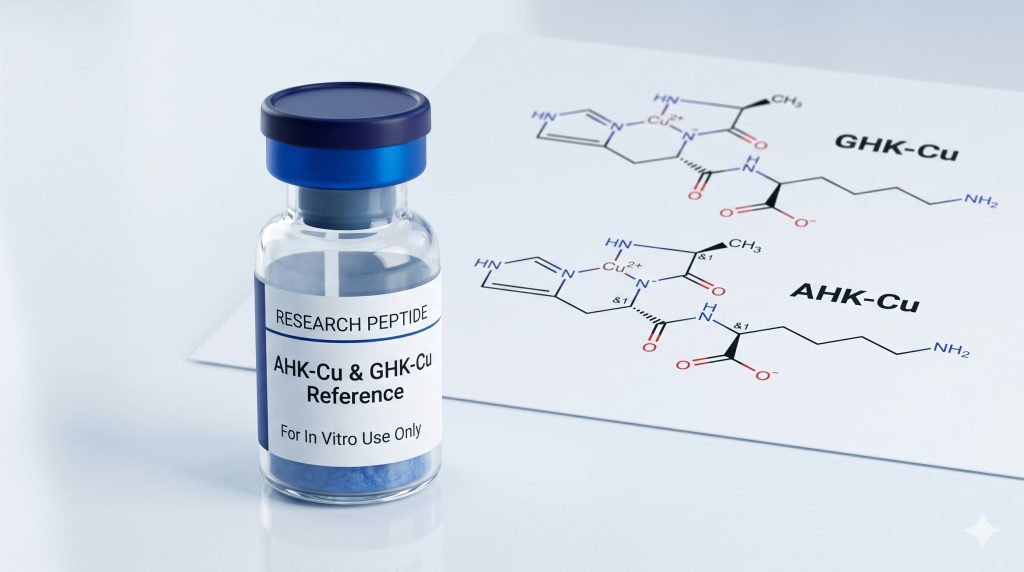
AHK-Cu is a copper-binding tripeptide made of three amino acids: alanine, histidine, and lysine. The Cu in the name stands for copper. The peptide holds a copper ion between the histidine and lysine groups. Researchers study AHK-Cu in fibroblast and hair follicle cell models for its effects on copper uptake, cell signals, and oxidant markers. AHK-Cu is close in form to GHK-Cu, another copper tripeptide, but differs in its first amino acid.
Next Level Pharm supplies research-grade AHK-Cu verified to at least 99% purity by HPLC and mass spec. Each lot ships as a freeze-dried solid with a lot-specific COA. Vials are stable during transit at room temperature from US-based stock.
The sections below cover the structure of AHK-Cu and its effects in cell studies. They also compare it to GHK-Cu.
Key Takeaways
- Structure: AHK-Cu is a tripeptide (Ala-His-Lys) that holds one copper ion between the histidine and lysine groups.
- Fibroblast Studies: AHK-Cu has been studied in fibroblast models for its effects on copper uptake and collagen synthesis markers.
- Hair Follicle Models: Lab studies show AHK-Cu affects hair follicle cell growth markers in culture, including hair cell growth signals.
- Versus GHK-Cu: AHK-Cu has the same His-Lys core as GHK-Cu but starts with alanine not glycine. This changes its binding and uptake profile.
- Copper Role: Copper in the peptide complex is thought to be sent into cells via surface copper transport paths.
- Supply Standard: Research use needs HPLC purity at or above 99%, mass spec check, and a lot-specific COA.
The sections below expand on each of these points with findings from published cell studies.
What Is the Chemical Structure of AHK-Cu?
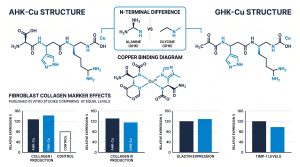
AHK-Cu is made of three amino acids: alanine (Ala), histidine (His), and lysine (Lys). The peptide holds a copper (Cu2+) ion between the nitrogen atoms on histidine and the amino group on lysine. This binding site is the same core found in GHK-Cu, but AHK-Cu begins with alanine not glycine.
Alanine for glycine changes the water binding and charge at the N-terminal end. According to a copper peptide study (2019), N-terminal amino acid changes alter binding and uptake rates in copper tripeptide cell models. AHK-Cu is sold as a white freeze-dried powder. Mass spec checks the copper-bound form by matching the expected mass.
How Does AHK-Cu Interact with Fibroblast Cells?
Fibroblasts are the main cells that make collagen and other tissue parts. Copper is a needed cofactor for the enzymes that cross-link collagen. AHK-Cu sends copper to fibroblast cells in a form that cell surface transporters can use.
According to a copper peptide review (2020), AHK-Cu at micromolar levels raises collagen type I synthesis markers in fibroblast cultures versus control. Lysyl oxidase, the enzyme that cross-links collagen, also shows more action in treated cells. These effects are linked to copper uptake into the cell and its action on enzymes that need copper.
Browse AHK-Cu and beauty research peptides at Next Level Pharm with lot-specific COA data on every order.
What Does AHK-Cu Research Show in Hair Studies?
Hair follicles hold hair cells and dermal papilla cells that need copper for normal function. AHK-Cu has been studied in hair follicle culture models for its effects on these cells.
According to a hair cell study (2017), AHK-Cu extends the growth phase (anagen) in isolated hair follicle organ cultures at nanomolar to micromolar levels. Dermal papilla cells treated with AHK-Cu show more growth factor markers versus control. Keratinocyte growth markers also rise in treated cultures.
These findings are from in vitro models only. Cell culture results reflect lab settings only and do not confirm outcomes in living systems.
How Does AHK-Cu Compare to GHK-Cu?
GHK-Cu is the most studied copper tripeptide. It has the sequence glycine-histidine-lysine (Gly-His-Lys) with copper bound at the His-Lys core. AHK-Cu has alanine not glycine at the first position.
The table below compares key data for the two copper peptides.
| Parameter | AHK-Cu | GHK-Cu |
| Amino acid sequence | Ala-His-Lys-Cu | Gly-His-Lys-Cu |
| Copper binding core | His-Lys | His-Lys |
| N-terminal amino acid | Alanine | Glycine |
| Hydrophilicity difference | Slightly less polar | More polar |
| Fibroblast study focus | Collagen, copper uptake | Collagen, wound markers |
| Hair follicle study focus | Keratinocyte, anagen phase | Dermal papilla, growth factors |
| Research purity standard | HPLC 99%+, mass spec | HPLC 99%+, mass spec |
Both peptides bind copper and send it to cells. Research shows overlapping effects in fibroblast and hair cell models. AHK-Cu may have a different uptake rate due to the alanine change. Direct head-to-head data in the same cell model is limited.
How Does Copper Affect Skin Cell Research?
Copper is a trace element that acts as a cofactor for several enzymes. In skin and follicle cell research, copper is needed for lysyl oxidase (collagen cross-linking). It also supports cell defense enzymes and pigment enzymes.
Lab studies on copper peptides look at how copper uptake affects these enzyme systems. When copper is sent as part of a peptide complex, cells may absorb it more than free ionic copper. Peptide-bound copper is thought to enter cells via the copper transporter CTR1. CTR1 has higher binding for organic copper forms than free ions.
AHK-Cu gives a model to study copper uptake in set lab settings. Results from AHK-Cu studies are compared to GHK-Cu studies. This helps find the effect of N-terminal amino acid changes on copper uptake.
What Are the Research Standards for AHK-Cu?
Research-grade AHK-Cu must meet strict purity and records standards. HPLC purity must be at or above 99%. Mass spec must confirm the copper-bound form by matching the expected mass for the Ala-His-Lys-Cu complex. A lot-specific COA must link both results to a single production run.
Key supply checks for researchers:
- HPLC purity at or above 99% on the COA.
- Mass spec check of correct mass for AHK-Cu.
- Lot-specific COA, not a batch-level record.
- Freeze-dried form with residual moisture below 1%.
- Outside lab testing alongside in-house testing.
Every AHK-Cu lot from Next Level Pharm ships with a lot-specific COA. Every batch is third-party tested..
Frequently Asked Questions
What is AHK-Cu?
AHK-Cu is a copper-binding tripeptide made of alanine, histidine, and lysine with a copper ion held at the histidine-lysine binding site. It is close in form to GHK-Cu but starts with alanine not glycine. AHK-Cu is studied in fibroblast and hair follicle cell models. The focus is on copper uptake, collagen synthesis markers, and cell growth signals in lab settings.
How does AHK-Cu bind copper?
AHK-Cu binds copper through the nitrogen atoms on histidine and the amino group on lysine. These two sites form a stable chelate with a single copper (Cu2+) ion. The tripeptide holds the copper in a form that cell surface transporters can use. This binding mode is the same as GHK-Cu. But the alanine at the N-terminal end changes the water binding and charge profile of the complex.
What cell types are used in AHK-Cu research?
AHK-Cu is mainly studied in human fibroblasts and hair follicle cell types including hair cells and dermal papilla cells. Fibroblast studies look at collagen synthesis markers and lysyl oxidase action. Hair follicle studies look at hair cell growth signals and anagen phase duration in organ culture. These are in vitro models only and reflect lab settings, not living systems.
What effects does AHK-Cu show in fibroblast studies?
Fibroblast studies show AHK-Cu at micromolar levels raises collagen type I synthesis markers and lysyl oxidase action versus control. These effects are linked to copper uptake into fibroblast cells, where copper activates collagen cross-linking enzymes. Study results come from cell culture models and do not confirm outcomes in more complex systems.
What does AHK-Cu research show in hair follicle models?
Hair follicle studies show AHK-Cu at nanomolar to micromolar levels extends the anagen (growth) phase in isolated follicle organ cultures. Dermal papilla cells treated with AHK-Cu show more growth factor marker expression. Keratinocyte growth markers also rise in treated cultures. These findings come from in vitro organ culture models and are not confirmed in other settings.
How does AHK-Cu differ from GHK-Cu?
AHK-Cu and GHK-Cu share the His-Lys copper binding core but differ in their N-terminal amino acid. GHK-Cu starts with glycine. AHK-Cu starts with alanine. Alanine is slightly less polar than glycine, which may change the uptake rate and binding profile of the complex. Both peptides show similar effects in fibroblast and hair cell models, but direct head-to-head data in the same model is limited.
What purity is needed for AHK-Cu research?
Research-grade AHK-Cu needs HPLC purity at or above 99% and mass spec check of the copper-bound mass for the Ala-His-Lys-Cu complex. A lot-specific COA must link both test results to a single production run. Batch-level COAs that cover multiple lots cannot confirm which specific vials were tested.
What is a lot-specific COA for AHK-Cu?
A lot-specific COA for AHK-Cu links HPLC purity and mass spec results to a single production run. The run is noted by a lot number on the COA and vial label. This lot number also appears on the vial label. Lot-specific COAs let researchers trace any data point back to the exact compound batch used in a study. A batch-level COA covers multiple lots and cannot give this traceability.
Where can researchers order AHK-Cu with full COA data?
Next Level Pharm stocks AHK-Cu as a freeze-dried solid. Each lot ships with a lot-specific COA that includes HPLC purity and mass spec results. Every batch is third-party tested.. This supports audit records for labs that track compound quality across multiple study runs.
Summary
AHK-Cu is a copper-binding tripeptide (Ala-His-Lys-Cu) studied in fibroblast and hair follicle cell models. Its structure is the same as GHK-Cu except for the alanine at the N-terminal position. Fibroblast studies show more collagen synthesis markers and lysyl oxidase action in treated cells. Hair follicle studies show extended anagen phase and more growth factor markers in treated cultures.
Copper delivery is central to the effects seen in these models. AHK-Cu gives a model compound for studying how N-terminal amino acid changes alter copper uptake and downstream enzyme action. All published findings come from in vitro cell models.
What Should You Do Next?
- Confirm the lot-specific COA shows HPLC purity above 99% and mass spec check of the copper-bound mass before use in a study.
- Store freeze-dried vials at -20°C and bring to room temperature before opening.
- Review published fibroblast and hair follicle study protocols before picking the concentration range for your assay.
Shop research-grade AHK-Cu to get lot-specific HPLC and mass spec COA data with every order.
People Also Read
- GHK-Cu Research: Copper Peptide Mechanisms and Skin Cell Studies
- GHK-Cu vs BPC-157: Comparing Research Findings in Recovery Models
About the Author
Next Level Pharm Research Team
Alex M covers peer-reviewed findings in peptide science for Next Level Pharm, a US-based supplier of research-grade peptides verified to at least 99% purity via HPLC and mass spectrometry on every batch.
Disclaimer: The information provided on this page is for educational and research purposes only. Next Level Pharm’s products are intended for laboratory research use only. They are not intended for human consumption, diagnostic, therapeutic, or medicinal purposes. This content does not constitute medical advice. Always consult a licensed healthcare professional before making any health-related decisions