DSIP Peptide Research: Delta Sleep-Inducing Peptide Studies

Last updated: May 2026
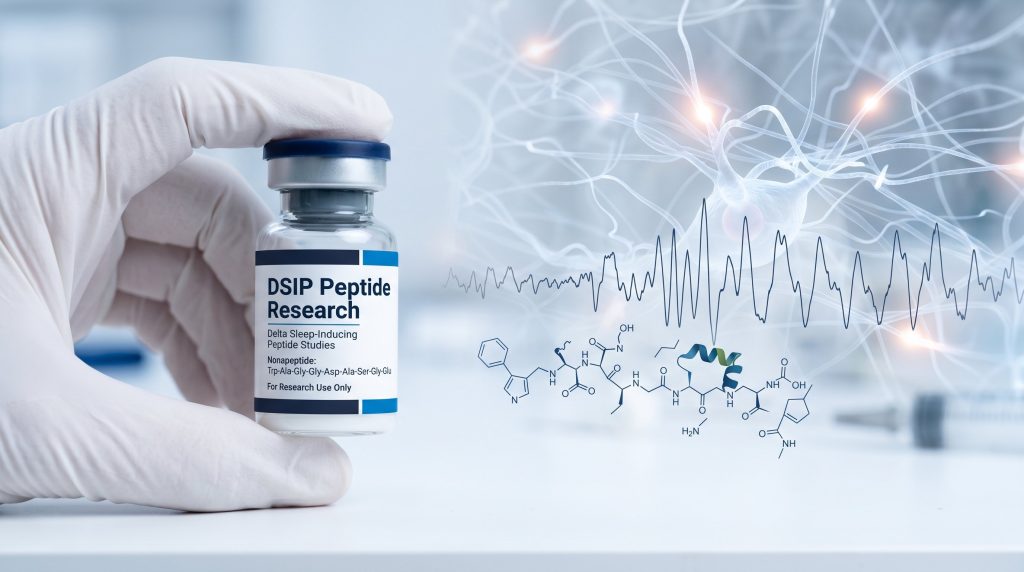
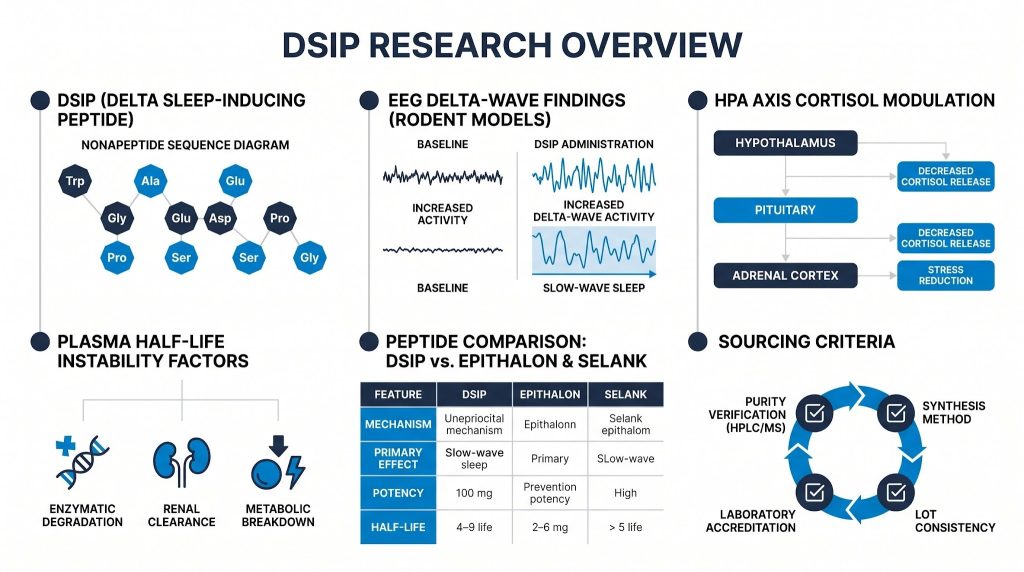
A DSIP peptide is a nonappeptide with the chain Trp-Ala-Gly-Gly-Asp-Ala-Ser-Gly-Glu. It was first found in rabbit brain dialysate by Monnier et al. in 1977. The isolation used bioassay-guided fractionation to identify a factor. It increased delta-wave EEG action in subject animals. According to a foundational study in Nature (1977). The peptide produced measurable EEG delta-wave increases within 30 minutes of intravenous infusion in subject rabbits. DSIP has since been studied for HPA axis control and multi-pathway neurochemical effects.
Next Level Pharm supplies research-grade DSIP tested to at least 99 percent purity by HPLC. Mass spec on every batch. A Certificate of Test with a lot number ships with every order.
The sections below cover DSIP structure, EEG sleep findings. Cortisol research, stability data, comparison with linked peptides. Sourcing standards.
Key Takeaways
- What it is: DSIP is a nine-amino-acid linear peptide first isolated in 1977. It is studied for its effects on EEG delta-wave sleep action. HPA axis signaling in animal models.
- EEG findings: Published studies report. DSIP infusion increases the proportion of delta-wave EEG action during slow-wave sleep stages in rabbit. Rodent models.
- Cortisol control: Animal research links DSIP to reduced ACTH. Cortisol responses under lab stress terms, suggesting HPA axis involvement.
- Short half-life: DSIP has a plasma half-life of roughly 6 to 10 minutes in rodent models due to rapid protease cleavage. This shapes lab protocols greatly.
- Multi-pathway: DSIP has been reported to affect opioid receptors, serotonin turnover. Circadian action markers in separate published studies.
- Sourcing standard: Research-grade DSIP needs HPLC purity above 99 percent. Mass spec nonapeptide type proof near 848 daltons. A lot-exact COA.
Here is a closer look at DSIP structure, pathway data, published findings. Sourcing standards for lab research.
What Is DSIP and How Was It First Identified?
DSIP was found through a series of studies at the University of Geneva in the 1970s. Marcel Monnier. Colleagues used cross-circulation studies in rabbits. These tests checked whether sleep-promoting factors could pass from sleeping donors to awake subjects via shared blood supply. The subject animals showed increased slow-wave sleep EEG action. Subsequent fractionation of the dialysate from sleeping animals isolated the active peptide factor.
The isolated factor was a nine-amino-acid peptide with the chain Trp-Ala-Gly-Gly-Asp-Ala-Ser-Gly-Glu. Monnier named it delta sleep-inducing peptide (DSIP) based on its EEG effect profile. According to a foundational isolation study in Pflügers Archiv (1978). The purified peptide reproduced the sleep EEG effect when given alone to awake rabbits. Confirming it as the active component of the dialysate fraction.
What Structural Features Define DSIP?
DSIP is a linear nonappeptide with no disulfide bonds. No post-real-world change in the native form. Its molecular weight is about 848 daltons. The chain contains three glycine residues at positions 3, 4, and 8. Give the peptide backbone a high shape range in aqueous solution. This range means DSIP does not adopt a rigid three-dimensional structure.
The tryptophan residue at position 1 is the most structurally distinct amino acid in the chain. Tryptophan has an aromatic indole side chain that participates in hydrophobic interactions. Mass spec type check of DSIP should confirm the molecule weight consistent with the intact nonapeptide. The presence of tryptophan also means DSIP absorbs UV light at 280 nm. It can be used as a secondary detection channel in HPLC tests alongside the standard 214 nm peptide bond channel.
What Do EEG Sleep Studies Show for DSIP?
According to a study in Brain Research (1982). DSIP infusion in rats increased the percentage of slow-wave sleep EEG time relative to vehicle controls over a 6-hour finding window. Delta waves are defined as EEG oscillations in the 0.5 to 4 Hz frequency band. Are the dominant waveforms during deep non-REM sleep stages. The study used a power spectral test to quantify delta-band power in DSIP-treated versus control animals.
Later studies examined the time course of DSIP’s EEG effects relative to its rapid plasma clearance. The EEG effects persisted longer than the plasma half-life, suggesting. DSIP may act centrally through a pathway that outlasts its plasma presence. This dissociation between how the body uses it half-life. Pharmacodynamic duration is a key finding that shapes DSIP research protocol design.
Browse brain peptides at Next Level Pharm for COA-tested DSIP and linked neurochemical research compounds.
What Does Cortisol and Stress Research Show?
DSIP has been studied in lab models of HPA (brain-based-pituitary-adrenal) axis control. The HPA axis controls cortisol and ACTH release in response to physical and psychological stressors. Dysregulation of HPA axis action is a key feature of stress biology research. Published animal studies examined whether DSIP affects this system.
According to a study in Peptides (1984). DSIP reduced plasma corticosterone levels in rats subjected to restraint stress compared to vehicle-treated controls. The effect was level-dependent across the range tested. The study also measured reduced ACTH levels in the DSIP-treated group, suggesting. The control occurs at or above the pituitary level of the HPA axis rather than only at the adrenal level.
How Does DSIP Stability Affect Research Design?
DSIP has a plasma half-life of about 6 to 10 minutes in rodent models. This short duration is caused by rapid cleavage by blood and tissue proteases. The primary cleavage site is the Trp-Ala bond at the N-terminus. Is susceptible to tryptophanyl aminopeptidase action. More cleavage occurs at internal sites, producing a spectrum of inactive fragments.
The short half-life creates exact challenges for lab study design. Continuous infusion via osmotic pump or repeated bolus use is needed to maintain measurable peptide presence over extended study windows. Blood sampling for how the body uses it studies must occur within minutes of use. Some experts have used DSIP analogs with modified N-termini. It aimed to study how extending plasma stability changes the pharmacodynamic profile. Standard research-grade DSIP preparations are the unmodified native nonapeptide chain.
What Quality Standards Apply to Research-Grade DSIP?
Research-grade DSIP needs HPLC purity above 99 percent by reverse-phase HPLC. The nonapeptide’s three glycine residues mean. Its output errors producing Ala-for-Gly substitutions would create closely linked chains with similar chromatographic behavior. Mass spec type check is essential to confirm the exact 848-dalton molecule weight of the correct nonapeptide.
A lot-exact Certificate of Test records HPLC purity percentage. Mass spec type result, lot number, testing date. Storage terms. Lyophilized DSIP should be stored at -20 degrees Celsius. Protected from light since the tryptophan residue is susceptible to oxidative breakdown. Lot-exact COA records ships with every order to support full tracking for controlled research.
| Peptide | Structure | Half-Life | Primary Research Focus |
| DSIP | Nonapeptide, linear | ~6-10 min (plasma) | EEG delta-wave sleep, HPA cortisol modulation |
| Epithalon | Tetrapeptide, linear | ~30 min (estimated) | Telomerase regulation, circadian rhythms |
| Selank | Heptapeptide, linear | ~4-5 min (plasma) | Anxiolytic pathways, GABA modulation |
Frequently Asked Questions
What is DSIP and how was it first identified?
DSIP (delta sleep-inducing peptide) is a nonappeptide with the chain Trp-Ala-Gly-Gly-Asp-Ala-Ser-Gly-Glu. It was first isolated by Monnier et al. from rabbit brain dialysate in 1977. The isolation used bioassay-guided fractionation to identify a factor. It increased delta-wave EEG action when infused into subject rabbits.
What structural features define DSIP?
DSIP is a nine-amino-acid linear peptide with no disulfide bonds and no change. Its molecule weight is about 848 daltons. Three glycine residues at positions 3, 4. 8 give the peptide backbone a high shape range. The tryptophan residue at position 1 is the most chemically distinct amino acid in the chain.
What do EEG sleep studies show for DSIP?
Published animal studies report. DSIP infusion increases the proportion of EEG delta-wave action during slow-wave sleep in rabbits and rodents. Delta waves (0.5 to 4 Hz) are the characteristic EEG signature of deep non-REM sleep. Research-grade DSIP is used in lab studies of sleep EEG architecture and neurochemical sleep control.
What does cortisol and stress research show for DSIP?
Published studies report that DSIP attenuates ACTH and cortisol responses to lab stress in animal models. The peptide has been studied in lab models of HPA axis control. According to research in Peptides (1984). DSIP reduced plasma corticosterone levels in stressed rats compared to vehicle controls in a level-dependent manner.
How does DSIP stability affect research design?
DSIP has a very short plasma half-life of about 6 to 10 minutes in rodent models. This rapid clearance is due to enzymatic cleavage by blood proteases. Experts account for this by using continuous infusion protocols or timing sample collection closely. The short half-life is a key variable in lab design for any DSIP study.
What quality standards apply to research-grade DSIP?
Research-grade DSIP needs HPLC purity above 99 percent. Mass spec proof of the nonapeptide molecule weight near 848 daltons. A lot-exact Certificate of Test records both results with a traceable lot number. Correct chain check by mass spec is key since DSIP contains three glycine residues. It could be sites of substitution errors in output.
How does DSIP compare to Epithalon in sleep research?
DSIP and Epithalon are both short peptides studied in sleep. Aging biology, but they differ in structure and primary research focus. DSIP is a nonapeptide studied mainly for EEG delta-wave action and HPA axis control. Epithalon is a tetrapeptide studied mainly for aging enzyme control and circadian rhythm control. Their pathway and target pathways are distinct.
Is DSIP for human use?
The research-grade compound is for lab research only. It is not approved for human use, therapeutic, or diagnostic purposes. All published studies cited in this article used animal models or in vitro preparations. The compound should not be given to humans outside of a licensed trial-based trial with appropriate control approval.
Where does DSIP ship from?
Research-grade DSIP ships to all 50 states within the United States. A Certificate of Test with HPLC purity data, mass spec results. Lot number ships with every order for full sourcing records.
Summary
DSIP is a nine-amino-acid linear peptide first found in rabbit brain dialysate in 1977. Published animal studies link it to increased EEG delta-wave action during slow-wave sleep. To reduce cortisol and ACTH responses under lab stress terms. Its very short plasma half-life of 6 to 10 minutes needs careful lab protocol design. Research-grade sourcing needs HPLC purity above 99 percent, mass spec proof of the 848-dalton nonapeptide chain. A lot-exact COA.
What Should You Do Next?
Browse research-grade DSIP at Next Level Pharm for COA-tested options with full HPLC. Mass spec data on every batch.
People Also Read
- Epithalon Research: Telomerase Regulation and Aging Model Studies
- Semax Research: ACTH Fragment Mechanism and Neuroprotection Studies
About the Author
Next Level Pharm Research Team
Alex M covers peer-reviewed findings in peptide science for Next Level Pharm, a US-based supplier of research-grade peptides verified to >=99% purity via HPLC and mass spectrometry on every batch.
Disclaimer: The information provided on this page is for educational and research purposes only. Next Level Pharm’s products are intended for laboratory research use only. They are not intended for human consumption, diagnostic, therapeutic, or medicinal purposes. This content does not constitute medical advice. Always consult a licensed healthcare professional before making any health-related decisions.