
Selank Reference Material: Purity and COA Standards

Last updated: July 2026
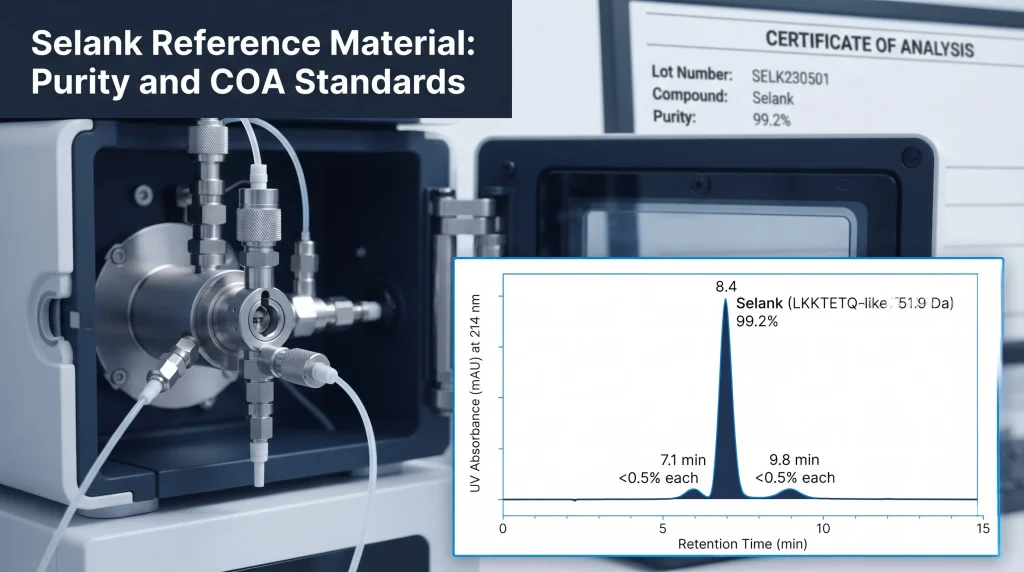
A Selank reference material is a certified peptide sample. It has a known purity and a confirmed amino acid sequence. It is used to calibrate HPLC purity testing. It also verifies COA accuracy for each research lot. According to Shah VP et al. (1992) (PMID 1448695), a certified reference material is required to convert HPLC peak area into an absolute purity percentage. Without one, purity is a ratio of peaks. It is not an absolute figure.
Next Level Pharm is a US-based supplier of research-grade peptides. Every Selank lot is verified to 99.4% average purity by HPLC and mass spectrometry. A COA with lot number ships with every order.
Understanding what a Selank reference material is helps researchers interpret COA data and choose suppliers with strong quality documentation.
Key Takeaways
- Selank Is a Seven-Amino-Acid Synthetic Peptide: Selank has the sequence Thr-Lys-Pro-Arg-Pro-Gly-Pro. It was developed as a synthetic analog of tuftsin (Thr-Lys-Pro-Arg), a natural immunomodulatory tetrapeptide, with a Pro-Gly-Pro extension added for stability.
- A Reference Material Has a Certified Purity: A reference material is a peptide sample with a documented purity, usually greater than 99.0%. The purity is set using independent analytical methods. It is used to calibrate HPLC assays and confirm mass spectrometry results.
- HPLC Purity Requires a Reference Standard to Be Absolute: Without a reference standard, HPLC purity is calculated by peak area ratio. This gives relative purity. A reference material converts peak area into an absolute purity percentage using a known mass of the standard.
- A Selank COA Should Include HPLC, MS, and Lot Data: A complete COA includes HPLC purity, mass spec MW, lot number, and test date. The lot number must match the vial label.
- COA Data Is Lot-Specific: Purity data reported on a COA applies only to the specific lot tested. A lot number traces back to the specific synthesis batch. Researchers should record the lot number from the COA in their protocol files.
COA data for Selank confirms that each lot has the right sequence, right purity, and right mass. This supports reproducible research results across batches.
What Is Selank and What Is Its Amino Acid Sequence?
Selank is a seven-amino-acid synthetic peptide. Its sequence is Thr-Lys-Pro-Arg-Pro-Gly-Pro. It is a structural analog of tuftsin, a natural immunomodulatory tetrapeptide. The Pro-Gly-Pro tail was added for metabolic stability in research models. Selank has a molecular weight of 751.9 Da. Its molecular formula is C33H57N11O9.
According to Seredenin SB et al. (2010) (PMID 20405214), Selank has been studied for its effects on GABA receptor activity and BDNF expression in animal research models. It acts as an anxiolytic research compound. Its short sequence is a key asset. Its defined molecular weight makes it well-suited for HPLC purity testing. Mass spec can confirm its identity quickly.
What Is a Peptide Reference Standard for Selank?
A reference standard for Selank is a certified sample. It has a known purity and confirmed sequence. It is used in HPLC calibration. The goal is to convert detector peak area into absolute purity. The standard is run at a known concentration. The detector gives a peak area. This sets a response factor. All Selank samples are then compared to this factor to calculate purity.
Reference standards are made to purity above 99.0%. They are stored cold. Labs use them in small amounts. According to Taverniers I et al. (2004), a reference material must have a documented, traceable purity. This is required for valid analytical measurements. Without it, purity results from different labs cannot be compared. They are just relative numbers.
How Is Selank Purity Verified by HPLC?
HPLC (high-performance liquid chromatography) separates Selank from related peptide impurities. It uses a stationary phase and a mobile solvent. Selank elutes at a specific retention time based on its sequence and charge. The detector measures peak area at 220 nm or 214 nm. These wavelengths cover UV absorbance for peptide bonds. The Selank peak area is compared to all peaks to give a purity percentage.
A research-grade Selank lot should show a primary peak with at least 99% of total area. Small side peaks may be synthesis by-products. They may also be deletion sequences or oxidized variants. Each is identified by its retention time and mass. A full HPLC trace should be included with the COA or available on request. Shop research peptides at Next Level Pharm. COA documentation includes HPLC purity, mass spectrometry identity, and lot number on every batch.
What Should a Selank COA Include?
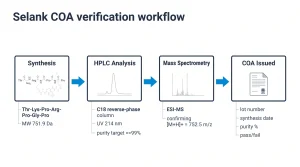
A complete Selank COA includes several key fields. It lists the HPLC purity as a percentage and the mass spec MW result (typically 751.9 Da). It also shows the lot number, synthesis date, and test methods used. Some COAs also include the HPLC chromatogram and the mass spectrum image. These allow researchers to verify the data visually.
The lot number is the key traceability field. It links the COA to the specific batch in the vial. Record the lot number in lab notebooks and protocol files. If results vary across lots, the lot number is the first place to check.
How Does Selank Compare Structurally to Tuftsin?
Tuftsin is the natural tetrapeptide Thr-Lys-Pro-Arg. It is a fragment of IgG. It acts as an immunomodulatory signal in cell research models. Selank adds a Pro-Gly-Pro tail at the C-terminus. This tail adds metabolic stability. Tuftsin breaks down quickly by peptidases. The Pro-Gly-Pro tail resists this cleavage. This extends stability in research assays.
The two peptides share the same N-terminal Thr-Lys-Pro-Arg core. They differ in chain length. Tuftsin has 4 residues. Selank has 7. They also differ in MW: tuftsin is 499.6 Da and Selank is 751.9 Da. This difference is clear in a mass spectrum. A COA with mass spec data confirms the lot is Selank at 751.9 Da and not tuftsin at 499.6 Da.
What Mass Spectrometry Data Confirms Selank Identity?
Mass spectrometry confirms Selank identity by measuring the intact peptide MW. For Selank free base, the expected MW is 751.9 Da. In positive-ion mode, Selank appears as a doubly charged ion at m/z 376.9. This accounts for two added protons. A high-resolution instrument confirms this to within 0.01 Da. This is a reliable and precise check.
MS/MS (tandem mass spectrometry) can also confirm the amino acid sequence. The b and y ion series for Selank are predictable. Its sequence is Thr-Lys-Pro-Arg-Pro-Gly-Pro. Key ions include y4 and b4. These map to specific fragments. A COA with MS/MS data gives stronger identity confirmation than one with only an intact mass result.
Frequently Asked Questions
What Is Selank Used for in Research?
Selank (Thr-Lys-Pro-Arg-Pro-Gly-Pro) is a synthetic analog of the natural tetrapeptide tuftsin. It has been studied in animal research models for effects on GABA receptor activity, BDNF (brain-derived neurotrophic factor) expression, and anxiolytic behavior in rodent protocols. Research labs use Selank as a reference compound to study GABAergic modulation and neuropeptide signaling. It is not approved for human therapeutic use. All Selank use is for laboratory research purposes only.
What Purity Level Is Expected for Research-Grade Selank?
Research-grade Selank is expected to have a purity of at least 99.0% by HPLC analysis. This is the standard for research-grade synthetic peptides intended for cell or animal assays. A purity below 95% increases the risk of impurity-driven false results in sensitive assays. The supplier average across 100 batches is 99.4%. The HPLC purity result should appear on the COA for each specific lot.
How Is Selank Stored for Research Use?
Selank in lyophilized (freeze-dried) form is stable at room temperature for short-term transport. For long-term storage in research labs, lyophilized Selank is kept at minus 20 degrees Celsius or colder. Once a vial is reconstituted, the solution is stored at 4 degrees Celsius. It should be used within 24 to 48 hours. Storage conditions and date of reconstitution should be recorded in the protocol file along with the COA lot number.
What Is the Molecular Weight of Selank?
The molecular weight of Selank (free base, Thr-Lys-Pro-Arg-Pro-Gly-Pro) is approximately 751.9 Da. The molecular formula is C33H57N11O9. This molecular weight should appear on the COA mass spectrometry data section. A mass spectrometry result within 0.1 Da of 751.9 Da confirms the compound is Selank and not a truncated or extended variant. High-resolution mass spectrometry confirms to within 0.01 Da.
What Is the Difference Between Selank and Semax?
Selank and Semax are both synthetic neuropeptide research compounds developed in Russia. Selank (Thr-Lys-Pro-Arg-Pro-Gly-Pro) is a tuftsin analog studied for anxiolytic effects. Semax (Met-Glu-His-Phe-Pro-Gly-Pro) is an ACTH(4-7) analog studied for effects on BDNF and catecholamine pathways. They are distinct compounds with different sequences, molecular weights, and receptor targets. HPLC retention times and mass spectrometry results confirm which compound is in a given lot.
What Is Relative vs. Absolute HPLC Purity?
Relative HPLC purity is calculated by dividing the target peak area by the total peak area in the chromatogram. It gives a percentage but does not account for detector response differences between compounds. Absolute HPLC purity uses a certified reference standard to set a response factor. The target sample is then compared to this factor to get a true purity percentage. Absolute purity is more accurate and can be compared across different labs and instruments.
How Many Peptide Impurities Are Typical in a 99% Purity Lot?
In a 99% purity Selank lot, the remaining 1% represents all impurities combined. This typically includes one or more deletion sequences, oxidation variants, or truncated by-products from synthesis. Each impurity appears as a small peak in the HPLC chromatogram. Most are present at 0.1 to 0.5% each. A 99% purity lot may have 2 to 5 minor impurity peaks, all below 0.5% each. The sum of all impurity peaks should not exceed 1.0%.
What Does the Lot Number on a Selank COA Represent?
The lot number is a unique identifier that traces back to the specific synthesis batch. It links the COA to the exact production run of that peptide. The lot number should appear on both the COA and the vial label. They must match. If they do not match, the COA does not apply to that vial. Researchers should record the lot number in their lab notebooks and protocol files for all lots used in published research.
Why Is Mass Spectrometry Identity Testing Important for Selank?
Mass spectrometry confirms that the compound in the vial is Selank and not a structurally similar peptide. Selank (MW 751.9 Da) and tuftsin (MW 499.6 Da) are structurally related. A researcher who receives tuftsin instead of Selank would get different results in assays. Mass spectrometry identity testing rules out this mix-up. A COA that includes mass spectrometry molecular weight confirmation (and ideally MS/MS sequence data) provides reliable identity verification for each lot.
Summary
A Selank reference material is a certified peptide sample. It is used to calibrate HPLC testing and validate COA accuracy. Selank has the sequence Thr-Lys-Pro-Arg-Pro-Gly-Pro and a MW of 751.9 Da. It is a structural analog of tuftsin, with a Pro-Gly-Pro tail for stability.
A complete Selank COA includes HPLC purity, mass spec identity, lot number, and testing date. The lot number links the COA to the specific synthesis batch. Record this in protocol files. It supports reproducible research results.
What Should You Do Next?
When sourcing Selank for research, request a COA with HPLC purity, mass spec MW, and a lot number. The lot number must match the vial label. Record the lot number in your protocol files. For critical assays, also request the HPLC chromatogram and mass spectrum.
Shop research peptides. COA documentation at Next Level Pharm includes HPLC purity, mass spectrometry data, and lot number on every batch.
People Also Read
- What Is Selank? GABA Pathways, Mechanisms, and Study Findings
- What Is a Peptide COA? Testing Standards Explained
About the Author
Next Level Pharm Research Team
Alex M covers peer-reviewed findings in peptide science for Next Level Pharm, a US-based supplier of research-grade peptides verified to ≥99% purity via HPLC and mass spectrometry on every batch.
Disclaimer: The information provided on this page is for educational and research purposes only. Next Level Pharm products are intended for laboratory research use only. They are not intended for human consumption, diagnostic, therapeutic, or medicinal purposes. This content does not constitute medical advice. Always consult a licensed healthcare professional before making any health-related decisions.