
What Is a Peptide COA? Testing Standards Explained

Last updated: May 2026
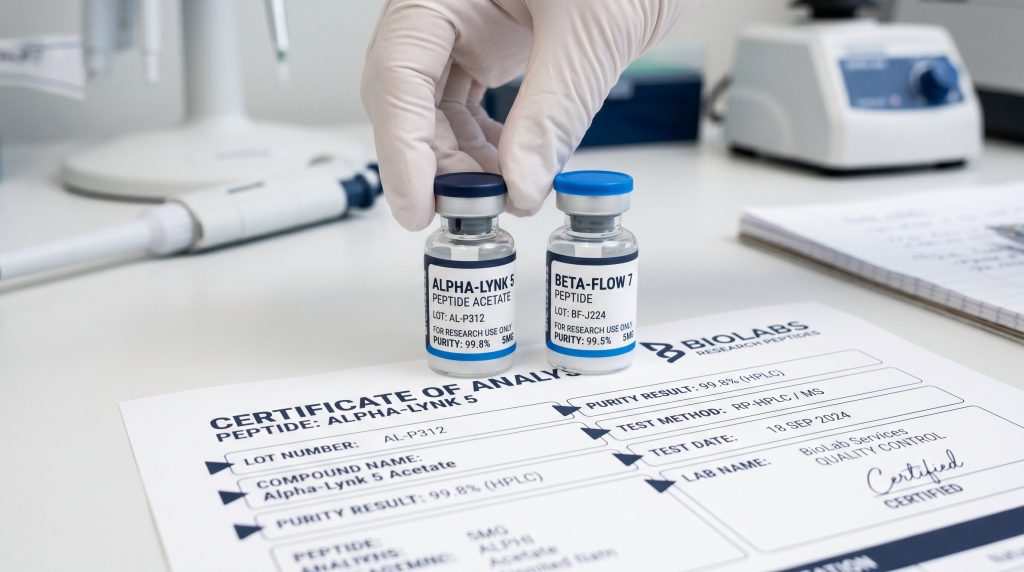
A peptide COA is a record that shows the test results for a specific lot of compounds. COA stands for certificate of analysis. This record links a compound to its purity result, test method, and lot number. Without a COA, a lab cannot confirm what it received matches what was ordered. Researchers use COA records to verify that a compound meets the purity and identity specs for their study. This guide explains what a valid COA includes, how to read HPLC and mass spec data, and why lot-specific records matter.
Next Level Pharm is a US-based peptide supplier. Every vial is tested by HPLC and mass spec before dispatch. Every batch is third-party tested.. Peptides ship in freeze-dried form from US-based stock.
COA quality varies widely across peptide supply chains. Some suppliers share only batch-level records, which cover many lots. Others share lot-specific records that trace results to a single production run. Lot-specific records are more useful for research because they let a lab trace any data error to a specific compound batch.
Key Takeaways
- COA Purpose: A COA links a compound lot to its purity result, test method, and analyst records.
- Required Fields: A valid COA includes lot number, compound name, purity result, test method, and lab name.
- HPLC Data: HPLC purity is shown as a percentage of the target compound’s peak area vs. total area.
- Mass Spec Role: Mass spec confirms the compound’s molecular mass matches the target sequence.
- Lot vs. Batch: A lot-specific COA covers one batch only; a batch COA may cover many lots at once.
Reading a COA correctly lets researchers assess compound quality before use in a study.
What Is a Peptide COA?
A peptide COA is a formal test record tied to a specific lot of compounds. It documents the purity result, the method used to get that result, and the date the test was run. A COA also records the lot number, compound name, and the lab that ran the test. These fields create a traceable link between a vial and its test outcome.
COA records serve two main roles. First, they confirm that a compound meets the purity spec at time of dispatch. Second, they let researchers check compound quality after a study if results are unclear. A lab that stores COA records with each experiment can trace any odd result to a specific compound lot. Every batch is third-party tested..
What Fields Must a COA Include?
A valid COA for a research-grade peptide must include specific fields to be useful. Each field serves a different purpose in the review process.
Required fields:
- Compound name and chemical formula or sequence.
- Lot number that matches the number on the vial.
- Test date when the purity check was run.
- Test method used, such as HPLC or mass spec.
- Purity results as a percentage for HPLC and a mass value for mass spec.
- Lab name, analyst ID, and instrument calibration date.
According to a compound testing review (2019), COA records that omit the test method or calibration date cannot confirm purity. They cannot support a peer-reviewed study. A COA that lists only a purity percentage without the method used cannot be independently reviewed. Always confirm all fields are present before using a COA as part of a study record.
How Is HPLC Data Shown on a COA?
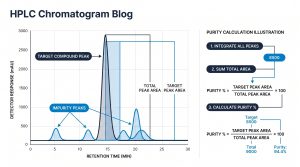
HPLC purity data is shown as a percentage on the COA. This percentage reflects how much of the total detected peak area belongs to the target compound. A result of 99% means the target compound accounts for 99% of total area. The other 1% may include small impurity peaks, solvent tails, or baseline noise.
According to a peptide analysis study (2018), RP-HPLC is the standard purity test method for synthetic peptide lots. The COA should state the column type, run time, and wavelength used for detection. These details allow an outside reviewer to assess whether the test was run correctly. Without them, the purity result cannot be checked or repeated by a third party.
What Is a Lot-Specific COA?
A lot-specific COA covers one production run only. The lot number on the COA matches the number on the vial label. This one-to-one link lets researchers trace any result back to the exact batch tested. Batch-level COAs, by contrast, may cover multiple lots under one test record. This makes it hard to know which exact vial was tested.
According to a quality record study (2017), lot-level records are a standard need in synthetic compound research. When test data is tied to a specific lot, researchers can flag lot-to-lot change over time. This matters when a lab orders the same compound from the same supplier across multiple studies. Lot-specific records make it possible to rule out compound quality as a source of data change.
Browse research peptides at Next Level Pharm to access lot-specific COA records and full HPLC and mass spec results on every order.
Why Does the Testing Lab Matter?
The testing lab listed on a COA affects how much weight the record carries. An in-house COA is produced by the same lab that made the compound. This creates a conflict of interest. An outside lab has no stake in the result, which removes reporting bias from the process.
Key signs of a reliable testing lab:
- Named on the COA with a physical location.
- Runs HPLC and mass spec under recognized quality standards.
- Lists the analyst ID and instrument calibration date.
- Provides results in a format that can be shared with a third-party reviewer.
In-house COAs are not worthless, but outside lab COAs are harder to dispute. A supplier that uses both methods gives researchers the strongest evidence of compound purity.
How Should a Lab Store COA Files?
COA records should be stored with the experiment data that used the compound. Each COA should be filed with the order date, the lot number, and the study it was used for. Digital copies are fine, but a clear naming system helps link each COA to the right experiment.
Key storage steps for COA records:
- Save the COA file with the order receipt and lot number in the file name.
- Link the COA to the specific protocol where that lot was used.
- Keep COA records for as long as the study data is archived.
- Cross-check the lot number on the vial label against the COA before use.
- Flag any mismatch between the vial label and the COA before running a study.
Good record habits mean that any question about compound quality can be answered with a specific document, not just a supplier claim.
Frequently Asked Questions
What does COA stand for in peptide research?
COA stands for certificate of analysis. In peptide research, a COA is the primary test record for a compound lot. It links the lot number to the purity result, the test method, and the lab that ran the test. A COA is not a guarantee of quality on its own. It is a record that lets a researcher check the purity claims made by a supplier for a specific compound lot. This check should happen before the lot is used in a study.
What is the difference between a batch COA and a lot-specific COA?
A batch COA covers multiple production runs under one test record. A lot-specific COA covers only one run and links the result to a single lot number. Lot-specific COAs are more useful in research because they allow a researcher to match a test result to the exact vials used in a study. Batch COAs cannot pinpoint which lot was tested if more than one lot was produced in the same batch period.
What does an HPLC purity result on a COA mean?
An HPLC purity result on a COA shows the percentage of total peak area that belongs to the target compound. A result of 99% or above means the target compound is the main species in the lot. The remaining area may come from small impurity peaks, solvent tails, or baseline noise. HPLC purity alone does not confirm the identity of the compound. Mass spec data on the same COA is needed to confirm that the compound has the correct molecular mass.
What does mass spec data on a COA confirm?
Mass spec data on a COA confirms the molecular mass of the compound. The measured mass is compared to the target mass from the known amino acid chain. If the masses match, the compound has the correct sequence. If they differ, a sequence error may be present. Mass spec is run alongside HPLC because HPLC cannot detect a wrong amino acid order. It also cannot find a missing link in the chain.
How do I know if a COA is from an outside lab?
An outside lab COA lists a lab name that is different from the supplier’s business name. It also includes an analyst ID, instrument calibration date, and lab address. If the COA only lists the supplier’s own name and contact details, it is an in-house document. Outside lab COAs are preferred because the lab has no financial stake in the purity result. A supplier that uses an outside lab for testing has an extra layer of independent review on its compounds.
Is a COA the same as a safety data sheet?
No. A COA records the purity and identity test results for a compound lot. A safety data sheet, or SDS, covers handling, storage, and hazard information for the compound class. Both are important records but serve different purposes. A COA is used to confirm compound quality before a study begins. An SDS is used to guide safe handling and storage of the compound in a lab. Both should be available from a reputable supplier.
Can a COA be faked or altered?
A COA can be fabricated by a supplier that does not run the listed tests. Signs of a low-quality COA include round purity numbers, no analyst ID, no calibration date, and no lab name. Researchers can check a COA by asking the supplier to provide raw HPLC chromatogram data. If a supplier cannot provide raw data on request, the COA may not reflect actual testing. Using outside lab COAs from named, accredited labs reduces this risk significantly.
What purity result should a research-grade peptide COA show?
A research-grade peptide COA should show 99% or higher purity by HPLC. Studies involving receptor binding, cell health assays, or in vivo models need higher purity to reduce data error. The COA purity result reflects the compound state at time of testing, not at time of use. Storage conditions after dispatch can affect purity. Always confirm storage steps with the supplier and check the COA test date before use in a study.
Where can I access COA records for my orders?
Every order from Next Level Pharm includes a lot-specific COA with HPLC and mass spec results. COA records are available for download from the order confirmation. Every batch is third-party tested.. This supports audit trails and experiment records for labs that need to document compound quality across multiple studies and experiments.
Summary
A peptide COA is a key quality record that links a compound lot to its purity and identity test results. A valid COA includes a lot number, compound name, purity result, test method, analyst ID, and lab name. Lot-specific COAs are more useful than batch-level records because they trace results to a single production run. Outside lab COAs carry more weight than in-house records because the testing lab has no stake in the result.
Reading a COA correctly allows a researcher to assess compound quality before a study begins. HPLC purity shows the compound fraction as a peak area percentage. Mass spec data confirms the compound’s molecular mass against its target chain. Both data points together give a full picture of compound identity and purity.
What Should You Do Next?
Researchers ordering peptides for lab work should request a COA before ordering. Confirm it is lot-specific, includes the test method, and comes from an outside lab.
Shop research-grade peptides to get lot-specific COAs and HPLC and mass spec data with every order.
For more on purity standards and sourcing red flags, see how to source research-grade peptides.
People Also Read
- How to Source Research-Grade Peptides: Purity Standards and Red Flags
- What Is Lyophilization? How Freeze-Drying Preserves Peptide Integrity
About the Author
Next Level Pharm Research Team
Alex M covers peer-reviewed findings in peptide science for Next Level Pharm, a US-based supplier of research-grade peptides verified to at least 99% purity via HPLC and mass spectrometry on every batch.
Disclaimer: The information provided on this page is for educational and research purposes only. Next Level Pharm’s products are intended for laboratory research use only. They are not intended for human consumption, diagnostic, therapeutic, or medicinal purposes. This content does not constitute medical advice. Always consult a licensed healthcare professional before making any health-related decisions