
Peptide Oxidation: How It Affects Research Quality

Last updated: July 2026
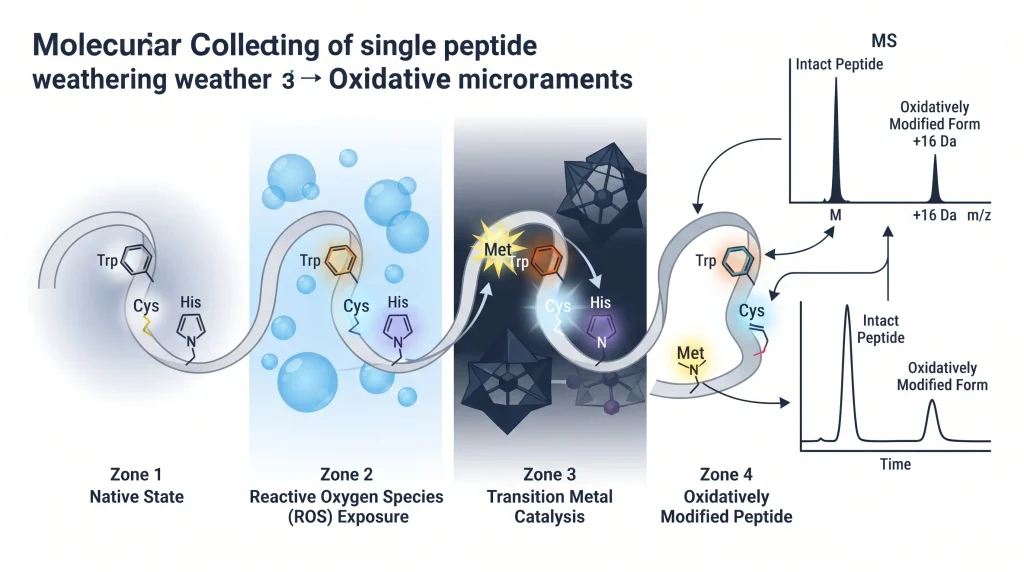
A peptide oxidation research study is a lab model that tracks oxygen-driven changes in peptide structure. Methionine (Met) and tryptophan (Trp) are the main targets. One oxidation event adds 16 daltons to peptide mass. This plus-16 Da shift is a key mass spectrometry signal. According to Smart et al. (2007), oxidized forms showed lower binding in receptor assays than the intact sequence.
Next Level Pharm is a US-based supplier of research-grade peptides, verified to ≥99.4% purity by HPLC and mass spectrometry on every batch. Each lot is lyophilized and ships with a COA that includes mass spec data to detect any oxidation before the compound reaches a researcher.
Oxidation is one of the most common breakdown paths for synthetic peptides. It affects purity, identity, and assay reproducibility. This guide covers where oxidation occurs, how to detect it, and how to limit it during storage and use.
Key Takeaways
- Met and Trp are the main targets: Methionine and tryptophan residues are most prone to oxidation. Each adds 16 Da to the observed mass.
- Mass spec detects oxidation: A plus-16 Da shift in the mass spectrum signals one oxidation event on the peptide.
- HPLC shows oxidized peaks: Oxidized peptide forms have a different retention time than the intact sequence.
- COA-verified lots: Next Level Pharm ships lyophilized peptide lots with HPLC and mass spec data on every batch. Each lot has a traceable number.
- Research use only: All peptides in this catalog are for laboratory research use only. No clinical outcomes are claimed.
Which Peptide Residues Are Most Prone to Oxidation?
Methionine and tryptophan are the two residues most prone to oxidation in synthetic research peptides.
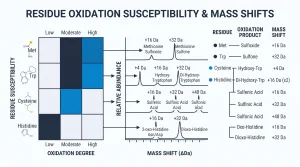
Met (Met, M) is the most reactive residue toward oxygen. Its sulfur side chain reacts with reactive oxygen species (ROS) to form Met sulfoxide. This adds 16 Da to the residue mass. A second oxidation step can convert Met sulfoxide to Met sulfone, adding another 16 Da. The net shift is plus 32 Da at this stage.
Trp (Trp, W) is the second most reactive. Its indole ring is oxidized by ozone, hydrogen peroxide, or light. The main product is hydroxytryptophan (plus 16 Da) or kynurenine (plus 4 Da), depending on the oxidation pathway. Trp oxidation can also produce light-emitting products, which interfere with light-based assays.
Other residues that can oxidize include cysteine (Cys, C), histidine (His, H), and tyrosine (Tyr, Y), but at lower rates. Disulfide bond formation between two Cys residues is a related reaction. It loses 2 Da per bond, not gains, so the direction of mass shift differs from oxidation.
According to Huff et al. (2004), peptide lots with Met residues show significantly higher rates of chemical change when stored at room temperature compared to cold storage.
| Residue | Common Oxidation Product | Mass Shift (Da) | Main Trigger |
| Met (M) | Met sulfoxide | +16 | O2, H2O2, ROS |
| Met (M) | Met sulfone | +32 | Strong oxidants |
| Trp (W) | Hydroxytryptophan | +16 | Ozone, UV light |
| Trp (W) | Kynurenine | +4 | Singlet oxygen |
| Cysteine (C) | Sulfenic acid | +16 | H2O2 |
| Histidine (H) | 2-oxo-histidine | +16 | Metal + O2 |
How Does Oxidation Change Peptide Purity?
Oxidized forms appear as separate HPLC peaks, which lowers the main-peak purity percentage.
HPLC purity is measured as the area of the main peptide peak divided by the total peak area. If 5% of a lot has oxidized, the oxidized form appears as a separate peak. The main peak area drops by 5%. The reported purity drops from, say, 99% to 94%. This change is measurable and is reported on the COA.
The oxidized form often elutes earlier than the intact peptide on a reversed-phase C18 column. Met sulfoxide is more polar than Met. The oxidized peptide is therefore more hydrophilic and elutes sooner in a water-acetonitrile gradient. This shift in retention time is one indicator of oxidation when no mass spec data is available.
HPLC alone cannot always distinguish oxidized from deamidated forms if their retention times are close. Mass spectrometry provides the definitive answer by measuring the mass shift directly. Third-party labs use both HPLC and mass spec together to give a complete oxidation picture.
How Is Peptide Oxidation Detected by Mass Spectrometry?
Mass spec detects oxidation as a plus-16 Da (or plus-32 Da for double oxidation) shift in the observed mass.
In a mass spectrum, a clean peptide produces a single main peak at the expected mass. If oxidation has occurred, an additional peak appears at plus 16 Da (single Met or Trp oxidation). The ratio of the intact peak area to the oxidized peak area shows how much of the lot is oxidized.
High-resolution mass spectrometry (HRMS) can distinguish oxidation (plus 16 Da) from base change (plus 0.984 Da) because the mass shifts differ at high precision. Low-resolution mass spec may show a combined +17 Da peak if both events occur. This is why HRMS data, where available, is more informative than standard resolution MS for oxidation characterization.
According to Skov et al. (2014), combining HPLC retention time shift with mass spec plus-16 Da confirmation is the standard dual-method approach. Single-method testing misses co-eluting degradants in some peptide sequences.
Browse GHK-Cu and KPV product pages for lot-specific mass spec data that confirms oxidation status before shipping.
How Does Oxidation Affect Peptide Assay Results?
Oxidation of Met or Trp residues in a binding domain can reduce or block receptor interaction in cell assays.
If the oxidized residue is part of the binding domain, the structural change can reduce binding affinity. Met oxidation converts a non-polar sulfur side chain to a polar sulfoxide. This changes the shape and charge of that part of the sequence. A receptor that fit the original sequence may bind the oxidized form with lower affinity or not at all.
Assay results from a partially oxidized lot show lower apparent potency. If 10% of the lot is oxidized and that form is inactive, the effective level is 10% lower than expected. This shifts level-response curves to the right and lowers calculated potency values. Researchers who do not check for oxidation may adjust levels based on a false read.
Peptides that do not contain Met or Trp are not affected by this type of oxidation. Researchers working with such sequences have a lower oxidation risk. All other residues still need HPLC purity and mass spec identity checks.
Browse Epithalon and NAD+ pages for research lots from verified low-oxidation synthesis processes.
How Can Peptide Oxidation Be Limited During Storage?
Cold storage, inert gas blanket, and light protection limit oxidation of Met and Trp residues in stored peptide lots.
Lyophilized peptide powder is more stable than solution. Dry powder has less contact with dissolved oxygen. Cold storage at minus 20°C or minus 80°C slows all chemical reactions. For long-term storage, vacuum or nitrogen-filled vials reduce oxygen exposure.
Storage tips to limit oxidation:
- Store dried peptides at minus 20°C or minus 80°C in dry, sealed vials.
- Avoid repeated freeze-thaw cycles. Aliquot on receipt for single-use vials.
- Keep vials in the dark. Light can drive Trp oxidation..
- Work under inert gas (argon or nitrogen) when dissolving if extreme sensitivity is needed.
- Use antioxidant additives (Met-free buffers, EDTA to chelate metals) only if the assay permits.
Dissolved peptide solutions oxidize faster than dry powder. Working stocks should be made fresh from dried material for each set of studies when oxidation-sensitive results are needed.
What Research Tools Support Peptide Oxidation Research?
High-resolution mass spec devices, HPLC with C18 columns, and COA-verified lots are the core tools for oxidation studies.
Research teams need a verified peptide lot to run any oxidation study. The lot must match the published reference standard for molecular weight and purity. Next Level Pharm verifies each peptide lot by HPLC and mass spectrometry before shipping. Standard tools include a reversed-phase C18 HPLC system and a high-resolution mass spec device (HRMS) or ESI-MS. A fluorescence reader for Trp oxidation monitoring and a COA with the mass spec spectrum are also needed. View the research peptide catalog for lot-specific COA and mass spec data.
Frequently Asked Questions
What is peptide oxidation in research?
Peptide oxidation is a chemical reaction where oxygen adds to a reactive amino acid residue, changing its mass and structure. Met and Trp are the most common targets. Each oxidation event adds 16 Da to the peptide mass. Oxidation lowers HPLC purity and can reduce binding activity in assays. Third-party mass spec testing on each lot detects oxidation before the compound is used in studies. All testing is for research purposes only.
How is peptide oxidation detected?
Peptide oxidation is detected by two methods. HPLC shows oxidized forms as separate peaks with earlier retention times. Mass spectrometry shows a plus-16 Da shift in the observed mass compared to the intact sequence. High-resolution mass spec distinguishes oxidation from base change because the mass shifts differ. Routine lot-release testing uses both methods. Researchers can also retest a lot that has been in storage to check for new oxidation before starting a new set of assays.
Does oxidation affect all peptides equally?
No. Peptides containing Met, Trp, cysteine, or histidine residues are more prone to oxidation. Peptides made entirely of non-reactive residues (Ala, Gly, Leu, Val, Pro) have very low oxidation risk. The position of the prone residue also matters. A Met residue in the binding domain causes more assay impact than one in a non-functional region. Checking the amino acid sequence for reactive residues before planning storage is a good first step.
What does a plus-16 Da shift mean in mass spectrometry?
A plus-16 Da shift in mass spec data means one oxygen atom has been added to the peptide. This is the signature of single Met or Trp oxidation. If the shift is plus 32 Da, two oxidation events have occurred. A shift of plus 4 Da can indicate Trp kynurenine formation. These shifts are compared to the expected mass from the amino acid sequence. Any shift outside the 0.1 Da tolerance for the unmodified peptide signals a chemical change.
How do I store peptides to prevent oxidation?
Store dried peptide powder at minus 20°C or minus 80°C in sealed, dry vials. Keep vials in the dark, because light drives Trp oxidation. Avoid repeated freeze-thaw cycles by aliquoting on receipt. Work under an inert gas blanket (nitrogen or argon) when dissolving oxidation-sensitive peptides. Dissolved solutions oxidize faster than dry powder. Making fresh working stocks from dried material for each study gives the most consistent results for sensitive assays.
Can oxidized peptide be used in research assays?
Partially oxidized peptide can still be used if the oxidized fraction is below 2% and the assay is not sensitive to that residue. If the assay measures binding at the oxidized site, the oxidized form may give lower or no signal. Account for the oxidized fraction when calculating effective level. A lot with more than 5% oxidation is below research-grade standards and should not be used in binding or activity assays.
How does HPLC detect peptide oxidation?
HPLC detects oxidized peptide forms as separate HPLC peaks. Oxidized Met (Met sulfoxide) is more polar than the intact residue. The oxidized peptide elutes earlier in a reversed-phase C18 gradient. The earlier peak area gives the percentage of the oxidized form. If the main peak purity is 97% and there is a plus-16 Da peak accounting for 3%, the effective non-oxidized content is 97%. Mass spec is run in parallel to confirm the identity of each peak.
What is the difference between oxidation and base change?
Oxidation adds an oxygen atom to a residue, shifting mass by plus 16 Da. Base change converts Asn or Gln residues to acidic forms, adding 0.984 Da. These two events have very different mass shifts. High-resolution mass spec distinguishes them. Standard-resolution MS may report a combined shift if both occur. Both events change peptide structure. They can cut binding activity. HPLC and HRMS together are needed to detect both at the same time.
Why do some peptide lots oxidize more than others?
Oxidation rate depends on synthesis conditions, handling, and storage. A lot synthesized in a poorly controlled atmosphere with higher oxygen exposure will have more oxidation at release. Lots stored at room temperature or exposed to light after synthesis will oxidize faster. The Met and Trp content of the sequence determines the inherent risk. Third-party COA testing at lot release catches oxidation before it reaches the researcher. Lyophilized storage and cold-chain handling after synthesis keep oxidation rates low over time.
Summary
Peptide oxidation is a chemical change where oxygen reacts with Met or Trp residues and adds 16 Da to the peptide mass. It lowers HPLC purity, shifts mass spec results, and can reduce binding activity in cell assays. Routine lot testing by HPLC and mass spec detects oxidized forms before they affect research data.
Limiting oxidation during storage requires cold temperature, darkness, dry conditions, and single-use aliquots. Dissolved solutions oxidize faster than dried powder. Starting from fresh dried stock for each study is the recommended practice for oxidation-sensitive assays.
Next Level Pharm verifies every peptide lot by HPLC and mass spec and includes mass spectrum data on the COA. Average batch purity is 99.4% across the last 100 lots, with mass accuracy within 0.1 Da of the theoretical sequence mass.
What Should You Do Next?
Researchers should review the peptide sequence for oxidation-prone Met and Trp residues. Confirm that the COA mass spectrum shows no unexpected plus-16 Da peak before the assay. Record storage conditions, sample condition, and the lot number in the lab log. Researchers sourcing these lab peptides can shop research peptides with full COA and lot traceability.
People Also Read
- GHK-Cu Research: Copper Peptide Oxidation and Stability.
- KPV Research: Tripeptide Quality and Purity Data.
About the Author
Next Level Pharm Research Team
Alex M covers peer-reviewed findings in peptide science for Next Level Pharm, a US-based supplier of research-grade peptides verified to ≥99% purity via HPLC and mass spectrometry on every batch.
Disclaimer: For research purposes only. Not intended for human consumption. Next Level Pharm products are not intended for diagnostic, therapeutic, or medicinal use. This content does not constitute medical advice. Always consult a licensed healthcare professional before making any health-related decisions.