
Peptide Endotoxin Testing: The LAL Assay in Research

Last updated: July 2026
Peptide endotoxin testing measures the level of bacterial endotoxins in a research compound before use. Endotoxins are LPS (lipopolysaccharide, a fragment from gram-negative bacterial cell walls). The LAL assay is the accepted standard. LAL stands for Limulus Amebocyte Lysate. It is a clotting test using horseshoe crab blood cells. According to Gorbet MB et al. (2005) (PMID 15479574), endotoxins are a common and often overlooked contaminant. They can trigger non-specific immune reactions in cell and animal research models.
Next Level Pharm is a US-based supplier of research-grade peptides. Each lot is tested for endotoxins as part of the quality protocol. A COA with lot number ships with every batch.
Understanding endotoxin testing helps researchers evaluate COA documentation and design cleaner cell protocols.
Key Takeaways
- Endotoxins Come From Gram-Negative Bacteria: LPS fragments come from the outer membrane of gram-negative bacteria. They enter peptide samples during synthesis if reagents or water are contaminated.
- Even Low Endotoxin Levels Affect Cell Assays: Immune cells respond to endotoxins at very low levels (0.1 EU/mL). A contaminated sample can activate immune pathways unrelated to the peptide itself.
- The LAL Assay Is the Standard Test: The LAL assay uses a clotting protein from horseshoe crab blood cells. It reacts with LPS to produce a color change. The change is measured to calculate the endotoxin level.
- EU/mg Is the Standard Unit: Endotoxin results are in EU/mg (Endotoxin Units per milligram). For general cell research, less than 1 EU/mg is the common limit. Immune cell assays may require less than 0.1 EU/mg.
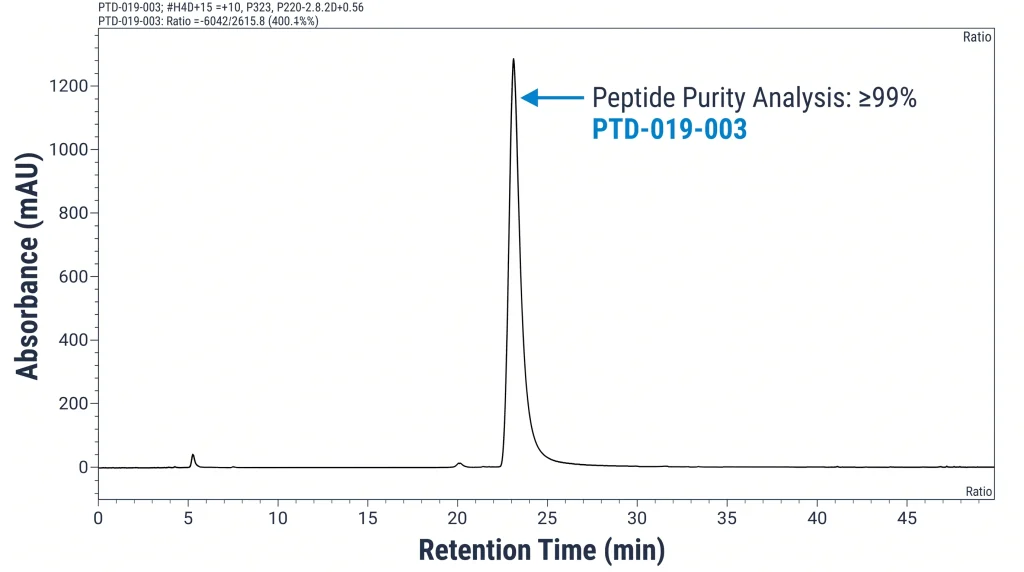
- Endotoxin Testing Is Separate from Purity Testing: HPLC measures chemical purity. It does not detect LPS. A separate LAL assay is needed for endotoxin data alongside HPLC COA results.
Endotoxin testing is a critical quality check. It sits alongside HPLC purity in the COA documentation for research peptides.
What Are Bacterial Endotoxins?
Bacterial endotoxins are LPS molecules. LPS stands for lipopolysaccharide. It is a key part of the outer wall of gram-negative bacteria. When bacteria are killed, LPS is set free into the solution. This is how it gets into peptide samples.
LPS has a lipid A region (the biologically active core) and a polysaccharide chain. According to Poltorak A et al. (1998) (PMID 9868853), TLR4 (toll-like receptor 4) is the main surface receptor for LPS on immune cells. This triggers a cascade of immune marker changes. In cell assays, this signal can look like a response to the peptide.
If the peptide sample has endotoxins, the cell result may come from LPS, not the peptide. This is a false result. Endotoxin testing confirms the sample is clean. Labs run this test before any cell assay is started.
How Does the LAL Assay Work?
The LAL assay uses a protein extract from horseshoe crab blood cells. These cells are called amebocytes. The protein reacts with LPS. This triggers a clotting response. The size of the clot or color change shows how much LPS is in the sample.
Three main formats exist. The gel-clot method checks for a physical clot in the sample. The turbidimetric method measures how cloudy the sample becomes over time. The chromogenic method uses a color dye. The dye changes color when the LAL enzyme is active. The chromogenic format is the most common method for getting a number.
According to Magalhães PO et al. (2007) (PMID 17493002), the LAL chromogenic assay is preferred for endotoxin detection in pharmaceutical research. Its sensitivity is typically 0.005 EU/mL for recombinant Factor C (rFC) formats.
What Endotoxin Level Is Acceptable?
Endotoxin limits depend on the assay type. Each assay has its own rule. According to the United States Pharmacopeia (USP) (2023), the Bacterial Endotoxins Test (Chapter 85) defines accepted methods and limits for pharmaceutical testing. Research peptides follow tighter limits than injectable drugs.
For cell assays, less than 1 EU/mg is the common standard. Immune cell assays (macrophage or dendritic cell models) may require less than 0.1 EU/mg. For animal model studies, less than 0.5 EU/mg is often used.
The limit depends on how sensitive the assay is. Immune cells react at much lower levels than other cell types. Fibroblasts and skin cells are less sensitive. Researchers must state the endotoxin limit for their batch in the methods section.
What Is the EU Unit?
EU stands for Endotoxin Unit. It is an activity-based unit. One EU equals the activity of 100 picograms of the International Reference Standard Endotoxin (from E. coli O113:H10).
The EU unit was created because endotoxins from different bacteria have different strengths per unit of mass. Using an activity unit makes results the same across labs. EU/mg shows how much endotoxin is in each milligram of compound. This makes it easy to compare data from different labs.
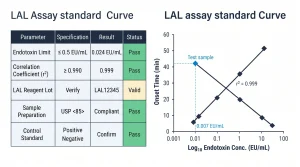
All LAL assay results are in EU/mg or EU/mL. The COA should state the value, the test method, and the limit.
Why Does Endotoxin Contamination Happen?
Endotoxins enter peptide samples during synthesis or processing. Solid-phase peptide synthesis uses amino acid reagents and resins. If any of these contain gram-negative bacteria or debris from bacteria, LPS enters the product. Even small amounts of LPS can cause problems.
Contamination can also occur during lyophilization, packaging, or shipping. Tiny bacterial particles in the air can settle into open vials. Research-grade synthesis should use clean lab spaces. Water and reagents must be endotoxin-free.
Endotoxins are heat-stable. They live through autoclave heat (121°C for 15-20 minutes). Normal heat sterilization does not remove them. To remove endotoxins, a different step is needed. This step is called depyrogenation. It uses dry heat at 250°C for at least 30 minutes. Some labs use chemical treatment as well.
How Do Suppliers Report Endotoxin Results?
A COA with endotoxin data should state the test method, the result in EU/mg, and the acceptance limit. The lot number should match the vial. A result of “less than 1.0 EU/mg” means the sample was below the stated limit.
Some COAs show the actual measured value. Actual values tell you more than “less than” statements. They show how close the result is to the limit. Researchers should ask for actual values where possible.
Shop research peptides. COA documentation is available for every batch with HPLC purity, mass spec identity, and lot number.
Frequently Asked Questions
What Is LPS?
LPS stands for lipopolysaccharide. It is the primary component of the outer membrane of gram-negative bacteria. LPS has a lipid A region (responsible for immune activation) and a polysaccharide chain. LPS is the same molecule as a bacterial endotoxin. It is detected by the LAL assay and reported in EU/mg. Even very low levels (less than 0.1 EU/mL) can activate immune pathways in cell assays and cause false-positive results.
What Is the Limulus Amebocyte Lysate?
LAL is a protein extract from blood cells of the horseshoe crab (Limulus polyphemus). These blood cells (amebocytes) contain a clotting protein called Factor C. Factor C reacts with LPS to trigger a clotting cascade. The degree of clotting or color change is measured. The result is proportional to the amount of LPS in the sample. LAL has been used in pharmaceutical endotoxin testing since the 1970s.
What Is the Difference Between the LAL Assay and the rFC Assay?
The rFC (recombinant Factor C) assay uses a synthetic version of the LAL clotting protein. It does not use horseshoe crab blood cells. The rFC assay has comparable sensitivity to LAL (0.005 EU/mL). It also avoids ethical concerns about horseshoe crab collection. Both LAL and rFC assays are accepted by regulatory agencies. The chromogenic rFC format is increasingly used in pharmaceutical and research labs.
Can HPLC Detect Endotoxins?
No. HPLC separates peptide compounds and chemical impurities by peak area. Endotoxins (LPS) are large lipopolysaccharide molecules. They do not elute as a separate peak in standard peptide HPLC methods. HPLC data tell you nothing about endotoxin content. A separate LAL assay is always needed. A COA with HPLC data but no endotoxin data does not confirm the sample is endotoxin-free.
What Is an Endotoxin Unit (EU)?
An EU is an activity-based unit for measuring endotoxin potency. One EU equals the activity of 100 picograms of the International Reference Standard Endotoxin (E. coli O113:H10). EU is used because different bacterial endotoxins have different potencies per unit mass. Using an activity unit makes results comparable across labs and sources. Results are reported in EU/mg (per mass of compound) or EU/mL (per volume of solution).
What Is Depyrogenation?
Depyrogenation is the process of removing endotoxins from a surface or material. Unlike sterilization, depyrogenation destroys LPS molecules. Common methods include dry heat at 250°C for 30 minutes (for glassware) or treatment with 0.1 M sodium hydroxide. Autoclaving (121°C) does not destroy endotoxins. They are heat-stable and survive standard autoclave cycles. Research labs use certified endotoxin-free plasticware and water to prevent contamination.
What Gram-Negative Bacteria Produce Endotoxins?
Common gram-negative bacteria include E. coli, Pseudomonas, Salmonella, and Klebsiella. Any of these can contaminate peptide synthesis reagents or water. Gram-positive bacteria (such as Staphylococcus) have a different cell wall structure and do not produce LPS. A full pyrogen test covers gram-positive sources too. For most peptide research, the LAL assay covers the main gram-negative LPS risk.
How Is the LAL Assay Validated?
LAL assay validation for a new compound checks for interference. Some compounds inhibit (reduce the signal) or enhance (increase the signal) the LAL reaction. Labs run the compound with and without a known spike of reference endotoxin. If spike recovery falls between 50% and 200%, there is no significant interference. If interference is found, the sample is diluted or pretreated to remove it before the main assay.
What Is the USP Bacterial Endotoxins Test?
The USP Bacterial Endotoxins Test (BET, USP Chapter 85) is the standard for endotoxin testing of pharmaceutical compounds. It defines three methods: gel-clot, turbidimetric, and chromogenic. It sets out sample preparation, spike tests, and result calculation. The USP BET chapter is the reference for pharmaceutical endotoxin quality control. Research labs follow the same principles even when not directly subject to USP requirements.
Does Lyophilization Reduce Endotoxin Levels?
No. Lyophilization (freeze-drying) removes water but does not destroy or remove endotoxins. If endotoxins are present in the liquid before lyophilization, they remain in the lyophilized cake at the same EU/mg level. Lyophilization does not replace endotoxin testing. Research compounds that are lyophilized for shipping should be tested for endotoxins before lyophilization or as a batch-release test on the final product.
Summary
Peptide endotoxin testing uses the LAL assay to measure bacterial LPS contamination. Endotoxins can cause false-positive results in cell assays by activating immune pathways. The LAL assay detects LPS at levels as low as 0.005 EU/mL.
Acceptable endotoxin limits depend on the assay type. Less than 1 EU/mg is common for general cell research. Immune cell assays need less than 0.1 EU/mg. HPLC cannot detect endotoxins. A separate LAL assay is needed for clean COA documentation.
What Should You Do Next?
Confirm that peptides sourced for cell or animal research include endotoxin data on the COA. Look for a stated result in EU/mg, the test method, and the acceptance limit. Record the result alongside the HPLC purity and lot number in the protocol file.
Shop research peptides. COA documentation on every batch includes HPLC purity, mass spec identity, and lot number.
People Also Read
- Peptide Purity Testing: What HPLC and Mass Spec Confirm
- What Makes a Peptide Research Grade? Standards and Testing Explained
About the Author
Next Level Pharm Research Team
Alex M covers peer-reviewed findings in peptide science for Next Level Pharm, a US-based supplier of research-grade peptides verified to ≥99% purity via HPLC and mass spectrometry on every batch.
Disclaimer: The information provided on this page is for educational and research purposes only. Next Level Pharm products are intended for laboratory research use only. They are not intended for human consumption, diagnostic, therapeutic, or medicinal purposes. This content does not constitute medical advice. Always consult a licensed healthcare professional before making any health-related decisions.