
Peptides in Hair Follicle Research: A Review

Last updated: July 2026
A peptide hair follicle research model is a lab system that tests how small protein chains affect hair follicle biology. Hair follicles cycle through three phases: anagen (growth), catagen (transition), and telogen (rest). Researchers study peptides that prolong anagen, delay catagen, or activate follicle stem cells. GHK-Cu is one of the most studied compounds in this space. According to PubMed (2015), GHK-Cu can reset gene expression patterns that support collagen synthesis and tissue repair in lab models.
Next Level Pharm supplies research-grade peptides for hair follicle and skin biology studies. Every batch is HPLC-tested and ships with a certificate of analysis (COA). Average purity across recent batches is 99.4%.
Hair follicle research is a growing area of peptide science. The follicle is a complex mini-organ with its own stem cell niche, signaling pathways, and growth cycle. Peptides that target specific parts of this system give researchers precise tools to probe follicle biology in lab settings.
Key Takeaways
- Hair Cycle Phases: Hair follicles cycle through anagen, catagen, and telogen. Research peptides are studied for their ability to extend the anagen phase or activate follicle stem cells in lab models.
- GHK-Cu and Follicle Growth: GHK-Cu is a copper-binding tripeptide. It activates fibroblast growth factors and supports the dermal papilla cells that control follicle growth. Labs study it in cell culture and organ culture models.
- Wnt Pathway Research: The Wnt/beta-catenin pathway is a key driver of anagen entry. Peptides that activate Wnt signaling can promote follicle growth in preclinical models.
- Dermal Papilla Cells: Dermal papilla (DP) cells sit at the base of the follicle. They send growth signals to the matrix cells above them. Researchers target DP cells to study how growth signals are sent and received.
- PTD-DBM in Wnt Research: PTD-DBM is a peptide that activates the Wnt pathway by blocking DPPIV (dipeptidyl peptidase IV). Labs study it to observe how Wnt activation changes follicle cycle entry in organ culture models.
- COA-Verified Supply: All hair follicle peptides are lyophilized and batch-tested. Lot numbers link to purity records for each vial.
The sections below expand each point in detail with research context.
What Are the Phases of the Hair Follicle Cycle?
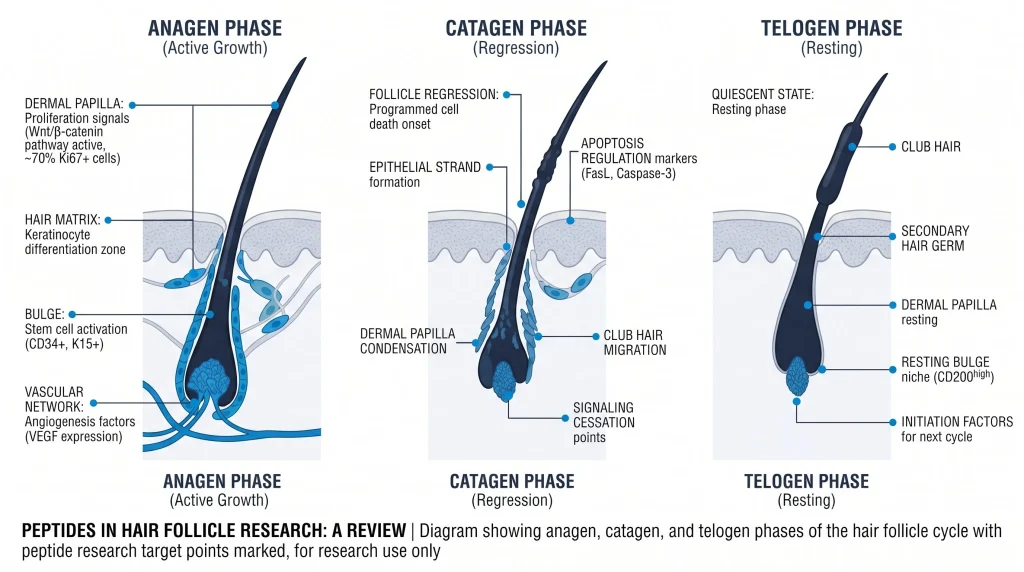
The hair follicle cycle has three main phases. Anagen is the active growth phase. Matrix cells at the base of the follicle divide rapidly and push the hair shaft upward. Anagen can last two to seven years in scalp follicles. Catagen is the transition phase. Growth slows and the follicle shrinks. This phase lasts a few weeks. Telogen is the rest phase. The follicle is dormant and the old hair is shed.
The shift from telogen back to anagen depends on stem cell activation in the follicle bulge region. Signals from dermal papilla cells and growth factors like IGF-1, VEGF, and FGF-7 drive this shift. Labs use organ culture models to test whether peptides can change this timing in follicle tissue outside the body.
How Does GHK-Cu Affect Follicle Biology?
GHK-Cu is the tripeptide glycine-histidine-lysine bound to copper. It is one of the oldest and most studied peptides in skin and follicle research. GHK-Cu promotes fibroblast activity and stimulates growth factor output. In follicle studies, it activates vascular endothelial growth factor (VEGF) and fibroblast growth factor (FGF-7). Both are key signals for anagen entry.
GHK-Cu also supports the extracellular matrix (ECM) around the follicle. The ECM gives structural support to dermal papilla cells. A healthy ECM is needed for proper DP cell signaling. According to PubMed (2015), GHK-Cu modulates gene expression in skin tissue toward a repair and renewal pattern. This makes it a key compound in follicle research models. Browse GHK-Cu research vials at Next Level Pharm for COA-verified supply.
What Is the Wnt Pathway in Hair Research?
The Wnt/beta-catenin pathway is one of the main drivers of anagen entry in hair follicles. When Wnt signals are active, beta-catenin moves into the cell nucleus. There it turns on genes that promote cell division in matrix cells. This starts the anagen growth phase. Without Wnt signaling, follicles stay in telogen.
Labs study Wnt-activating peptides to probe how this pathway controls the hair cycle. PTD-DBM is one compound studied for Wnt activation in follicle models. It works by blocking DPPIV, an enzyme that breaks down Wnt-activating proteins. According to PubMed (2018), Wnt pathway activation promoted earlier anagen entry in rodent follicle organ culture models. This makes Wnt-targeting peptides a research focus for follicle biology labs.
What Are Dermal Papilla Cells and Why Do Labs Study Them?
Dermal papilla (DP) cells sit at the base of each hair follicle. They form a cluster called the dermal papilla. DP cells send growth and maintenance signals to the matrix cells above them. These signals control when the follicle enters anagen and how long it stays there. DP cells also communicate with follicle stem cells in the bulge region.
Labs grow DP cells in culture to study how peptides change their signaling output. When DP cells are in good shape, they release more growth factors. When they lose their unique gene expression pattern (called DP identity), their signaling weakens. Research focuses on peptides that preserve or restore DP identity in culture. Browse BPC-157 research vials for a compound studied in connective tissue and follicle support models.
How Is KPV Studied in Follicle Research?
KPV is a tripeptide that blocks the NF-kB pathway. NF-kB drives swelling signals in many tissue types. In the scalp, excess swelling can disrupt follicle cycling. Labs study KPV in follicle models to see how reducing NF-kB activity affects cycle timing and cell health. KPV also has a role in skin barrier research, which overlaps with follicle skin studies.
KPV can be studied alongside GHK-Cu in the same follicle model. This maps how swelling reduction and growth factor support interact. Multi-peptide study designs give more data on how follicle biology responds to combined inputs. Browse KPV research vials for batch-tested supply with lot-specific COA data.
How Do Hair Follicle Peptides Compare?
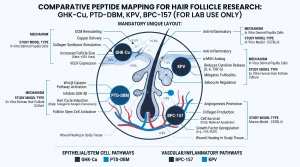
Each peptide targets a different part of follicle biology. Labs choose compounds based on which pathway or cell type they want to probe.
| Peptide | Primary Target | Mechanism | Main Research Model |
| GHK-Cu | Dermal papilla, ECM | VEGF/FGF activation, matrix support | Cell culture, organ culture |
| PTD-DBM | Wnt/beta-catenin pathway | DPPIV blockade, Wnt activation | Organ culture, rodent models |
| KPV | NF-kB pathway | Cytokine reduction | Skin/follicle swelling models |
| BPC-157 | Angiogenesis, ECM | NO signaling, collagen support | Connective tissue, skin models |
All four are available as COA-verified, lyophilized research peptides for lab use.
Frequently Asked Questions
What is hair follicle research in peptide science?
Hair follicle research in peptide science uses lab models to study how small protein chains affect follicle biology. Researchers track peptide effects on the hair growth cycle, dermal papilla cell signaling, and Wnt pathway activity. Common models include cell culture, organ culture, and rodent follicle studies. GHK-Cu, PTD-DBM, BPC-157, and KPV are among the most studied compounds in this area. All research is conducted in controlled lab settings for scientific purposes only.
What is GHK-Cu and how is it studied in follicle models?
GHK-Cu is the tripeptide glycine-histidine-lysine bound to a copper ion. In follicle research, it activates VEGF and FGF-7 growth factor output from dermal papilla cells. It also supports the extracellular matrix around the follicle. According to PubMed (2015), GHK-Cu modulates gene expression toward repair and renewal in skin tissue. Labs use it in cell culture and organ culture models to probe its effects on follicle growth signals.
What is the anagen phase and why is it studied?
Anagen is the active growth phase of the hair follicle cycle. During anagen, matrix cells divide rapidly and push the hair shaft upward. The length of the anagen phase determines hair length. Labs study peptides that prolong anagen or delay the shift to catagen. Extending anagen in lab models allows researchers to observe how growth factors, Wnt signals, and dermal papilla activity interact during the peak growth period.
What is the Wnt pathway in hair follicle biology?
The Wnt/beta-catenin pathway is a key driver of anagen entry in hair follicles. When Wnt is active, beta-catenin enters the cell nucleus and turns on genes for matrix cell division. This starts the growth phase. Labs use Wnt-activating compounds like PTD-DBM to probe how this pathway controls follicle cycle timing. According to PubMed (2018), Wnt activation promoted earlier anagen entry in follicle organ culture models.
What are dermal papilla cells and why do labs target them?
Dermal papilla cells sit at the base of each hair follicle and send growth signals to the matrix cells above. These signals control anagen timing and follicle health. DP cells also communicate with stem cells in the follicle bulge. Labs grow DP cells in culture to test how peptides change their gene expression and signaling output. Peptides that preserve DP identity in culture are of particular interest for follicle biology research.
How is PTD-DBM studied in hair follicle research?
PTD-DBM is a peptide studied for its ability to activate the Wnt/beta-catenin pathway. It works by blocking DPPIV, an enzyme that breaks down Wnt-activating proteins. When DPPIV is blocked, more Wnt signals reach the nucleus. Labs study PTD-DBM in organ culture models to observe how Wnt activation changes anagen entry timing. This makes it a useful tool for probing the upstream drivers of the hair growth cycle in controlled lab settings.
What is NF-kB and how does KPV target it in follicle models?
NF-kB is a protein complex that turns on genes for pro-swelling cytokines. In the scalp, excess swelling signals can disrupt follicle cycling. KPV blocks NF-kB from entering the cell nucleus, which cuts cytokine output. Labs study KPV in follicle models to see how reducing swelling signals affects cycle timing and cell health. KPV is often paired with other follicle peptides in multi-compound study designs.
What types of lab models are used in hair follicle peptide research?
Common models include cell culture studies of dermal papilla cells and keratinocytes. Organ culture models keep isolated follicle tissue alive outside the body for days to weeks. This lets researchers apply peptides directly and measure anagen/catagen timing. Rodent models offer in vivo data on follicle cycle changes under peptide input. Each model type gives different data on follicle biology and peptide mechanism of action.
How does the extracellular matrix relate to hair follicle function?
The extracellular matrix (ECM) is the network of proteins around and between cells in the follicle. It provides structural support and carries signaling molecules to dermal papilla cells. A healthy ECM is needed for proper DP cell signaling and follicle cycling. GHK-Cu is studied for its ability to support and remodel the ECM in skin and follicle tissue. Labs measure collagen content, matrix protein output, and fibroblast activity to track ECM health under peptide input.
Summary
Hair follicle peptide research studies how small protein chains affect the follicle growth cycle. GHK-Cu targets the ECM and growth factor output in dermal papilla cells. PTD-DBM activates Wnt/beta-catenin signaling to probe anagen entry timing. KPV reduces NF-kB-driven swelling signals in follicle tissue models. BPC-157 supports angiogenesis and ECM remodeling near the follicle.
Each compound targets a distinct part of follicle biology. Multi-compound study designs let labs cover growth factor, Wnt, and swelling pathways in a single model run.
What Should You Do Next?
Researchers should choose the follicle pathway and model that fit the study question. Match the compound to a cell culture, organ culture, or animal research design. Review the COA and record purity, molecular identity, and the lot number before each run. Researchers sourcing these lab peptides can shop research peptides with full COA and lot traceability.
Related research: PTD-DBM and hair follicle Wnt signaling research, GHK-Cu research explained, and copper peptide research (GHK-Cu, AHK-Cu).
People Also Read
- GHK-Cu Research Peptide: Copper Tripeptide for Lab Use
- BPC-157 Research Peptide: Lab-Grade Vials for Tissue Research
About the Author
Next Level Pharm Research Team
Alex M covers peer-reviewed findings in peptide science for Next Level Pharm, a US-based supplier of research-grade peptides verified to ≥99% purity via HPLC and mass spectrometry on every batch.
Disclaimer: For research purposes only. Not intended for human consumption. Next Level Pharm products are not intended for diagnostic, therapeutic, or medicinal use. This content does not constitute medical advice. Always consult a licensed healthcare professional before making any health-related decisions.