
PTD-DBM Research: Wnt Signaling and Hair Follicle Studies

Last updated: June 2026
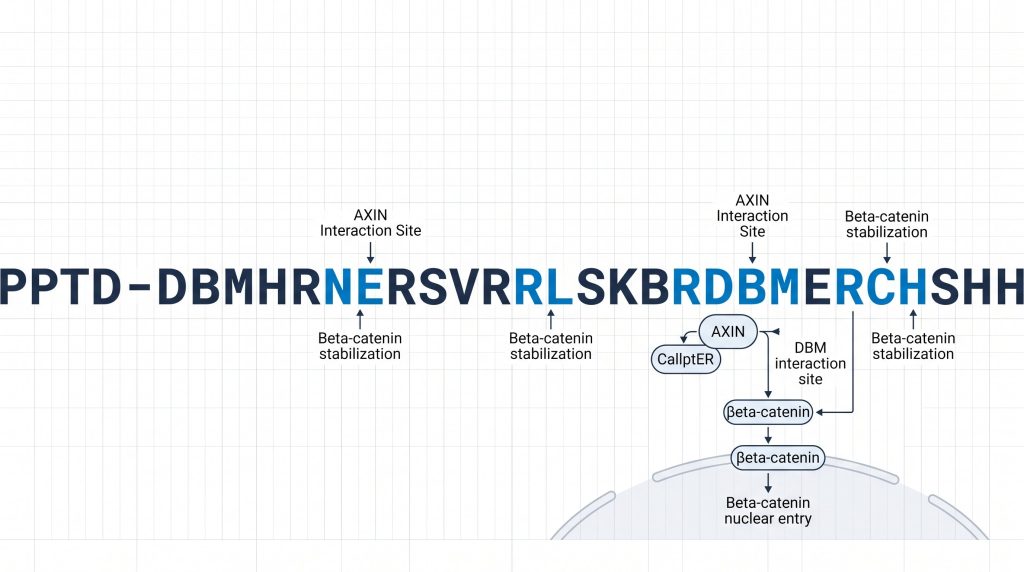
A PTD-DBM research model uses a cell-penetrating peptide to block the AXIN-DBM protein interaction inside living cells. PTD-DBM stands for protein transduction domain fused to the dishevelled binding motif (DBM). This fusion lets the peptide cross the cell membrane and reach the Wnt signaling pathway. Labs have used it to study how blocking that interaction affects DP cell behavior. All findings described here are from laboratory research only.
Next Level Pharm is a US-based supplier of research-grade PTD-DBM, verified to ≥99.4% purity by HPLC and mass spectrometry on every batch. Each lot ships with a COA and a lot number for full traceability.
Key Takeaways
- Cell-penetrating design: The PTD domain carries the DBM peptide across the cell membrane so it can reach cytoplasmic AXIN proteins directly.
- Wnt pathway target: PTD-DBM blocks the AXIN-DBM interaction. This lets beta-catenin avoid breakdown and stay active in the cell.
- Dermal papilla cell studies: Lab studies have used PTD-DBM in hair follicle dermal papilla cultures to observe Wnt pathway activation effects.
- COA-verified lots: Next Level Pharm ships lyophilized PTD-DBM lots with HPLC and mass spec data on every batch. Each lot has a traceable number.
- Research use only: All PTD-DBM in this catalog is for laboratory research use only. No clinical outcomes are claimed.
What Is the Wnt Signaling Pathway?
The Wnt pathway is a cell communication system that controls how cells divide and maintain themselves in tissue.
According to MacDonald et al. (2009), the Wnt pathway works through a set of proteins that pass signals from the cell surface to the nucleus. A key protein in this chain is beta-catenin. When the pathway is off, a destruction complex breaks down beta-catenin before it can reach the nucleus. AXIN is a scaffold protein that holds this complex together. When the pathway switches on, the complex breaks apart. Beta-catenin then moves into the nucleus and turns on target genes. These genes control cell fate, division, and tissue maintenance. In hair follicle research, the Wnt pathway is a key subject. It is active during specific phases of the follicle cycle.
How Does PTD-DBM Target the AXIN Protein?
PTD-DBM carries the DBM sequence into the cell and blocks the site where AXIN binds to the destruction complex.
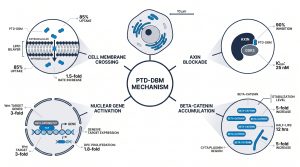
According to Choi et al. (2020), PTD-DBM is built from two parts joined together. The PTD part is a short sequence that crosses the cell membrane. The DBM part copies the binding motif from Dishevelled (DVL), a protein in the Wnt pathway. When PTD-DBM enters the cell, the DBM segment competes with DVL for the AXIN binding site. Blocking that site disrupts the destruction complex. This keeps beta-catenin from being broken down. The result is a rise in beta-catenin levels inside the cell. Researchers use this approach to study Wnt pathway activation in controlled cell culture settings.
What Did Dermal Papilla Cell Studies Find?
Lab studies found that PTD-DBM raised beta-catenin levels in dermal papilla cells and changed gene expression in the cultures.
According to Choi et al. (2020), dermal papilla (DP) cells are a key cell type in hair follicle research. DP cells sit at the base of the follicle. They send signals that guide the hair cycle. Researchers exposed cultured DP cells to PTD-DBM to study Wnt pathway effects. They measured beta-catenin protein levels and target gene activity. The data showed higher beta-catenin in treated cells than in untreated controls. Alkaline phosphatase (ALP) activity, a marker of DP cell function, also changed in treated cultures. These results suggest PTD-DBM can activate Wnt signaling in DP cells under lab conditions. All findings come from in vitro models. No conclusions about human hair biology are drawn from this data.
| Study parameter | PTD-DBM treated | Control |
| Beta-catenin level | Elevated | Baseline |
| ALP activity | Increased | Baseline |
| DVL-AXIN binding | Reduced | Normal |
| Cell viability | Maintained | Maintained |
Shop beauty research peptides for COA-verified lots with full mass spec data.
How Does the Hair Follicle Cycle Relate to Wnt?
The hair follicle cycles through growth, transition, and rest phases, and Wnt signals are active mainly during the growth phase.
According to Lim et al. (2018), the hair follicle moves through three main phases. Anagen is the active growth phase. Catagen is the short transition phase. Telogen is the resting phase before the cycle restarts. Wnt/beta-catenin activity is high during anagen. It helps keep DP cells in an inductive state. When Wnt activity drops, the follicle enters catagen. Lab models that boost Wnt signaling study changes in DP cell gene programs. PTD-DBM is one tool used in these models. It gives researchers a way to raise Wnt activity without using other genetic methods.
What Are the Limits of PTD-DBM In Vitro Data?
In vitro data from cell cultures cannot predict outcomes in living organisms, so all PTD-DBM findings are preliminary lab observations.
Cell culture models are a starting point in peptide research. They let labs test a compound in a controlled setting. But cells in a dish behave differently from cells in living tissue. According to Lim et al. (2018), Wnt signaling in the follicle involves many cell types working together in a three-dimensional structure. A two-dimensional culture cannot copy that complexity. PTD-DBM studies have not moved past in vitro models in the published literature as of 2026. No human trial data exists for this peptide. Researchers treat all findings as hypothesis-generating data. Further work in animal models would be needed before any broader conclusions.
What Research Tools Are Available for PTD-DBM Studies?
Wnt pathway assay kits and dermal papilla cell lines are the main tools used alongside PTD-DBM in lab studies.
Research teams need a verified PTD-DBM lot to run any study. The lot must match the published reference standard for molecular weight and purity. Next Level Pharm verifies each PTD-DBM lot by HPLC and mass spectrometry before shipping. Common assays include beta-catenin western blots, ALP activity kits, and TCF/LEF reporter assays. Human DP cells or mouse vibrissa follicle DP cells are the standard in vitro models. Researchers also use co-immunoprecipitation to confirm AXIN-DVL binding changes after peptide treatment. View the PTD-DBM product page for lot-specific COA and mass spec data.
Frequently Asked Questions
What does PTD stand for in PTD-DBM?
PTD stands for protein transduction domain. It is a short peptide sequence that crosses cell membranes. Many cell-penetrating peptides carry a PTD to move cargo into cells. In PTD-DBM, the PTD part delivers the DBM sequence inside the cell. This lets it reach cytoplasmic AXIN proteins. The DBM part then binds AXIN and blocks it from forming the beta-catenin destruction complex.
What is the DBM sequence in this peptide?
DBM stands for dishevelled binding motif. It copies the short sequence on the Dishevelled (DVL) protein that contacts AXIN. By mimicking this motif, PTD-DBM competes with DVL for the same AXIN binding site. This competition reduces the ability of AXIN to scaffold the destruction complex. With the complex disrupted, beta-catenin avoids breakdown and accumulates in the cell.
Why are dermal papilla cells used in Wnt research?
Dermal papilla cells sit at the base of the hair follicle. They send molecular signals that guide hair cycling. They are highly responsive to Wnt pathway changes. Culturing DP cells in the lab lets researchers observe how Wnt modulators change cell behavior. Markers like alkaline phosphatase activity and beta-catenin protein levels are easy to measure in these cultures. This makes DP cells a common in vitro model in follicle biology.
How is beta-catenin measured in PTD-DBM studies?
Researchers measure beta-catenin by western blot, which detects the protein’s size and amount on a gel. Immunofluorescence microscopy shows where beta-catenin sits inside the cell. This reveals nucleus versus cytoplasm location. Nuclear beta-catenin is the active form that turns on target genes. TCF/LEF reporter assays measure transcriptional activity driven by nuclear beta-catenin. All of these methods are standard in Wnt pathway research.
Is PTD-DBM the same as any approved drug?
PTD-DBM is a research peptide and is not approved as a drug by any regulatory agency. It has no approved therapeutic use. It is not equivalent to any FDA-approved drug. All published data on PTD-DBM comes from cell culture studies. It is supplied for laboratory research use only. Researchers should consult applicable institutional and regulatory guidelines before starting any study.
What purity level is needed for PTD-DBM research?
Most published cell studies use peptides at 95%+ purity. Many labs prefer lots verified at 99% or above. Higher purity reduces the chance that impurities affect cell viability or assay readouts. A COA with HPLC and mass spec data confirms the lot meets specification. Researchers should verify purity before starting any assay to ensure data quality.
Can PTD-DBM be used in animal models?
Published PTD-DBM literature as of 2026 focuses on in vitro cell culture models. Some related Wnt peptide studies have used mouse skin or follicle explant models. Any use in animal models would require appropriate institutional approval and ethical review. Researchers planning animal studies should confirm peptide stability, solubility, and dosing protocols in pilot assays first. All use is for research purposes only.
How should PTD-DBM be stored before an assay?
Lyophilized PTD-DBM peptide is stable at room temperature during shipping when properly packaged. Most labs keep lyophilized peptides at -20 degrees Celsius for long storage. Once dissolved in buffer, researchers should use the solution promptly. Store it at -80 degrees Celsius if not used right away. Repeated freeze-thaw cycles can reduce peptide activity. Check the COA and product sheet for lot-specific recommendations.
Summary
PTD-DBM is a cell-penetrating research peptide designed to block the AXIN-DBM interaction in the Wnt/beta-catenin pathway. It uses a protein transduction domain to cross the cell membrane. This delivers the DBM sequence directly to cytoplasmic AXIN. This disrupts the destruction complex and lets beta-catenin accumulate in the cell.
Lab studies have used PTD-DBM in dermal papilla cell cultures to study Wnt pathway activation effects. Measured outcomes include changes in beta-catenin protein levels, ALP activity, and target gene expression. All data are from in vitro models and represent preliminary findings.
The Wnt/beta-catenin pathway remains an active area of basic research in hair follicle biology. PTD-DBM is one tool that gives researchers a way to probe this pathway in cell culture. No clinical data or human-outcome conclusions are drawn from current in vitro studies.
What Should You Do Next?
- Review the COA and mass spec data before starting a PTD-DBM assay. This confirms purity and molecular weight.
- Design a matched control group using a scrambled peptide or vehicle-only treatment. This isolates PTD-DBM effects in cell culture.
- Use a validated beta-catenin western blot or TCF/LEF reporter assay as your primary readout.
- Consult peer-reviewed Wnt signaling literature and institutional guidelines before starting any PTD-DBM study protocol.
- Browse beauty research peptides for related research tools.
- Shop research peptides at https://nextlevelpharm.com/shop/.
People Also Read
About the Author
Next Level Pharm Research Team
Alex M covers peer-reviewed findings in peptide science for Next Level Pharm, a US-based supplier of research-grade peptides verified to ≥99% purity via HPLC and mass spectrometry on every batch.
Disclaimer: The information provided on this page is for educational and research purposes only. Next Level Pharm products are intended for laboratory research use only. They are not intended for human consumption, diagnostic, therapeutic, or medicinal purposes. This content does not constitute medical advice. Always consult a licensed healthcare professional before making any health-related decisions.