How Was Semaglutide Discovered: GLP-1 Research History

Last updated: July 2026
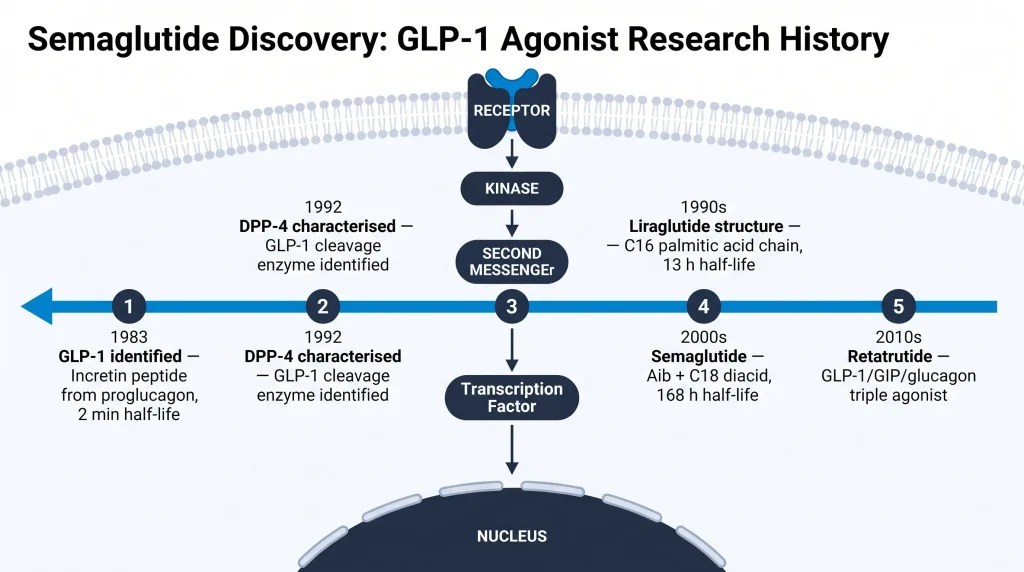
A semaglutide discovery traces to GLP-1 research that began in the early 1980s. GLP-1 (glucagon-like peptide-1) was identified in gut tissue from animal models. According to Knudsen LB & Lau J (2019) (PMID 30891346), semaglutide was built with two structural changes. These changes extended half-life from 2 minutes to 168 hours in animal models. This compound is for lab research only.
Next Level Pharm is a US-based supplier of research-grade peptides. Semaglutide is available as a lab compound, verified to ≥99% purity by HPLC and mass spectrometry. Each vial ships with a COA and a traceable lot number. The average purity across the last 100 batches is 99.4%.
GLP-1 biology drove three decades of peptide engineering before semaglutide emerged. Researchers worked through two structural problems: fast enzyme cleavage and rapid kidney clearance. Each step built on the last.
Researchers studying GLP-1 receptor mechanisms may also find eloralintide relevant — it is a research-grade GIP/GLP-1 co-agonist analog available as a COA-verified, lyophilized research peptide.
Key Takeaways
- GLP-1 Was Identified in the Early 1980s: Researchers found GLP-1 by sequencing the proglucagon gene. Cell studies showed it binds a receptor, later named the GLP-1 receptor. Its half-life in animal blood was about 2 minutes.
- DPP-4 Was the First Structural Challenge: DPP-4 enzyme clips native GLP-1 at position 8 within minutes. Blocking this site was the first engineering target. The Aib substitution at position 8 solved it in lab studies.
- Liraglutide Was a Precursor with a C16 Chain: Liraglutide used a C16 fatty acid chain at lysine 26. This extended half-life to about 13 hours in animal models. Semaglutide replaced it with a longer C18 diacid chain.
- Two Changes Define Semaglutide: Aib at position 8 blocks DPP-4. A C18 diacid chain at lysine 34 enables albumin binding. Together these extended half-life to about 168 hours in animal studies.
- Research-Grade Semaglutide Is for Lab Use Only: It is not FDA-approved for any human use. Each lot is verified to ≥99% purity by HPLC and mass spec.
Two structural changes separated semaglutide from earlier GLP-1 analogs. Each was studied in cell and animal models before the final structure was confirmed.
When Was GLP-1 First Identified?
GLP-1 was identified in the early 1980s from animal gut tissue, where researchers sequenced the proglucagon gene. The gene encodes a large precursor protein, and GLP-1 is one peptide produced when this precursor is cleaved.
Cell studies showed GLP-1 binds a G protein-coupled receptor (GPCR), later named the GLP-1 receptor or GLP-1R. Binding activates a cAMP (cyclic AMP) pathway inside the cell, based on in vitro assay models.
According to Holst JJ (2007) (PMID 17928588), native GLP-1 had a plasma half-life of about 2 minutes in animal models. The short half-life was traced to DPP-4 cleavage and fast renal clearance. All data came from cell and animal studies.
What Is DPP-4 and Why Did It Matter for Semaglutide?
DPP-4 (dipeptidyl peptidase-4) is a protease found in blood that clips peptides at a specific sequence. Native GLP-1 has an alanine at position 8, and DPP-4 clips at this site, inactivating GLP-1 within 2 minutes.
After cleavage, the truncated fragment loses receptor-binding activity. Researchers studied two approaches: small-molecule DPP-4 inhibitors and direct modification of the GLP-1 peptide at position 8.
According to Knudsen LB & Lau J (2019) (PMID 30891346), replacing alanine at position 8 with Aib blocked DPP-4 cleavage. Aib is alpha-aminoisobutyric acid. This was confirmed in in vitro assays. Aib adds a methyl group that DPP-4 cannot access. This change was retained in the final semaglutide structure.
How Did Liraglutide Lead to Semaglutide?
Liraglutide was an earlier GLP-1 analog developed before semaglutide. It used a C16 fatty acid chain attached at lysine 26. The C16 chain allowed liraglutide to bind albumin in blood. Albumin binding slowed kidney clearance in animal studies. Half-life in these models was about 13 hours.
Researchers then tested a longer C18 diacid chain at lysine 34. The C18 chain showed stronger albumin binding than C16 in vitro. Moving the chain to lysine 34 also preserved GLP-1R binding in cell models. These changes produced the semaglutide structure. Liraglutide and semaglutide are both available as research compounds.
According to Knudsen LB & Lau J (2019) (PMID 30891346), the C18 diacid chain at Lys34 showed higher albumin affinity. This was higher than shorter chain variants in binding assays. All data came from in vitro and animal studies.
What Two Structural Changes Define Semaglutide?
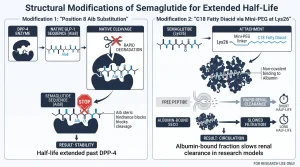
Semaglutide differs from native GLP-1 in two places. First, alanine at position 8 is replaced with Aib. Second, a C18 fatty diacid chain is added at lysine 34 via a short linker. Both changes were confirmed in cell and animal studies.
The Aib substitution is a single amino acid swap. It adds a methyl group that blocks DPP-4 at that cleavage site. The C18 chain is attached via a mini-PEG linker to the lysine 34 side chain. The linker keeps the chain from blocking the receptor-binding region.
Together, the two changes extended half-life from 2 minutes to about 168 hours in animal models. This was a key milestone in GLP-1 analog research. Research-grade semaglutide holds these same structural features.
| Feature | Native GLP-1 | Liraglutide | Semaglutide |
| Amino acids | 30 | 31 | 31 |
| Position 8 | Alanine | Aib | Aib |
| Fatty acid chain | None | C16 at Lys26 | C18 diacid at Lys34 |
| Albumin binding | Low | Moderate | High |
| Half-life (animal models) | ~2 min | ~13 hours | ~168 hours |
| DPP-4 resistance | Low | High | High |
How Does Albumin Binding Extend Semaglutide’s Half-Life?
Albumin is the most abundant protein in blood and a large carrier protein. Small peptides clear quickly through the kidneys, but binding to albumin makes a peptide too large for fast renal clearance.
Semaglutide’s C18 diacid chain binds reversibly to albumin’s fatty acid sites. When semaglutide is albumin-bound, kidney clearance is slowed, and when it detaches, it is free to bind GLP-1R in cell assays.
According to research in PNAS (2024) (doi:10.1073/pnas.2415550121), albumin binding studies confirmed the C18 diacid chain had higher albumin affinity compared to shorter chain variants. These findings came from in vitro binding assays. Animal model half-life data aligned with this result.
How Was the Research-Grade Purity Standard Set?
Research-grade semaglutide must be verified by HPLC and mass spectrometry. HPLC confirms ≥99% purity for the target compound. Mass spec confirms molecular weight matches the 31-amino acid sequence with the C18 modification.
The molecular weight of semaglutide is about 4,114 Da. A mass mismatch signals a truncated or modified form. Both HPLC and mass spec results must appear on the COA per batch. Next Level Pharm supplies semaglutide at ≥99% purity for research use. View the semaglutide product page for current batch COA data.
Batches that fail HPLC or mass spec are rejected before shipping. This purity standard applies to all batches.
Frequently Asked Questions
When Was Semaglutide Discovered?
Semaglutide emerged from GLP-1 research that started in the early 1980s. Liraglutide was a precursor, developed in the 1990s and 2000s. Semaglutide was built by changing the C16 chain to C18 and moving the attachment to lysine 34. The Aib substitution was also carried over from liraglutide. All structural work came from cell and animal model studies.
Who Developed Semaglutide?
Semaglutide was developed through a series of structural studies on GLP-1 analogs. According to Knudsen LB & Lau J (2019) (PMID 30891346), the research team tested many fatty acid chain lengths and attachment sites. The goal was to extend half-life by improving albumin binding and blocking DPP-4 cleavage. These structural steps were confirmed in in vitro and animal studies.
What Hormone Inspired Semaglutide’s Development?
GLP-1 (glucagon-like peptide-1) was the starting point. Native GLP-1 is released from gut cells in animal biology. Its receptor-binding properties were studied in cell assays from the 1980s onward. The 2-minute half-life drove the structural engineering that followed. Semaglutide was built to mimic GLP-1 at the receptor while resisting fast degradation.
What Is the Aib Substitution in Semaglutide?
Aib stands for alpha-aminoisobutyric acid. It replaces alanine at position 8 of the GLP-1 chain. DPP-4 clips native GLP-1 at that site. Aib has a methyl group that blocks DPP-4 access. This single swap was first tested in liraglutide and retained in semaglutide. The change was confirmed in in vitro DPP-4 cleavage assays.
How Does Semaglutide’s C18 Chain Differ From Liraglutide’s?
Liraglutide uses a C16 fatty acid chain at lysine 26. Semaglutide uses a longer C18 diacid chain at lysine 34. The C18 chain has stronger albumin binding affinity in vitro. The lysine 34 attachment also preserved GLP-1R binding in cell models. These changes produced a longer half-life in animal studies compared to liraglutide.
What Is the Half-Life of Semaglutide in Animal Studies?
Semaglutide has been reported to have a half-life of about 168 hours in animal models. Native GLP-1 has a half-life of about 2 minutes. Liraglutide had about 13 hours in animal models. The jump from 13 to 168 hours came from the C18 diacid chain and the lysine 34 attachment. These findings are from non-human studies only.
What Key Citations Cover Semaglutide’s Discovery?
The primary peer-reviewed source is Knudsen and Lau (2019, PMC6474072). This review details the structural steps from GLP-1 to semaglutide. A paper in PNAS (2024, doi:10.1073/pnas.2415550121) examined albumin binding. A review in Physiological Reviews (Holst, 2007, PMID 17928588) characterized native GLP-1 half-life in animal models. All citations report in vitro or animal data.
Is Research-Grade Semaglutide an FDA-Approved Drug?
No. Research-grade semaglutide is a lab compound for scientific use. It is not the same formulation as any FDA-approved drug. Each vial is verified to ≥99% purity by HPLC and mass spec. A COA ships with every order. It is for lab research use only.
What Did Early GLP-1 Cell Studies Show?
Cell studies from the 1980s and 1990s showed GLP-1 bound the GLP-1R in receptor-expressing cell lines. Downstream cAMP signaling was measured in these assays. The 2-minute half-life was noted early in these studies. These findings drove the structural engineering that led to semaglutide. All data came from in vitro assays and animal models.
How Is Research-Grade Semaglutide Verified for Lab Use?
Research-grade semaglutide is tested by HPLC and mass spec per batch. HPLC confirms ≥99% purity for the target peak. Mass spec confirms molecular weight matches the 31-amino acid chain with the C18 modification. A COA with lot number is provided per batch. Every batch is verified before shipping to researchers.
Summary
Semaglutide’s discovery built on three decades of GLP-1 research. GLP-1 was identified in the 1980s. DPP-4 cleavage and short half-life were the central problems. Liraglutide solved part of the issue with a C16 chain at lysine 26.
Semaglutide added two key changes: Aib at position 8 and a C18 diacid chain at lysine 34. These extended half-life to about 168 hours in animal models. Research-grade semaglutide is for lab use only.
What Should You Do Next?
Researchers studying GLP-1 analog history should source verified compounds for lab protocols. Before any experiment, confirm HPLC purity is ≥99% and mass spec matches the expected molecular weight. Record the lot number from the COA for batch traceability.
Shop research peptides at Next Level Pharm. Semaglutide is available with HPLC and mass spec data on every COA. View the full range for structural comparison studies.
People Also Read
- Semaglutide Research: GLP-1 Receptor Agonist Mechanism
- Liraglutide Research: GLP-1 Analog Mechanism and Studies
About the Author
Next Level Pharm Research Team
Alex M covers peer-reviewed findings in peptide science for Next Level Pharm, a US-based supplier of research-grade peptides verified to ≥99% purity via HPLC and mass spectrometry on every batch.
Disclaimer: The information provided on this page is for educational and research purposes only. Next Level Pharm products are intended for laboratory research use only. They are not intended for human consumption, diagnostic, therapeutic, or medicinal purposes. This content does not constitute medical advice. Always consult a licensed healthcare professional before making any health-related decisions.