Liraglutide Research: GLP-1 Analog Mechanism and Studies

Last updated: June 2026
Liraglutide is a GLP-1 analog studied in cell and animal models. A GLP-1 receptor agonist is a compound that binds to the GLP-1 receptor in research models. Liraglutide differs from native GLP-1 by one amino acid substitution. It also has a C16 fatty acid chain at lysine 26. This change extends its half-life in animal models from about two minutes to about thirteen hours. Research-grade liraglutide is for cell and animal model studies only. It is not an FDA-approved drug or supplement.
Next Level Pharm is a US supplier of research-grade peptides. Every liraglutide batch is verified to ≥99% purity by HPLC and mass spec. A COA ships with each order. Research-grade liraglutide from Next Level Pharm is batch-tested and COA-verified. The average purity across the last 100 batches is 99.4%.
GLP-1 analogs have been studied in the context of metabolic and pancreatic cell research. Each analog differs in structure, half-life, and receptor binding profile. Liraglutide was among the first long-acting GLP-1 analogs studied in animal models of beta cell function.
Researchers studying GLP-1 receptor mechanisms may also find eloralintide relevant — it is a research-grade GIP/GLP-1 co-agonist analog available as a COA-verified, lyophilized research peptide.
Key Takeaways
- Liraglutide Is a Modified GLP-1 Analog: It has one amino acid change from native GLP-1. A C16 fatty acid at lysine 26 extends its half-life in animal models.
- GLP-1 Receptors Are Studied in Pancreatic Cell Lines: The receptor is found on beta cells and in brain tissue. Cell models use these receptors to study cAMP signaling and enzyme cascades.
- Animal Models Have Recorded Beta Cell Effects: Animal studies have recorded changes in insulin-related markers in liraglutide-treated groups. These are passive-voice findings from preclinical models only.
- Fatty Acid Acylation Extends Half-Life in Models: The C16 chain binds albumin in blood and slows clearance. This has been studied in rodent half-life models.
- Research-Grade Purity Needs ≥99% HPLC: Both HPLC and mass spec results should appear on the COA. The lot number links each result to the specific batch.
All liraglutide findings below come from cell culture and animal models. Liraglutide has been studied in relation to GLP-1 receptor biology. No findings from these models should be applied to humans without clinical trial evidence.
What Is Liraglutide and How Is It Structured?
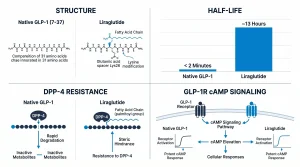
Liraglutide is a 31-amino acid peptide analog of human GLP-1. It differs from native GLP-1 at one position: arginine replaces lysine at position 34. A C16 fatty acid (palmitic acid) is attached via a glutamic acid spacer at lysine 26. This gives liraglutide 97% homology with human GLP-1.
The C16 fatty acid chain is the key structural feature. It allows liraglutide to bind reversibly to albumin in blood. This albumin binding protects the peptide from DPP-4 (dipeptidyl peptidase-4) degradation and renal clearance. The result is a longer half-life in animal models.
According to a study in J Med Chem (2000), liraglutide structural changes have been studied for effects on receptor binding affinity and plasma half-life. The C16 acylation has been shown to extend the plasma half-life to about 13 hours in rodent studies. These are animal model findings.
How Does Liraglutide Bind to GLP-1 Receptors?
The GLP-1 receptor is a class B GPCR (G protein-coupled receptor). It is expressed on pancreatic beta cells, in the brain, and in the gut. When liraglutide binds to the GLP-1 receptor in cell models, it activates the Gs protein pathway. This stimulates adenylyl cyclase and raises intracellular cAMP levels.
Elevated cAMP in beta cell models activates protein kinase A (PKA). PKA phosphorylates several targets linked to insulin secretion signaling cascades. These are in vitro findings from pancreatic cell lines. They show how GLP-1 receptor activation changes enzyme activity in cell models.
According to a study in J Mol Biol (2020), GLP-1 receptor activation via class B GPCR signaling has been studied in pancreatic cell lines. The cAMP-PKA cascade has been recorded in vitro as a downstream marker of receptor binding. These are cell model findings.
What Has Cell Research Found About Liraglutide?
Cell studies have used liraglutide to probe GLP-1 receptor biology in beta cell lines. Researchers have measured cAMP levels, PKA activity, and insulin secretion markers after liraglutide exposure. Changes in these markers have been recorded in multiple cell model studies.
Liraglutide has also been studied in neuronal cell lines. Brain GLP-1 receptors have been shown to activate similar cAMP pathways in these models. Cell studies have recorded changes in gene output markers for nerve protection pathways. These are in vitro findings only and do not predict effects in humans.
Cell research on liraglutide has also studied DPP-4 resistance. Native GLP-1 is rapidly cleaved by DPP-4, an enzyme present in blood and tissue. The structural modification in liraglutide has been shown to reduce DPP-4 cleavage in cell-free enzyme assay models. This is a structural advantage studied in enzymatic assays.
What Do Animal Studies Show About Liraglutide?
Animal studies using liraglutide have focused on metabolic markers in rodent models. Researchers have tracked beta cell mass, insulin-related gene output, and GLP-1 receptor expression in treated groups. These markers have been studied as proxy endpoints for GLP-1 receptor biology in vivo.
Liraglutide has also been studied in rodent models examining gastric motility. Changes in gastric emptying rate have been recorded in some animal studies. These findings are passive-voice research results from animal models and do not establish effects in humans.
According to a review in Front Endocrinol (2019), liraglutide and related GLP-1 analogs have been studied in a range of animal models. These studies studied receptor activation, beta cell biology, and structural analog design. These are animal model findings.
| Feature | Native GLP-1 | Liraglutide |
| Chain length | 30 AA | 31 AA |
| Modification | None | C16 fatty acid at K26 |
| DPP-4 resistance | Low (rapid cleavage) | High (structural protection) |
| Animal half-life | ~2 min | ~13 hours |
| Receptor homology | 100% (native) | 97% homology |
| Research model use | Acute GLP-1 studies | Extended-exposure GLP-1 studies |
How Does Liraglutide Differ From Native GLP-1?
Native GLP-1 has a half-life of about two minutes in blood. DPP-4 cleaves native GLP-1 at the N-terminal alanine within seconds of release. This short half-life limits its use as a research tool in extended-exposure cell and animal studies.
Liraglutide was designed to overcome this. The C16 fatty acid at lysine 26 binds albumin reversibly. Albumin binding shields the peptide from DPP-4 and slows renal clearance. These features have been studied in animal pharmacokinetic models as a proxy for analog stability.
Liraglutide also has one amino acid change at position 34 (Arg instead of Lys). This change removes the C-terminal amidation site. Both changes together produce the ~13-hour half-life recorded in rodent studies.
How Is Research-Grade Liraglutide Verified?
Research-grade liraglutide is tested by HPLC and mass spec. HPLC confirms ≥99% purity by main peak area. Mass spec confirms the found molecular weight matches the theoretical mass for the 31-amino acid acylated sequence.
A COA for liraglutide should show HPLC purity as a percentage, an HPLC chromatogram, and mass spec data. The lot number must be on the COA for batch records. Shop liraglutide from Next Level Pharm with full COA for every batch.
Frequently Asked Questions
What Is Liraglutide?
Liraglutide is a 31-amino acid GLP-1 analog studied in cell and animal models. It differs from native GLP-1 by one amino acid change and a C16 fatty acid at lysine 26. These changes extend its half-life in animal models and increase DPP-4 resistance in enzyme assays. It is a research-grade compound and is not FDA-approved.
What Type of Compound Is Liraglutide?
Liraglutide is a GLP-1 receptor agonist. A GLP-1 receptor agonist is a compound that binds and activates the GLP-1 receptor in cell models. GLP-1 receptors are expressed on pancreatic beta cells, in the brain, and in gut tissue. Cell models use these receptors to study cAMP signaling and related enzyme cascades.
How Does GLP-1 Receptor Binding Work?
The GLP-1 receptor is a class B GPCR. When liraglutide binds to this receptor in cell models, it activates the Gs protein. Gs activates adenylyl cyclase, which raises cAMP in the cell. Elevated cAMP activates PKA, which then hits targets in the insulin output signaling pathway. These are in vitro findings from beta cell lines.
What Has Cell Research Found About Liraglutide?
Cell studies have measured cAMP levels, PKA activity, and insulin secretion markers after liraglutide exposure in beta cell lines. Changes in these markers have been recorded in vitro. Liraglutide has also been studied in neuronal cell lines for GLP-1 receptor-driven cAMP effects. These are in vitro findings and do not predict human outcomes.
What Do Animal Studies Show About Liraglutide?
Animal studies have tracked beta cell mass, insulin-related gene output, and gastric emptying markers in liraglutide-treated rodent groups. Changes in these endpoints have been recorded as proxy measures of GLP-1 receptor biology in vivo. These are animal model findings only and do not establish effects in humans.
How Is Liraglutide Different From Native GLP-1?
Native GLP-1 has a two-minute half-life due to rapid DPP-4 cleavage. Liraglutide has a ~13-hour half-life in animal models because the C16 fatty acid chain binds albumin and shields the peptide from DPP-4. Liraglutide also has one amino acid change at position 34 that removes the C-terminal amidation site. Both changes make liraglutide a better tool for extended research models.
How Is Liraglutide Different From Semaglutide?
Semaglutide has a C18 fatty diacid at lysine 34 and a different amino acid at position 8. These changes give semaglutide a ~168-hour half-life in animal models versus ~13 hours for liraglutide. Both are GLP-1 analogs studied in the context of receptor biology research. Each analog has a distinct structural profile for use in different research models.
What Purity Is Needed for Liraglutide Research?
Research-grade liraglutide needs ≥99% purity by HPLC and a confirmed molecular weight by mass spec. The COA should list HPLC purity, the mass spec result with found and expected masses, and the lot number. Always verify all three items on the COA before any lab use.
Is Liraglutide the Same as Any FDA-Approved Drug?
Research-grade liraglutide shares a sequence with compounds used in FDA-approved drugs. It is produced by synthesis for cell and animal model research only. It is not an FDA-approved drug or supplement. It is not intended for personal use. It is for lab research only, sourced with HPLC and mass spec verification.
Summary
Liraglutide is a 31-amino acid GLP-1 analog with a C16 fatty acid at lysine 26. Cell studies have recorded GLP-1 receptor-driven cAMP and PKA signaling in beta cell lines. Animal models have tracked beta cell and gastric motility markers as research endpoints.
All findings are from cell and animal models only. Liraglutide is not FDA-approved. It is for research use only.
What Should You Do Next?
Researchers sourcing liraglutide should verify ≥99% HPLC purity, mass spec molecular weight confirmation, and lot number on the COA before any study use.
Shop research peptides. Every liraglutide batch is verified by HPLC and mass spec. Full COA data ships with each order.
People Also Read
- Retatrutide Research: Triple Agonist Mechanism and GLP-1 Pathway Studies
- AOD-9604 Research: What Studies Show About This HGH Fragment
About the Author
Next Level Pharm Research Team
Alex M covers peer-reviewed findings in peptide science for Next Level Pharm, a US-based supplier of research-grade peptides verified to ≥99% purity via HPLC and mass spectrometry on every batch.
Disclaimer: The information provided on this page is for educational and research purposes only. Next Level Pharm products are intended for laboratory research use only. They are not intended for human consumption, diagnostic, therapeutic, or medicinal purposes. This content does not constitute medical advice. Always consult a licensed healthcare professional before making any health-related decisions.