
Sexual Health Peptides: PT-141 and Kisspeptin Research

Last updated: June 2026
A sexual health peptide research compound targets receptors in the hypothalamic and pituitary signaling systems. PT-141 (bremelanotide), Melanotan II, and Kisspeptin-10 are three well-studied examples. PT-141 binds melanocortin receptors. Kisspeptin-10 targets the KISS1R receptor in the GnRH (gonadotropin-releasing hormone) pathway. Lab teams use these peptides in cell models to study receptor binding, signal output, and downstream pathway activation. All data come from preclinical models and cell assays.
Next Level Pharm is a US-based supplier of research-grade PT-141, verified to ≥99.4% purity by HPLC and mass spectrometry on every batch. Each lot ships with a COA and a lot number for full traceability.
Key Takeaways
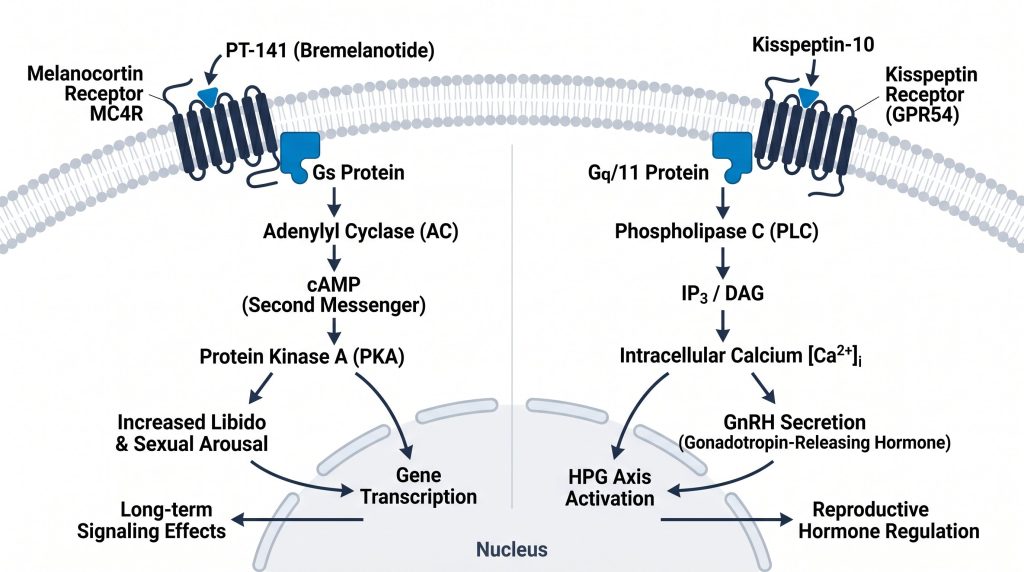
- PT-141 mechanism: PT-141 binds MC3R and MC4R (melanocortin receptors 3 and 4) in hypothalamic cell models. It activates the cAMP pathway and has been studied for central signal output in preclinical assays.
- Kisspeptin-10 target: Kisspeptin-10 targets the KISS1R receptor on GnRH neurons. When KISS1R is activated, it triggers GnRH release. GnRH then signals the pituitary to release LH and FSH in animal models.
- Melanotan II binding: Melanotan II is a cyclic analog of alpha-MSH. It binds MC1R, MC3R, and MC4R. Lab studies measure receptor activation and cAMP output in cell lines expressing these receptors.
- COA-verified lots: Next Level Pharm ships lyophilized PT-141 lots with HPLC and mass spec data on every batch. Each lot has a traceable number.
- Research use only: All PT-141 in this catalog is for laboratory research use only. No clinical outcomes are claimed.
What Receptors Do Sexual Health Peptides Target?
PT-141 and Melanotan II target MC3R and MC4R. Kisspeptin-10 targets KISS1R on GnRH neurons. All three activate cAMP pathways in cell assays.
MC4R (melanocortin 4 receptor) is a G-protein-coupled receptor in the hypothalamus. It is one of five melanocortin receptors (MC1R to MC5R). PT-141 binds MC3R and MC4R and raises cAMP inside the cell. KISS1R (kisspeptin receptor 1) sits on GnRH neurons in the hypothalamus. When Kisspeptin-10 binds KISS1R, it triggers GnRH release. According to Pfaus et al. (2007), MC4R activation in central nervous system cell models is linked to specific signal outputs in preclinical studies. Lab teams confirm receptor binding by measuring cAMP after peptide treatment in cell lines that express the target receptor.
How Does PT-141 Activate the cAMP Pathway?
PT-141 binds MC3R and MC4R and activates the G-protein-cAMP pathway. cAMP then activates PKA and downstream gene output in cell models.
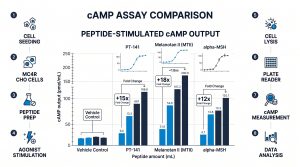
When PT-141 binds MC4R on the cell surface, the receptor activates Gs protein. Gs protein turns on adenylyl cyclase (the enzyme that makes cAMP). cAMP levels rise inside the cell. PKA (protein kinase A) is then activated. PKA tags proteins and turns on gene programs linked to cell signal output. According to Rosen et al. (2014), melanocortin peptides that activate MC4R produce measurable cAMP rises in CHO cell models expressing human MC4R. Researchers measure this cAMP rise by HTRF or ELISA assay kits. A higher cAMP reading in peptide-treated cells versus vehicle controls confirms MC4R activation.
How Does Kisspeptin-10 Signal Through GnRH Neurons?
Kisspeptin-10 binds KISS1R on GnRH neurons. This triggers GnRH release. GnRH then signals the pituitary to release LH and FSH in animal models.
KISS1R is a G-protein-coupled receptor linked to the Gq/11 pathway. When Kisspeptin-10 binds KISS1R, it activates phospholipase C (PLC). PLC raises intracellular calcium. High calcium triggers GnRH release from neuron terminals. GnRH then travels to the pituitary and signals LH and FSH release. According to Navarro et al. (2005), kisspeptin signaling through KISS1R is one of the main control points for GnRH release in preclinical animal models. Lab teams measure GnRH output and calcium flux after Kisspeptin-10 treatment in hypothalamic neuron cultures or KISS1R-expressing cell lines.
How Does Melanotan II Compare to PT-141 in Assays?
Both are melanocortin receptor agonists. Melanotan II is cyclic and binds MC1R, MC3R, and MC4R. PT-141 is a fragment of Melanotan II with a narrower receptor profile.
Melanotan II (MT-II) is a cyclic heptapeptide analog of alpha-MSH. It binds MC1R, MC3R, and MC4R with similar strength. PT-141 is a linear fragment of MT-II. It has stronger MC3R and MC4R binding relative to MC1R. This difference in receptor profile is studied in binding competition assays. Researchers add both peptides to cell lines expressing single receptor types and measure cAMP output for each. This lets them compare receptor selectivity in controlled assays.
| Peptide | Type | Main Receptors | cAMP Signal | Key Study |
| PT-141 | Linear fragment | MC3R, MC4R | High | Pfaus et al. (2007) |
| Melanotan II | Cyclic | MC1R, MC3R, MC4R | High | Rosen et al. (2014) |
| Alpha-MSH | Natural | MC1R to MC5R | Moderate | Navarro et al. (2005) |
What Biomarkers Are Measured in These Receptor Studies?
Key markers are cAMP level, calcium flux, GnRH output, receptor binding Kd, and pCREB. Each marker links to a different step in the signaling chain.
cAMP is measured by HTRF or ELISA in cell lysates after peptide treatment. This confirms Gs-coupled receptor activation (MC4R, MC3R, MC1R). Calcium flux is measured by fluorescent probes in KISS1R assays. A calcium rise shows Gq-pathway activation. GnRH output is measured in conditioned media from hypothalamic cultures. Receptor binding Kd is measured by radioligand competition assay. pCREB (phosphorylated CREB) is measured by ELISA in post-PKA signal studies. Together, these markers track the full receptor-to-gene signal chain in a single cell assay.
What Research Tools Are Available for PT-141 Studies?
Lab teams need COA-verified peptide, MC4R or KISS1R cell lines, cAMP HTRF kits, and calcium flux assay reagents.
Research teams need a verified PT-141 lot to run any study. The lot must match the published reference standard for molecular weight and purity. Next Level Pharm verifies each PT-141 lot by HPLC and mass spectrometry before shipping. CHO cells expressing human MC4R are the standard reference line for PT-141 and Melanotan II studies. KISS1R-expressing HEK293 cells are used for Kisspeptin-10 calcium flux assays. View the PT-141 product page for lot-specific COA and mass spec data.
Frequently Asked Questions
What is PT-141 in research?
PT-141 (bremelanotide) is a synthetic melanocortin peptide studied in cell models for MC3R and MC4R receptor binding and cAMP signal output. It is a fragment of Melanotan II. All data come from in vitro and preclinical models. This product is for laboratory research use only.
Which receptors does PT-141 bind?
PT-141 binds MC3R and MC4R (melanocortin receptors 3 and 4). These are G-protein-coupled receptors in the hypothalamus. Binding raises cAMP inside the cell through the Gs protein pathway. Researchers confirm binding by measuring cAMP in CHO cells expressing human MC4R after PT-141 treatment.
What is Kisspeptin-10 and what does it target?
Kisspeptin-10 is a 10-amino-acid peptide that targets the KISS1R receptor on GnRH neurons. When KISS1R is activated, it raises intracellular calcium through the Gq pathway. This triggers GnRH release in cell and animal models. All data come from preclinical models.
How is MC4R activation confirmed in cell assays?
MC4R activation is confirmed by measuring cAMP rise in cells expressing the receptor. Researchers use HTRF or ELISA kits on cell lysates collected after peptide treatment. A higher cAMP in peptide-treated cells than in vehicle controls confirms MC4R activation. pCREB western blot is used as a downstream confirmation step.
How does Melanotan II differ from PT-141?
Melanotan II (MT-II) is a cyclic heptapeptide that binds MC1R, MC3R, and MC4R. PT-141 is a linear fragment of MT-II with stronger preference for MC3R and MC4R over MC1R. This receptor selectivity difference is studied using single-receptor cell lines and radioligand competition assays.
What is the GnRH pathway in Kisspeptin-10 research?
GnRH (gonadotropin-releasing hormone) is released from hypothalamic neurons when KISS1R is activated by Kisspeptin-10. GnRH then signals the pituitary to release LH and FSH. Lab teams measure GnRH in conditioned media and LH/FSH in downstream cell culture assays to map this signaling chain.
What published research covers PT-141 and melanocortin receptor binding?
Pfaus et al. (2007) in Psychopharmacology covers MC4R activation by melanocortin peptides in preclinical models (PMID 17445681). Rosen et al. (2014) covers melanocortin receptor pharmacology (PMID 24407748). Navarro et al. (2005) covers kisspeptin signaling through KISS1R in hypothalamic neuron models (PMID 15590703).
What purity standards apply to these research peptides?
Research-grade PT-141, Melanotan II, and Kisspeptin-10 must each be verified to ≥99% purity by HPLC and mass spectrometry. Each lot must have a COA with lot number, purity value, and molecular weight confirmation. Teams confirm a lot of identity before any receptor binding assay. Lower-purity lots can produce off-target cAMP signals in MC4R and KISS1R assays, which reduces data reliability.
How should these peptides be stored for research?
Lyophilized research-grade peptides should be stored at -20°C in a sealed container away from light. Reconstituted solutions should be kept at 4°C and used within 24 to 48 hours. Freeze-thaw cycles reduce peptide activity in receptor binding assays. These products ship as dry powders stable at room temperature during transit. Check the COA for lot-specific storage recommendations before starting your assay protocol.
Summary
PT-141, Melanotan II, and Kisspeptin-10 are used in cell models to study melanocortin and GnRH receptor signaling. PT-141 and Melanotan II activate MC3R and MC4R through cAMP. Kisspeptin-10 activates KISS1R and raises calcium in GnRH neuron models.
Key biomarkers are cAMP, calcium flux, pCREB, and GnRH output. All data come from in vitro and preclinical models. No clinical outcomes are claimed for these research-grade peptides.
What Should You Do Next?
- Confirm MC4R or KISS1R expression in your cell line before ordering research peptides.
- Review melanocortin receptor assay protocols in published literature before setting up your study.
- Check COA data for lot purity and molecular weight on the PT-141 product page.
- Run cAMP and calcium flux assays in parallel to compare MC4R and KISS1R signal outputs.
- Browse sexual health research peptides for related research tools.
- Shop research peptides at https://nextlevelpharm.com/shop/.
People Also Read
- Melanotan I Research: Alpha-MSH Mechanism Studies
- Kisspeptin-10 Research: GnRH Signaling and Receptor Studies
About the Author
Next Level Pharm Research Team
Alex M covers peer-reviewed findings in peptide science for Next Level Pharm, a US-based supplier of research-grade peptides verified to ≥99% purity via HPLC and mass spectrometry on every batch.
Disclaimer: The information provided on this page is for educational and research purposes only. Next Level Pharm products are intended for laboratory research use only. They are not intended for human consumption, diagnostic, therapeutic, or medicinal purposes. This content does not constitute medical advice. Always consult a licensed healthcare professional before making any health-related decisions.