
ACTH 1-39 Research: Steroid output Adrenal Cell Studies

Last updated: June 2026
A full-length ACTH 1-39 research compound is the 39-amino-acid form of adrenocorticotropin. It is a pituitary-derived peptide that binds the MC2R (melanocortin 2 receptor) with high target range. In cell-based research, scientists apply it to cortical lines such as H295R to study steroid output pathways. Key endpoints include cAMP signaling, StAR protein onset, and cortisol output.
Next Level Pharm is a US-based supplier of research-grade ACTH(1-39), verified to ≥99.4% purity by HPLC. Mass spectrometry on every batch. Each lot ships with a COA and a lot number for full traceability.
Key Takeaways
- Full-length adrenocorticotropin: ACTH(1-39) is the complete 39-residue peptide. Shorter fragments retain partial action only.
- MC2R target range: ACTH(1-39) binds only the MC2R melanocortin receptor, unlike shorter ACTH fragments that bind multiple subtypes.
- H295R cell model: The NCI-H295R cortical line is the primary cell model for ACTH steroid output research.
- COA-verified lots: Next Level Pharm ships lyophilized ACTH(1-39) lots with HPLC. Mass spec data on every batch. Each lot has a traceable number.
- Research use only: All ACTH(1-39) in this catalog is for lab research use only. No clinical outcomes are claimed.
What Is ACTH 1-39 and How Is It Structured?
ACTH(1-39) is the full 39-residue adrenocorticotropin peptide secreted by the anterior pituitary. According to Mountjoy et al. (1992), the MC2R receptor was cloned using ACTH(1-39) as the reference ligand. This established the full-length peptide as the benchmark for adrenal steroid output research.
ACTH is processed from a larger precursor called pro-opiomelanocortin (POMC). The pituitary cleaves POMC to release ACTH(1-39) as the primary bioactive form. The N-terminal residues 1 through 24 are conserved across species and carry most receptor-binding action.
The C-terminal residues 25 through 39 contribute to receptor binding affinity and plasma half-life. Shorter fragments such as ACTH(1-24) retain receptor action but lack the C-terminal stabilizing sequence. Researchers use ACTH(1-39) as the full reference standard in steroid output cell studies.
How Does ACTH 1-39 Signal Through MC2R?
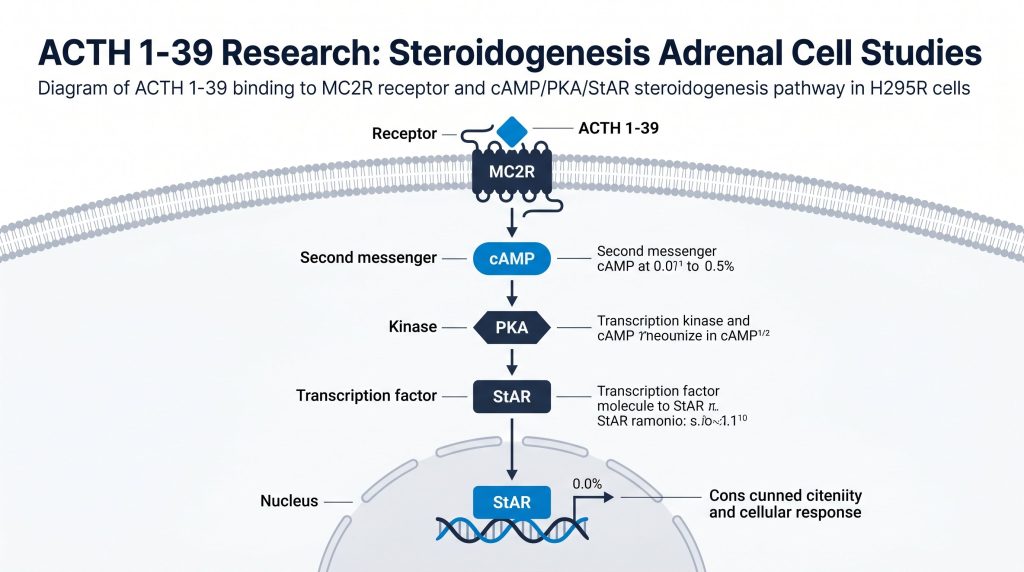
ACTH(1-39) binds MC2R, activates adenylyl cyclase, raises cAMP, and triggers PKA-mediated steroid output. According to Catania et al. (2010), melanocortin receptor biology defines five subtypes (MC1R through MC5R). MC2R is the only subtype that binds ACTH with high target range. MC1R through MC5R bind alpha-MSH and related ligands, but not ACTH alone.
When ACTH(1-39) binds MC2R, it activates adenylyl cyclase through a Gs-coupled mechanism. Adenylyl cyclase converts ATP to cyclic AMP (cAMP). Elevated cAMP activates protein kinase A (PKA). PKA then phosphorylates StAR protein and steroidogenic enzymes.
StAR (steroidogenic acute regulatory protein) transports cholesterol into the mitochondria. Inside the mitochondria, CYP11A1 (cholesterol side-chain cleavage enzyme) converts cholesterol to pregnenolone, the first committed steroid. Downstream enzymes then produce cortisol and aldosterone.
What Cell Model Is Used for ACTH 1-39 Research?
NCI-H295R human cortical cells are the tested cell line for ACTH steroid output studies. According to Pignatelli et al. (2006), H295R cells express the full complement of steroidogenic enzymes. They produce cortisol and aldosterone under ACTH stimulation in a reproducible manner.
H295R cells were derived from a human cortical carcinoma. They retain expression of MC2R, StAR, CYP11A1, CYP11B1, and CYP11B2. This enzyme panel supports the complete cortisol and aldosterone synthesis pathway.
Researchers culture H295R cells in DMEM/F12 medium with insulin-transferrin-selenium supplement. ACTH(1-39) is added at defined levels and the cells are incubated for 24 to 48 hours. Supernatants are collected for cortisol ELISA. Cell lysates are used for cAMP, StAR, and CYP11A1 assays.
How Does ACTH 1-39 Compare to Shorter ACTH Fragments?
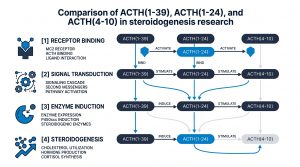
ACTH(1-39), ACTH(1-24), and ACTH(4-10) differ in length, receptor binding, and cell model use. Researchers sometimes compare the full-length ACTH(1-39) with shorter fragments to isolate which residues drive specific signaling outcomes.
| Feature | ACTH(1-39) | ACTH(1-24) | ACTH(4-10) |
| Residue length | 39 | 24 | 7 |
| MC2R binding | High affinity | Moderate | Minimal |
| Steroid output | Full | Partial | Not detected |
| Cell model | H295R | H295R, Y1 | Non-adrenal CNS models |
| cAMP induction | Yes | Yes | No |
ACTH(1-24) lacks the C-terminal stabilizing sequence but retains enough N-terminal receptor-binding residues for partial MC2R onset. ACTH(4-10), a heptapeptide, has no detectable steroidogenic action in adrenal models. It is studied in central nervous system cell models for non-adrenal behavioral biology.
What Biomarkers Measure ACTH 1-39 Action in Cell Studies?
cAMP ELISA, cortisol ELISA, StAR western blot, and CYP11A1 qRT-PCR are the core endpoints. A four-assay panel covers the ACTH(1-39) signaling cascade from receptor to steroid output.
- cAMP ELISA: Measures internal cyclic AMP as the immediate second messenger. Cells are lysed at 15 to 60 minutes post-treatment. ELISA kits calibrated for internal cAMP in adrenal cell lysates are used.
- Cortisol ELISA: Quantifies cortisol in cell culture supernatant at 24 and 48 hours. Confirms that the cAMP signal translated into steroid output.
- StAR western blot: Detects StAR protein expression and phosphorylation by immunoblot. Anti-StAR antibody (clone D10G4 or equivalent) is used after SDS-PAGE separation.
- CYP11A1 qRT-PCR: Quantifies mRNA for the rate-limiting steroidogenic enzyme. Results are normalized to GAPDH or ACTB as housekeeping genes. Elevated CYP11A1 expression confirms transcriptional onset downstream of PKA.
What Research Tools Are Available for ACTH(1-39) Studies?
cAMP ELISA kits, cortisol ELISA kits, anti-StAR antibody, and a qRT-PCR system are the core tools for ACTH(1-39) studies.
Research teams need a verified ACTH(1-39) lot to run any study. The lot must match the published reference standard for molecular weight and purity. Next Level Pharm verifies each ACTH(1-39) lot by HPLC and mass spectrometry before shipping. Competitive cAMP ELISA kits calibrated for internal lysates measure the immediate MC2R signaling response. Cortisol ELISA kits specific for cell supernatant matrices quantify steroid output at 24 and 48 hours. A qRT-PCR system with tested CYP11A1 primer-probe sets and GAPDH normalization completes the transcriptional readout. View the ACTH(1-39) product page for lot-specific COA and mass spec data.
Frequently Asked Questions
What is ACTH 1-39?
ACTH(1-39) is the full-length, 39-amino-acid form of adrenocorticotropin. It is processed from the precursor protein pro-opiomelanocortin (POMC) in the anterior pituitary. In cell research, it is used as the reference ligand for MC2R-mediated steroid output studies. The full sequence is required for high-affinity MC2R binding in cortical cell models. ACTH 1-39 is the full-length form. It has 39 amino acids. Purity is 99% or higher.
What receptor does ACTH 1-39 bind in cell research?
ACTH(1-39) binds the MC2R, also called the melanocortin 2 receptor. MC2R is the only melanocortin receptor subtype that binds ACTH with high target range. The other four subtypes (MC1R, MC3R, MC4R, MC5R) bind alpha-MSH and related ligands instead. MC2R is expressed primarily on cortical cells, making it the adrenal ACTH receptor. MC2R is on the adrenal cortex. cAMP onset confirms binding. Run a cAMP ELISA.
What signaling pathway does ACTH 1-39 activate?
ACTH(1-39) activates the cAMP/PKA pathway through MC2R. Receptor binding stimulates adenylyl cyclase, which converts ATP to cyclic AMP (cAMP). Elevated cAMP activates protein kinase A (PKA). PKA phosphorylates StAR protein and steroidogenic enzymes, initiating cholesterol transport into the mitochondria for cortisol and aldosterone synthesis.
What is the H295R cell line used for in ACTH research?
H295R is a human cortical carcinoma cell line that retains the full steroidogenic enzyme set. It expresses MC2R, StAR, CYP11A1, CYP11B1, and CYP11B2. Researchers use it to model cortisol and aldosterone synthesis under ACTH stimulation. It is the tested standard cell model for adrenal steroid output research in vitro. H295R cells make steroids in culture. Run at 48 hours. Include a vehicle control.
What is StAR protein and why is it measured in ACTH studies?
StAR stands for steroidogenic acute regulatory protein. It controls the rate-limiting step in steroid output by transporting cholesterol from the outer to the inner mitochondrial membrane. PKA, activated downstream of ACTH, phosphorylates StAR to initiate this transport. Researchers measure StAR by western blot to confirm that the ACTH signal reached the mitochondria. StAR is detected by western blot. Band appears at 37 kDa. Use an anti-StAR antibody.
Why is CYP11A1 measured by qRT-PCR in ACTH 1-39 studies?
CYP11A1 is cholesterol side-chain cleavage enzyme, the first enzyme in steroid synthesis. It converts cholesterol to pregnenolone inside the mitochondria. qRT-PCR quantifies CYP11A1 mRNA to show whether ACTH activated steroidogenic gene transcription. Results are normalized to a housekeeping gene such as GAPDH or ACTB for accuracy. mRNA is measured by qPCR. Normalize to GAPDH. Run all wells in triplicate.
How does ACTH 1-39 differ from ACTH 1-24?
ACTH(1-39) is the full 39-residue sequence with high MC2R binding affinity. ACTH(1-24) is a shorter 24-residue fragment that retains partial MC2R action. ACTH(1-24) lacks the C-terminal stabilizing sequence of the full peptide. In H295R cells, ACTH(1-39) produces a more complete steroidogenic response than ACTH(1-24). ACTH 1-24 is the short form. It binds MC2R. Full activity is with the 1-39 form.
What is cAMP ELISA and when is it used in ACTH cell studies?
cAMP ELISA is an enzyme-linked immunosorbent assay that quantifies cyclic AMP in cell lysates. Researchers collect lysates at 15 to 60 minutes after ACTH treatment. This early timepoint captures the immediate second messenger response to MC2R onset. The cAMP result confirms that the peptide engaged the receptor before downstream assays are run. The assay runs for two hours. Plates are read at 450 nm. Include a standard curve.
What is the research-use status of ACTH 1-39?
ACTH(1-39) is available as a research compound for in vitro lab use only. It is not approved for any clinical or therapeutic application in humans. All published data referenced here comes from cell-based or preclinical research models. Researchers obtain it as a lyophilized, COA-verified peptide for lab work. ACTH 1-39 is not for clinical use. All lots are for in vitro research only.
Where can labs source COA-verified ACTH 1-39 for research?
Labs need a lot-verified ACTH(1-39) sample with HPLC and mass spec data on the COA. The COA should confirm purity at or above 99 percent. Match the expected molecular weight of 4541 Da. Lot numbers provide traceability to the analytical batch report. Lyophilized peptide is preferred for shipping stability and short-term storage at 4 degrees C.
Summary
ACTH(1-39) is the full-length, 39-amino-acid adrenocorticotropin peptide. It binds the MC2R receptor with high target range and activates the cAMP/PKA signaling cascade. This leads to StAR protein onset and downstream cortisol. Aldosterone synthesis in H295R cortical cell models. Each lot ships with a COA. Purity is 99% by HPLC. Mass spec confirms the sequence.
The four-assay panel for ACTH(1-39) studies covers cAMP ELISA, cortisol ELISA, StAR western blot, and CYP11A1 qRT-PCR. Together these endpoints trace the signal from receptor binding to steroid output. Shorter fragments such as ACTH(1-24) and ACTH(4-10) serve as structural comparison standards.
ACTH(1-39) is available for in vitro lab research as a lyophilized, COA-verified peptide. Every lot carries HPLC and mass spec confirmation of purity and molecular identity. All use is restricted to preclinical research settings.
What Should You Do Next?
- Culture H295R cells in DMEM/F12 with ITS supplement before adding ACTH(1-39) at defined levels.
- Collect cell lysates at 15 to 60 minutes post-treatment for the cAMP ELISA timepoint.
- Use an anti-StAR antibody tested for human cortical lysates in the western blot assay.
- Normalize CYP11A1 qRT-PCR data to GAPDH or ACTB housekeeping genes for reliable comparison.
- Browse recovery research peptides for related research tools.
- Shop research peptides at https://nextlevelpharm.com/shop/.
- Confirm lot number matches the COA before each assay run.
- Store vials at -20°C until use.
- Use fresh buffer for each assay run.
- Record the lot number used in each experiment.
People Also Read
- Neuroprotective Peptide Research: Semax, Selank, and PE-22-28 Studies
- Anti-Inflammatory Peptide Research: BPC-157, KPV, and ARA-290 Studies
About the Author
Next Level Pharm Research Team
Alex M covers peer-reviewed findings in peptide science for Next Level Pharm, a US-based supplier of research-grade peptides verified to ≥99% purity via HPLC and mass spectrometry on every batch.
Disclaimer: The information provided on this page is for educational and research purposes only. Next Level Pharm products are intended for laboratory research use only. They are not intended for human consumption, diagnostic, therapeutic, or medicinal purposes. This content does not constitute medical advice. Always consult a licensed healthcare professional before making any health-related decisions.