
AOD-9604, HGH Fragment 176-191, and 5-Amino-1MQ: Research


Last updated: June 2026
AOD-9604, HGH Fragment 176-191, and 5-Amino-1MQ are three distinct compounds studied in metabolic cell and animal models. AOD-9604 is a modified fragment of human growth hormone (hGH) with a tyrosine addition at the N-terminus, studied in adipocyte cell assays for lipid metabolism. HGH Fragment 176-191 is the C-terminal fragment of hGH (amino acids 176-191). It has been studied for lipid-related effects in cell models. 5-Amino-1MQ is a small molecule NNMT inhibitor studied for NAD+ pathway effects in cell assays.
Next Level Pharm is a US supplier of research-grade peptides. AOD-9604, HGH Fragment 176-191, and 5-Amino-1MQ are each available with a full COA. Every lot is verified by HPLC and mass spec. Purity is ≥99% per batch. The average purity across the last 100 batches is 99.4%.
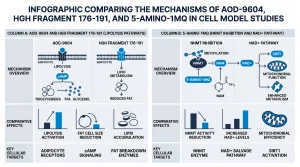
All three compounds act through distinct mechanisms. AOD-9604 and HGH Fragment 176-191 are peptides; 5-Amino-1MQ is a small molecule. Each targets a different enzyme or receptor in cell models. The following is a side-by-side research overview of their structures and cell-model findings.
Researchers studying GLP-1 receptor mechanisms may also find eloralintide relevant — it is a research-grade GIP/GLP-1 co-agonist analog available as a COA-verified, lyophilized research peptide.
Key Takeaways
- AOD-9604 Is a Modified hGH Fragment: AOD-9604 (anti-obesity drug 9604) is hGH amino acids 177-191 with a tyrosine added at position 1. In adipocyte cell assays, it has been studied for lipolytic (fat-cell lipid breakdown) effects. These effects occur without the growth-promoting activity of full hGH.
- HGH Fragment 176-191 Is the Native C-Terminal hGH Sequence: HGH Fragment 176-191 is amino acids 176-191 of hGH without change. In cell assays, it has been studied for lipid metabolism effects. It differs from AOD-9604 by the lack of the N-terminal tyrosine and starting one position earlier.
- 5-Amino-1MQ Inhibits NNMT: 5-Amino-1MQ is a small molecule inhibitor of NNMT (nicotinamide N-methyltransferase). NNMT is an enzyme that methylates nicotinamide. By blocking NNMT, 5-Amino-1MQ has been studied for its effects on NAD+ and SAM (S-adenosylmethionine) levels in cell assays.
- All Three Have Distinct Cell Targets: AOD-9604 and HGH Frag 176-191 act on β3-adrenergic and IGF-1R-independent pathways in adipocyte assays. 5-Amino-1MQ acts on NNMT in the methyl transfer pathway. The three compounds do not share a receptor.
- All Data Are From Cell and Animal Models: None of these compounds are FDA-approved. All findings cited are from cell assays or rodent model studies.
The metabolic peptide research space includes a range of compounds studied for adipocyte cell biology and lipid pathway effects. AOD-9604 and HGH Fragment 176-191 are closely related peptides. 5-Amino-1MQ represents a distinct small-molecule approach to metabolic cell research.
What Is AOD-9604 and How Was It Developed?
AOD-9604 stands for Anti-Obesity Drug 9604. It is based on the C-terminal region of human growth hormone (hGH). The native hGH sequence contains a lipolytic domain in its C-terminal region (roughly amino acids 176-191). AOD-9604 is a synthetic version of this region with a tyrosine added at the N-terminus and the sequence starting at residue 177.
In full hGH, the C-terminal region has been linked to lipolytic activity in fat cell assays. The growth-promoting activity of hGH comes from its N-terminal region and IGF-1R-mediated signaling. AOD-9604 retains the C-terminal lipolytic domain but lacks the N-terminal growth-promoting region. This makes it a selective research tool in fat cell studies.
According to NCBI (2004), AOD-9604 has been studied for its lipolytic effects in adipocyte cell assays and rodent fat cell models. The data showed lipid breakdown responses in treated adipocytes. These are cell assay and rodent model findings.
What Is HGH Fragment 176-191 in Research?
HGH Fragment 176-191 is the native C-terminal peptide of human growth hormone, spanning amino acids 176-191 (16 amino acids). It does not include the N-terminal tyrosine added in AOD-9604. HGH Frag 176-191 has a molecular weight of about 1,815 Da and shares the same lipolytic domain as AOD-9604 but starts one residue earlier.
In cell assays, HGH Frag 176-191 has been studied for its effects on adipocyte lipid metabolism. It does not bind the full hGH receptor and does not trigger IGF-1-mediated growth signals in cell models. Its cell effects are limited to the fat cell lipid pathway in vitro.
According to NCBI (2001), HGH Fragment 176-191 has been studied for adipocyte lipid effects in cell models. The data showed lipolytic responses in fat cell assays treated with the peptide. These are in-vitro findings.
How Do AOD-9604 and HGH Frag 176-191 Differ?
The two peptides are closely related but have key differences. HGH Frag 176-191 starts at amino acid 176. AOD-9604 starts at amino acid 177 with a tyrosine added at the N-terminus. The extra tyrosine in AOD-9604 is thought to improve its stability in plasma models. Both peptides lack the N-terminal growth-promoting domain of full hGH.
In cell assays, both peptides have been studied for β3-adrenergic receptor-independent lipolytic effects in adipocytes. The data from cell models suggest a direct lipase-activating pathway rather than a receptor-mediated signaling path. Neither peptide triggers IGF-1R in cell assays at study concentrations.
What Is 5-Amino-1MQ and How Does NNMT Work?
5-Amino-1MQ is the full name 5-amino-1-methylquinolinium. It is a small molecule inhibitor of NNMT (nicotinamide N-methyltransferase). NNMT is an enzyme that methylates nicotinamide to 1-methylnicotinamide using SAM (S-adenosylmethionine) as the methyl donor. High NNMT activity in adipose tissue is linked to changes in NAD+ and SAM levels in cell models.
By blocking NNMT, 5-Amino-1MQ raises intracellular NAD+ and SAM levels in cell assays. In adipocyte cell lines, this has been studied for its effects on lipid accumulation markers. These are in-vitro findings from adipocyte cell models.
According to doi.org (2021), 5-Amino-1MQ has been studied as an NNMT inhibitor in adipocyte cell models. The data showed changes in NAD+ and SAM levels and lipid metabolism markers in treated adipocytes. These are in-vitro findings.
| Feature | AOD-9604 | HGH Fragment 176-191 | 5-Amino-1MQ |
| Type | Peptide (17 AA) | Peptide (16 AA) | Small molecule |
| Origin | Modified hGH C-terminus | Native hGH C-terminus | Synthetic quinolinium compound |
| Target | β3-adrenergic/lipase pathway | β3-adrenergic/lipase pathway | NNMT enzyme |
| Cell model | Adipocyte assays | Adipocyte assays | Adipocyte and cancer cell lines |
| FDA-approved | No | No | No |
AOD-9604, HGH Fragment 176-191, and 5-Amino-1MQ are each available as COA-verified research peptides.
How Do All Three Compare in Cell Research?
In cell research, all three compounds are studied in adipocyte or metabolic cell models. AOD-9604 and HGH Frag 176-191 both target the same general lipolytic pathway but differ in sequence and stability. 5-Amino-1MQ targets a different pathway (NNMT/NAD+) and is a small molecule rather than a peptide.
Researchers studying adipocyte lipid metabolism may use all three in separate assays to examine different aspects of the cell’s lipid handling machinery. AOD-9604 and HGH Frag 176-191 can be compared for potency at the same cell target. 5-Amino-1MQ can be used to study a separate upstream pathway in the same cell system.
Frequently Asked Questions
What Is AOD-9604?
AOD-9604 is a synthetic peptide based on the C-terminal region of human growth hormone (hGH). It spans hGH amino acids 177-191 with a tyrosine added at the N-terminus. In cell and animal models, AOD-9604 has been studied for lipolytic effects in adipocyte assays without the growth-promoting activity of full hGH. AOD-9604 is not FDA-approved.
What Is HGH Fragment 176-191?
HGH Fragment 176-191 is the native C-terminal peptide of human growth hormone, spanning amino acids 176-191. It is a 16-amino-acid peptide with a molecular weight of about 1,815 Da. In cell assays, it has been studied for adipocyte lipid metabolism effects without triggering IGF-1R or hGH receptor signaling. It is not FDA-approved.
What Is 5-Amino-1MQ?
5-Amino-1MQ (5-amino-1-methylquinolinium) is a small molecule inhibitor of NNMT (nicotinamide N-methyltransferase). NNMT methylates nicotinamide using SAM as the methyl donor. By blocking NNMT, 5-Amino-1MQ raises NAD+ and SAM levels in adipocyte cell models. These are in-vitro findings. 5-Amino-1MQ is not FDA-approved.
How Is AOD-9604 Different from HGH Fragment 176-191?
AOD-9604 starts at amino acid 177 with a tyrosine at the N-terminus. HGH Frag 176-191 starts at amino acid 176 with no added tyrosine. Both peptides share the same C-terminal lipolytic domain of hGH. AOD-9604’s added tyrosine may improve its plasma stability in animal models.
What Is NNMT?
NNMT (nicotinamide N-methyltransferase) is an enzyme that transfers a methyl group from SAM to nicotinamide, producing 1-methylnicotinamide. This reaction lowers NAD+ and SAM levels in adipose tissue cell models. High NNMT activity in adipocytes is linked to changes in lipid and methyl pathway markers in cell research.
Do These Compounds Bind the Same Receptor?
No. AOD-9604 and HGH Frag 176-191 are believed to act on a β3-adrenergic-linked or lipase-direct pathway in adipocyte assays. They do not bind the full hGH receptor or IGF-1R at study concentrations. 5-Amino-1MQ acts as an enzyme inhibitor (NNMT), not a receptor agonist. All three have distinct cell targets.
How Is Purity Confirmed for These Compounds?
Each compound at Next Level Pharm is tested by HPLC and mass spec on every lot. HPLC confirms purity (≥99%). Mass spec confirms the molecular weight and sequence identity for each peptide. For 5-Amino-1MQ, mass spec confirms the small molecule identity and purity. Researchers should confirm the lot number on the COA before study use.
Are Any of These Compounds FDA-Approved?
No. AOD-9604, HGH Fragment 176-191, and 5-Amino-1MQ are all research compounds and are not FDA-approved. All data cited in this overview are from cell and animal model studies. None are approved for any clinical or therapeutic use.
What Cell Lines Are Used in AOD-9604 Research?
AOD-9604 has been studied in 3T3-L1 adipocytes (a standard mouse fat cell line), primary adipocytes isolated from rodent fat tissue, and human adipocyte cell lines. HGH Fragment 176-191 has been studied in similar adipocyte model systems. These are standard in-vitro models for fat cell research.
Summary
AOD-9604, HGH Fragment 176-191, and 5-Amino-1MQ are three metabolic research compounds with distinct structures and cell targets. AOD-9604 and HGH Frag 176-191 are closely related hGH C-terminal peptides studied for lipolytic effects in adipocyte cell models. 5-Amino-1MQ is an NNMT inhibitor studied for NAD+ pathway effects in cell assays.
All findings are from cell and animal research models. None are FDA-approved. For research purposes only.
What Should You Do Next?
Researchers sourcing AOD-9604, HGH Fragment 176-191, or 5-Amino-1MQ should confirm HPLC purity and mass spec identity on the COA for each compound before study use. Lot numbers should match the COA on file. Each compound has a distinct molecular weight and should be confirmed before use in cell or animal assays.
Shop research peptides at Next Level Pharm. COA-verified on every batch.
People Also Read
- AOD-9604 Research: What Studies Show About This HGH Fragment
- AICAR Research: AMPK Activation and Metabolic Studies
About the Author
Next Level Pharm Research Team
Alex M covers peer-reviewed findings in peptide science for Next Level Pharm, a US-based supplier of research-grade peptides verified to ≥99% purity via HPLC and mass spectrometry on every batch.
Disclaimer: The information provided on this page is for educational and research purposes only. Next Level Pharm products are intended for lab research use only. They are not intended for human consumption, diagnostic, therapeutic, or medicinal purposes. This content does not constitute medical advice. Always consult a licensed healthcare professional before making any health-related decisions.