
Melanotan 1 vs Melanotan 2: Research Compared

Last updated: July 2026
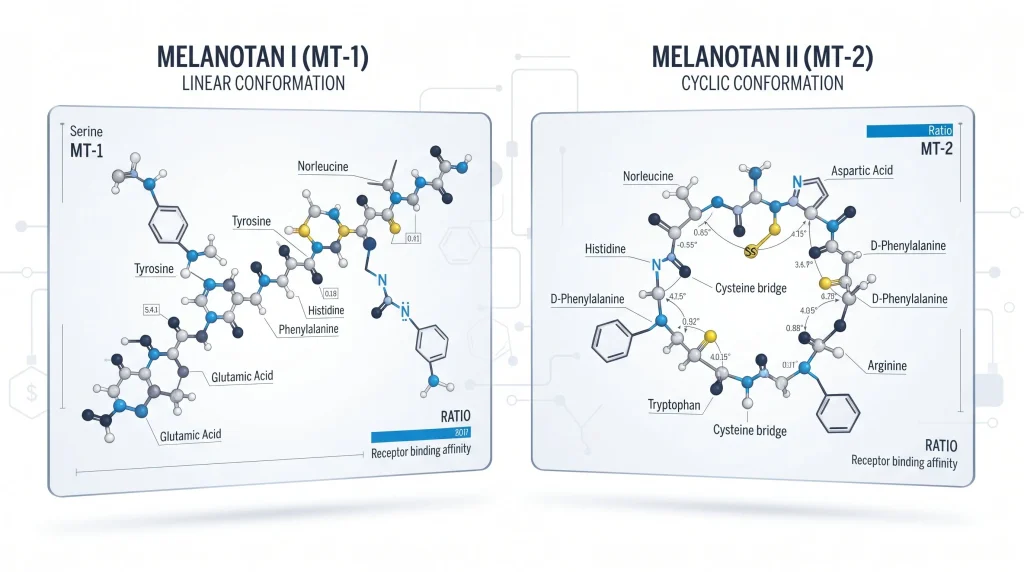
A melanotan 1 vs melanotan 2 comparison is a review of two lab-made analogs of alpha-melanocyte-stimulating hormone (alpha-MSH). Both peptides act as MC receptor agonists in lab tests. But their structures and binding profiles differ. Melanotan 1 is a linear 13-amino-acid chain with high MC1R targeting. Melanotan 2 is a shorter cyclic peptide that binds four receptor types. These shape gaps define each compound’s role in current peptide research.
Next Level Pharm gives both compounds for lab use. Each batch is HPLC and mass spec verified to ≥99% purity, with a COA on every order. Researchers can access lot-specific data for full tracking across all batches.
Scientists often compare these two analogs to assess how receptor binding profiles alter study outcomes. Melanotan 1 is a linear peptide; Melanotan 2 has a ring shape that broadens its binding with neural paths. These distinct chemical shapes guide researchers toward the right compound for their specific test design.
Key Takeaways
- Structural form: Melanotan 1 is a linear 13-amino-acid chain. Melanotan 2 is a cyclic 7-amino-acid peptide.
- Receptor targeting: Melanotan 1 targets MC1R only. Melanotan 2 binds MC1R, MC3R, MC4R, and MC5R.
- main research focus: Melanotan 1 is studied for light protection via MC1R trigger. Melanotan 2 is studied for pigment, appetite signal, and sexual function.
- strength vs. focus: Melanotan 2 shows higher strength at MC1R in some lab tests. Melanotan 1 offers narrower, more controlled receptor binding.
- Side-effect profile: Melanotan 2 produces a wider range of observed effects due to multi-site binding. Melanotan 1 produces fewer extra effects in lab tests.
The sections below examine receptor bindings, chemical structure. Study uses for both compounds. This information helps researchers match the right peptide to their study model and test design.
What Are Melanotan 1 and 2?
Melanotan 1 and Melanotan 2 are lab-made analogs of alpha-MSH (alpha-MSH). They were designed to study melanin output and light protection in lab tests. Both act as MC receptor agonists, but their binding profiles differ. This is because Of shape changes from the parent hormone.
Melanotan 1, also known as afamelanotide, is a linear peptide with 13 amino acids. It shows high targeting for the MC 1 receptor (MC1R), the main site for melanin production in skin cells. Melanotan 2 is a smaller cyclic heptapeptide. It binds MC3R, MC4R, and MC5R as well. This expanded binding profile gives Melanotan 2 a wider research scope. Melanotan 1 remains a precise tool for studies focused on the pigment path. Each compound ships in freeze-dried form for long-term shelf life.
How Do Their Chemical Structures Differ?
Melanotan 1 mirrors the linear sequence of natural alpha-MSH with 13 amino acids. This structure gives clear receptor targeting but limits cell life compared to cyclic analogs. According to PubMed (2006), shape changes between linear. Cyclic MC analogs directly influence receptor binding affinity and cell half-life in lab tests.
Melanotan 2 uses a ring shape with 7 amino acids. The ring shape resists enzyme breakdown more than linear peptides. This cyclization increases cell life and allows the compound to interact with a wider set of MC receptors. The smaller size also affects tissue spread in lab tests. Researchers select between these structures based on binding targets, shelf life needs. Spread needs of their test design.
Which Receptors Do They Target?
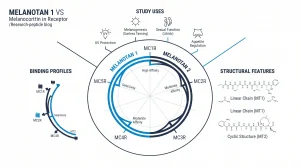
The binding profiles of these two peptides set their study uses. Melanotan 1 binds only to MC1R, the main receptor for melanin production in skin cells. This focused binding limits the compound’s body impact to the pigment path. It is well-suited for light protection studies where receptor focus is essential for clean data.
Melanotan 2 activates MC1R, MC3R, MC4R, and MC5R. This wider affinity extends its research scope into appetite control (MC4R). Sexual function (MC3R and MC4R). Scientists must note off-target trigger when designing tests with Melanotan 2. Each batch of both compounds is COA-verified, with purity confirmed by HPLC. Mass spec on every vial.
Shop research peptides at Next Level Pharm
How Do Melanotan 1 and 2 Compare?
The table below outlines key differences between these two peptides across the most common research factors. Structural and receptor data help researchers find which compound fits their study design.
| Feature | Melanotan 1 | Melanotan 2 |
| Structure | Linear, 13 amino acids | Cyclic, 7 amino acids |
| Receptor targeting | MC1R only | MC1R, MC3R, MC4R, MC5R |
| main study area | light protection, EPP studies | pigment, appetite, sexual function |
| Half-life | Shorter (linear shape) | Longer (cyclic, enzyme resistant) |
| Key distinction | High MC1R focus | wider multi-site binding |
These structural and receptor differences make each compound suited to distinct study models. Researchers should align compound choice with their specific binding target and assay precision needs.
What Side Effects Are Noted In Studies?
Lab tests for both peptides report facial flushing. Nausea as a common observed effect. These effects appear more often and with higher levels in Melanotan 2 studies. Additional findings in Melanotan 2 models include yawning, spontaneous erections, and appetite changes. These effects trace to MC3R and MC4R triggers in the central nervous system.
Melanotan 1 produces fewer extra effects in published research. Its MC1R targeting limits body-wide effects to the pigment path. According to PubMed (2002), the breadth of observed effects in MC peptide studies correlates directly with the number of receptor types bound by the compound. This makes Melanotan 1 a cleaner tool for studies that need isolated MC1R data without extra neural signals.
What are their main study uses?
Melanotan 1 is mainly studied for light protection. Research has examined its role in models of erythropoietic protoporphyria (EPP), a condition marked by extreme light sensitivity. According to the NIH (2020), this peptide increases melanin production at MC1R. This A cell buffer against UV damage in lab tests. Its receptor targeting makes it a precise tool for isolating pigment effects. It avoids extra neural triggers.
Melanotan 2 is studied across a wider range of study areas. Its wider receptor binding allows scientists to investigate appetite control, pigment. Sexual function in a single compound. This peptide led to the development of PT-141 (bremelanotide), a focused MC4R agonist studied for neural effects on sexual effect. Researchers can explore related compounds in the sexual health peptides overview.
Which Peptide Is More Strong in Lab Tests?
strength depends on the study goal. According to PubMed (2006), Melanotan 2 is up to 10 times more strong than Melanotan 1 at MC1R on a molar basis. Its ring shape enables stronger receptor binding than the linear form. This higher raw activity comes with wider receptor triggers across MC3R, MC4R. MC5R that researchers must control for in study design.
If the study goal is pure MC1R signal, Melanotan 1 offers greater precision. Its linear shape limits binding to a single receptor type, reducing extra results and simplifying data reading. Both compounds are available as batch-tested, COA-verified compounds. Researchers studying related pigment compounds can browse the beauty peptides category or read the beauty peptides research overview.
Frequently Asked Questions
What is the difference between Melanotan 1 and Melanotan 2?
Melanotan 1 is a linear 13-amino-acid peptide with high targeting for MC1R. Melanotan 2 is a cyclic 7-amino-acid peptide that binds MC1R, MC3R, MC4R, and MC5R. According to PubMed (2006), Melanotan 2 shows higher strength at MC1R. But Also triggers non-focused triggers across the MC receptor system. These shape gaps define their distinct study uses. Guide compound choice in lab studies.
Does Melanotan 1 show a narrower side-effect profile than Melanotan 2?
In research contexts, Melanotan 1 displays higher receptor focus. Limits extra signal effects. Melanotan 2 studies often observe a wider range of body effects due to multi-site binding at MC1R, MC3R, MC4R, and MC5R. Data from PubMed (2002) show that observed effect profiles correlate directly with receptor targeting. Narrower binding in Melanotan 1 often produces fewer off-target findings in lab tests.
Does Melanotan 2 affect MC receptors differently than Melanotan 1?
Melanotan 2 acts as a non-focused agonist across many MC receptors. Melanotan 1 displays a focused binding limited to MC1R. Published findings in PubMed (2006) show this lack of targeting shapes how Melanotan 2 is studied. It influences appetite, neural activity, and sexual function in animal tests. The two compounds are not the same in study designs that require focused triggers.
Why is Melanotan 1 studied for EPP?
Melanotan 1 is studied for EPP (EPP). This is because It triggers dark melanin production via MC1R. dark melanin gives cell protection against visible light and UV radiation. According to Langendonk et al. (2015), this approach has been examined to reduce the acute light sensitivity observed in subjects with genetic pigment disorders in lab tests. Its MC1R targeting makes Melanotan 1 a targeted tool for EPP-related light protection research.
What is the half-life of Melanotan 1 compared to Melanotan 2?
The ring shape of Melanotan 2 gives greater enzyme block than the linear shape of Melanotan 1. This shape gap results in a longer active window for Melanotan 2 in lab tests. Research published in Peptides (2010) notes that shape gaps directly affect how quickly each compound is cleared from the body. Researchers planning long-duration tests should account for these clearance differences when selecting a compound.
Can lab tests develop a tolerance to Melanotan peptides?
Research shows that prolonged use to MC agonists may reduce receptor sensitivity over time. Scientists tracking this effect note that cell downregulation of receptors can occur with repeated use plans. According to PubMed (2006), long-term data suggest this reduced effect may reduce the level of observed effects. Researchers should plan to use gaps well to maintain consistent study outcomes throughout the study period.
What is PT-141 and how does it relate to Melanotan 2?
PT-141, also known as bremelanotide, is a byproduct derived from Melanotan 2. It acts as a focused MC4R agonist without the strong pigment-making properties of its parent compound. PT-141 is studied mainly for its role in neural paths linked to sexual function. According to the NIH (2020), minor shape changes can shift a peptide’s receptor focus. As seen in the relationship between Melanotan 2 and PT-141.
What are observed effects of Melanotan 2 on appetite in animal tests?
Animal research shows that Melanotan 2 can influence central MC signals to reduce calorie intake. By binding MC4R receptors in the brain region, it affects paths linked to fullness and energy balance. According to PubMed (2005), MC trigger at MC4R has been a focal point for studies on cell signals in animal tests. This makes Melanotan 2 relevant to a broad range of appetite. Energy control study designs.
Are there structural similarities between alpha-MSH and these peptides?
Both Melanotan 1 and Melanotan 2 are lab-made analogs of alpha-MSH. They share the core amino chain of the natural hormone. But Include changes that increase cell life. According to PubMed (2006), these chemical adjustments allow the peptides to resist enzyme breakdown far more than native alpha-MSH. Has a very short half-life. This shelf life makes them more practical for controlled lab research.
What sets apart Melanotan 1 from other MC peptides?
Melanotan 1 is set apart by its high targeting for MC1R. Most MC peptides bind many receptor types. Complicates data reading in single-path studies. Melanotan 1’s linear shape and targeted binding profile make it a precise research tool for studies focused on the pigment path. Researchers who need isolated MC1R signals often select Melanotan 1 over wider-acting MC analogs.
Summary
Melanotan 1 and Melanotan 2 are both lab-made alpha-MSH analogs. But their shape gaps produce distinct drug profiles. Melanotan 1 is a linear peptide with high MC1R targeting. It is used to study light protection. Pigment effects with minimal off-target signal. Melanotan 2 is a cyclic peptide that binds four MC receptors.
Melanotan 2 shows higher strength at MC1R but. Also, Binds MC3R, MC4R, and MC5R. This multi-site activity broadens its research scope to include appetite control and sexual function studies. The two compounds are not the same in designs that require receptor-focused data.
Researchers should select between these compounds based on the binding targets. Precision needs of their specific test design. Both peptides are available as COA-verified, batch-tested research compounds.
What Should You Do Next?
Researchers should decide whether the model needs MC1R-focused signaling or broader melanocortin receptor activity. Compare the structural and receptor-binding profiles of Melanotan 1 and Melanotan 2. Verify molecular weight, HPLC purity, and lot identity on the COA before the study begins. Researchers sourcing these lab peptides can shop research peptides with full COA and lot traceability.
People Also Read
- Melanotan II Research: MC paths and Pigmentation Studies
- Melanotan I Research: MC1R and Pigment Cell Studies
About the Author
Next Level Pharm Research Team
Alex M covers peer-reviewed findings in peptide science for Next Level Pharm, a US-based supplier of research-grade peptides verified to ≥99% purity via HPLC and mass spectrometry on every batch.
Disclaimer: For research purposes only. Not intended for human consumption. Next Level Pharm products are not intended for diagnostic, therapeutic, or medicinal use. This content does not constitute medical advice. Always consult a licensed healthcare professional before making any health-related decisions.