
Muscle Bioregulator Research: Myostatin and Repair Pathway Studies

Last updated: July 2026
A muscle bioregulator is a short peptide studied for effects on muscle gene activity. These compounds act on pathways that control how much muscle protein a cell produces. Key research targets include myostatin inhibition and mechano-growth factor signaling. According to McPherron et al. (1997) (PMID 9055856), myostatin (GDF-8) was identified as a negative regulator of muscle mass in animal models. All cited data come from cell and animal studies.
Next Level Pharm is a US-based supplier of research-grade peptides. ACE-031, MOTS-c, and MGF are available as COA-verified research compounds. Each lot is verified to ≥99% purity by HPLC and mass spec. The average purity across the last 100 batches is 99.4%.
Muscle bioregulators differ from anabolic hormones. They act on gene regulatory pathways in muscle cells. They are studied in controlled cell and animal models. They are not approved for human use.
Key Takeaways
- Myostatin Limits Muscle Protein Production: Myostatin (GDF-8) is a protein that suppresses muscle growth in animal models. It signals through ActRIIB receptors on muscle cells.
- ACE-031 Blocks Myostatin and Related Proteins: ACE-031 is an ActRIIB-Fc fusion protein. It was studied in animal models to block myostatin and related pathway proteins.
- MOTS-c Is a Mitochondrial Peptide: MOTS-c is encoded in mitochondrial DNA. It is studied for effects on skeletal muscle metabolism in cell and animal models.
- MGF Is a Mechano-Growth Factor Variant: MGF (mechano-growth factor) is a splice variant of IGF-1. It is studied for responses to mechanical stress in muscle cell models.
- All Findings Come from Cell and Animal Models: Human clinical data have not been established for these compounds. They are for lab research use only.
Scientists use muscle bioregulators to study how peptides affect gene activity in muscle tissue. The results guide further research into muscle cell biology.
What Are Muscle Bioregulators?
A muscle bioregulator is a peptide that affects gene activity in muscle tissue. These compounds are studied in cell assays and animal models. They are not receptor-blocking drugs. They act on intracellular pathways that control muscle protein output.
Key targets include the myostatin signaling pathway, the IGF-1 splice variant pathway, and mitochondrial metabolic signals. Each target affects how much protein a muscle cell produces. Scientists measure gene expression markers to track these changes.
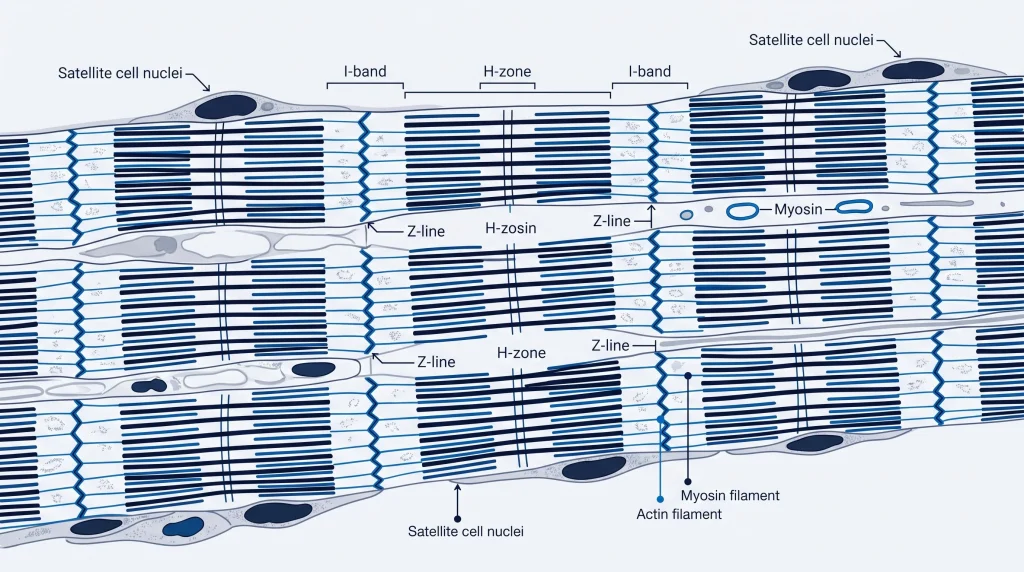
Muscle bioregulators may also act through satellite cells. Satellite cells are stem cells found in muscle tissue. They are activated after injury to repair muscle fibers. Research examines how short peptides affect satellite cell activity in cell models.
What Is Myostatin and How Is It Studied?
Myostatin is a protein made by muscle cells. It belongs to the TGF-beta (transforming growth factor beta) family. In animal models, myostatin acts as a brake on muscle growth. Muscle cells that produce more myostatin make less protein. Muscle cells with less myostatin produce more protein.
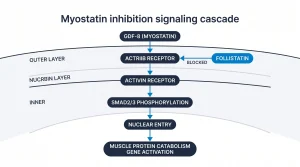
Myostatin binds to a receptor called ActRIIB. This receptor is found on muscle cell surfaces. Binding activates a signaling chain inside the cell. The chain includes proteins called Smad2 and Smad3. These proteins enter the nucleus and reduce muscle protein gene activity.
According to Lee et al. (2005) (PMID 15632087), blocking myostatin signaling in mouse models led to increased muscle mass. This was measured in treated vs. control animals. These are animal model findings only.
How Does ACE-031 Affect the Myostatin Pathway?
ACE-031 is a fusion protein used in research. It combines part of the ActRIIB receptor with a human antibody region (Fc). This design lets it bind myostatin and related proteins in solution. It blocks them from reaching the receptor on muscle cells.
In animal models, ACE-031 treatment was studied for effects on lean body mass. Researchers measured muscle fiber size and protein markers in treated animals. Control groups received no treatment. The difference in muscle markers was recorded.
ACE-031 also blocks other proteins in the TGF-beta family. These include GDF-11 and activin A. Blocking multiple proteins at once may amplify the effect on muscle tissue. All findings come from cell and animal models.
ACE-031 is available at Next Level Pharm as a COA-verified research compound. Every lot is tested by HPLC and mass spec. Each vial ships with a COA and lot number.
What Is MOTS-c and How Is It Studied?
MOTS-c is a peptide encoded in mitochondrial DNA. The term “MOTS” stands for mitochondrial open reading frame of the 12S rRNA-c. It is 16 amino acids long. It is found in skeletal muscle, the liver, and the bloodstream in animal models.
MOTS-c is studied for effects on glucose metabolism in muscle cells. In cell assays, it was shown to activate AMPK (adenosine monophosphate kinase), an energy-sensing enzyme. Activated AMPK changes how cells use glucose and fat for energy.
According to Kim et al. (2018) (PMID 29346381), MOTS-c treatment activated AMPK in skeletal muscle cells. Glucose uptake markers shifted in treated cells. These are in vitro findings only.
MOTS-c is available as a COA-verified research compound. Every lot is tested by HPLC and mass spec to ≥99% purity.
What Is MGF and How Does Mechanical Stress Affect It?
MGF stands for mechano-growth factor. It is a splice variant of IGF-1 (insulin-like growth factor 1). Muscle cells produce MGF in response to mechanical stress. This stress can come from stretching or exercise in animal models.
MGF acts on satellite cells in muscle tissue. Satellite cells are stem cells that repair muscle fibers. In cell models, MGF exposure activated satellite cell proliferation. More active satellite cells can increase repair capacity after mechanical damage.
Scientists study MGF by applying mechanical stress to cultured muscle cells. They then measure MGF mRNA and satellite cell markers. PEG-MGF (pegylated mechano-growth factor) is a modified version with a longer half-life in animal models.
How Do These Compounds Differ From GHRPs?
Standard growth peptides such as GHRPs bind to ghrelin receptors. This triggers growth hormone release from the pituitary. The GH then acts on multiple tissues, including muscle.
Muscle bioregulators act differently. They target specific pathways in muscle cells. ACE-031 blocks the myostatin receptor pathway. MOTS-c activates AMPK inside the cell. MGF signals through satellite cells. Each targets a specific step in muscle gene regulation.
| Feature | GHRP (e.g. GHRP-2) | Muscle Bioregulator (e.g. ACE-031) |
| Binding site | Ghrelin receptor (pituitary) | ActRIIB receptor / intracellular |
| Primary effect | GH release in animal models | Pathway-specific muscle cell change |
| Target tissue | Pituitary (primary), muscle (secondary) | Skeletal muscle (direct) |
| Amino acid length | 6 amino acids | Variable (MOTS-c: 16 aa; ACE-031: fusion protein) |
| Study metric | GH spike | Gene expression or lean mass marker |
| Purity standard | ≥99% HPLC + mass spec | ≥99% HPLC + mass spec |
Frequently Asked Questions
What Are Muscle Bioregulators?
Muscle bioregulators are peptides studied for effects on muscle gene activity in cell and animal models. They include myostatin pathway inhibitors, mechano-growth factors, and mitochondrial peptides. Each type targets a distinct step in muscle cell biology. They are studied in cell assays and animal models. They are not approved for human use. Key examples include ACE-031, MOTS-c, and MGF. These are for lab research use only.
What Is Myostatin?
Myostatin is a protein produced by muscle cells. It belongs to the TGF-beta family of signaling proteins. It suppresses muscle protein production in animal models. It binds to the ActRIIB receptor on muscle cell surfaces. This triggers a Smad2/3 signaling chain that reduces muscle gene activity. Animals with inactivated myostatin genes showed increased muscle mass in studies. All data come from cell and animal models.
How Is ACE-031 Studied in Research?
ACE-031 is an ActRIIB-Fc fusion protein. It binds to myostatin and related TGF-beta proteins in solution. This blocks them from reaching the ActRIIB receptor on muscle cells. In animal models, ACE-031 treatment was studied for effects on lean mass markers. Researchers measured muscle fiber size and protein content. All findings come from animal studies. Next Level Pharm supplies ACE-031 at ≥99% purity for lab research.
What Is MOTS-c?
MOTS-c is a 16-amino acid peptide encoded in mitochondrial DNA. MOTS stands for mitochondrial open reading frame of the 12S rRNA-c. It is found in skeletal muscle and the bloodstream in animal models. In cell assays, it activated AMPK, an energy-sensing enzyme. AMPK activation changed how cells processed glucose and fat. All data come from in vitro and animal models. For lab research use only.
What Is MGF?
MGF (mechano-growth factor) is a splice variant of IGF-1. Muscle cells produce it in response to mechanical stress in animal models. It acts on satellite cells, the stem cells that repair muscle fibers. In cell models, MGF exposure activated satellite cell proliferation. PEG-MGF is a pegylated form with extended half-life in animal models. All cited findings come from cell and animal research. For lab research use only.
How Does Myostatin Inhibition Work in Cell Models?
In cell models, myostatin inhibition is studied by blocking the ActRIIB receptor. ACE-031 binds myostatin before it reaches the receptor. Anti-myostatin antibodies also block binding. Once the receptor is blocked, the Smad2/3 signaling chain is not activated. Muscle protein genes remain more active. Researchers measure changes in myosin heavy chain and other muscle markers. All findings come from in vitro assays and animal studies.
What Is the Difference Between MGF and IGF-1?
IGF-1 is a growth factor that circulates in the blood. It acts on many tissues, including muscle, bone, and the liver. MGF is a splice variant. Muscle cells produce it locally in response to mechanical stress. MGF has a different C-terminal peptide sequence than standard IGF-1. This changes which receptors and pathways it activates in cell models. MGF is tissue-specific. IGF-1 is systemic. Both are studied in cell and animal models.
Are These Compounds Synthetic?
Yes. Modern research compounds are lab-synthesized. MOTS-c (16 amino acids) and ACE-031 (a fusion protein) are both produced by chemical or recombinant synthesis. Synthesis ensures exact sequences and consistent purity. It also removes the risk of contamination from biological sources. Research-grade compounds must meet ≥99% HPLC purity standards. Mass spec confirms molecular weight for each batch.
How Are These Compounds Verified for Research Use?
Research-grade compounds are tested by HPLC and mass spec per batch. HPLC confirms ≥99% purity for the target compound peak. Mass spec confirms molecular weight matches the expected sequence. A COA with lot number is provided per batch. Every batch is verified before shipping to researchers. All compounds are for lab research use only.
What Models Are Used to Study Muscle Repair Pathways?
Muscle repair research uses cell models and animal models. Common cell models include C2C12 myoblasts (mouse muscle cells) and primary satellite cells. These are cultured in dishes and treated with the test compound. Animal models include mouse and rat strains. Researchers measure muscle mass, fiber size, and gene expression markers. All cited findings in this article come from cell and animal model studies.
Summary
Muscle bioregulators are peptides studied for effects on muscle gene regulation. Key targets include the myostatin pathway (ACE-031), mitochondrial metabolic signals (MOTS-c), and mechano-growth factor signaling (MGF). Each compound acts on a distinct step in muscle cell biology.
Myostatin suppresses muscle protein production in animal models. ACE-031 blocks this pathway. MOTS-c activates AMPK in muscle cells. MGF acts on satellite cells after mechanical stress. All cited findings come from cell and animal model research.
What Should You Do Next?
Researchers studying muscle gene regulation should source verified compounds for lab protocols. Confirm HPLC purity is ≥99% and mass spec matches the expected molecular weight. Record the lot number from the COA for batch traceability.
Shop research peptides. ACE-031, MOTS-c, MGF, and PEG-MGF are available with HPLC and mass spec data on every COA.
People Also Read
- Cartalax Research: Bioregulator Peptide and Cartilage Studies
- ACE-031 Research: Myostatin Inhibitor and Muscle Studies
About the Author
Next Level Pharm Research Team
Alex M covers peer-reviewed findings in peptide science for Next Level Pharm, a US-based supplier of research-grade peptides verified to ≥99% purity via HPLC and mass spectrometry on every batch.
Disclaimer: The information provided on this page is for educational and research purposes only. Next Level Pharm products are intended for laboratory research use only. They are not intended for human consumption, diagnostic, therapeutic, or medicinal purposes. This content does not constitute medical advice. Always consult a licensed healthcare professional before making any health-related decisions.