
What Is the Melanocortin Receptor System?

Last updated: July 2026
A melanocortin receptor research model is a lab system used to study one of five G protein-coupled receptors, labeled MC1R through MC5R. They are labeled MC1R through MC5R, and each one binds peptide hormones from the POMC protein. The five types sit in different tissues. MC1R is in skin cells and MC2R is in the adrenal glands. MC3R and MC4R are in the brain, while MC5R is in exocrine glands. Together they control skin color, energy use, stress response, and gland output. Lab studies use this system to map how peptide hormones shape cell behavior.
Next Level Pharm stocks research-grade peptides for scientists working with the melanocortin system. Every batch reaches at least 99% purity by HPLC and mass spectrometry, and a certificate of analysis ships with every order.
Understanding these five receptor subtypes helps researchers pick the right compound. Each subtype has a unique location and a distinct ligand profile, which helps labs run cleaner experiments and get more precise data.
Key Takeaways
- Five Distinct Subtypes: The system has five receptor subtypes, MC1R through MC5R. Each sits in a different tissue and controls a different set of signals.
- Energy Control Hub: MC3R and MC4R sit in the hypothalamus of the brain. They receive signals that control food intake and energy use.
- Pigmentation Switch: MC1R sits on melanocytes in the skin. It controls whether cells make dark eumelanin or light pheomelanin.
- Adrenal Gland Link: MC2R is found in the adrenal cortex. It responds to ACTH and helps the gland make cortisol.
- Gland Secretion Role: MC5R is found in exocrine glands. It has been studied for its part in controlling gland output.
- Synthetic Research Tools: Scientists use agonist peptides to probe each receptor subtype. These tools help map how each one shapes biological responses in lab models.
The sections below go deeper on each receptor and its research applications. Each section focuses on one part of the system.
What Are Melanocortins and Where Do They Come From?
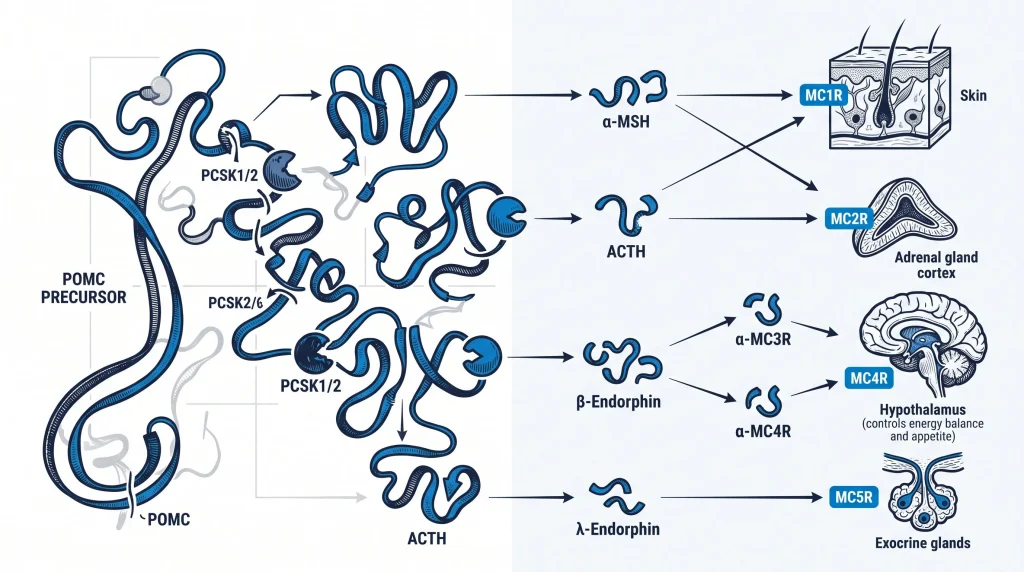
Melanocortins come from a precursor protein called pro-opiomelanocortin, or POMC. POMC is a large protein, and enzymes cut it into smaller peptides. The main one is alpha-melanocyte-stimulating hormone, known as alpha-MSH. Alpha-MSH is the natural agonist for most melanocortin receptors.
When alpha-MSH binds a receptor, it triggers a signaling cascade. The receptor activates adenylyl cyclase inside the cell. This raises cyclic AMP, or cAMP, levels. High cAMP changes gene output and cell behavior. This is the core pathway the system uses. According to Cone RD (2001), each of the five subtypes shares this G protein-coupled pathway but differs in tissue location and function.
Which Tissues Express These Five Receptors?
Each receptor has a distinct home in the body. This matters for study design. A brain study needs to focus on MC3R or MC4R. A skin study needs to focus on MC1R.
| Receptor | Primary Location | Key Ligand | Primary Research Area |
| MC1R | Skin melanocytes | Alpha-MSH | Pigmentation, inflammation |
| MC2R | Adrenal cortex | ACTH | Glucocorticoid output |
| MC3R | Hypothalamus | Alpha-MSH | Energy balance, nutrient use |
| MC4R | Hypothalamus | Alpha-MSH | Appetite, energy output |
| MC5R | Exocrine glands | Alpha-MSH | Gland secretion |
According to Wikberg JE et al. (2000), these five subtypes show very different expression patterns across tissues. This means agonists at MC1R will trigger a different response than agonists at MC4R. Researchers use this to design targeted lab studies.
How Does MC4R Control Energy Balance?
MC4R sits in the hypothalamus of the brain. It is a key node in the leptin-melanocortin pathway. When the body has enough energy, leptin levels rise. Leptin binds to neurons that release alpha-MSH. Alpha-MSH then binds MC4R and cuts food-seeking behavior.
Mutations in MC4R are the top known cause of single-gene obesity. They stop the brain from getting the signal to cut food intake. According to Huszar D et al. (1997), mice lacking MC4R become obese. This shows how central this receptor is to energy balance. Scientists study MC4R agonists and antagonists to map this pathway in lab models.
Shop research peptides at Next Level Pharm. The catalog includes COA-verified compounds for melanocortin system research, each tested by HPLC and mass spectrometry.
What Does MC1R Do in Skin Research?
MC1R sits on melanocytes, the cells that make pigment. It acts as a switch between two types of melanin. When MC1R is off, cells make pheomelanin, which is light in color. When MC1R is on, cells make eumelanin, which is dark.
Eumelanin absorbs UV radiation better than pheomelanin. So MC1R activity is linked to UV protection in skin cell models. Beyond pigment, MC1R also controls an anti-inflammatory pathway. When it is active, it blocks nuclear factor-kappa B, or NF-kB, from entering the cell nucleus. This cuts the release of pro-inflammatory cytokines. Researchers studying skin biology can browse beauty peptides for COA-verified Melanotan I. For more detail, see the review of Melanotan I and MC1R pigment cell studies.
Why Do Scientists Study Melanocortin Agonists?
Agonist peptides are tools for activating a specific receptor. They let researchers isolate one pathway at a time. This is useful because the five subtypes overlap in location. A non-selective agonist can hit several receptors at once. A selective agonist targets just one.
Melanotan II is a non-selective agonist. It binds MC1R, MC3R, MC4R, and MC5R. This broad profile makes it useful for wide-scope studies. PT-141, also called bremelanotide, has higher affinity for MC3R and MC4R. It is more useful for studies of central signaling in the brain. Researchers comparing the two can find both at Next Level Pharm. The skin peptides comparison page also covers overlapping research tools in this area.
What Are Melanocortin Antagonists Studied For?
An antagonist blocks a receptor. It stops the natural agonist from binding. In the melanocortin system, the body makes its own antagonist. It is called agouti-related protein, or AgRP. AgRP binds MC4R and blocks the signal that cuts food intake. This triggers hunger.
Scientists study synthetic MC4R antagonists to model states where food intake is too low. Cancer cachexia, a condition marked by severe tissue wasting, is one example. Lab models using MC4R antagonists help researchers study how to reverse this state. These are lab-only tools used in controlled studies.
Frequently Asked Questions
What is the melanocortin receptor system?
The melanocortin receptor system is a group of five G protein-coupled receptors. They are labeled MC1R through MC5R. Each one binds peptide hormones from the POMC protein. The receptors are found in the skin, brain, adrenal glands, and exocrine glands. Together they control pigmentation, energy balance, and gland output. Research on this system uses agonists and antagonists to probe how each receptor shapes biological responses in lab models.
How many subtypes are in the melanocortin system?
There are five subtypes in the melanocortin system, labeled MC1R through MC5R. Each sits in a different tissue. MC1R is in skin cells. MC2R is in the adrenal cortex. MC3R and MC4R are in the brain. MC5R is in exocrine glands. Each subtype has a distinct ligand profile and a distinct role in signaling. Lab studies target individual subtypes to isolate specific effects in research models.
What is the role of MC2R in the melanocortin system?
MC2R is unique among the five subtypes. It only responds to ACTH, not alpha-MSH. It also needs a helper protein called MRAP to reach the cell surface. MC2R sits in the adrenal cortex. When ACTH binds it, the receptor tells the adrenal gland to make cortisol and other glucocorticoids. This makes MC2R the key link between the pituitary and the adrenal stress response in research models.
What peptides act as natural ligands for melanocortin receptors?
The main natural ligands come from the POMC protein. Cleavage of POMC yields alpha-MSH, beta-MSH, gamma-MSH, and ACTH. Alpha-MSH binds MC1R, MC3R, MC4R, and MC5R. ACTH binds MC2R as its main ligand. The body also makes an endogenous antagonist called AgRP. AgRP blocks MC3R and MC4R. Researchers use these natural ligands as reference points when testing synthetic peptides in lab assays.
What does MC3R do in metabolic research?
MC3R sits in the hypothalamus. It helps control nutrient partitioning, which is how the body splits energy between storage and use. It also plays a part in anti-inflammatory signaling. When MC3R is active, it can cut pro-inflammatory cytokine output. Studies in animal models show that MC3R loss leads to changes in fat storage patterns. Researchers study this receptor to learn how the brain manages energy during caloric shifts.
Why is MC4R important in energy homeostasis research?
MC4R is the most studied receptor in this system for energy research. It sits in the hypothalamus and links leptin signaling to food intake control. When MC4R is active, the brain gets a signal to cut hunger. When it is blocked, hunger rises. Genetic studies show MC4R mutations are the top known cause of single-gene obesity. So scientists use MC4R agonists and antagonists to model energy balance in preclinical research.
What is the difference between Melanotan II and PT-141 in receptor binding?
Melanotan II is a non-selective agonist. It binds MC1R, MC3R, MC4R, and MC5R. This broad binding profile makes it useful for wide-scope studies of the melanocortin system. PT-141 has higher affinity for MC3R and MC4R. It engages fewer receptor subtypes. This makes it a more targeted research tool for studying brain pathways. Researchers pick between them based on whether they want broad or narrow receptor coverage in their assay.
How does MC1R control inflammation beyond pigmentation?
MC1R sits on skin cells. When alpha-MSH or a synthetic agonist binds it, cAMP rises inside the cell. High cAMP blocks the NF-kB pathway. NF-kB normally moves into the cell nucleus and turns on genes for pro-inflammatory cytokines. By blocking this move, MC1R activation cuts cytokine output. This makes MC1R a target for skin inflammation studies. Researchers use both natural and synthetic agonists to study this anti-inflammatory pathway in cell culture models.
What is AgRP and why is it studied in melanocortin research?
AgRP stands for agouti-related protein. It is an endogenous antagonist that blocks MC3R and MC4R. In the brain, AgRP neurons fire when energy is low. They release AgRP, which blocks MC4R and removes the satiety signal. This tells the body to seek food. Scientists study AgRP because it is the natural brake on the energy-suppressing arm of the melanocortin system. It helps map the full circuit of hunger and satiety in lab models.
What is the POMC gene and why does it matter in this system?
The POMC gene codes for pro-opiomelanocortin. Enzymes cleave this large protein into smaller peptides. These include alpha-MSH, ACTH, and beta-endorphin. Alpha-MSH is the main agonist for MC1R, MC3R, MC4R, and MC5R. ACTH is the main agonist for MC2R. Without POMC, the system lacks its natural ligands. This disrupts energy signaling, the stress response, and pigmentation control. POMC mutations are studied as a cause of metabolic changes in animal models.
Summary
The melanocortin receptor system includes five subtypes, MC1R through MC5R. Each sits in a specific tissue and controls a distinct set of signals. MC1R manages skin pigment and inflammation. MC2R links the pituitary to adrenal cortisol output. MC3R and MC4R control energy balance in the brain, while MC5R controls exocrine gland secretion.
All five receptors use the same core G protein-coupled pathway. They raise cAMP inside the cell when a ligand binds. Natural ligands come from the POMC protein. Synthetic agonists and antagonists let researchers isolate each receptor and study it in controlled lab models.
What Should You Do Next?
Researchers should begin with a clear question about the melanocortin receptor subtype under study. Select a compound and assay endpoint that isolates that receptor pathway. Confirm HPLC purity, mass spec identity, and the lot number on the COA before the first run. Researchers sourcing these lab peptides can shop research peptides with full COA and lot traceability.
People Also Read
- What Is PT-141? Melanocortin Receptor Research Explained
- Melanotan II Research: Melanocortin Pathways and Pigmentation Studies
About the Author
Next Level Pharm Research Team
Alex M covers peer-reviewed findings in peptide science for Next Level Pharm, a US-based supplier of research-grade peptides verified to ≥99% purity via HPLC and mass spectrometry on every batch.
Disclaimer: For research purposes only. Not intended for human consumption. Next Level Pharm products are not intended for diagnostic, therapeutic, or medicinal use. This content does not constitute medical advice. Always consult a licensed healthcare professional before making any health-related decisions.