
Thymosin Beta-4 vs TB-500: Comparison in Research

Last updated: July 2026
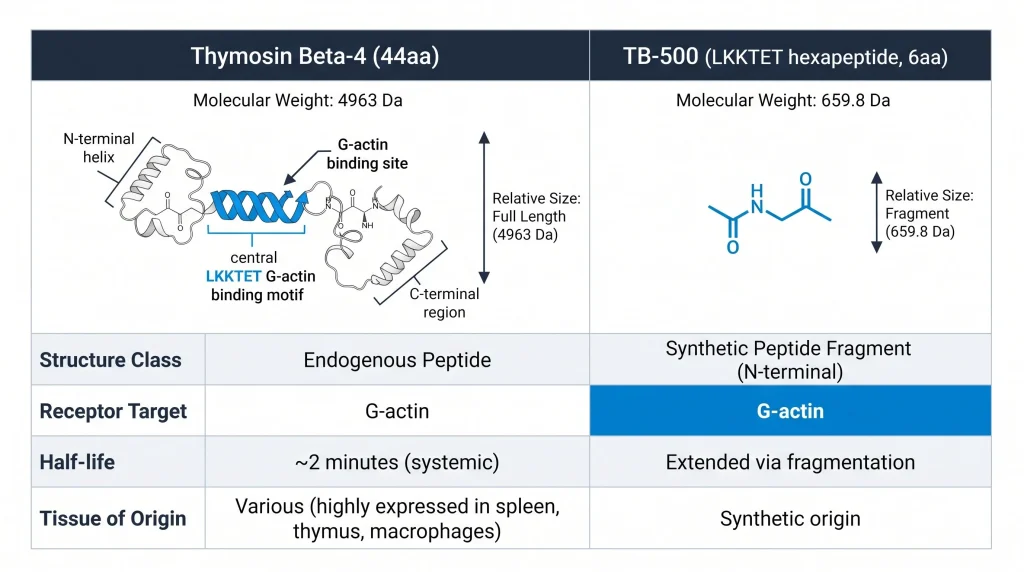
A thymosin beta-4 vs TB-500 comparison looks at a full protein vs a synthetic peptide fragment. Tb4 is a natural 43-amino acid protein. TB-500 is a synthetic research label applied to peptide fragments made from part of the Tb4 sequence. According to Goldstein AL et al. (2012) (PMID 22166892), thymosin beta-4 is a multi-functional peptide studied for cell migration and tissue-protective effects in cell and animal models. All cited data come from cell and animal studies.
Next Level Pharm is a US-based supplier of research-grade peptides. Both TB-500 and Frag 17-23 are available as COA-verified research compounds. Each lot is tested to ≥99% purity by HPLC and mass spec. The average purity across the last 100 batches is 99.4%.
These compounds are not approved drugs. They are studied only in cell and animal models. All findings cited here come from such models.
Key Takeaways
- Full Tb4 Is 43 Amino Acids: Thymosin beta-4 is a full protein. It includes the actin-binding region (residues 17-23) plus other regions. These extra regions may interact with ILK and other proteins.
- TB-500 Is a Synthetic Fragment Label: TB-500 refers to synthetic peptide fragments made from the Tb4 sequence. The most common form is the 17-23 fragment (LKKTETQ), 7 amino acids long.
- The Key Difference Is Molecular Completeness: Full Tb4 has a broader range of study outcomes. The synthetic fragment is limited to actin-binding region effects in research protocols.
- Actin Dynamics Are Studied with Both: Both full Tb4 and the 17-23 fragment are studied in scratch assays and actin polymerization assays in cell models.
- Neither Is Approved for Human Use: Both compounds are studied in cell and animal models only. They are not approved for clinical or personal use.
Researchers use both forms to study actin dynamics and cell migration in cell models. Comparing the two helps isolate which regions of Tb4 are responsible for specific study outcomes.
What Is Thymosin Beta-4 in Research?
Thymosin beta-4 (Tb4) is a 43-amino acid protein. Its molecular weight is about 4,921 daltons. It is found in thymus tissue, platelets, and wound fluid in animal models. Its main function in cells is to bind G-actin (globular actin) and hold it in a pool.
G-actin is the unassembled form of actin. Cells need to release G-actin to build F-actin filaments (the cell skeleton). Tb4 controls this pool. When cells need to move, they release G-actin from the Tb4 pool to form new filaments.
According to Safer D et al. (1991) (PMID 2002545), thymosin beta-4 sequesters G-actin at micromolar concentrations in cell models. The WH2 domain at residues 17 to 23 is the primary actin-binding site. These are in vitro findings only.
What Is TB-500 in Research?
TB-500 is a research label applied to synthetic peptide fragments derived from the thymosin beta-4 sequence. The most common form is the 17-23 fragment (Leu-Lys-Lys-Thr-Glu-Thr-Gln, or LKKTETQ). Some protocols use a slightly extended form.
TB-500 is not a single defined compound. Researchers specify which fragment they are using. The 17-23 fragment contains only the actin-binding (WH2) domain of the full protein. It does not include the N-terminal or C-terminal regions of full Tb4.
TB-500 is available at Next Level Pharm as a COA-verified research compound. Every lot is tested by HPLC and mass spec. Each vial ships with a COA and lot number.
How Do Full Tb4 and TB-500 Differ?
Full Tb4 (43 amino acids) has three functional regions. The N-terminal region is studied for interactions with specific proteins in cell models. The actin-binding WH2 domain (residues 17-23) controls G-actin sequestration. The C-terminal region may play additional roles in protein binding.
The 17-23 fragment (TB-500 common form) contains only the WH2 domain. It shows actin-binding effects in cell models. But it lacks the N-terminal and C-terminal regions of full Tb4.
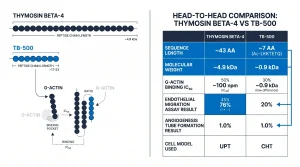
| Feature | Full Thymosin Beta-4 | TB-500 (17-23 Fragment) |
| Length | 43 amino acids | 7 amino acids |
| MW | ~4,921 daltons | ~835 daltons |
| Actin-binding region | Yes (residues 17-23) | Yes (entire sequence) |
| ILK interaction | Studied (via other regions) | Not confirmed alone |
| Research scope | Broader multi-pathway | Actin-binding specific |
| Study models | Cell and animal models | Cell and animal models |
| Purity standard | ≥99% HPLC + mass spec | ≥99% HPLC + mass spec |
How Is Full Tb4 Studied in Models?
In cell models, full Tb4 is studied for its effects on G-actin to F-actin ratio. Scientists add Tb4 to cell cultures and then measure actin filament assembly. A lower ratio of G-actin means more F-actin has formed in the cell.
In animal models, Tb4 is studied for effects on cell migration and tissue gene markers after injury. Scientists administer the compound and measure gene marker changes in target tissue at set time points.
According to Bock-Marquette I et al. (2004) (PMID 15181200), Tb4 activated ILK (integrin-linked kinase) and changed cell survival gene markers in cardiac cell and animal models. ILK is an enzyme that links cell surface integrins to the actin skeleton. These are cell and animal model findings only.
What Research Uses Only the Fragment?
The 17-23 fragment (LKKTETQ) is used in research when scientists want to study the actin-binding function alone. This isolates the WH2 domain effect from other Tb4 regions. Scratch assays are the most common method.
A scratch assay makes a gap in a cell monolayer. The rate at which cells close the gap is measured. TB-500 (the 17-23 fragment) is added to one group. The control group gets vehicle only. Cell migration rates are compared.
Actin polymerization assays also use the 17-23 fragment. These measure the shift from G-actin to F-actin after the fragment is added to cell cultures. Both assays give data on the specific actin-binding role of the 17-23 region.
Frag 17-23 is available as a COA-verified research compound. Every lot is tested to ≥99% purity. Each vial ships with a COA and lot number.
Shop research peptides. TB-500 and Frag 17-23 are available with HPLC and mass spec data on every COA.
How Do Their Outcomes Compare?
Full Tb4 produces broader study outcomes because it has more functional regions. Studies track ILK activation, actin dynamics, and gene expression markers in injury models. The 17-23 fragment produces more targeted outcomes focused on actin sequestration and cell migration speed.
The two are sometimes studied together. Comparing outcomes from full Tb4 vs the 17-23 fragment in the same cell assay is informative. It helps researchers identify which regions of the protein drive specific gene marker changes.
Neither form is used in clinical settings. Both are for lab research use only. All data come from cell and animal models.
Frequently Asked Questions
What Is the Main Difference Between Tb4 and TB-500?
Full thymosin beta-4 (Tb4) is a 43-amino acid protein with multiple functional regions. TB-500 is a research label for synthetic fragments from the Tb4 sequence, most commonly the 17-23 fragment (LKKTETQ). The 17-23 fragment contains only the actin-binding WH2 domain. Full Tb4 also has regions that interact with ILK and other proteins. The fragment produces more targeted study outcomes. Full Tb4 produces broader outcomes in research models. Both are for lab research use only.
What Is the WH2 Domain?
The WH2 (Wiskott-Aldrich Syndrome protein Homology 2) domain is an actin-binding motif. It is found in many proteins that interact with G-actin. In thymosin beta-4, the WH2 domain is located at residues 17 to 23 (LKKTETQ). This domain binds G-actin and sequesters it in a cellular pool. Cells use this pool when they need to move or change shape. The WH2 domain is conserved across many actin-regulatory proteins. It is the main actin-binding site in the Tb4 sequence.
What Is G-Actin?
G-actin (globular actin) is the single-molecule, unassembled form of actin. Actin exists in two forms in cells. G-actin is the unassembled pool. F-actin (filamentous actin) is the assembled form that makes up the cell skeleton. Thymosin beta-4 binds G-actin and holds it in a cellular pool. When cells need to move, they release G-actin to build new F-actin filaments. The ratio of G-actin to F-actin is measured in actin polymerization assays.
What Is ILK and Why Is It Studied?
ILK (integrin-linked kinase) is an enzyme inside cells. It links cell surface integrins (adhesion proteins) to the actin skeleton. When ILK is active, it changes how cells stick to surfaces and how they move. Full thymosin beta-4 has regions that interact with ILK in cell models. The 17-23 fragment does not appear to activate ILK on its own. ILK activation is tracked by protein phosphorylation assays. These are in vitro findings only.
What Is a Scratch Assay?
A scratch assay (also called a wound closure assay) measures cell migration in a culture dish. A straight scratch is made in a monolayer of cells. The gap is photographed at set time points. Cells that migrate faster close the gap sooner. TB-500 (the 17-23 fragment) is added to treated cells. Control cells get vehicle only. Migration speed is compared between groups. All data come from in vitro models. These are not clinical findings.
How Is TB-500 Labeled in Research?
In published research, the term TB-500 may refer to the full 17-23 fragment (LKKTETQ) or a slightly extended sequence. Researchers define the exact fragment used in their methods section. The term does not refer to a standardized single compound with a fixed sequence. When sourcing TB-500 for research, scientists confirm the amino acid sequence and lot purity from the COA. Mass spec data confirm the molecular weight matches the expected fragment sequence.
Are Full Tb4 and the Fragment Interchangeable?
No. Full Tb4 and the 17-23 fragment are not interchangeable in research protocols. Full Tb4 has multiple functional regions that may produce broader effects in cell models. The 17-23 fragment is limited to the actin-binding region. Researchers choose one or the other based on which mechanism they want to isolate. Comparing both in the same protocol is the most rigorous approach for attribution. Neither is approved for human use.
What Purity Standards Apply to These Compounds?
Research-grade Tb4 fragments are tested by HPLC and mass spec per batch. HPLC confirms ≥99% purity for the target compound peak. Mass spec confirms the molecular weight matches the expected amino acid sequence (LKKTETQ or the full 43-aa Tb4 sequence). A COA with lot number is provided per batch. The COA includes a chromatogram showing peak area data. Both compounds must meet ≥99% purity to be classed as research-grade.
What Animal Models Are Used?
Rodent models are most common in thymosin beta-4 and TB-500 research. Scientists administer the compound and measure gene and protein markers in target tissue. Cardiac injury models track ILK activity and cell survival markers. Skin injury models track collagen gene expression and cell migration markers. Control groups receive vehicle only. Results from treated vs. control groups are compared by statistical analysis. All are animal model findings.
Are These Compounds Verified for Research Use?
Research-grade TB-500 and Frag 17-23 are tested by HPLC and mass spec per batch. HPLC confirms ≥99% purity. Mass spec confirms molecular weight matches the expected sequence. A COA with lot number is provided per batch. All compounds are for lab research use only and are not for clinical or personal use of any kind.
Summary
Thymosin beta-4 (Tb4) is a full 43-amino acid protein. TB-500 is a research label for synthetic fragments from the Tb4 sequence. The most common fragment is the 17-23 actin-binding region (LKKTETQ).
Full Tb4 has broader study outcomes because it includes ILK-interacting regions beyond the WH2 domain. The 17-23 fragment gives targeted data on actin sequestration and cell migration speed. All cited findings come from cell and animal models. Neither compound is approved for human use.
What Should You Do Next?
Researchers studying actin dynamics and cell migration should source verified compounds for lab protocols. Confirm HPLC purity is ≥99% and that mass spec data match the target sequence. Record the lot number for batch traceability.
Shop research peptides. TB-500 and Frag 17-23 are available with HPLC and mass spec data on every COA.
People Also Read
- TB-500 Mechanism of Action: Actin Binding and Tissue Research
- TB-500 Fragment 17-23 Research: LKKTET Actin-Binding Studies
About the Author
Next Level Pharm Research Team
Alex M covers peer-reviewed findings in peptide science for Next Level Pharm, a US-based supplier of research-grade peptides verified to ≥99% purity via HPLC and mass spectrometry on every batch.
Disclaimer: The information provided on this page is for educational and research purposes only. Next Level Pharm products are intended for laboratory research use only. They are not intended for human consumption, diagnostic, therapeutic, or medicinal purposes. This content does not constitute medical advice. Always consult a licensed healthcare professional before making any health-related decisions.