
TB-500 Fragment 17-23 Research: LKKTET Actin-Binding Studies

Last updated: June 2026
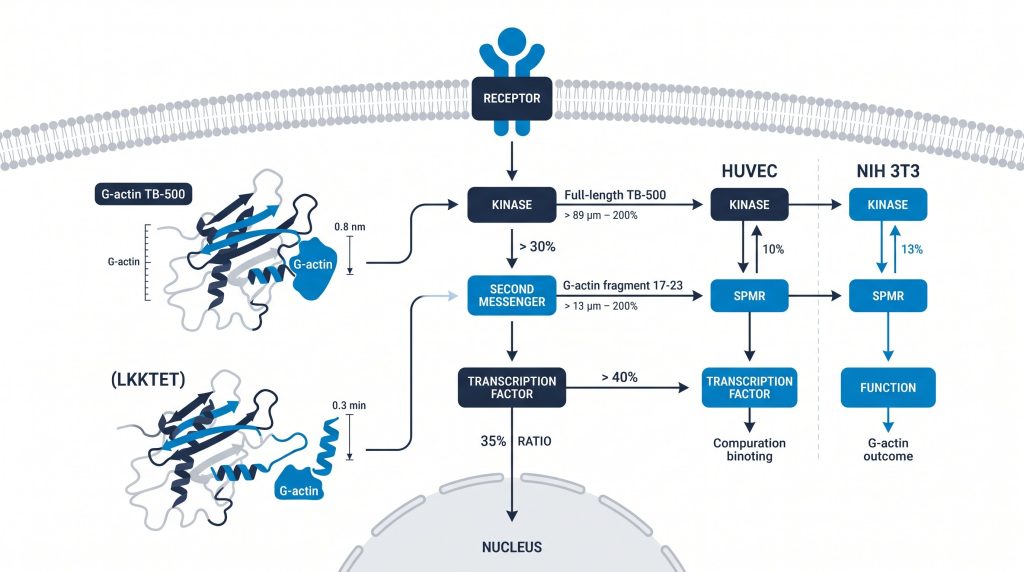
A TB-500 fragment 17-23 research compound is a six-amino-acid peptide with the sequence LKKTET (Leu-Lys-Lys-Thr-Glu-Thr). It represents the core G-actin binding domain of full-length thymosin beta-4 (TB-500), a 44-amino-acid protein. Researchers study Fragment 17-23 in cell models to understand how this domain drives G-actin binding, reduces F-actin chain growth, and affects cell migration. It is distinct from HGH Fragment 176-191. Is derived from growth hormone.
Next Level Pharm is a US-based supplier of research-grade Fragment 17-23, verified to ≥99.4% purity by HPLC. Mass spectrometry on every batch. Each lot ships with a COA and a lot number for full traceability.
Key Takeaways
- LKKTET is the actin-binding core of thymosin beta-4. Fragment 17-23 is the hexapeptide LKKTET. It carries the G-actin binding activity of the full 44-amino-acid TB-500 protein in a compact six-residue sequence.
- G-actin binding reduces F-actin chain growth. By binding monomeric G-actin, LKKTET reduces the pool available for filamentous F-actin chain growth. The G/F-actin ratio is measured by DNase I blocking assay.
- Cell models include HUVECs, NIH 3T3. HMEC-1 cells: These three cell lines allow researchers to study actin dynamics, pFAK Y397 phosphorylation. Scratch wound migration in endothelial and fibroblast contexts.
- COA-verified lots: Next Level Pharm ships lyophilized Fragment 17-23 lots with HPLC. Mass spec data on every batch. Each lot has a traceable number.
- Research use only: All Fragment 17-23 in this catalog is for lab research use only. No clinical outcomes are claimed.
What Is TB-500 Fragment 17-23 and How Is It Named?
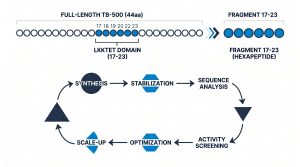
Fragment 17-23 is the hexapeptide LKKTET, spanning residues 17-23 of the full-length thymosin beta-4 protein. According to Huff et al. (2004), the LKKTET sequence is the minimal actin-sequestering domain of thymosin beta-4. Full-length thymosin beta-4 (also called TB-500 in research supply catalogs) is a 44-amino-acid intracellular protein. Its primary function is to sequester monomeric G-actin (globular actin).
The numbering 17-23 refers to residues 17 through 23 of the full-length sequence. The six-residue peptide LKKTET retains the core G-actin binding activity. Researchers use this fragment to isolate the actin-binding mechanism from the other functional domains of the full protein.
Fragment 17-23 (LKKTET) is not related to HGH Fragment 176-191. HGH Fragment 176-191 is a 15-amino-acid peptide derived from human growth hormone, spanning residues 176-191 of the GH sequence. The names sound similar but they come from entirely different parent proteins. Have unrelated research applications.
| Peptide | Parent Protein | Length | Sequence | Primary Research Use |
| TB-500 (full) | Thymosin beta-4 | 44aa | Full sequence | Actin dynamics, broad |
| Fragment 17-23 | Thymosin beta-4 | 6aa | LKKTET | G-actin binding studies |
| HGH Frag 176-191 | Growth hormone | 15aa | Residues 176-191 | GH receptor studies |
How Does LKKTET Bind G-Actin in Cell Model Studies?
LKKTET binds monomeric G-actin and reduces its availability for F-actin filament chain growth in cell assays. According to Goldstein et al. (2012), the thymosin beta-4 fragment retains measurable G-actin binding activity in chemical assays. G-actin (globular actin) is the monomeric form of actin. F-actin (filamentous actin) is the polymerized form that makes up the cell-scaffold network. The ratio of G-actin to F-actin controls cell shape, motility, and adhesion.
LKKTET sequesters G-actin by occupying the thymosin/WH2 binding site on the actin monomer. This reduces the free G-actin pool available to polymerize into F-actin filaments. The DNase I blocking assay is the standard method to measure the G/F-actin ratio. DNase I activity is inhibited by G-actin but not by F-actin. Lower DNase I blocking signals a lower G-actin pool.
Profilin is another G-actin binding protein. Unlike LKKTET, profilin promotes barbed-end F-actin chain growth. Researchers compare LKKTET and profilin effects in the same cell system to map opposing control roles. WASP (Wiskott-Aldrich syndrome protein) interacts with actin at branched filament nucleation sites. LKKTET studies examine whether LKKTET alters WASP-dependent actin branching in NIH 3T3 fibroblast models.
What Cell Models Are Used in Fragment 17-23 Studies?
HUVECs, NIH 3T3 fibroblasts. HMEC-1 endothelial cells are the three main Fragment 17-23 cell models. According to Smart et al. (2007), thymosin beta-4 domain studies use endothelial. Fibroblast cell lines that are rich in dynamic actin cytoskeleton activity. HUVECs (human umbilical vein endothelial cells) are a primary endothelial cell model. They are used in scratch wound migration assays to track actin-dependent cell movement.
NIH 3T3 cells are a mouse embryonic fibroblast line. They are one of the most studied fibroblast models for actin cytoskeleton research. Their flat morphology makes them ideal for fluorescence imaging of F-actin structures (stress fibers, lamellipodia, filopodia).
HMEC-1 cells are a human microvascular endothelial cell line. They offer a more physiological endothelial model than HUVECs in some contexts. Researchers run parallel experiments in HUVECs. HMEC-1 cells to check whether Fragment 17-23 effects are consistent across endothelial subtypes.
Each cell model requires a different seeding density and pre-treatment protocol. NIH 3T3 cells are typically serum-starved before LKKTET treatment to synchronize actin dynamics at baseline.
What Assays Measure Actin Dynamics in LKKTET Studies?
DNase I blocking, scratch wound migration. PFAK Y397 western blot are the core Fragment 17-23 assay endpoints. The DNase I blocking assay quantifies the G/F-actin ratio. Cells are lysed and the lysate is added to DNase I. Free G-actin in the lysate inhibits DNase I activity. Higher G-actin means more blocking. A colorimetric or assay substrate reports DNase I activity level. The G-to-F ratio is then calculated from the blocking curve.
The scratch wound (wound healing) assay measures cell migration. A pipette tip creates a linear gap in a confluent cell monolayer. Images are taken at 0, 12, and 24 hours. Gap closure rate is calculated by image analysis software. Actin chain growth is required for lamellipodia-driven gap closure. LKKTET-treated cells show altered closure rates compared to vehicle controls.
pFAK Y397 (focal adhesion kinase phosphorylated at tyrosine 397) is measured by western blot. FAK (focal adhesion kinase) links integrin-matrix contacts to actin cytoskeleton signaling. Its phosphorylation at Y397 is an index of focal adhesion activity. LKKTET alters F-actin assembly and can change pFAK Y397 levels in treated cells.
How Does Fragment 17-23 Compare to Full TB-500?
Fragment 17-23 isolates the G-actin binding domain; full-length TB-500 carries additional functional regions beyond actin binding. Full-length thymosin beta-4 (44aa) carries several distinct regions beyond the LKKTET core. These include an N-terminal acetylated serine, a central helix domain. A C-terminal region that interacts with additional actin-binding partners. Studies using Fragment 17-23 (6aa) isolate the actin-binding function alone.
Using the fragment instead of the full protein reduces off-target effects in mechanistic studies. It also simplifies synthesis and allows higher purity verification by HPLC. Researchers who need to attribute effects to the LKKTET domain specifically use Fragment 17-23 as the primary experimental compound.
An actin-binding control peptide (a scrambled LKKTET sequence) is used as a negative control in well-designed studies. The scrambled peptide has the same amino acid composition but lacks the ordered sequence required for G-actin binding. This controls for non-specific charge or hydrophobicity effects.
Browse recovery research peptides for Fragment 17-23 lots with COA documentation and mass spec data.
What Research Tools Support Fragment 17-23 Research?
COA-verified Fragment 17-23 lots and actin assay kits are the core tools for LKKTET G-actin binding cell research.
Research teams need a verified Fragment 17-23 lot to run any study. The lot must match the published reference standard for molecular weight and purity. Next Level Pharm verifies each Fragment 17-23 lot by HPLC and mass spectrometry before shipping. Standard kits include the G-actin/F-actin In Vivo Assay Kit (Cytoskeleton Inc.), a scratch wound migration imaging system. A pFAK Y397 western blot antibody. A scrambled LKKTET control peptide should be ordered alongside Fragment 17-23 for every mechanistic study. View the Fragment 17-23 product page for lot-specific COA and mass spec data.
Frequently Asked Questions
What is TB-500 Fragment 17-23 in research?
TB-500 Fragment 17-23 is the hexapeptide LKKTET, spanning residues 17-23 of the full-length thymosin beta-4 protein (44 amino acids). It is studied as the core G-actin binding domain of thymosin beta-4. Researchers use it in HUVEC, NIH 3T3 fibroblast. HMEC-1 endothelial cell models to study actin dynamics and cell migration. It is for lab research use only. Each vial ships lyophilized. Purity is ≥99% by HPLC.
Is Fragment 17-23 the same as HGH Fragment 176-191?
No. These are completely different peptides from unrelated parent proteins. Fragment 17-23 (LKKTET) is a six-amino-acid sequence from thymosin beta-4, a 44-amino-acid actin-binding protein. HGH Fragment 176-191 is a 15-amino-acid sequence from human growth hormone. The similar numbering in their names causes confusion. But their structures, parent proteins. Research applications are entirely distinct. Check the sequence on the COA. Mass spec confirms each lot.
What does G-actin binding mean in cell biology?
G-actin (globular actin) is the monomeric form of actin. F-actin (filamentous actin) is the polymerized form that forms the cytoskeleton. Binding means binding and holding G-actin monomers away from the filament chain growth machinery. LKKTET sequesters G-actin by occupying the thymosin/WH2 binding site on the monomer, reducing the pool available for new F-actin filament formation. G-actin monomers form the pool. F-actin fibers form from this pool.
How is the G/F-actin ratio measured in Fragment 17-23 studies?
The G/F-actin ratio is measured by the DNase I blocking assay. Cells are lysed and the lysate is added to DNase I. G-actin inhibits DNase I activity; F-actin does not. A colorimetric or assay substrate reports DNase I activity. Higher blocking means more G-actin. Researchers use this ratio to quantify how LKKTET treatment shifts the actin equilibrium toward the monomeric form. Spin at 100,000 g for 60 min. Each pellet is the F-actin fraction.
What is the scratch wound assay used for in LKKTET research?
The scratch wound (wound healing) assay measures cell migration. A pipette tip creates a linear gap in a confluent monolayer. Images are captured at 0, 12, and 24 hours. Gap closure rate is quantified by image analysis software. Actin chain growth is required for lamellipodia-driven gap closure. Fragment 17-23 studies use this assay in HUVECs. HMEC-1 endothelial cells to examine how LKKTET alters migration rate. Image at 0 and 24 hours. Measure gap closure as a percent.
What is pFAK Y397 and why is it measured in actin studies?
FAK (focal adhesion kinase) is a non-receptor tyrosine kinase that links integrin-matrix contacts to actin cytoskeleton signaling. Phosphorylation at tyrosine 397 (pFAK Y397) is its primary autophosphorylation site. Marks active focal adhesion signaling. In Fragment 17-23 studies, pFAK Y397 western blot is used to assess whether LKKTET-driven actin changes alter focal adhesion activity in treated cells. pFAK Y397 is a focal adhesion mark. Western blot detects it at 125 kDa.
What negative control is used in Fragment 17-23 experiments?
A scrambled LKKTET sequence is the standard negative control for Fragment 17-23 research. The scrambled peptide has the same six amino acids as LKKTET but in a randomized order. It lacks the structural arrangement required for G-actin binding. Including this control separates specific actin-binding effects from non-specific charge or hydrophobicity effects that any peptide at that level might produce. Use vehicle-only wells as controls. Match the solvent in each well.
Is Fragment 17-23 approved for human therapeutic use?
No. Fragment 17-23 (LKKTET) is a research-use-only compound. Published data is limited to in vitro cell models and chemical assays. It is not approved by the FDA for any clinical or therapeutic application. Lots supplied for lab research are not for clinical use. Researchers should consult applicable institutional biosafety guidelines before handling any peptide research compound. This compound is for in vitro lab use only. Institutional biosafety guidelines apply.
Summary
TB-500 Fragment 17-23 (LKKTET) is the core G-actin binding domain of full-length thymosin beta-4. It is studied in HUVECs, NIH 3T3 fibroblasts. HMEC-1 endothelial cells using the DNase I blocking assay, scratch wound migration. PFAK Y397 western blot. It is not related to HGH Fragment 176-191. Each lot ships with a COA. Purity is ≥99% by HPLC.
Using Fragment 17-23 instead of full-length TB-500 isolates the G-actin binding mechanism from other protein domains. A scrambled LKKTET control peptide is used in well-designed studies to confirm specificity. WASP and profilin interaction data provide context on how LKKTET fits within the broader actin control network.
Fragment 17-23 is available as a COA-verified, lyophilized research lot with HPLC. Mass spec confirmation on every batch. This is a research-grade compound for lab research use only.
What Should You Do Next?
- Review the Fragment 17-23 product page for COA and mass spec data before ordering.
- Select your cell model (HUVECs for endothelial studies, NIH 3T3 for fibroblast studies) based on your research question.
- Include a scrambled LKKTET negative control peptide in every experiment to confirm G-actin binding specificity.
- Run DNase I blocking assay and scratch wound assay as paired endpoints to capture both actin pool shift and migration effects.
- Browse recovery research peptides for related research tools.
- Shop research peptides at https://nextlevelpharm.com/shop/.
- Verify lot numbers match the COA before each assay.
- Store lyophilized vials at -20°C until use.
- Use fresh assay buffer for each run.
People Also Read
- TB-500 Research: Thymosin Beta-4 and Actin Cell Studies
- BPC-157 Research: Gastric Pentadecapeptide Cell Studies
About the Author
Next Level Pharm Research Team
Alex M covers peer-reviewed findings in peptide science for Next Level Pharm, a US-based supplier of research-grade peptides verified to ≥99% purity via HPLC and mass spectrometry on every batch.
Disclaimer: The information provided on this page is for educational and research purposes only. Next Level Pharm products are intended for laboratory research use only. They are not intended for human consumption, diagnostic, therapeutic, or medicinal purposes. This content does not constitute medical advice. Always consult a licensed healthcare professional before making any health-related decisions.