
CJC-1295, Sermorelin, and Tesamorelin: GHRH Research

Last updated: June 2026
CJC-1295, Sermorelin, and Tesamorelin are three GHRH analogs studied for GH (growth hormone) release in cell and animal models. Each has a distinct structure, half-life, and receptor binding profile. The following is a review of cell and animal model data on these three GHRH analogs, including receptor binding, half-life, and downstream GH release markers.
Next Level Pharm supplies research-grade CJC-1295, Sermorelin, and Tesamorelin as COA-verified lyophilized peptides. Each lot is verified by HPLC and mass spec to ≥99% purity before dispatch. The average purity across the last 100 batches is 99.4%.
GHRH (growth hormone-releasing hormone) is a 44-amino-acid peptide made in the hypothalamus. It binds the GHRH receptor (GHRHR) on pituitary somatotroph cells to trigger GH release. Analogs of GHRH have been developed in research to improve stability and extend half-life. CJC-1295, Sermorelin, and Tesamorelin are three such analogs with distinct structural modifications and research profiles.
Key Takeaways
- Sermorelin Is the Shortest Analog: Sermorelin is a 29-amino-acid fragment of GHRH. It covers the active binding domain. In cell assays, sermorelin binds GHRHR and raises cAMP. Its plasma half-life in animal models is 10-20 minutes without modification.
- CJC-1295 No DAC Uses a Short Linker: CJC-1295 without DAC (No DAC) is a 29-amino-acid GHRH analog with a GE3 linker at the C-terminus. In cell assays, it binds GHRHR with similar affinity to sermorelin. Its half-life in rodent models is approximately 30 minutes.
- CJC-1295 with DAC Has Extended Half-Life: CJC-1295 with DAC (Drug Affinity Complex) adds a maleimidyl-propionic acid group that binds covalently to serum albumin. In animal studies, this extends half-life to several days. It is used in research to model sustained GHRH receptor stimulation.
- Tesamorelin Is the Longest Analog: Tesamorelin is a 44-amino-acid GHRH analog with a trans-3-hexenoic acid group at the N-terminus. This group protects the N-terminal His residue from DPP-4 cleavage. In animal studies, its half-life is approximately 25-30 minutes.
- All Three Bind GHRHR: CJC-1295, Sermorelin, and Tesamorelin all bind the GHRHR (GHRH receptor) on pituitary cells. In cell assays, binding triggers Gs protein coupling and cAMP elevation. These are in-vitro findings.
- GH Release Is the Key Downstream Marker: In animal studies, all three analogs have been linked to GH pulse release from the pituitary. GH levels are measured in blood at set time points after dosing. These are animal model data only.
GHRH analogs are widely used in research to study pituitary function, GH axis signaling, and half-life extension techniques. Each of the three analogs here has a distinct structural approach to improving stability over native GHRH.
What Is Sermorelin and How Is It Structured?
Sermorelin is the 29-amino-acid N-terminal fragment of native GHRH (GHRH 1-29 NH2). Native GHRH has 44 amino acids. Residues 1-29 are the minimum sequence needed for full GHRHR binding and activation in cell assays. Residues 30-44 add structural support but are not required for binding.
In cell assays, sermorelin binds GHRHR with an EC50 in the low nanomolar range. GHRHR is a Gs-coupled GPCR (G protein-coupled receptor). Binding raises intracellular cAMP via Gs protein coupling. cAMP then activates PKA (protein kinase A), which drives GH synthesis and secretion markers in somatotroph cell lines.
In rodent studies, sermorelin showed a plasma half-life of approximately 10-20 minutes. DPP-4 (dipeptidyl peptidase-4) and other endopeptidases cleave the peptide rapidly. This short half-life has led researchers to compare sermorelin to CJC-1295 and Tesamorelin, which have structural modifications that extend stability.
What Makes CJC-1295 No DAC Different From Sermorelin?
CJC-1295 No DAC is a 29-amino-acid GHRH analog based on the GHRH 1-29 sequence. It has four amino acid substitutions at positions 2, 8, 15, and 27 compared to sermorelin. These changes increase resistance to enzymatic cleavage by DPP-4 and other peptidases.
The C-terminus of CJC-1295 No DAC has a GE3 linker (Gly-Glu-Ala-Gly). This linker reduces steric hindrance at the C-terminus and may improve receptor contact geometry. In binding assays, CJC-1295 No DAC has similar GHRHR affinity to sermorelin. Its plasma half-life in rodent models is approximately 30 minutes, roughly 1.5-2x that of sermorelin.
According to NCBI (2006), CJC-1295 with and without DAC were studied in animal models for half-life and GH release. CJC-1295 No DAC showed a shorter half-life than the DAC version but longer than native GHRH. GH pulse patterns were recorded over 24 hours in rodents. These are animal model data only.
CJC-1295, Sermorelin, and Tesamorelin are each available as COA-verified research peptides.
How Does CJC-1295 with DAC Extend Half-Life?
CJC-1295 with DAC (Drug Affinity Complex) adds a maleimidyl-propionic acid (MPA) group to the C-terminal GE3 linker of CJC-1295 No DAC. The MPA group reacts with the Cys34 residue on serum albumin to form a covalent thioether bond. This links the peptide to albumin in the bloodstream.
Albumin has a half-life of approximately 19 days in humans and similar rates in rodents. By binding to albumin, the CJC-1295 DAC complex is shielded from renal clearance and enzymatic cleavage. The complex acts as a depot, slowly releasing the active peptide over time.
In animal studies, CJC-1295 with DAC showed a half-life of 6-8 days. GH levels were elevated for up to 14 days after a single injection in rodent models. These findings are from animal studies only and are not clinical data.
What Is Tesamorelin and How Is It Modified?
Tesamorelin is a full-length 44-amino-acid GHRH analog. It includes the full native GHRH sequence. At the N-terminus, a trans-3-hexenoic acid group is attached. This short lipophilic chain protects the His1 residue at the N-terminus from cleavage by DPP-4.
DPP-4 cleaves after the second residue of peptides with a Pro or Ala at position 2. GHRH has Ala at position 2. The trans-3-hexenoic acid cap at position 1 sterically blocks DPP-4 access. This extends the plasma half-life to approximately 25-30 minutes in rodent models, compared to 7-10 minutes for native GHRH.
In GHRHR binding assays, Tesamorelin shows high affinity comparable to native GHRH. The full 44-amino-acid sequence and the intact C-terminal region may contribute to this binding efficiency. Cell assay data show cAMP elevation in GHRHR-expressing cells after Tesamorelin treatment.
According to NCBI (2010), Tesamorelin has been studied for GHRHR binding and GH release in cell and animal models. Data showed GHRHR binding with low nanomolar EC50 and downstream cAMP elevation in pituitary cell lines. These are in-vitro and animal model data.
How Do These Three Analogs Compare in Cell Assays?
In GHRHR cell binding assays, all three analogs bind the receptor and raise cAMP. The key differences are in binding kinetics and resistance to enzymatic cleavage. CJC-1295 No DAC and Tesamorelin both show higher enzymatic stability than sermorelin due to their structural modifications.
CJC-1295 with DAC adds albumin binding on top of enzymatic stability. In cell assay conditions (in vitro, no albumin), CJC-1295 with DAC behaves similarly to CJC-1295 No DAC for GHRHR binding. The albumin binding only extends half-life in vivo when albumin is present.
According to NCBI (2011), a comparative study of GHRH analogs in pituitary cell lines showed that all analogs raised cAMP in a concentration-dependent manner. Sermorelin, CJC-1295, and Tesamorelin all had EC50 values in the low nanomolar range in these assays. These are cell assay data.
| Analog | Length | Key Modification | Half-Life (Rodent) | Albumin Binding |
| Sermorelin | 29 AA | None (native GHRH 1-29) | 10-20 min | No |
| CJC-1295 No DAC | 29 AA | 4 AA substitutions + GE3 linker | ~30 min | No |
| CJC-1295 with DAC | 29 AA | + MPA-albumin covalent bond | 6-8 days | Yes |
| Tesamorelin | 44 AA | Trans-3-hexenoic acid at N-term | 25-30 min | No |
Frequently Asked Questions
What Is a GHRH Analog?
A GHRH analog is a synthetic peptide based on the sequence of native GHRH (growth hormone-releasing hormone). Analogs are designed with structural changes to improve stability, extend half-life, or alter binding properties. CJC-1295, Sermorelin, and Tesamorelin are all GHRH analogs studied in cell and animal models for GH release and GHRHR binding.
What Is GHRHR?
GHRHR (growth hormone-releasing hormone receptor) is a Gs-coupled GPCR expressed on pituitary somatotroph cells. When a GHRH analog binds GHRHR, the receptor couples to Gs protein and raises intracellular cAMP. cAMP activates PKA, which drives GH synthesis and release markers in cell assays. This pathway is the main research target for GHRH analog studies.
How Does Sermorelin Differ From Native GHRH?
Sermorelin is the 29-amino-acid N-terminal fragment of native GHRH (44 amino acids). The 1-29 fragment retains full GHRHR binding activity. Residues 30-44 are not required for binding. Sermorelin has the same amino acid sequence as GHRH 1-29, so it does not have enhanced enzymatic stability. Its half-life in rodent models is approximately 10-20 minutes.
What Are the Four Amino Acid Changes in CJC-1295?
CJC-1295 has four amino acid substitutions compared to native GHRH 1-29. These are at positions 2, 8, 15, and 27. Each change was selected to reduce cleavage by DPP-4 or other endopeptidases. These substitutions are the main reason CJC-1295 No DAC has a longer half-life than sermorelin in rodent models.
What Does DAC Mean in CJC-1295 with DAC?
DAC stands for Drug Affinity Complex. It refers to the maleimidyl-propionic acid (MPA) group added to the C-terminal GE3 linker of CJC-1295. MPA reacts with Cys34 on serum albumin to form a covalent thioether bond. This binds the peptide to albumin in the bloodstream. The albumin binding extends the plasma half-life to 6-8 days in animal models.
Why Does Tesamorelin Use a Trans-3-Hexenoic Acid Cap?
Trans-3-hexenoic acid is a short lipophilic chain attached to the N-terminus of Tesamorelin. DPP-4 cleaves GHRH at the His1-Ala2 bond. The cap at position 1 blocks DPP-4 access to this bond. This is the primary mechanism for extending Tesamorelin’s plasma half-life to 25-30 minutes in rodent models compared to 7-10 minutes for native GHRH.
How Are These Peptides Used in Animal Studies?
In animal studies, CJC-1295, Sermorelin, and Tesamorelin are given by subcutaneous or intraperitoneal injection to rodents. GH levels are measured in blood at set time points by ELISA (enzyme-linked immunosorbent assay) or RIA (radioimmunoassay). Data are collected for GH pulse height, frequency, and area under the curve. These are animal study protocols for research use only.
What Is the Role of Albumin in CJC-1295 DAC Research?
Albumin is the main carrier protein in blood. Its long half-life (about 19 days) protects bound molecules from renal clearance and enzymatic cleavage. CJC-1295 DAC binds to albumin covalently via the MPA group. This allows the peptide to act as a slow-release depot in vivo. Researchers use CJC-1295 DAC to model sustained GHRHR stimulation in animal studies.
Do These Peptides Have Different Purity Requirements?
For research use, all three analogs should meet the same purity standard: ≥99% HPLC purity, confirmed by mass spec identity. A COA with lot number should be available for each batch. Next Level Pharm supplies CJC-1295 (No DAC and with DAC), Sermorelin, and Tesamorelin at ≥99% purity with a COA on every order.
Summary
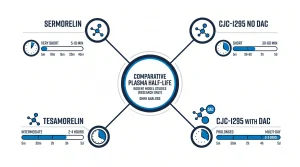
CJC-1295, Sermorelin, and Tesamorelin are GHRH analogs that all bind GHRHR and trigger cAMP elevation in pituitary cell assays. The key difference is half-life: Sermorelin (~10-20 min), CJC-1295 No DAC (~30 min), Tesamorelin (~25-30 min), and CJC-1295 with DAC (6-8 days via albumin binding). Each analog uses a distinct structural approach to extend stability over native GHRH.
All data cited are from cell and animal studies. For research purposes only.
What Should You Do Next?
Researchers studying GHRH analogs should review the COA for each peptide before use. Confirm HPLC purity (≥99%), mass spec identity, and lot number. Review the primary literature for the specific analog and model system before designing experiments.
Shop research peptides. COA-verified on every batch.
People Also Read
- CJC-1295 and Ipamorelin: GHRH Secretagogue Research
- CJC-1295 With DAC: Drug Affinity Complex GH Research
About the Author
Next Level Pharm Research Team
Alex M covers peer-reviewed findings in peptide science for Next Level Pharm, a US-based supplier of research-grade peptides verified to ≥99% purity via HPLC and mass spectrometry on every batch.
Disclaimer: The information provided on this page is for educational and research purposes only. Next Level Pharm products are intended for laboratory research use only. They are not intended for human consumption, diagnostic, therapeutic, or medicinal purposes. This content does not constitute medical advice. Always consult a licensed healthcare professional before making any health-related decisions.