
CJC-1295 and Ipamorelin: GHRH Secretagogue Research

Last updated: June 2026
CJC-1295 and ipamorelin are two distinct GH secretagogues used together in combination research. CJC-1295 is a modified GHRH (growth hormone releasing hormone) analog. Ipamorelin is a selective ghrelin receptor (GHS-R1a) agonist. Each acts through a different receptor and a different cell signaling pathway. Together, animal studies have found they produce additive effects on GH secretion. The following is a review of lab findings.
Next Level Pharm is a US supplier of research-grade peptides. CJC-1295 and ipamorelin are available as separate compounds and as a pre-mixed blend. All products are COA-verified by HPLC and mass spec on every batch. The average purity across the last 100 batches is 99.4%.
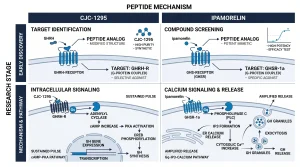
GHRH analogs and GHRP agonists target different steps in GH release. GHRH stimulates GH gene output via the GHRHR. Ghrelin receptor agonists like ipamorelin trigger GH release from stored granules via a calcium signal. Using both together is studied for the combined effect on GH pulse biology. This is the basis of the CJC-1295 and ipamorelin co-administration model used in most rodent studies.
Key Takeaways
- CJC-1295 and Ipamorelin Target Different Receptors: CJC-1295 binds the GHRH receptor (GHRHR). Ipamorelin binds the ghrelin receptor (GHS-R1a). They do not compete with each other.
- Ipamorelin Is Selective for GH Release: Ipamorelin does not stimulate prolactin or cortisol at research doses in animal models, unlike some other GHRP peptides. This selectivity is a key property studied in research.
- Combined, They Show Additive GH Effects in Animals: Animal studies found that CJC-1295 plus ipamorelin produces more GH output than either alone. The effect is additive due to the two distinct pathways.
- CJC-1295 Raises GH Pulse Amplitude; Ipamorelin Raises Frequency: GHRH analogs raise GH pulse amplitude, while GHRP agonists raise GH pulse frequency. Combined, both dimensions of GH pulsatility are studied.
- All Findings Are From Lab Models: These are cell culture and animal model findings. Neither compound is FDA-approved for any use.
The combination of GHRH analogs and ghrelin receptor agonists has been studied since the 1990s. CJC-1295 and ipamorelin are among the most selective pair studied in lab GH research.
How Does CJC-1295 Work in Research?
CJC-1295 is a 29-amino-acid GHRH analog. It binds the GHRH receptor (GHRHR) on pituitary somatotrophs. Binding activates the Gs protein, raises cAMP, and activates PKA. PKA activates the transcription factor CREB, which drives GH gene expression. The GH made in response is stored in secretory granules.
CJC-1295 (without DAC) has a plasma half-life of about 30 minutes. It was designed with four amino acid changes from native GHRH(1-29) to improve stability against plasma proteases. These changes extend the half-life without changing receptor binding specificity.
According to NCBI (2006), CJC-1295 has been studied as a GHRH receptor agonist in pituitary cell models. The data showed cAMP elevation and increased GH gene output versus controls. These are cell model findings.
How Does Ipamorelin Work in Research?
Ipamorelin is a 5-amino-acid peptide. It was designed as a selective ghrelin receptor (GHS-R1a) agonist. GHS-R1a is expressed on pituitary somatotrophs and in the hypothalamus. When ipamorelin binds GHS-R1a, it activates phospholipase C via Gq protein. This raises IP3 (inositol triphosphate) and DAG (diacylglycerol). IP3 triggers calcium release from cell stores. The calcium rise triggers GH granule release.
Ipamorelin is selective. It does not stimulate prolactin, cortisol, or ACTH at doses that produce GH release in animal models. This sets it apart from earlier GHRP peptides like GHRP-2 and GHRP-6, which stimulate cortisol at higher doses.
According to NCBI (1998), ipamorelin has been studied for GH selectivity in animal models. The data found no increase in prolactin or cortisol at GH-releasing doses. These are animal model findings only.
What Does Combination Research Show?
CJC-1295 and ipamorelin act through different receptors and different pathways. CJC-1295 raises GH gene output via cAMP-PKA-CREB. Ipamorelin releases stored GH via a calcium signal. These two steps can occur together without interference.
In animal studies, the combination has been studied for additive GH effects. The combined GH pulse area under the curve (AUC) was greater than either compound alone in rodent models. These are animal model findings and have not been confirmed in clinical studies.
Some rodent studies also tracked IGF-1 levels as a time-averaged read-out of GH axis activity. IGF-1 is made in the liver in response to GH. In these studies, IGF-1 levels were higher in the combination group than in single-compound groups over the same study period. All such data are from animal models only.
| Feature | CJC-1295 | Ipamorelin |
| Length | 29 amino acids | 5 amino acids |
| Receptor | GHRHR | GHS-R1a (ghrelin receptor) |
| Signaling | Gs-cAMP-PKA-CREB | Gq-IP3-calcium |
| Primary effect | GH gene synthesis | GH granule release |
| GH selectivity | High | Very high (no prolactin/cortisol effect) |
| Plasma half-life | ~30 min | Short (minutes in animal models) |
How Does Ipamorelin Compare to GHRP-2 and GHRP-6?
GHRP-2 and GHRP-6 are earlier ghrelin receptor agonists. Both stimulate GH release but also raise prolactin and cortisol at higher doses in animal models. This side-hormone effect makes them less selective research tools.
Ipamorelin was designed to be more selective. Research data show it does not raise prolactin or ACTH at GH-active doses. This makes it the preferred GHRP in combination research where GH selectivity is key. CJC-1295 and Ipamorelin are each available as COA-verified research peptides.
According to doi.org (1998), ipamorelin produced selective GH release in animal models without the prolactin or ACTH side effects seen with GHRP-2. The study compared receptor binding and GH selectivity profiles. These are animal model findings.
Shop research peptides. COA-verified compounds on every batch.
What Are the Dosing Models in Combination Studies?
In animal studies, CJC-1295 and ipamorelin are often studied as separate compounds given at the same time or as a pre-mixed blend. The timing of each administration is studied because GHRH analogs prime GH synthesis while GHRP agonists trigger release. Researchers administer both at the same time to capture the combined effect on GH output.
In rodent studies, GH levels are tracked by serial blood sampling. GH peak, trough, and pulse area are the main metrics. IGF-1 is also measured as a time-averaged proxy for GH axis activity. Both CJC-1295 and ipamorelin show concentration-based effects in these animal models. These findings are from rodent research only.
Frequently Asked Questions
What Is CJC-1295 and Ipamorelin?
CJC-1295 is a 29-amino-acid GHRH analog that binds the GHRH receptor and raises GH gene output via cAMP-PKA signaling. Ipamorelin is a 5-amino-acid ghrelin receptor agonist that triggers GH granule release via calcium. Together, they are studied for additive GH secretion effects in animal models.
What Is the Ghrelin Receptor (GHS-R1a)?
GHS-R1a (growth hormone secretagogue receptor 1a) is the ghrelin receptor. It is expressed on pituitary somatotrophs and in the hypothalamus. Ipamorelin is a synthetic GHS-R1a agonist. When it binds GHS-R1a, it raises IP3 and calcium, which triggers GH granule release. It is distinct from the GHRH receptor (GHRHR).
Why Is Ipamorelin Considered Selective?
Ipamorelin does not stimulate prolactin, cortisol, or ACTH at doses that release GH in animal models. This is different from GHRP-2 and GHRP-6, which raise prolactin and cortisol at higher doses. Ipamorelin’s selectivity makes it a preferred research tool when GH-specific effects are needed without side-hormone stimulation.
How Do CJC-1295 and Ipamorelin Combine?
CJC-1295 drives GH gene synthesis via the GHRHR-cAMP-CREB pathway. Ipamorelin drives GH granule release via the GHS-R1a-IP3-calcium pathway. These are two separate steps in GH secretion. When both are active at the same time, GH synthesis and GH release are both stimulated. This is the basis of the additive effect seen in animal studies.
What Is the GHRH Receptor?
The GHRH receptor (GHRHR) is a G-protein-coupled receptor on pituitary somatotrophs. It binds GHRH and GHRH analogs like CJC-1295. Binding activates Gs protein, raises cAMP, and activates PKA. PKA activates CREB, which turns on GH gene transcription. This is the main cell pathway studied in GHRH analog research.
How Is CJC-1295 Purity Confirmed?
Each batch of CJC-1295 at Next Level Pharm is tested by HPLC and mass spec. HPLC confirms purity as a percentage of peak area. Mass spec confirms the 29-amino-acid sequence. A COA is issued for every lot. Researchers should verify the lot number against the COA before any study use.
How Is Ipamorelin Purity Confirmed?
Each batch of ipamorelin is tested by HPLC and mass spec. HPLC confirms purity. Mass spec confirms the 5-amino-acid sequence and molecular weight. A COA is issued for every lot. Researchers should verify lot-specific data before any study use.
Is the CJC-1295 and Ipamorelin Blend FDA-Approved?
No. Neither CJC-1295 nor ipamorelin is FDA-approved for any use. They are research compounds studied in cell and animal models. All data in this overview are from lab research settings.
What Is GHRP in Peptide Research?
GHRP (growth hormone releasing peptide) is a class of synthetic peptides that bind the ghrelin receptor (GHS-R1a) and stimulate GH release. Ipamorelin is one member of this class. Others include GHRP-2 and GHRP-6. GHRPs differ from GHRH analogs, which bind the GHRHR, a different receptor. Both classes increase GH output through distinct pathways.
Summary
CJC-1295 and ipamorelin are distinct GH secretagogues that act through separate receptors. CJC-1295 raises GH gene output via GHRHR-cAMP-PKA-CREB. Ipamorelin triggers GH granule release via GHS-R1a-IP3-calcium. Together, they show additive GH effects in animal models. Ipamorelin is selective for GH and does not raise prolactin or cortisol in research models.
All findings cited here are from cell and animal research models. They are not clinical outcomes and have not been confirmed in human clinical trials. For research purposes only.
What Should You Do Next?
Researchers sourcing CJC-1295 and ipamorelin should verify HPLC purity and mass spec identity from the COA for each compound before any study use. Both the 29-amino-acid sequence of CJC-1295 and the 5-amino-acid sequence of ipamorelin should be confirmed on the COA by molecular weight. Lot numbers should match the COA on file.
Shop research peptides. Every compound is COA-verified on every batch.
People Also Read
- CJC-1295 Research: How This GHRH Analog Works in Lab Models
- GH Secretagogues: CJC-1295, Ipamorelin, and Sermorelin Research
About the Author
Next Level Pharm Research Team
Alex M covers peer-reviewed findings in peptide science for Next Level Pharm, a US-based supplier of research-grade peptides verified to ≥99% purity via HPLC and mass spectrometry on every batch.
Disclaimer: The information provided on this page is for educational and research purposes only. Next Level Pharm products are intended for lab research use only. They are not intended for human consumption, diagnostic, therapeutic, or medicinal purposes. This content does not constitute medical advice. Always consult a licensed healthcare professional before making any health-related decisions.