
Sleep Peptide Research: DSIP, Epithalon, Selank Studies

Last updated: June 2026
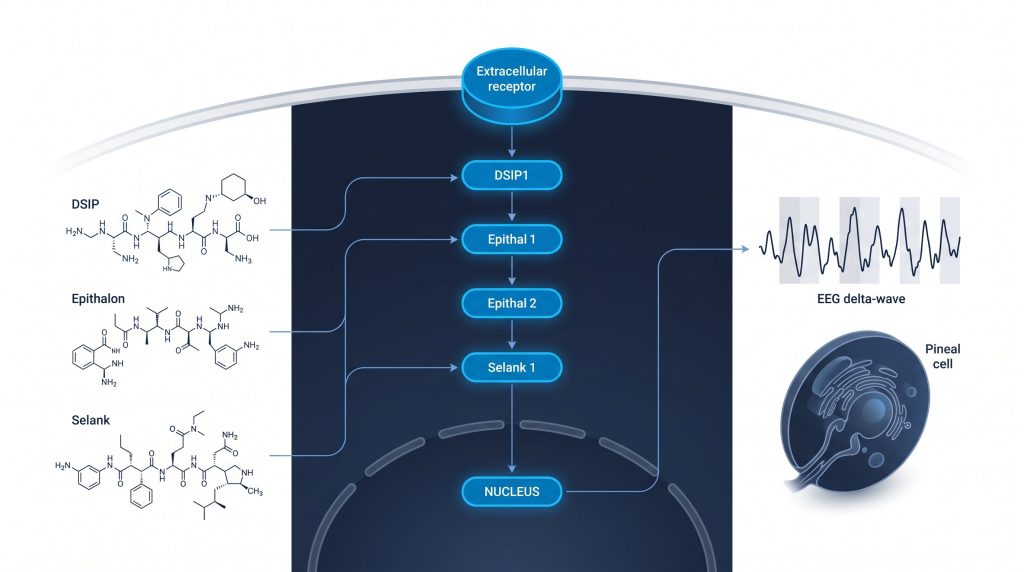
A sleep peptide research compound is a short amino acid chain. It is studied in cell and animal models for brain wave activity. DSIP (delta sleep-inducing peptide) is a nine-amino-acid nonapeptide. Epithalon is a four-amino-acid tetrapeptide. Selank is a six-amino-acid analog. Each acts on a different part of the nervous system. Researchers use EEG recordings, GABA assays, and pineal cell cultures to study these compounds.
Next Level Pharm is a US-based supplier of research-grade DSIP, verified to ≥99.4% purity by HPLC and mass spectrometry on every batch. Each lot ships with a COA and a lot number for full traceability.
Key Takeaways
- DSIP and delta waves: DSIP is a nonapeptide studied in animal models for its link to EEG delta-wave activity. It acts on the GABAergic system.
- Epithalon and pineal cells: Epithalon (Ala-Glu-Asp-Gly) has been tested in pineal cell cultures. Studies use TRAP assay to measure telomerase activity.
- Selank and GABA-A receptors: Selank is a heptapeptide analog. It has been studied at the GABA-A receptor with IL-6 cytokine measurement in cell assays.
- COA-verified lots: Next Level Pharm ships lyophilized DSIP lots with HPLC and mass spec data on every batch. Each lot has a traceable number.
- Research use only: All DSIP in this catalog is for laboratory research use only. No clinical outcomes are claimed.
What Is DSIP and How Is It Studied?
DSIP is a nine-amino-acid peptide studied in animal models for EEG delta-wave activity. It stands for delta sleep-inducing peptide. It contains nine amino acids. This makes it a nonapeptide. It crosses the blood-brain barrier. The blood-brain barrier separates blood from brain tissue. Researchers use rat EEG models to study it. They look for delta-wave increases in the brain. Delta waves are slow brain waves. They appear during deep sleep stages.
GABA stands for gamma-aminobutyric acid. It is the main calming brain signal. DSIP acts on the GABAergic system. The GABAergic system uses GABA as its signal. Researchers measure GABA levels with HPLC assays. They also record EEG traces in rat brain slice models. According to Nagaki et al. (2013), rat EEG models show delta-wave changes after DSIP treatment. Results come from GABA assay and EEG readouts. All studies are in animal models only. No human outcomes are claimed.
How Does Epithalon Work in Pineal Cell Models?
Epithalon is a four-amino-acid tetrapeptide tested in pineal cell cultures for telomerase activity. Epithalon has a four-amino-acid sequence. The sequence is Ala-Glu-Asp-Gly. This makes it a tetrapeptide. Researchers study it in pineal gland cell cultures. The pineal gland makes melatonin. Melatonin is a hormone tied to sleep cycles. Cell studies use bovine and rat pineal cell lines.
Researchers use the TRAP assay to study telomerase. TRAP stands for telomeric repeat amplification protocol. Telomerase is the enzyme that adds caps to chromosomes. The TRAP assay detects telomerase in cell lysates. Researchers also run melatonin ELISA on cell culture medium. ELISA stands for enzyme-linked immunosorbent assay. According to Anisimov et al. (2003), pineal cell cultures show telomerase changes after Epithalon treatment. TRAP assay and melatonin ELISA are the key readouts. All studies are in cell models only. No human outcomes are claimed.
What Does Selank Do at the GABA-A Receptor?
Selank acts at the GABA-A receptor and has been studied for IL-6 cytokine changes in cell assays. Selank is a synthetic peptide. It is based on tuftsin. Tuftsin is a natural immune peptide. Selank acts at the GABA-A receptor. The GABA-A receptor calms nerve signals in the brain. Researchers measure IL-6 after Selank treatment. IL-6 is an immune signal protein. They collect IL-6 data from cell supernatants by ELISA.
Researchers also use behavioral tests in rat models. These tests look at anxiety-related patterns. According to Zozulya et al. (2001), Selank cell assays show IL-6 changes at the GABA-A receptor. GABA-A binding and IL-6 ELISA are the key readouts. All studies are in cell and animal models only. No human outcomes are claimed.
Which Cell Models Are Used in Sleep Peptide Research?
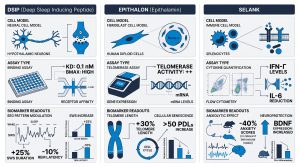
Pineal cell cultures, rat EEG models, and PBMC panels are used to study sleep peptides. Each peptide needs a specific cell model. DSIP uses rat brain slice EEG recordings. Epithalon uses bovine or rat pineal cell cultures. Selank uses PBMC panels and rat behavioral assays. PBMC stands for peripheral blood mononuclear cells. Model choice depends on the peptide target.
All three peptides need COA-verified lots. Purity must be 99% or above. Low-purity lots can confound assay readouts. Shop research peptides for COA-verified lots with HPLC and mass spec data.
How Do Researchers Measure Sleep Peptide Activity?
GABA assays, TRAP assay, melatonin ELISA, and IL-6 ELISA are the key readout methods. Each assay matches a specific peptide target. GABA assay uses HPLC to measure GABA levels. Brain tissue samples are used for this assay. TRAP assay detects telomerase in cell lysates. Melatonin ELISA measures melatonin in cell culture medium. IL-6 ELISA measures IL-6 in PBMC supernatant.
All assays require COA-verified peptide lots. Purity must be 99% or above. Impurities shift cytokine and EEG readouts. Mass spec data confirms peptide identity before each run. HPLC data confirms purity on every lot.
What Research Tools Are Available for DSIP Studies?
COA-verified lots of DSIP, Epithalon, and Selank are required as starting materials for sleep peptide cell assays. Research teams need a verified DSIP lot to run any study. The lot must match the published reference standard for molecular weight and purity. Next Level Pharm verifies each DSIP lot by HPLC and mass spectrometry before shipping. GABA assay kits and TRAP assay reagents are available from major life-science suppliers. Melatonin and IL-6 ELISA kits are designed to pair with research-grade peptide lots. View the DSIP product page for lot-specific COA and mass spec data.
Frequently Asked Questions
What is a sleep peptide research compound?
A sleep peptide research compound is a short amino acid chain. It is studied in cell and animal models. Researchers look at how it interacts with brain signaling systems. DSIP, Epithalon, and Selank are three examples. Each targets a different part of the nervous system. DSIP acts on the GABAergic system. Epithalon is studied in pineal cell cultures. Selank acts at the GABA-A receptor. All studies are in laboratory models only.
What is DSIP and what does the abbreviation stand for?
DSIP stands for delta sleep-inducing peptide. It is a nonapeptide, meaning it has nine amino acids. Researchers study it in animal models. They use EEG recordings and GABA assays. EEG stands for electroencephalogram. It records brain wave patterns. Delta waves are slow brain waves seen in deep sleep stages. DSIP studies look for delta-wave changes in rat brain slice models. No human use claims are made.
How is Epithalon studied in pineal cell models?
Epithalon has the sequence Ala-Glu-Asp-Gly. It is a tetrapeptide with four amino acids. Researchers place it in pineal gland cell cultures. They use bovine or rat tissue lines. The TRAP assay measures telomerase in treated cell lysates. Melatonin ELISA measures melatonin output in culture medium. These two assays give a picture of pineal cell activity. All work is in cell models only.
What receptor does Selank target in cell studies?
Selank targets the GABA-A receptor in cell studies. GABA-A is a brain receptor that calms nerve signals. Selank is based on tuftsin, a natural immune peptide. Researchers measure IL-6 levels after Selank treatment. IL-6 is an immune signal protein measured by ELISA. Rat behavioral assays also test anxiety-related patterns. All studies are in laboratory models only. No clinical outcomes are claimed.
What is a TRAP assay in peptide research?
TRAP stands for telomeric repeat amplification protocol. It is a lab method that measures telomerase activity. Telomerase is the enzyme that adds caps to chromosomes. These caps are called telomeres. Researchers use the TRAP assay in Epithalon pineal cell studies. The assay amplifies telomere repeats added by telomerase. Results are detected by gel or fluorescent plate readers. It is a standard tool for pineal cell biology.
What are EEG delta waves and why do researchers study them?
EEG stands for electroencephalogram. It records electrical brain wave patterns. Delta waves have a frequency of 0.5 to 4 Hz. They appear during deep sleep stages in mammals. Researchers study delta waves in rat models. They look at how compounds like DSIP affect the GABAergic system. Changes in delta-wave strength after treatment are a key readout. These are animal study results only.
Why does peptide purity matter for sleep research assays?
Low purity can add endotoxin to assay systems. Endotoxin is a bacterial cell wall fragment. It triggers immune responses in cell cultures. Even small amounts shift IL-6 and other cytokine readings. This confounds ELISA results. HPLC and mass spectrometry verify purity to 99% or above. COA data also confirms molecular weight. Both checks are required before running any sleep peptide assay.
How does the GABAergic system relate to DSIP research?
The GABAergic system uses GABA as its main signal. GABA stands for gamma-aminobutyric acid. It calms nerve activity across many brain regions. DSIP has been studied for its link to this system. Researchers use rat EEG models for this work. They use GABA assays to measure GABA in brain tissue. Changes in GABA levels are compared to EEG delta-wave data. All results are from animal models only.
Can DSIP, Epithalon, and Selank be studied in the same model?
Researchers can set up parallel assay arms in the same study. Each peptide targets a different system. DSIP targets the GABAergic system. Epithalon targets pineal cell telomerase. Selank targets the GABA-A receptor and IL-6 output. Separate readouts are needed for each peptide. A single assay plate cannot capture all three targets. Parallel arms with matched vehicle controls allow side-by-side results. This is a standard multi-arm study design.
Summary
DSIP, Epithalon, and Selank are three sleep peptide research compounds. Each acts on a different system. DSIP targets the GABAergic system. Epithalon works in pineal cell cultures. Selank acts at the GABA-A receptor.
Researchers use EEG, TRAP assay, melatonin ELISA, and IL-6 ELISA. Each assay matches the peptide target. Purity above 99% is required. Impurities can shift cytokine and EEG readouts.
All studies cited here are in cell and animal models. No clinical outcomes are claimed.
What Should You Do Next?
- Confirm lot purity at 99% or above before starting any sleep peptide assay.
- Select the cell model based on the peptide: rat EEG for DSIP, pineal cell cultures for Epithalon, PBMCs for Selank.
- Run a matched vehicle control in every assay to separate peptide effects from solvent effects.
- Request HPLC and mass spec COA data for each lot before use.
- Browse recovery research peptides for related research tools.
- Shop research peptides at https://nextlevelpharm.com/shop/.
People Also Read
- Epithalon Research: Telomere and Pineal Peptide Cell Studies
- Selank Research: Anxiolytic Peptide and GABAergic Studies
About the Author
Next Level Pharm Research Team
Alex M covers peer-reviewed findings in peptide science for Next Level Pharm, a US-based supplier of research-grade peptides verified to ≥99% purity via HPLC and mass spectrometry on every batch.
Disclaimer: The information provided on this page is for educational and research purposes only. Next Level Pharm products are intended for laboratory research use only. They are not intended for human consumption, diagnostic, therapeutic, or medicinal purposes. This content does not constitute medical advice. Always consult a licensed healthcare professional before making any health-related decisions.