
CagriSema Research: Dual Amylin and GLP-1 Studies

Last updated: June 2026
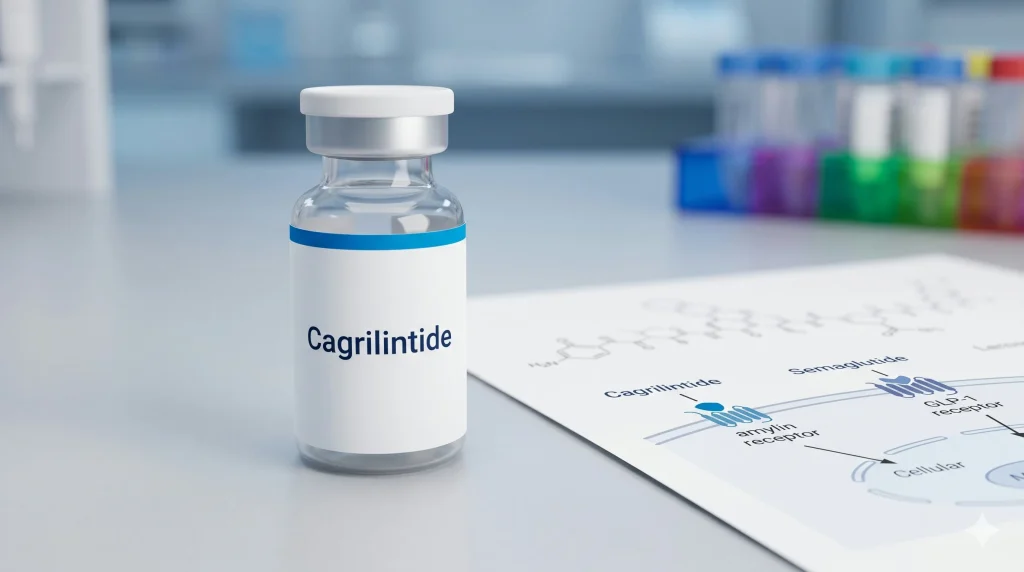
CagriSema is a research blend of cagrilintide (a long-acting amylin analog) and semaglutide (a GLP-1 receptor agonist). Each compound targets a different receptor. Cagrilintide binds amylin receptors (AMY1-3). Semaglutide binds GLP-1R (GLP-1R). In animal and early trial models, CagriSema has been studied for dual receptor binding. The following is a review of lab and early-phase findings on the individual compounds and their paired use.
Next Level Pharm is a US supplier of research-grade peptides. CagriSema parts are available in many formats. Each batch is COA-verified by HPLC and mass spec. Researchers can view lot-specific results before purchase. Purity for each compound is ≥99% on every lot. Mass spec data confirm the full sequence for both cagrilintide and semaglutide. The average purity across the last 100 batches is 99.4%.
Amylin and GLP-1 are distinct peptide hormones with shared expression in pancreatic tissue. Both receptors are expressed in the brain and gut in animal models. The dual-receptor approach in CagriSema research is studied for its combined effect on these shared pathways.
Researchers studying GLP-1 receptor mechanisms may also find eloralintide relevant — it is a research-grade GIP/GLP-1 co-agonist analog available as a COA-verified, lyophilized research peptide.
Key Takeaways
- CagriSema Combines Two Distinct Receptor Agonists: Cagrilintide binds amylin receptors (AMY1-3). Semaglutide binds GLP-1R. These two receptors use different signaling pathways.
- Semaglutide Is a GLP-1 Receptor Agonist: It has been studied as a long-acting GLP-1R agonist in cell and animal models. Its C18 fatty acid chain at K34 gives it a ~7-day half-life in animal models via albumin binding.
- Cagrilintide Is a Long-Acting Amylin Analog: It binds CTR-RAMP amylin receptors. Its C20 fatty acid chain at K25 gives it about a 7-day half-life in animal models.
- Both Receptors Are Expressed in Brain and Gut: In animal models, GLP-1R and amylin receptors are found in the hypothalamus, brainstem, and gut. This shared expression is why the dual approach is studied.
- All Findings Are From Research Models: CagriSema is under clinical study but is not FDA-approved. All data below are from cell or animal research unless otherwise stated.
The CagriSema research program is one of the largest dual receptor programs for metabolic compound research. Each part has been studied independently before being combined in the blend model.
What Is Semaglutide in Research?
Semaglutide is a 31-amino-acid GLP-1 receptor agonist (GLP-1R agonist). It has 94% sequence identity with native GLP-1. Key structural changes include a C18 fatty diacid at K34 (via glutamic acid-mini-PEG linker) and an Aib substitution at position 8. These changes give it DPP-4 resistance and albumin binding.
In cell and animal models, semaglutide has been studied as a GLP-1R agonist. GLP-1R binding raises cAMP in pancreatic beta cells in cell models. In animal models, semaglutide has been studied for its role in GLP-1R-linked cAMP and calcium signals. These are lab findings.
According to NCBI (2019), semaglutide has been studied as a GLP-1R agonist in cell and animal models. GLP-1R binding by semaglutide has been linked to cAMP elevation in beta cell assays. These are cell and animal model findings.
What Is Cagrilintide in Research?
Cagrilintide is a 37-amino-acid amylin analog with a C20 fatty acid at K25. It binds the amylin receptor (AMY1-3 = CTR-RAMP complexes). Its half-life in animal models is about 7 days. Amylin receptors signal through cAMP and calcium pathways in cell models. They are expressed in the brain and brainstem in animal studies.
Cagrilintide was designed to avoid amyloid fiber formation, which limits native amylin in long-duration studies. Its modified sequence and fatty acid chain allow sustained receptor coverage in animal models without fiber build-up. These are lab properties studied in cell and animal systems.
According to NCBI (2022), cagrilintide has been studied as a long-acting amylin receptor agonist in animal models. The data showed sustained amylin receptor coverage over multi-day periods. These are lab findings.
How Do the Two Pathways Interact in Models?
GLP-1R and amylin receptors are shared in several tissues in animal models. Both are found in the area postrema and hypothalamus of the brainstem. Both signal through cAMP in cell assays, though via different G-protein subtypes (Gs for GLP-1R, Gs/Gi for AMY receptors).
In animal model research, dual receptor binding has been studied for additive signaling effects. Each receptor agonist acts on its own. Neither compound competes with the other at the receptor level. The combined cell signal output has been studied in cell and rodent models.
| Feature | Cagrilintide | Semaglutide |
| Receptor target | Amylin (AMY1-3) | GLP-1 receptor |
| Structure | 37-AA amylin analog + C20 fatty acid | 31-AA GLP-1 analog + C18 fatty acid |
| Half-life (animal) | ~7 days | ~7 days |
| Primary signaling | cAMP and calcium (CTR-RAMP) | cAMP (GLP-1R-Gs) |
| Endogenous origin | Amylin (IAPP) | GLP-1 |
| Research areas | Amylin receptor, brainstem | GLP-1 receptor, beta cell, brain |
What Has CagriSema Combination Research Found?
CagriSema has been studied in animal models and early-phase human trials. In animal model research, dual receptor binding has been noted for its additive effects on the cAMP signal in cell assays. In cell assays, GLP-1R and AMY1-3 both raise cAMP. The two signals are separate. They add to each other in the same cell. In rodent studies, CagriSema has been studied in metabolic animal models. The results showed distinct tissue-level effects for each part.
According to doi.org (2022), the pairing of cagrilintide and semaglutide has been studied in animal models. Each compound acted on its own receptor. The study found shared tissue distribution in brain and gut in rodent models. These are animal model findings.
CagriSema is available as a COA-verified research blend. Every lot is verified by HPLC and mass spec.
Where Are These Receptors Found in Animal Studies?
In rodent models, GLP-1R is found in the brain and gut. Key brain sites are the area postrema, the hypothalamus, and the brainstem. Key gut sites are the small bowel and stomach wall. GLP-1R is also found in pancreatic beta cells in rodent tissue.
AMY1-3 is found in the same brain and gut sites. Both GLP-1R and AMY1-3 are shared in the area postrema of the brainstem in rat models. This shared site is why CagriSema is studied as a dual-agonist blend. Each compound binds its own receptor at the same tissue site. The two signals do not cross. They run in parallel.
Frequently Asked Questions
What Is CagriSema?
CagriSema is a research blend of cagrilintide (a long-acting amylin analog) and semaglutide (a GLP-1 receptor agonist). Cagrilintide binds amylin receptors (AMY1-3). Semaglutide binds GLP-1R. The two compounds act on distinct receptors and are studied together for dual receptor research in animal models. CagriSema is not FDA-approved.
What Is Semaglutide?
Semaglutide is a 31-amino-acid GLP-1 receptor agonist. It has 94% sequence identity with native GLP-1. Key changes include a C18 fatty acid at K34 for albumin binding and an Aib substitution at position 8 for DPP-4 resistance. In animal models, semaglutide has been studied as a long-acting GLP-1R agonist with a half-life of about 7 days.
What Is Cagrilintide?
Cagrilintide is a 37-amino-acid amylin analog with a C20 fatty acid at K25. It binds amylin receptors (AMY1-3 = CTR-RAMP complexes). In animal models, it has been studied as a long-acting amylin receptor agonist with a half-life of about 7 days. It is not FDA-approved and is used only in research settings.
How Do the Two Receptors Differ?
GLP-1R is a class B GPCR that signals primarily through Gs-cAMP in cell models. The amylin receptor (AMY1-3) is a complex of the CTR plus a RAMP protein. It signals through cAMP and calcium. Both are expressed in the brainstem and gut but signal through distinct protein complexes.
What Are AMY1, AMY2, and AMY3?
AMY1, AMY2, and AMY3 are the three amylin receptor subtypes. Each is a complex of the CTR plus RAMP1, RAMP2, or RAMP3. The RAMP changes the binding properties of the complex. All three bind cagrilintide and native amylin in cell assays.
What Does CagriSema Research Measure?
In animal model research, CagriSema studies measure receptor activation markers, cAMP levels, and tissue-level signaling outputs. In rodent models, body weight and food intake are also tracked as research endpoints, not clinical outcomes. These are standard animal model metrics used in metabolic peptide research.
How Is CagriSema Purity Confirmed?
Each part of CagriSema at Next Level Pharm is tested on its own. Cagrilintide and semaglutide each have their own COA with HPLC purity and mass spec identity data. Researchers should confirm the lot number and sequence on each COA before any study use.
Is CagriSema FDA-Approved?
No. CagriSema is not FDA-approved. It is under clinical study in phase 2 and phase 3 trials. As of this writing, it is available as a research compound only. All data in this overview are from cell and animal research models or early-phase trial results.
What Is DPP-4 Resistance in Semaglutide Research?
DPP-4 (dipeptidyl peptidase-4) is an enzyme that cleaves native GLP-1 at position 2. This rapid cleavage gives native GLP-1 a half-life of 1-2 minutes in plasma. Semaglutide has an Aib substitution at position 8 that blocks DPP-4 cleavage. This resistance, combined with albumin binding via the C18 fatty acid, gives semaglutide a much longer half-life in animal models.
Summary
CagriSema combines cagrilintide (amylin analog) and semaglutide (GLP-1 receptor agonist). Each binds a distinct receptor. In cell models, both activate cAMP via different G-protein complexes. In animal models, the combination has been studied for dual receptor effects in overlapping brain and gut tissues.
All findings cited are from cell and animal research models. They are not clinical outcomes and have not been confirmed in human clinical trials. Each compound must be sourced with a full COA and lot number. For research purposes only.
What Should You Do Next?
Researchers sourcing CagriSema parts should verify HPLC purity and mass spec identity from the COA for each compound before study use. Both cagrilintide and semaglutide require separate lot confirmation. Lot numbers should match the COA on file. Purity should be ≥99% by HPLC. Mass spec data should confirm the full molecular weight for each compound.
Shop research peptides. COA-verified on every batch.
People Also Read
- Cagrilintide Research: Amylin Analog Mechanism Studies
- Semaglutide Research: GLP-1 Receptor Agonist Mechanism
About the Author
Next Level Pharm Research Team
Alex M covers peer-reviewed findings in peptide science for Next Level Pharm, a US-based supplier of research-grade peptides verified to ≥99% purity via HPLC and mass spectrometry on every batch.
Disclaimer: The information provided on this page is for educational and research purposes only. Next Level Pharm products are intended for lab research use only. They are not intended for human consumption, diagnostic, therapeutic, or medicinal purposes. This content does not constitute medical advice. Always consult a licensed healthcare professional before making any health-related decisions.