
Retatrutide Research: Triple Receptor Agonist Mechanisms

Last updated: May 2026
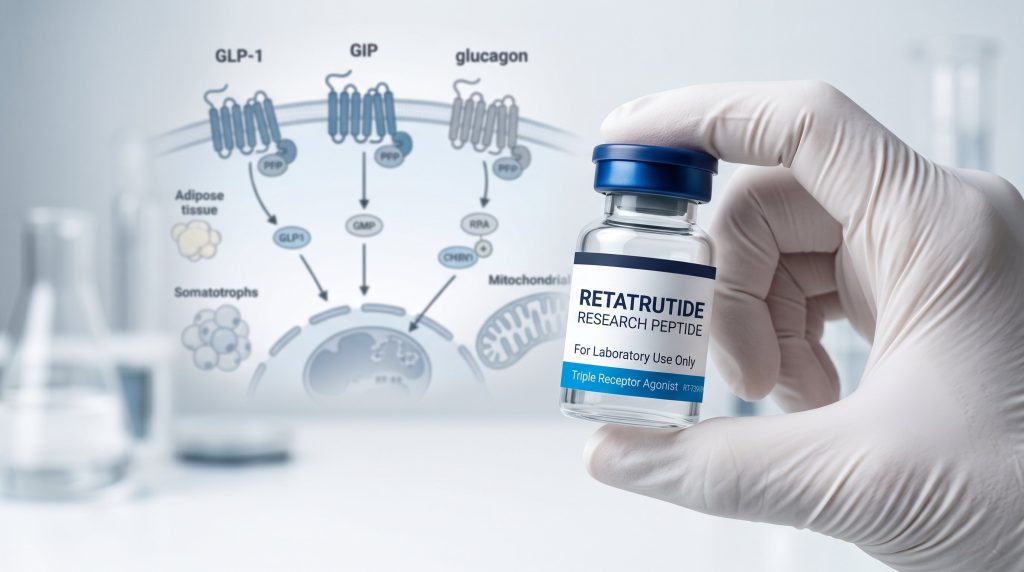
A retatrutide research review covers a triple receptor agonist studied in lab and clinical models. The compound has been found to bind GLP-1 (glucagon-like peptide-1), GIP (a gut hormone), and glucagon receptors. According to NEJM (2023), retatrutide has been studied in a Phase 2 trial. It is a research compound. It has not received FDA approval. All findings here are for research use only.
Next Level Pharm supplies retatrutide as a COA-tested, lyophilized research compound. A COA (certificate of analysis) with a lot of ships with every order. Every batch is tested to >=99% purity via HPLC and mass spec.
Research into triple receptor agonists has grown since retatrutide’s binding profile was first studied. Lab teams look at how it binds three G-protein-coupled receptors at the same time. This is not seen in single or dual agonists. The sections below cover the key published findings.
Key Takeaways
- Triple Receptor Binding: Retatrutide has been studied for binding to GLP-1, GIP, and glucagon receptors. This profile is not shared by single or dual agonists.
- Phase 2 Trial: According to NEJM (2023), retatrutide has been studied in a randomized, double-blind Phase 2 trial.
- GLP-1 Part: The GLP-1 receptor part has been studied for effects on insulin signals and gastric motility in research models.
- GIP Part: The GIP receptor part has been studied for effects on lipid storage and insulin signals in fat cell models.
- Glucagon Part: The glucagon receptor part has been studied for effects on liver fat signals and heat-gene paths in animal models.
- Research Context: Retatrutide is a research compound. It has not received FDA approval. It is sold for lab research only.
Research into retatrutide’s triple receptor profile is ongoing. The sections below cover each receptor target and what published studies have found.
What Receptors Does Retatrutide Target?
Retatrutide has been studied as a single peptide that binds three G-protein-coupled receptors. These are GLP-1R (GLP-1 receptor), GIPR (GIP receptor), and GcgR (glucagon receptor). Each receptor sits in a new tissue type. GLP-1R is in pancreatic beta cells and the gut. GIPR is in pancreatic tissue and fat cells. GcgR is found mainly in liver and fat cells.
According to NEJM (2023), retatrutide showed agonist action at all three receptors in the Phase 2 study. Lab teams study how a single peptide can achieve this triple binding profile. Structural studies have looked at how the peptide backbone places its side chains to engage each receptor type. This triple binding is what sets retatrutide apart from mono and dual agonist compounds in the same class.
How Does the GLP-1 Part Work?
The GLP-1R part of retatrutide has been studied for effects on insulin signals and gut motility. GLP-1R binding has been found to raise cAMP (cyclic AMP) levels in beta cells. cAMP is a signal that supports glucose-driven insulin release. In research models, GLP-1R binding has also been studied for effects on gastric emptying.
According to Physiol Rev (2007), GLP-1R binding has been studied for effects on beta cell insulin release and gastric emptying in research models. These findings apply to the GLP-1R class broadly. Lab teams study whether retatrutide’s GLP-1 part shows effects like other GLP-1R agonists in cell and animal models. No human outcome data is shown. All findings come from research models.
What Role Does GIP Receptor Agonism Play?
The GIPR part of retatrutide has been studied in pancreatic and fat cell models. GIPR binding has been found to affect lipid storage signals in fat cells. It has also been studied for effects on beta cell insulin signals.
According to Cell Metab (2021), GIP receptor binding has been found to affect lipid flux in fat tissue models. When studied with GLP-1R binding, GIPR signals have been linked to added effects on insulin release in cell models. Lab teams study whether the GIP part of retatrutide changes the signal profile vs. GLP-1 alone. All findings come from cell and animal research models.
What Does Glucagon Receptor Research Show?
The GcgR part sets retatrutide apart from dual GLP-1/GIP agonists. GcgR is found mainly in liver cells. Glucagon receptor binding has been studied for effects on liver fat signals and heat-gene paths.
In animal models, triple agonism with a GcgR part has been linked to higher UCP1 (uncoupling protein 1) levels in brown fat tissue. UCP1 is a marker of heat-making steps in fat cells. Lab teams study whether the GcgR part adds a distinct liver and fat signal path that GLP-1 and GIP alone do not engage. All findings come from animal and cell models. These are research findings only.
What Did Phase 2 Trial Data Show?
A Phase 2 trial of retatrutide was published by Jastreboff et al. in NEJM (2023). The trial enrolled adults in a randomized, double-blind, placebo-controlled design. People were placed in a placebo group or one of several retatrutide groups. The trial ran for 24 weeks. Some groups ran to 48 weeks.
Lab teams looked at body makeup markers, metabolic signals, and safety data. The study was a Phase 2 work. Phase 3 trials were planned or active as of the publish date. The compound has not received FDA approval. Next Level Pharm supplies retatrutide as a COA-tested, lyophilized research compound for lab use only.
How Does Retatrutide Compare to Other Agonists?
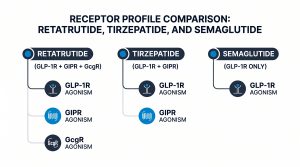
The table below compares the receptor binding profiles of retatrutide and related compounds. Profiles are based on published research data as of 2024.
| Compound | GLP-1R | GIPR | GcgR | Class |
| Retatrutide | Yes | Yes | Yes | Triple agonist |
| Tirzepatide | Yes | Yes | No | Dual agonist |
| Semaglutide | Yes | No | No | Mono agonist |
| Liraglutide | Yes | No | No | Mono agonist |
GLP-1R: GLP-1 receptor. GIPR: GIP receptor. GcgR: Glucagon receptor.
Retatrutide is the only compound in this table with all three receptor targets. Tirzepatide binds GLP-1R and GIPR but not GcgR. Single-agonist compounds target GLP-1R only. Lab teams study how the extra receptor targets affect signal profiles in the same models.
Next Level Pharm stocks all of these compounds in its metabolic peptide catalog. Each is sold as a separate, COA-tested research compound. Visit the shop to view current lot numbers and COA links.
Frequently Asked Questions
What is retatrutide in research terms?
Retatrutide is a synthetic peptide research compound. It has been studied for binding to GLP-1, GIP, and glucagon receptors at the same time. According to NEJM (2023), it has been studied in a Phase 2 randomized trial. It is a research compound. The FDA has not approved it for any use. It is sold for lab research only.
How does retatrutide differ from semaglutide in mechanism?
Semaglutide is a GLP-1R mono-agonist studied for single-receptor binding. Retatrutide targets GLP-1R, GIPR, and GcgR. The added GIP and glucagon receptor action brings in signal paths in fat and liver tissue. These are not engaged by GLP-1 binding alone. Lab teams looking at both compounds have noted different binding rates and cAMP response profiles in cell assay models. These are differences seen in research models only.
What is the role of the glucagon receptor part?
GcgR is found mainly in the liver and brown fat tissue. Glucagon receptor binding has been linked to liver fat oxidation signals and heat-gene paths in animal models. Higher UCP1 (uncoupling protein 1) in brown fat has been found in triple agonist studies. This gives retatrutide a distinct tissue signal profile vs. dual GLP-1/GIP agonists. All findings are from animal and cell models.
Has retatrutide been studied in clinical trials?
Yes. A Phase 2 randomized, double-blind, placebo-controlled trial was published in NEJM (2023). The study looked at many treatment groups over 24 and 48 weeks. Phase 3 trials were active as of 2024. All research is lab-stage only. Retatrutide is not FDA-approved. It is sold only for lab research use.
What purity and testing standards apply to research-grade retatrutide?
Research-grade retatrutide should be verified by HPLC and mass spec to confirm peptide identity and purity. The standard is >=99% purity. A COA with a lot number is issued per batch. COA data includes HPLC and mass spec results for that specific lot. Lab teams use this data to verify identity before any lab test.
What is the half-life of retatrutide in research models?
PK studies have shown retatrutide’s half-life fits once-weekly use in research models. This is linked to a fatty acid chain change. The change promotes albumin binding and slows renal clearance. This approach is common in the GLP-1 peptide class. It has been shown in published research for incretin peptide studies.
What cell receptors are involved in retatrutide’s mechanism?
Three G-protein-coupled receptors are key to retatrutide’s studied mechanism: GLP-1R, GIPR, and GcgR. Each couples to Gs proteins, raising cAMP as the main cell signal. Lab teams study how the relative action at each receptor changes the overall signal output. This is compared to single or dual-receptor compounds in the same assay models.
Is retatrutide the same as a GLP-1 agonist?
Retatrutide includes GLP-1R agonism as one part of its profile. But it is not classed as a GLP-1 agonist only. Its added GIP and glucagon receptor action gives it a different tissue signal profile. Lab teams have studied whether triple receptor binding produces different signal patterns in cell models vs. mono or dual agonists. Published studies point to new paths from the broader receptor profile.
What research formats is retatrutide supplied in?
For lab research, retatrutide is supplied as a lyophilized (freeze-dried) powder in sealed vials. Lyophilized peptides are stable at room temperature during shipping. They do not need cold-chain transport. Long-term storage at -20 degrees C is standard after receipt. Each vial includes COA data per batch with HPLC and mass spec results.
Where can researchers find primary literature on retatrutide?
The main Phase 2 trial is on PubMed under PMID 37366315 (Jastreboff et al., NEJM, 2023). More papers are on PubMed. Search retatrutide with terms like GLP-1, triple agonist, or glucagon receptor. ClinicalTrials.gov lists registered trials under the name retatrutide. Always verify that cited studies are primary research, not review summaries or conference abstracts.
Summary
Retatrutide is a triple receptor agonist studied for binding to GLP-1, GIP, and glucagon receptors. Published research includes a Phase 2 trial in NEJM (2023). The glucagon receptor part adds a distinct liver and fat signal path that mono and dual agonists do not engage.
All findings here are from lab research models. Retatrutide is not FDA-approved. It is sold only as a research-grade peptide for lab use. No human outcome data is shown.
What Should You Do Next?
Lab teams studying this compound can access the Phase 2 trial on PubMed (PMID 37366315). For lab sourcing, review the metabolic peptide catalog for COA-tested compounds. Visit the retatrutide product page to see COA data per lot. Shop research peptides across all categories with free shipping over $150.
People Also Read
About the Author
Next Level Pharm Research Team
Alex M covers peer-reviewed findings in peptide science for Next Level Pharm, a US-based supplier of research-grade peptides verified to ≥99% purity via HPLC and mass spectrometry on every batch.
Disclaimer: The information provided on this page is for educational and research purposes only. Next Level Pharm’s products are intended for laboratory research use only. They are not intended for human consumption, diagnostic, therapeutic, or medicinal purposes. This content does not constitute medical advice. Always consult a licensed healthcare professional before making any health-related decisions