What Is HPLC Testing? How Peptide Purity Is Verified in Research Labs

Last updated: May 2026
HPLC testing is the main way labs check peptide purity. HPLC stands for high-performance liquid chromatography. It separates compounds in a sample. Each compound exits the column at a different time. The instrument records a graph called a chromatogram. According to published research indexed on PubMed (2019), HPLC can detect impurities below 0.1%. This makes it the gold standard for peptide quality checks. Research labs rely on it for every batch.
Next Level Pharm runs HPLC and mass spectrometry on every batch it produces. A Certificate of Analysis (COA) ships with every order. The COA is tied to the exact lot number delivered. This lets researchers trace results back to the specific batch tested.
Understanding HPLC testing helps researchers make sense of COA data. It also clarifies what purity numbers mean in practice. The sections below cover how the method works, what the results show, and why it matters for research.
Key Takeaways
- Gold Standard Method: HPLC is the primary tool labs use to check peptide purity.
- Separation Principle: The column separates compounds by how they interact with the solvent.
- Purity Output: Results appear as a chromatogram. The target peak area gives the purity percentage.
- Detection Limit: HPLC can flag impurities at levels below 0.1% of the total sample.
- Combined Testing: HPLC measures purity. Mass spectrometry confirms molecular identity. Both are needed for full verification.
- COA Requirement: A COA should list the HPLC purity score and the lot number for every batch.
The sections below go deeper into each of these points. They cover the method step by step, what to look for on a COA, and how HPLC compares to other analytical tools.
How Does HPLC Work for Peptides?
HPLC pushes a liquid sample through a column packed with tiny particles. The sample contains the target peptide and any impurities. Each compound in the sample sticks to the column particles at a different strength. Compounds that stick less exit first. The target peptide exits in the middle of the run. Compounds that stick more exit last.
A detector at the end of the column measures each compound as it exits. It records a signal over time. The result is a chromatogram, which looks like a series of peaks. Each peak is one compound. The area of each peak shows how much of that compound is in the sample. According to USP analytical validation methods reviewed on PubMed (2023), this ratio method is the accepted standard for peptide purity reporting.
What Does the Solvent Mix Do?
The solvent mix is called the mobile phase. It carries the sample through the column. Most HPLC runs for peptides use a mix of water and an organic solvent. The solvent ratio changes over the run. This is called a gradient. At the start, the mix is mostly water. Water-loving impurities exit early. The main peptide exits mid-run as the solvent becomes more organic. Fat-loving residues exit last.
The gradient controls how well compounds separate. A shallow gradient gives more separation. A steep gradient speeds up the run. Lab chemists choose the gradient to match the peptide being tested. Longer peptides need longer run times. The solvent choice also affects the baseline noise on the chromatogram. A clean baseline makes small impurity peaks easier to see.
What Is a Chromatogram and How Do You Read It?
A chromatogram is the graph the HPLC instrument prints. The horizontal axis shows time in minutes. The vertical axis shows detector signal strength. Each compound produces a peak at the time it exits the column. That time is called the retention time. The retention time for the target peptide is set by the method and should match across runs.
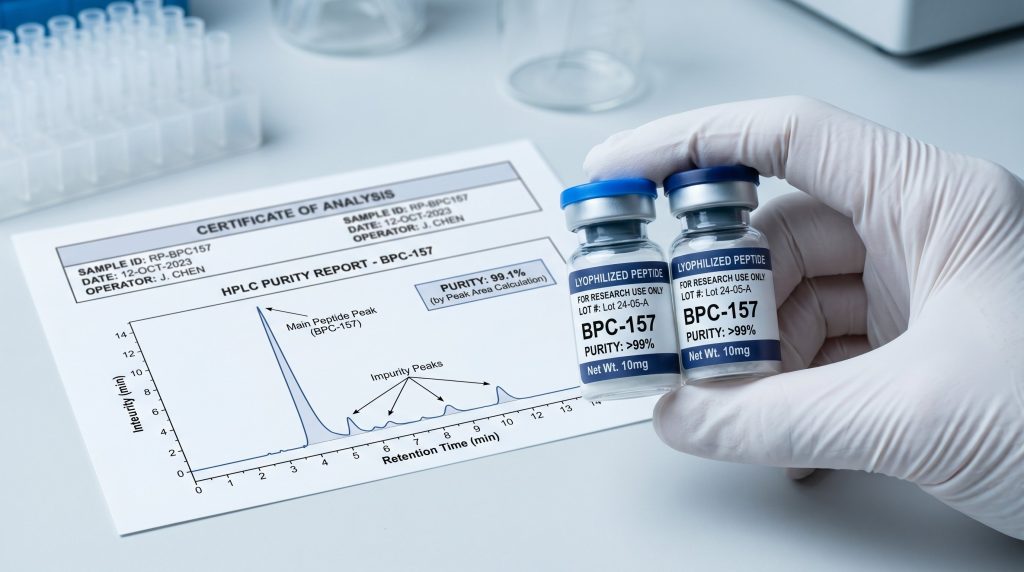
To read a chromatogram, find the tallest peak. That is usually the target peptide. Look at its retention time and compare it to the expected value. Then look at any smaller peaks. These are impurities. The purity score equals the target peak area divided by the total area of all peaks, times 100. A score of 99% means at least 99 out of every 100 parts are the target compound. The COA should include both the chromatogram image and the calculated purity score.
Why Is 99% Purity the Research-Grade Standard?
Research-grade peptides need high purity because impurities can affect results. Even 1% contamination can skew assay data. In a cell culture study, an unknown impurity might cause a response that researchers attribute to the peptide. This leads to false conclusions. According to a review of synthesis quality standards on PubMed (2022), a 99% purity floor is the accepted threshold for peptides used in research settings.
The 99% standard also allows replication. When two labs use the same peptide at the same purity, their results should align. If purity differs, results may not match even if the protocol is identical. This is why the COA purity score matters. Next Level Pharm averages 99.4% purity across the last 100 batches. Every batch is tested by HPLC before it ships.
Browse research-grade recovery peptides with COA data on every lot.
How Does HPLC Compare to Mass Spectrometry?
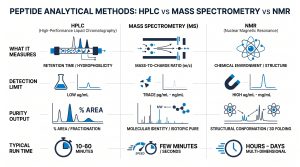
HPLC and mass spectrometry (MS) answer different questions. HPLC measures purity: what percentage of the sample is the target compound. MS measures identity: does the molecular weight match the target peptide. The two methods work together. HPLC alone cannot confirm a compound is what the label says. MS alone cannot give a precise purity percentage.
The table below compares the three main analytical methods used in peptide testing.
| Method | What It Measures | Purity Output | Detection Limit | Key Strength |
| HPLC | Compound separation by polarity | Percentage (area ratio) | Below 0.1% | Precise purity score |
| Mass Spectrometry | Molecular weight and fragments | Identity confirmation | Sub-nanogram level | Confirms correct molecule |
| NMR | Atomic structure | Structural map | Moderate sensitivity | Confirms full structure |
For research peptides, HPLC plus MS is the standard pair. HPLC gives the purity number. MS confirms the compound is correctly identified. NMR is used less often for routine testing because it takes longer and costs more. Most COAs for research peptides include HPLC purity and an MS result.
Can HPLC Detect All Impurities?
HPLC detects most impurities, but not all. It can only detect compounds that absorb the detector’s signal at the set wavelength. Most peptide impurities are truncated sequences or modified forms of the target peptide. These absorb well at the standard UV wavelength used for peptides. HPLC catches them reliably.
Some impurities absorb poorly at that wavelength. Residual solvents and some small-molecule contaminants may not show up clearly on a standard UV run. Labs using charged aerosol detectors catch more of these. For most research uses, UV HPLC is sufficient. Pairing it with MS covers the gap for identity confirmation. It adds a check for molecular-weight variants that a UV detector alone might miss.
Shop fitness and GH research peptides with full HPLC and mass spec COA on every batch.
Frequently Asked Questions
What is HPLC testing?
HPLC testing is a lab method for checking the purity of peptides and other compounds. HPLC stands for high-performance liquid chromatography. It separates compounds in a sample using a column and a solvent. Each compound exits at a different time. The instrument records a graph called a chromatogram. The area of the target peak divided by all peaks gives the purity percentage. It is the standard method for research-grade peptide quality checks.
How does HPLC work for peptides?
HPLC pushes a liquid sample through a packed column under high pressure. Each compound sticks to the column material at a different strength. Compounds that stick less exit first. The target peptide exits mid-run. A detector records each compound as it exits. The result is a chromatogram with one peak per compound. The area of each peak shows how much of that compound is present.
Why is HPLC used for peptide testing?
HPLC is used because it is precise, fast, and number-based. It gives a clear purity percentage from each run. The method can detect impurities below 0.1% of the sample. It is also repeatable: the same sample run twice should give the same result. These qualities make it the standard tool for checking peptide quality before research use.
What does an HPLC result show?
An HPLC result shows a chromatogram and a purity percentage. The chromatogram is a graph of detector signal over time. Each peak is one compound. The purity percentage is the target peak area divided by the total area of all peaks. A result of 99% means 99 out of 100 parts in the sample are the target peptide. The COA should include both the chromatogram image and the calculated score.
What is a COA in peptide research?
A COA is a Certificate of Analysis. It records the test results for a specific batch of peptide. A complete COA includes the lot number, the HPLC purity score, the mass spectrometry result, and the date of testing. It lets researchers trace results back to the exact batch used. A COA tied to a lot number is the key document for verifying research-grade quality.
What purity is research grade?
Research-grade peptides are generally defined as 99% purity or above by HPLC. This means at least 99 out of every 100 parts in the sample are the target compound. Some sources accept 98% for certain uses, but 99% is the common threshold. Next Level Pharm averages 99.4% across recent batches. The COA should state the exact purity score, not just a passing label.
How do you read an HPLC chromatogram?
Find the tallest peak on the chromatogram. That is usually the target peptide. Check its retention time against the expected value for that compound. Then look at any smaller peaks: these are impurities. The purity score is the target peak area divided by the sum of all peak areas, times 100. A clean chromatogram has one large peak and very small or absent impurity peaks.
What is the difference between HPLC and mass spectrometry?
HPLC measures purity. Mass spectrometry confirms identity. HPLC separates compounds and calculates what percentage of the sample is the target peptide. Mass spectrometry measures the molecular weight to confirm the compound’s structure. The two methods answer different questions and are used together. A complete COA includes both results.
Can HPLC detect all impurities?
HPLC detects most impurities but not all. It reliably catches truncated peptide sequences and modified forms of the target compound. It may miss some residual solvents that do not absorb well at the standard UV wavelength. Pairing HPLC with mass spectrometry covers the most common gaps. For most research uses, HPLC plus MS is sufficient.
How often should peptide testing happen?
Every batch should be tested before it ships. Batch-level testing means each lot of peptide has its own COA with its own HPLC and MS results. Testing once at launch and skipping later batches is not acceptable for research use. Synthesis conditions can vary between batches, so each lot needs its own test. Researchers should request the COA for the specific lot in their order.
Summary
HPLC testing is the gold standard for checking peptide purity. It separates compounds in a sample using a column and a solvent. The result is a chromatogram. The target peak area gives the purity percentage. Labs accept 99% or above as the research-grade threshold.
HPLC measures purity. Mass spectrometry confirms identity. Both are needed for full verification. A COA tied to a specific lot number is the document that connects test results to the exact batch a researcher receives.
Every batch of research peptides should come with HPLC results, MS identity confirmation, and a lot-linked COA. Without all three, purity claims cannot be checked.
What Should You Do Next?
If you are sourcing peptides for research, here are three steps to follow.
First, request the COA for your specific lot before ordering. It should show the HPLC purity score, the MS result, and the lot number.
Second, check that the purity score is 99% or above, not just a passing label.
Third, confirm the supplier tests every batch. Shop research peptides with full HPLC and mass spec COA on every lot.
People Also Read
- GHK-Cu vs BPC-157: How Two Research Peptides Compare in Studies
- What Is Research-Grade Peptide Purity? Standards and Testing Methods
About the Author
Next Level Pharm Research Team
Alex M covers peer-reviewed findings in peptide science for Next Level Pharm, a US-based supplier of research-grade peptides verified to >=99% purity via HPLC and mass spectrometry on every batch.
Disclaimer: The information provided on this page is for educational and research purposes only. Next Level Pharm’s products are intended for laboratory research use only. They are not intended for human consumption, diagnostic, therapeutic, or medicinal purposes. This content does not constitute medical advice. Always consult a licensed healthcare professional before making any health-related decisions.