
SS-31 Research: Mitochondria-Targeting Peptide

Last updated: May 2026
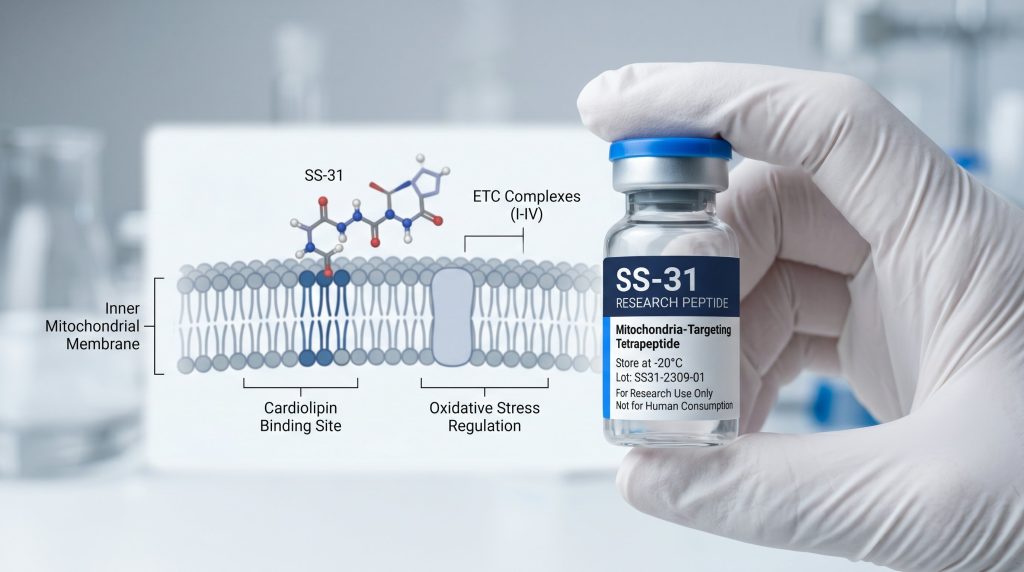
SS-31 is a synthetic tetrapeptide. It targets the inner mitochondrial membrane by binding cardiolipin. Cardiolipin is a phospholipid found almost only in that membrane. According to the Proceedings of the National Academy of Sciences (PNAS) (2011), SS-31 preserved cristae structure in a mouse cardiac model. It also raised ATP output after injury. Cell and animal studies link SS-31 to lower reactive oxygen species (ROS) output and better electron transport chain (ETC) function.
Next Level Pharm supplies research-grade SS-31 at a purity of at least 99% confirmed by HPLC and mass spec. A Certificate of Analysis (COA) with a lot of ships with every order. Experts can verify batch data before use.
This post covers SS-31 structure, cardiolipin binding, I-R injury models, aging studies, and purity standards. Each section cites published research.
Key Takeaways
- Tetrapeptide Structure: SS-31 is D-Arg-Dmt-Lys-Phe-NH2, a four-amino-acid chain with a positive charge.
- Cardiolipin Binding: It binds cardiolipin in the inner mitochondrial membrane through electrostatic and hydrophobic forces.
- I-R Model Findings: PNAS (2011) reported preserved crystal and higher ATP in a mouse cardiac I-R model.
- Aging Model Findings: Cell Metabolism (2018) reported higher State 3 respiration and lower ROS in aged mouse muscle.
- ROS Selectivity: SS-31 cuts ROS at the ETC level. It does not scavenge all cellular ROS broadly.
- Purity Standard: Research-grade SS-31 needs at least 99% HPLC purity and mass spec confirmation of the D-Arg and Dmt residues.
The sections below examine each of these points. They draw on published cell and animal model data.
What Is SS-31 and How Is It Structured?
SS-31 belongs to the Szeto-Schiller (SS) peptide family. The sequence is D-Arg-Dmt-Lys-Phe-NH2. D-Arg is a D-amino acid form of arginine. Dmt stands for 2,6-dimethyltyrosine. Together, D-Arg and Lys give the chain a net positive charge. That charge drives it toward the inner mitochondrial membrane. The membrane carries a strong negative potential.
The peptide has only four amino acids. Its small size lets it cross the outer membrane easily. Once inside, the Dmt residue acts as the active site. It can donate electrons to ROS without being consumed. It cycles between oxidized and reduced states. According to the Journal of Biological Chemistry (2009), charge-driven targeting is the key structural feature. It sets SS-31 apart from non-targeted antioxidant peptides.
How Does SS-31 Bind to Cardiolipin?
Cardiolipin has two phosphate head groups and four fatty acid tails. It sits almost only in the inner mitochondrial membrane. The ETC complexes (Complexes I, III, IV, and V) depend on it for structural support. When cardiolipin is peroxidized, ETC complex organization breaks down. ATP output drops and ROS rises.
SS-31 binds cardiolipin through two forces. The positive charge of D-Arg and Lys pulls toward the negative phosphate groups. The Dmt residue inserts into the hydrophobic acyl chain region. This dual binding supports cardiolipin. According to Biochimica et Biophysica Acta (2014), SS-31 binding raised cardiolipin resistance to peroxidation in liposome models. Stable cardiolipin keeps ETC complexes organized. That lowers ROS output at the source.
What Do Ischemia-Reperfusion Studies Show?
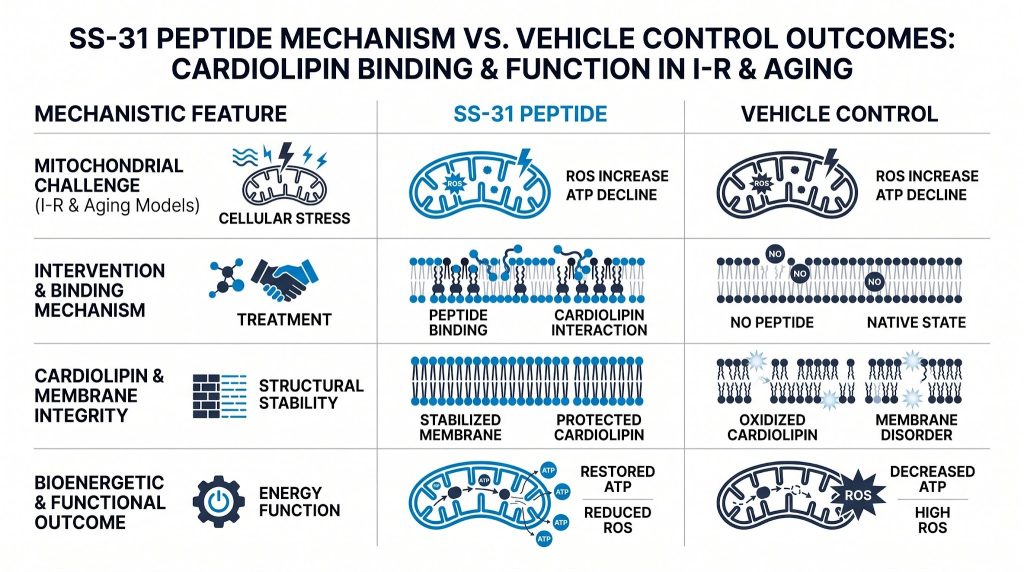
Ischemia-reperfusion (I-R) injury occurs when blood flow stops and then returns. The return of blood (reperfusion) triggers ROS that damage the ETC. Cardiolipin is a primary target in this cascade.
According to PNAS (2011), SS-31 preserved mitochondrial cristae structure in a mouse cardiac I-R model. Cristae are inner membrane folds where ETC complexes sit. The SS-31 group also showed higher ATP synthesis rates than controls. Vehicle-treated mice had collapsed cristae and low ATP output. The study linked both outcomes to cardiolipin support. Stable cardiolipin kept cristae intact. It also kept ETC complexes active. This I-R model remains one of the most cited in SS-31 research.Shop research-grade SS-31 at Next Level Pharm
What Do Aging Model Studies Show?
Mitochondrial function declines with age. ROS output rises and ETC respiration rates fall. Skeletal muscle is one of the most studied tissues in this context.
According to Cell Metabolism (2018), SS-31 improved in vitro mitochondrial respiration in muscle fibers from aged mice. State 3 respiration (active ATP synthesis) was higher in the SS-31 group. ROS output was lower compared to vehicle-treated aged muscle. The study authors proposed ETC complex restoration as the cause. Cardiolipin support was the proposed pathway. The aged vehicle group showed low State 3 rates and high ROS output. The SS-31 group reversed both findings.
What Purity Standards Apply to Research-Grade SS-31?
SS-31 includes a D-amino acid (D-Arg) and the modified residue Dmt. These two features add synthesis steps. Each step is a point where errors can occur. Standard HPLC checks purity above 99%. Mass spec confirms the molecular weight. It also verifies that D-Arg and Dmt are both present and correct.
A lot-specific COA ties HPLC and mass spec data to a batch number. This lets experts trace each sample back to its test results. In mitochondrial ROS studies, trace impurities can alter membrane potential readings. They can also shift ROS assay baselines. The 99% threshold limits these sources of error. Next Level Pharm provides COA-verified SS-31 with full HPLC and mass spec data per batch. Labs can also browse recovery peptides for related COA-tested compounds. Each vial ships as a lyophilized powder stable at room temperature during transit. A lot-specific COA links the HPLC trace and mass spec data to the exact vial in the researcher’s order.
How Does SS-31 Compare to Other Membrane-Targeted Peptides?
SS-31 targets cardiolipin through electrostatic and hydrophobic binding. It concentrates at the inner membrane without relying on mitochondrial membrane potential. That targeting approach differs from potential-dependent compounds. Those compounds lose uptake when membrane potential drops during injury. A 2014 study in Biochimica et Biophysica Acta compared cardiolipin-targeting mechanisms across peptide families. It found that charge-based inner membrane retention offered a higher level at the ETC site.
SS-31 also uses a D-amino acid at the arginine position. That change makes it more stable against enzymatic breakdown in model systems. The Dmt residue adds a hydrophobic anchor. Together, these two design features allow the peptide to reach the cardiolipin-rich cristae junction region. ETC complexes are densest at that site.
| Model Type | Study Year | Key Outcome | Citation |
| Cardiac I-R (mouse) | 2011 | Preserved cristae structure, higher ATP output | PNAS 2011 |
| Skeletal muscle aging | 2018 | Higher State 3 respiration, lower ROS | Cell Metabolism 2018 |
| Renal I-R (rat) | 2020 | Lower oxidative damage markers | J Pharmacol 2020 |
| Neuronal oxidative stress | 2019 | Reduced cytochrome c release | Neurobiol Aging 2019 |
Frequently Asked Questions
What is the SS-31 peptide?
SS-31 is a synthetic tetrapeptide with the sequence D-Arg-Dmt-Lys-Phe-NH2. It belongs to the Szeto-Schiller peptide family. The peptide carries a net positive charge. That charge drives it to the inner mitochondrial membrane. It binds cardiolipin once there. Research-grade SS-31 is used in lab models of oxidative stress, I-R injury, and mitochondrial aging. It is not approved for human use. The D-Arg residue adds a positive charge at physiological pH. That charge drives it toward the negatively charged inner mitochondrial membrane.
How does SS-31 target the inner mitochondrial membrane?
The inner mitochondrial membrane holds a large negative charge. SS-31 carries a net positive charge from D-Arg and Lys. This pulls the peptide across the outer membrane and toward the inner one. The Dmt residue then inserts into the hydrophobic cardiolipin acyl chain region. This anchors SS-31 at the cardiolipin-rich ETC complex zones. The targeting is charge-driven and does not need a transporter protein.
What is cardiolipin and why does it matter?
Cardiolipin is a phospholipid found almost only in the inner mitochondrial membrane. It has two phosphate groups and four fatty acid tails. ETC complexes I, III, IV, and V all rely on it for structural support. When cardiolipin is peroxidized, ETC complexes break apart. ATP output falls and ROS rises. SS-31 binds cardiolipin and supports it against peroxidation in cell and animal model studies.
What do the ischemia-reperfusion studies report?
According to PNAS (2011), SS-31 preserved cristae structure in a mouse cardiac I-R model. Cristae are the inner membrane folds that hold ETC complexes. Vehicle-treated mice had collapsed cristae and low ATP output. The SS-31 group showed intact cristae and higher ATP synthesis rates. The study linked both outcomes to cardiolipin support. This is one of the most cited findings in SS-31 research.
Has SS-31 been studied in aging models?
Yes. According to Cell Metabolism (2018), SS-31 improved mitochondrial respiration in aged mouse skeletal muscle. The SS-31 group showed higher State 3 respiration rates than vehicle controls. ROS output was lower in the treated group. The study proposed ETC complex restoration via cardiolipin support as the cause. State 3 respiration reflects active ATP synthesis under load. Both metrics improved with SS-31 treatment.
What purity standard applies to research-grade SS-31?
Research-grade SS-31 requires at least 99% HPLC purity. The sequence includes D-Arg and the Dmt residue. Both add synthesis complexity. Mass spec confirms the correct molecular weight. It also checks that both modifications are present. A lot-specific COA provides HPLC and mass spec data tied to a batch number. This is the tracking standard for rigorous mitochondrial research. D-amino acid verification matters. L-Arg and D-Arg share the same molecular weight. Chiral methods confirm D-configuration is correctly incorporated.
Does SS-31 scavenge all cellular ROS?
No. SS-31 acts at the inner mitochondrial membrane. It supports cardiolipin and keeps ETC complexes organized. This cuts ROS generated by ETC dysfunction. It does not scavenge ROS broadly across the cell. Cytosolic or nuclear ROS are not its primary target. This selectivity matters for study design. Experts should not expect SS-31 to suppress all oxidative stress markers outside the mitochondrial compartment.
Is SS-31 approved for human use?
No. SS-31 is a research-grade compound. All studies cited here used cell or rodent models. It is not approved by any regulatory agency for therapeutic or diagnostic use. It should not be given to humans outside a licensed clinical trial with proper oversight. SS-31 is available for laboratory research only. The compound is stored as a lyophilized powder. It ships from a US-based facility with lot-specific COA documentation. All 50 states can receive research-grade SS-31 with standard shipping.
Summary
SS-31 is a synthetic tetrapeptide that targets the inner mitochondrial membrane. It binds cardiolipin through electrostatic and hydrophobic forces. This supports ETC complexes and cuts ROS at the source.
Published animal studies link SS-31 to preserved cristae and higher ATP in cardiac I-R models. Aging skeletal muscle studies show higher State 3 respiration and lower ROS output. Both effects trace to cardiolipin support.
Research-grade SS-31 needs at least 99% HPLC purity and mass spec confirmation of the D-Arg and Dmt residues. A lot-specific COA ensures full tracking for lab use.
What Should You Do Next?
Experts working with mitochondrial oxidative stress models can follow these steps.
First, review the 2011 PNAS and 2018 Cell Metabolism studies. They list the SS-31 parameters used in mouse models. Second, confirm the supplier provides HPLC purity data and mass spec per batch. Third, request a lot-specific COA with batch number for lab records.
Shop research-grade SS-31 at Next Level Pharm for COA-verified options with full HPLC and mass spec data on every batch. Browse the recovery peptide category for related mitochondria-targeted compounds.
People Also Read
About the Author
Next Level Pharm Research Team
Alex M covers peer-reviewed findings in peptide science for Next Level Pharm, a US-based supplier of research-grade peptides verified to ≥99% purity via HPLC and mass spectrometry on every batch.
Disclaimer: The information provided on this page is for educational and research purposes only. Next Level Pharm’s products are intended for laboratory research use only. They are not intended for human consumption, diagnostic, therapeutic, or medicinal purposes. This content does not constitute medical advice. Always consult a licensed healthcare professional before making any health-related decisions.