What Is BAC Water? Bacteriostatic Water in Peptide Research

Last updated: May 2026
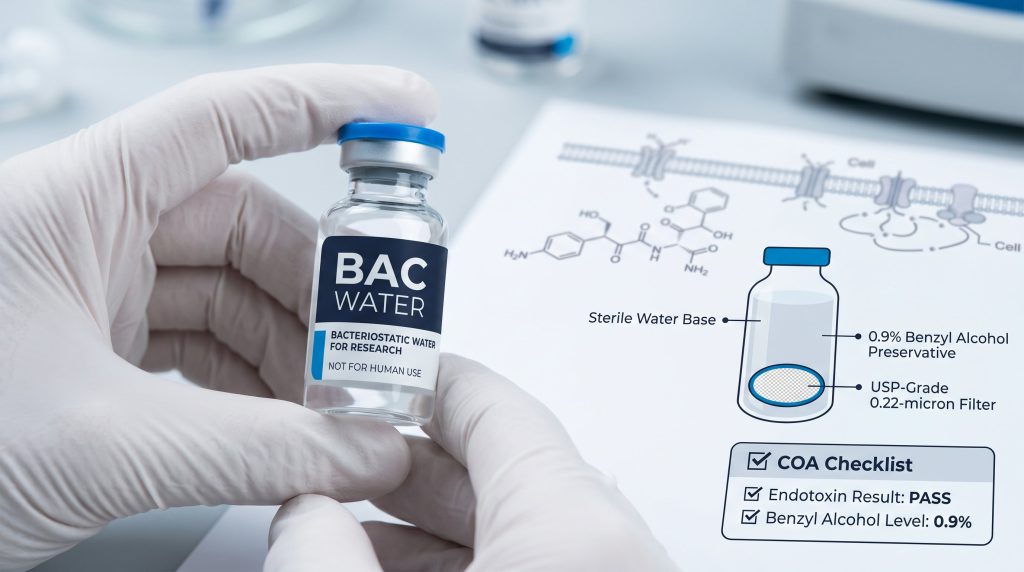
A BAC water research protocol studies bacteriostatic water as a laboratory solvent. Bacteriostatic water is sterile water with 0.9% benzyl alcohol added. Benzyl alcohol is a preservative. It stops germs from growing in the vial. According to the National Library of Medicine StatPearls (2023), BAC water is defined by its benzyl alcohol content and multi-access use in laboratory settings. These traits make it a subject of solvent quality research.
Next Level Pharm supplies USP-grade BAC water with HPLC-verified benzyl alcohol content. Endotoxin levels are checked by LAL assay on each batch. A Certificate of Analysis (COA) ships with every order.
BAC water quality depends on its chemical makeup and production standards. The sections below cover each key property in depth.
Key Takeaways
- Preservative Mechanism: BAC water has 0.9% benzyl alcohol. This stops germ growth in open vials during lab use.
- USP-Grade Standard: Research-grade BAC water meets United States Pharmacopeia (USP) specs for sterility, endotoxin limits, and benzyl alcohol level.
- Shelf Life Advantage: The benzyl alcohol preservative keeps open solutions usable longer than single-use sterile water.
- Lot-Level Verification: Each lot is tested by HPLC, LAL assay, sterility check. Particle count before a COA is issued.
- Research Scope: BAC water is studied as a lab-grade solvent for controlled scientific work. It is not for human use.
The sections below study each property in depth, drawing on USP standards and published preservative research.
What Is Bacteriostatic Water and How Does It Work?
BAC water is simple in concept, and bAC water is simple in concept. BAC water is simple in concept, and bAC water is simple in concept. BAC water is sterile water with 0.9% benzyl alcohol. This level stops germs from growing, and it does not kill all microbes. This sets it apart from autoclaved or single-use sterile water. The key is the 0.9% level, and it stops germs. It does not kill them.
Benzyl alcohol disrupts bacterial cell walls, and it blocks the germ from growing. According to a review in the International Journal of Pharmaceutics (2020), 0.9% benzyl alcohol stops growth in a wide range of lab germs. The 0.9% level is set by USP guidance as the right threshold for multi-access water solutions. This makes BAC water a subject of laboratory solvent quality and stability research.
What Sets BAC Water Apart From Sterile Water?
The gap is clear, and the gap is clear. The gap is clear, and the gap is clear. Sterile water has no added preservatives, and it is made for single-use only. BAC water adds 0.9% benzyl alcohol. This keeps the vial protected across multiple accesses. One vial can be used more than once. The other cannot.
In laboratory settings, researchers often access the same vial many times. Sterile water loses protection after the first access. There is no preservative to stop germ growth after that point. BAC water stays protected for up to 28 days after opening. According to the National Library of Medicine StatPearls (2023), the USP has separate standards for each water type. These cover different tests for preservatives and endotoxins.
Why Does Purity Matter in Research-Grade BAC Water?
Purity is the core issue, and purity is the core issue. Purity is the core issue, and purity is the core issue. Trace impurities in laboratory solvents add unwanted factors to research data. For BAC water, three purity concerns stand out. Each test checks one key risk, and all three must pass.
Each impurity poses a specific risk:
- Endotoxins: LPS (cell toxin) fragments from gram-negative bacteria. At low levels, they can skew results in cell-based assay systems.
- Tiny particles: Particles from 2 to 100 microns. These can block filters and affect light-based assays.
- Off-spec benzyl alcohol: Below 0.8%, germ control weakens. Above 1.1%, some cell research systems may be affected.
Third-party testing for all three parameters supports traceable laboratory sourcing. Next Level Pharm provides lot-specific COA data with every BAC water shipment. This covers LAL endotoxin results, HPLC benzyl alcohol data, and sterility test outcomes.
How Is Research-Grade BAC Water Produced and Tested?
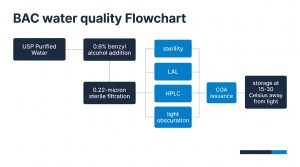
The steps are set by USP, and the steps are set by USP. The steps are set by USP, and the steps are set by USP. USP-grade BAC water starts with USP Purified Water. This meets limits for conductivity, carbon content, and germ counts. Benzyl alcohol is then added to reach the 0.9% target. The solution is filtered through a 0.22-micron membrane. Each step is checked. No lot of ships without a clean COA.
Final lot testing has four stages. First, sterility testing confirms no microbial growth. Second, the LAL assay measures endotoxin content. Third, HPLC testing checks benzyl alcohol levels. Fourth, light obscuration counts tiny particles. According to USP verification standards (2023), each test must pass before a lot gets its COA.
| Quality Parameter | Test Method | USP Limit |
| Sterility | USP sterility test | No microbial growth |
| Endotoxins | LAL assay | <0.5 EU/mL |
| Benzyl alcohol | HPLC | 0.9% (within 10%) |
| Particulates (10 micron) | Light obscuration | <6,000 per container |
| Particulates (25 micron) | Light obscuration | <600 per container |
| pH | pH meter | 4.5 to 7.0 |
Researchers should request lot-specific COA data before use. A complete COA shows each test result for that specific batch.
What Storage Conditions Does BAC Water Need?
BAC water is stable at room temperature between 15 and 30 degrees Celsius. It does not need cooling. Temperatures above 30 degrees break down benzyl alcohol faster. This reduces the preservative effect over time.
Light is also a concern. UV light breaks down benzyl alcohol into benzaldehyde and benzoic acid. As benzyl alcohol drops below its minimum level, germ control weakens. Amber glass vials or opaque packaging help prevent this. After opening, store vials at the correct temperature. Use within the stability window listed on the COA.
Shop research-grade solvents to view available BAC water lots with full COA data and stability details.
Why Does Benzyl Alcohol Concentration Matter for Research?
The level is key, and the level is key. The level is key, and the level is key. Benzyl alcohol level drives both germ control and safety for lab use. Below 0.8%, protection weakens against many gram-negative germs. Above 1.1%, some research cell systems may be affected. Too low and germs can grow. Too high and lab work is skewed.
The 0.9% level balances germ control with low impact on laboratory systems. HPLC testing of each lot confirms the 0.9% target was reached. Steady benzyl alcohol content from lot to lot reflects strong process control.
Key quality factors for researchers to review:
- Minimum level: 0.8% for most gram-positive and gram-negative lab germs.
- HPLC spec: 0.9% with a 10% tolerance, giving a range of 0.81% to 0.99%.
- Breakdown markers: benzaldehyde and benzoic acid in HPLC data signal old or degraded lots.
For more on sourcing standards, see the guide on buying research-grade materials.
Frequently Asked Questions
What is bacteriostatic water and why is it used in research?
BAC water is sterile water with 0.9% benzyl alcohol as a preservative. The benzyl alcohol stops germ growth without killing all microbes. This keeps the vial usable across multiple lab accesses. Research labs source BAC water as a solvent for controlled work where the same solution is accessed more than once. COA data confirms sterility, endotoxin levels. Benzyl alcohol content at the time of manufacture.
What concentration of benzyl alcohol is in BAC water?
Standard BAC water contains 0.9% benzyl alcohol by volume. USP guidance sets this level as effective for germ control in multi-access water solutions. A COA confirms that the benzyl alcohol content in each lot falls within the accepted range. The standard tolerance is plus or minus 10% of the 0.9% target, giving a range of 0.81% to 0.99%.
How long is BAC water stable after opening?
Properly stored BAC water stays effective for up to 28 days after the first access. Storage temperature must stay between 15 and 30 degrees Celsius. Light exposure must also be limited. Stability depends on benzyl alcohol staying above its minimum control level. The COA for each lot includes an expiration date based on stability testing data.
What is the difference between BAC water and sterile water for injection?
Sterile water for injection has no preservatives and is for single-use only. Opening the vial introduces germ risk that nothing can stop after that point. The contents must be used at once. BAC water adds benzyl alcohol to protect the vial across multiple accesses. The USP has separate standards for each type with different tests for preservatives and endotoxins.
Is USP-grade certification necessary for research-grade BAC water?
USP-grade certification is the top quality standard for research solvents. It sets tested limits for endotoxins, sterility, particle counts, benzyl alcohol level, and pH. Labs that need high the same results each time benefit from this level of records. Lot-level COA data from a USP-grade source supports tracking and audit needs in research settings.
What impurities can affect BAC water quality?
Three impurities matter most: endotoxins, tiny particles, and off-spec benzyl alcohol. Endotoxins are measured by LAL assay in endotoxin units (EU) per mL. The USP limit is below 0.5 EU per mL. Tiny particles are counted by light obscuration testing. Off-spec benzyl alcohol signals mixing errors or degradation. Any impurity above spec can affect the quality of research preparations.
How does endotoxin testing work for BAC water?
Endotoxin testing uses the LAL assay. The LAL reagent reacts with LPS fragments from gram-negative bacteria. Results are in the EU per mL. The USP limit for injectable-grade water is below 0.5 EU per mL. BAC water that passes LAL testing at or below this level gives labs a low-endotoxin solvent baseline. This helps limit germ-related factors in cell-based and laboratory research work.
Can BAC water be stored at room temperature without cooling?
BAC water is designed for room temperature storage between 15 and 30 degrees Celsius. No cooling is needed. Sustained temperatures above 30 degrees Celsius break down benzyl alcohol faster. This reduces germ control over time. Amber glass vials or opaque packaging protect benzyl alcohol from UV light during storage between lab uses.
What should researchers verify in a BAC water COA?
A complete BAC water COA should list five results. These are HPLC benzyl alcohol at 0.9% and LAL endotoxin below 0.5 EU per mL. Also check sterility results with no growth, light obscuration particle counts. PH between 4.5 and 7.0. The lot number with manufacturing and expiration dates should also appear. Verifying these before first use keeps solvent quality proven in the study record.
Is BAC water intended for human use?
BAC water for laboratory research is for research use only. It is not for human use or diagnostic purposes. Research-grade solvents are for use by qualified researchers in licensed laboratory settings only. This material should not be used outside a qualified research environment.
Summary
Bacteriostatic water is a USP-defined laboratory solvent with 0.9% benzyl alcohol. It stops germ growth in water solutions that researchers access more than once. Quality is governed by USP standards for sterility, endotoxin limits, benzyl alcohol level, and particle counts. Each result is proven in the COA for every certified lot.
Research teams should check endotoxin levels, sterility results. Benzyl alcohol content before use. COA-verified, USP-grade lots with full quality data support traceable laboratory research.
What Should You Do Next?
Researchers sourcing research-grade solvents should review the COA for each lot before first use. Key checks include: benzyl alcohol at 0.9%, LAL endotoxin below 0.5 EU per mL, and sterility results. Store vials at 15 to 30 degrees Celsius, away from direct light, to stay within the stability window.
Shop research-grade BAC water at Next Level Pharm to see lot-specific COA data, HPLC benzyl alcohol results. Endotoxin outcomes for each production batch. Free shipping on orders over $150 within the United States.
People Also Read
- How to Read a Peptide COA: What Purity Results and Mass Spec Data Mean
- What Is Lyophilization? How Freeze-Drying Preserves Peptide Integrity
About the Author
Next Level Pharm Research Team
Alex M covers peer-reviewed findings in peptide science for Next Level Pharm, a US-based supplier of research-grade peptides verified to >=99% purity via HPLC and mass spectrometry on every batch.
Disclaimer: The information provided on this page is for educational and research purposes only. Next Level Pharm’s products are intended for laboratory research use only. They are not intended for human consumption, diagnostic, therapeutic, or medicinal purposes. This content does not constitute medical advice. Always consult a licensed healthcare professional before making any health-related decisions