
ACE-031 Research: Myostatin Inhibitor and Muscle Studies

Last updated: June 2026
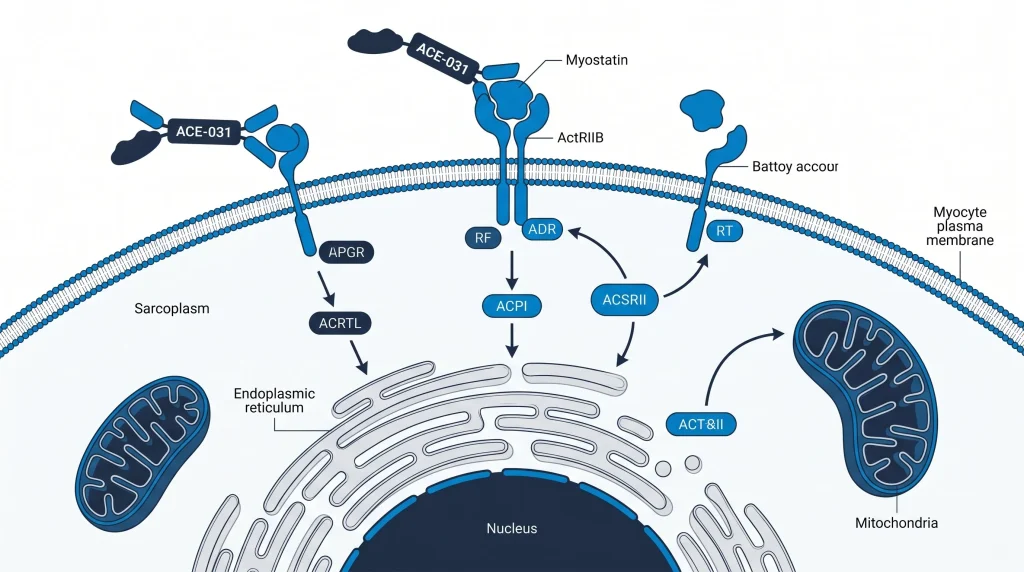
An ACE-031 research compound is a lab-made fusion protein designed to block myostatin. Myostatin is a natural signal that limits how much muscle the body builds. ACE-031 targets the receptor that myostatin binds to, stopping it before it reaches muscle cells. According to a record on ClinicalTrials.gov (2010), a single administration raised lean mass by about 5% in healthy adult volunteers over 85 days.
Next Level Pharm stocks ACE-031 as a lyophilized research compound. Lyophilized means freeze-dried for stable room-temperature shipping. Every vial is tested to >=99% purity via HPLC and mass spectrometry. HPLC is a lab method that checks compound purity. Mass spectrometry confirms the exact molecular weight. A COA, or certificate of analysis, ships with every order. The average purity across the last 100 batches is 99.4%.
Scientists studying muscle loss have used ACE-031 to explore the full ActRIIB ligand pathway. ActRIIB is the main cell receptor for myostatin and several related signals. ACE-031 blocks all of these at once. This makes it useful for studying how the whole ligand family controls muscle mass.
Key Takeaway
- Mechanism: ACE-031 acts as a decoy receptor. It binds myostatin and related TGF-beta signals before they reach muscle cells, stopping the growth-limiting cascade.
- Preclinical data: Rodent disease models showed lean mass gains of up to 30% with ACE-031 treatment. Muscle fiber health and grip strength also improved in these studies.
- Clinical history: A Phase 2 trial in Duchenne muscular dystrophy was paused in 2013. Some participants developed vascular effects linked to activin A suppression.
- Ligand breadth: ACE-031 blocks myostatin plus activin A, activin B, and GDF-11. This is a wider target profile than most myostatin antibodies.
- Purity standard: ACE-031 is verified to >=99% purity on every batch. HPLC and mass spectrometry run on every vial before shipment.
ACE-031 gives researchers a way to study what happens when the full ActRIIB ligand family is blocked. This differs from single-target myostatin antibodies. The difference in effect size and side effect profile between broad and narrow blockade has been a key area of study. The Phase 2 vascular data changed how researchers think about full ActRIIB blockade. The finding that activin A affects both muscle and blood vessel biology drove interest in more selective approaches. Later compounds tried to keep the muscle benefit while reducing systemic vascular exposure.
What Is ACE-031 and How Does It Work?
ACE-031 is a recombinant ActRIIB-Fc fusion protein. Recombinant means it is made using gene-splicing methods in a lab cell line. It has two main parts. The first is the outer binding region of ActRIIB. The second is an Fc region from human immunoglobulin G1. The Fc part keeps the compound active longer in the body.
The outer ActRIIB region binds myostatin in solution. It does this before myostatin can reach muscle cells. Once myostatin is captured, it cannot attach to the real ActRIIB receptor on muscle. The growth-limiting signal is blocked. ACE-031 also captures activin A, activin B, and GDF-11 through the same binding region. These are related TGF-beta ligands that also use ActRIIB. According to research in NCBI (2012), the broad ligand capture profile is what distinguishes ACE-031 from earlier myostatin-specific antibodies.
What Did Animal Studies on ACE-031 Show?
Animal studies showed large lean mass gains with ACE-031. Rodent models of Duchenne muscular dystrophy showed mass increases of up to 30% over multi-week treatment periods. Grip strength improved in these same models. Muscle fiber damage also went down compared to untreated controls.
Bone density markers rose in several experiments. This pointed to shared ActRIIB ligand control over both muscle and bone pathways. According to research published in PubMed (2011), mdx mice treated with ActRIIB-Fc showed better muscle function at 12 weeks than controls. The mdx mouse is a standard lab model for Duchenne muscular dystrophy research. These preclinical results were strong enough to support human trial design at Acceleron Pharma.
What Did the ACE-031 Clinical Trials Show?
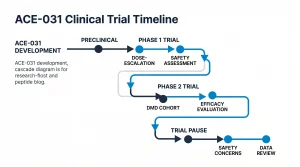
Acceleron Pharma ran a Phase 1 study in healthy adult volunteers. The trial ID is NCT00952887 on ClinicalTrials.gov. Single amounts ranged from 0.01 mg/kg to 3 mg/kg. The 1 mg/kg and 3 mg/kg groups showed clear lean mass increases. Bone mineral density markers also rose in higher amount groups. Researchers measured these outcomes at 85 days after administration.
A Phase 2 trial in boys with Duchenne muscular dystrophy followed. The trial ID is NCT01099761. This study tested safety and early evidence of muscle preservation. The trial was paused in 2013. Some participants developed telangiectasias. These are small clusters of dilated blood vessels near the skin surface. Nosebleeds also appeared in some participants. Researchers found these effects were linked to activin A suppression. Activin A plays a role in blood vessel maintenance. Broad ActRIIB blockade affected this pathway alongside muscle signaling.
How Does ACE-031 Compare to Myostatin Antibodies?
Myostatin antibodies bind only myostatin. ACE-031 binds myostatin plus activin A, activin B, and GDF-11. This broader capture produces larger muscle gains in animal studies. It also carries more off-target risk, as the Phase 2 vascular data showed.
Researchers have used this difference to study how much of muscle regulation depends on myostatin alone versus the full ActRIIB family. Studies comparing ACE-031 with stamulumab, an anti-myostatin antibody, have helped clarify that multiple signals share the ActRIIB pathway. The broad approach increases muscle response but also impacts blood vessel biology. Researchers exploring these differences can browse fitness and GH research compounds in the research catalog.
What Parameters Have Been Used in ACE-031 Research?
The Phase 1 protocol used single subcutaneous injections. Subcutaneous means under the skin. Amounts ranged from 0.01 mg/kg to 3 mg/kg in adult volunteers. The 3 mg/kg cohort showed the largest lean mass and bone marker changes. Researchers measured outcomes at days 29, 57, and 85 after administration.
Published protocol data includes reconstitution procedures and storage conditions used in the original trials. Researchers in cell studies and rodent models typically adapt these parameters to their specific model. In vitro concentrations used in cell culture differ from the in vivo amounts studied in clinical trials. Researchers sourcing ACE-031 can view lot-specific COA data for the current batch before beginning their study.
ACE-031 is for laboratory research only. It is not intended for human injection, internal administration, or any human application. Researchers designing in vitro or animal studies should consult the primary literature for relevant protocol details.
What Are the Structural Features of ACE-031?
ACE-031 is a dimeric glycoprotein. Dimeric means it consists of two linked protein chains. Glycoprotein means it has sugar chains attached. Its molecular weight is about 110 to 115 kDa. This is much larger than typical small research peptides.
Because of its size, ACE-031 does not enter cells. It acts only outside cell membranes. This limits its effect to extracellular ligand capture. The lyophilized form is stable at room temperature during shipping. Researchers reconstitute it in aqueous buffer for use in cell or animal studies. The Fc region extends its half-life, which is why single-administration effects in human trials lasted several weeks. The large molecular weight also means standard small-molecule analysis methods do not apply. Mass spectrometry is essential for confirming the identity of fusion proteins at this scale.
Which Compounds Are Related to ACE-031 in Research?
| Compound | Type | Ligands Blocked | Trial Status |
| ACE-031 | ActRIIB-Fc fusion protein | Myostatin, activin A, GDF-11 | Phase 2 paused (2013) |
| ACE-083 | Local ActRIIB-Fc | Myostatin (local muscle) | Phase 2 completed |
| Stamulumab | Anti-myostatin antibody | Myostatin only | Phase 2 completed |
| Landogrozumab | Anti-myostatin antibody | Myostatin only | Phase 2 completed |
| Follistatin | Endogenous protein | Myostatin, activins | Preclinical only |
Frequently Asked Questions
What is ACE-031 used for in research?
ACE-031 has been studied in the context of muscle-wasting diseases, mainly Duchenne muscular dystrophy. Lab studies used it to explore how blocking the ActRIIB ligand family affects lean mass, bone density, and muscle fiber health. It is a research tool for cell and animal studies. It is for verified laboratory use only, not a clinical treatment, and is not for human application.
How does ACE-031 work as a myostatin inhibitor?
ACE-031 mimics the outer region of the ActRIIB receptor. It floats in solution and captures myostatin before myostatin can reach muscle cells. This stops the signal that limits muscle growth. ACE-031 also captures activin A, activin B, and GDF-11. These related signals all use the ActRIIB pathway. The result is broader TGF-beta blockade than myostatin-only antibodies can achieve.
What did the Phase 1 ACE-031 study find?
The Phase 1 study tested single administrations in healthy adults. Amounts ranged from 0.01 mg/kg to 3 mg/kg. Higher amount groups showed about a 5% rise in lean mass over 85 days. Bone mineral density markers also increased in these cohorts. Researchers viewed the results as early support for the idea that systemic ActRIIB blockade can change body composition. The study helped set the amount range for the Phase 2 DMD trial.
Why was the ACE-031 Phase 2 trial paused?
The Phase 2 trial in Duchenne muscular dystrophy was paused in 2013. Some participants developed telangiectasias, which are small clusters of dilated vessels near the skin. Nosebleeds also appeared in a subset. Researchers linked these effects to ACE-031 suppressing activin A. Activin A helps regulate blood vessels. Broad ActRIIB blockade disrupted this pathway alongside muscle signaling.
How does ACE-031 differ from ACE-083?
ACE-031 is a systemic compound. It circulates throughout the body and blocks ActRIIB ligands broadly. ACE-083 is a modified version designed for local muscle injection. It targets a specific muscle with less systemic exposure. ACE-083 completed a Phase 2 trial in facioscapulohumeral muscular dystrophy. The two compounds differ in delivery method, ligand binding range, and clinical development history.
How does ACE-031 compare to follistatin?
Both ACE-031 and follistatin block ActRIIB ligands including myostatin. Follistatin is a natural protein the body produces. ACE-031 is a lab-made fusion protein with a defined structure and longer half-life. ACE-031 was tested via injection in clinical trials. Follistatin research has mostly used gene therapy methods. Neither compound is approved for human therapeutic use.
What purity level should research-grade ACE-031 meet?
Research-grade ACE-031 should be tested by HPLC and mass spectrometry on every batch. HPLC measures purity as a percentage of the total compound. Mass spectrometry confirms the molecular weight matches the expected value. Both tests run on every vial and a COA ships with each order. The average purity across the last 100 batches is 99.4%.
Where can researchers source ACE-031 for lab studies?
Next Level Pharm stocks research-grade ACE-031 verified to >=99% purity. Every order includes a COA with lot number and purity data. The compound is lyophilized for stable room-temperature shipping within the USA. Researchers can shop research peptides and confirm purity data on every lot before beginning their study. USA storage and approximately 48-hour average dispatch are standard.
Summary
ACE-031 is a lab-made fusion protein that blocks myostatin and related ActRIIB ligands by acting as a decoy receptor in solution. Preclinical data in rodent disease models showed lean mass gains of up to 30%. A Phase 1 study confirmed a 5% lean mass rise from a single administration.
A Phase 2 trial in Duchenne muscular dystrophy was paused in 2013 after vascular effects appeared. Broad ActRIIB blockade affected activin A, a signal also involved in blood vessel control. The findings shaped the design of later, more targeted compounds.
Researchers sourcing ACE-031 for laboratory work should verify purity via HPLC and mass spectrometry on every batch. COA-verified, lyophilized ACE-031 at >=99% purity with USA storage and fast dispatch is available for laboratory research. A lot number and full COA ship with every order.
What Should You Do Next?
Read the published Phase 1 data at ClinicalTrials.gov (NCT00952887) for the amount ranges used in ACE-031 human research. Review the Phase 2 record at NCT01099761 for the trial design and vascular safety findings. When you are ready to source compound for your studies, shop research peptides and confirm purity on every lot.
Related research: muscle bioregulator and myostatin research, IGF-1 LR3 vs MGF muscle research, and MGF (mechano growth factor) research.
People Also Read
About the Author
Next Level Pharm Research Team
Alex M covers peer-reviewed findings in peptide science for Next Level Pharm, a US-based supplier of research-grade peptides verified to >=99% purity via HPLC and mass spectrometry on every batch.
Disclaimer: The information provided on this page is for educational and research purposes only. Next Level Pharm’s products are intended for laboratory research use only. They are not intended for human consumption, diagnostic, therapeutic, or medicinal purposes. This content does not constitute medical advice. Always consult a licensed healthcare professional before making any health-related decisions.