
Thymus Bioregulator Research: Peptide Immunomodulation

Last updated: July 2026
A thymus bioregulator is a short peptide studied for effects on immune cell gene activity. The thymus is a gland near the heart. It trains T-cells (immune cells) from precursor cells that come from bone marrow. Short peptides are studied for how they change gene markers in T-cells and B-cells. According to Khavinson et al. (2002) (PMID 11756978), short bioregulator peptides showed tissue-specific gene expression changes in immune cell models. All cited data come from cell and animal studies.
Next Level Pharm is a US-based supplier of research-grade peptides. Thymalin, Epithalon, Selank, and KPV are available as COA-verified research compounds. Each lot is tested to ≥99% purity by HPLC and mass spec. The average purity across the last 100 batches is 99.4%.
These compounds are not approved drugs. They are studied only in cell and animal models. All findings cited here come from such models.
Key Takeaways
- Thymalin Is a Thymus Bioregulator: Thymalin is a peptide preparation linked to the thymus gland. It is studied for effects on T-cell and B-cell maturation markers in animal models.
- Epithalon Is a Pineal Bioregulator: Epithalon is a 4-amino acid peptide (Ala-Glu-Asp-Gly). It is studied for immune aging markers and telomerase (cell renewal enzyme) activity.
- Selank Is a Tuftsin Analog: Selank is a 7-amino acid peptide. Tuftsin is a natural immune signal. Selank is studied for immune cell signaling markers in cell models.
- KPV Is an Anti-Inflammatory Tripeptide: KPV (Lys-Pro-Val) is a 3-amino acid peptide. It is studied for effects on NF-kB (an inflammation gene switch) in immune and kidney cell models.
- All Findings Come from Cell and Animal Models: Human clinical data have not been established. These compounds are for lab research use only.
Researchers use these peptides to study how short amino acid chains change immune cell gene activity. The results guide further thymus biology research.
What Are Thymus Bioregulators?
A thymus bioregulator is a peptide studied for effects on immune cell gene activity in cell and animal models. These compounds are tested in T-cell lines, bone marrow cultures, and animal models. They are not approved drugs.
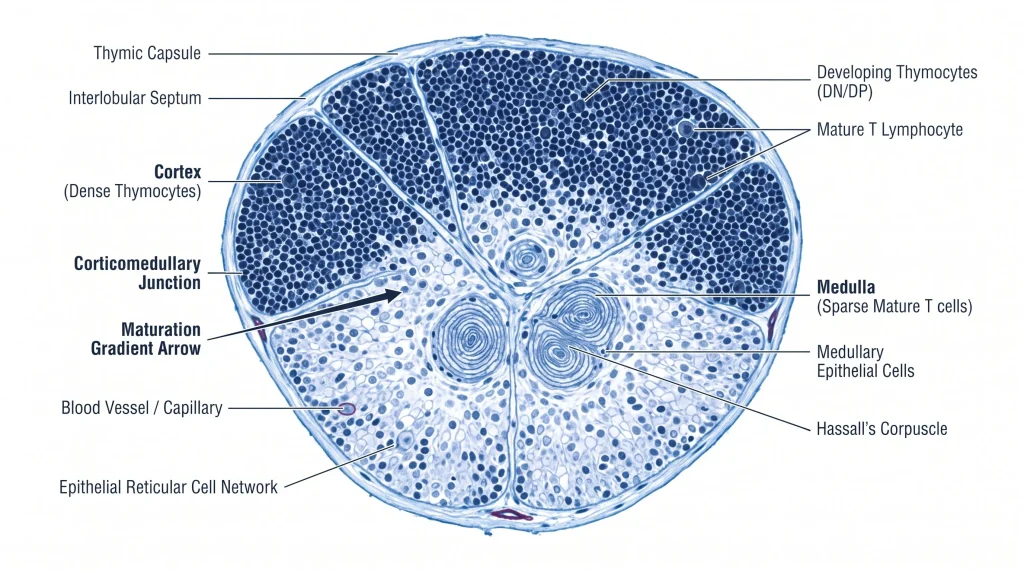
The thymus trains pre-T cells from bone marrow into mature T-cells. This training process is called thymic education. T-cells then circulate in blood and check body cells for signs of infection or damage. Peptides are studied for effects on this training process.
B-cells are a different immune cell type. They produce antibodies. B-cells also come from bone marrow. Some immune bioregulators are studied for effects on both T-cell and B-cell markers.
What Is Thymalin and How Is It Studied?
Thymalin is a peptide preparation derived from the thymus gland. It contains short peptides that are studied for effects on immune cell gene activity. It is linked to the thymus-derived bioregulator class in Khavinson research.
In animal models, Thymalin is studied for changes in T-cell and B-cell counts. Scientists measure surface markers on immune cells after treatment. CD3 marks T-cells. CD19 marks B-cells. CD4 and CD8 mark helper and cytotoxic T-cell subgroups.
Some animal models also track thymus weight and immune response markers after Thymalin exposure. All data come from animal models. They do not reflect results in humans.
Thymalin is available as a COA-verified research compound. Every lot is tested by HPLC and mass spec. Each vial ships with a COA and lot number.
What Is Epithalon and How Does It Work?
Epithalon is a 4-amino acid peptide. Its sequence is Ala-Glu-Asp-Gly. It was developed as part of the Khavinson bioregulator program. It is linked to the pineal gland, a small gland in the brain that makes melatonin.
Epithalon is studied for effects on telomerase (a cell renewal enzyme) in cell models. Telomerase helps rebuild the ends of chromosomes (called telomeres) after each cell division. Short telomeres are linked to cell aging in research models.
According to Anisimov VN et al. (2004) (PMID 15541768), Epithalon extended the life span of mice in animal models and changed markers of immune function and cell aging. These are animal model findings only.
Epithalon is available at Next Level Pharm as a COA-verified research compound. Every lot is tested to ≥99% purity. Each vial ships with a COA and lot number.
How Is Selank Related to Immune Research?
Selank is a 7-amino acid peptide derived from tuftsin. Tuftsin (Thr-Lys-Pro-Arg) is a natural tetrapeptide. It is cleaved from IgG (immune antibody) in the body. Tuftsin activates macrophages (immune scavenger cells) and other immune cells.
Selank extends the tuftsin core with three more amino acids. In cell models, Selank changed immune signaling markers. Scientists measured cytokine gene expression (cytokines are immune signal proteins) in treated cells.
Selank also is studied in CNS models (see CNS bioregulator research). In immune cell models, the tuftsin-derived core of Selank is the focus of immune signaling assays.
Selank is available as a COA-verified research compound. Each vial ships with a COA and lot number.
What Is KPV and What Immune Pathway Does It Target?
KPV is a tripeptide. Its sequence is Lys-Pro-Val. These three amino acids come from the C-terminal region of alpha-MSH (alpha-melanocyte stimulating hormone). KPV is studied for anti-inflammatory effects in cell models.
The key pathway for KPV is NF-kB. NF-kB (nuclear factor kappa-light-chain-enhancer of activated B cells) is a gene switch. When active, it turns on genes that make inflammatory cytokines. KPV is studied for effects on NF-kB activity in immune and intestinal cells.
According to Khavinson et al. (2011) (PMID 21757022), short peptides derived from larger protein sequences show tissue-specific gene activity changes in cell models. KPV studies use similar NF-kB reporter assays. All data come from in vitro studies.
KPV is available as a COA-verified research compound. Every lot is tested to ≥99% purity. Each vial ships with a COA and lot number.
How Do These Peptides Differ From Approved Immunomodulators?
Approved immunomodulators have completed human clinical trials. They have known safety and efficacy profiles. Examples include immune-suppressing drugs used after organ transplants or for autoimmune conditions.
Thymus research peptides have not completed human clinical trials. They are studied in cell and animal models only. Each targets a distinct step in immune biology. Thymalin targets T-cell maturation. Epithalon targets telomerase. KPV targets NF-kB.
Each mechanism is tracked with specific lab assays. T-cell markers are measured by flow cytometry. Telomerase is measured by TRAP assay (telomeric repeat amplification protocol). NF-kB activity is measured by reporter gene kits.
| Feature | Approved Immunomodulator | Thymus Research Peptide |
| Clinical status | FDA-approved | Research-stage (cell/animal models only) |
| Study model | Human clinical trials | Cell assay, animal model |
| Target | Established immune pathway | Gene expression or enzyme activity |
| Purity standard | Pharmaceutical-grade | ≥99% HPLC + mass spec |
| Availability | Prescription pharmacy | Research compound supplier |
| Application | Clinical care | Lab research only |
Frequently Asked Questions
What Are Thymus Bioregulators?
Thymus bioregulators are short peptides studied in cell and animal models for effects on immune cell gene activity. Key examples include Thymalin (thymus-derived, T-cell maturation markers), Epithalon (pineal gland bioregulator, telomerase activity), Selank (tuftsin analog, immune signaling), and KPV (anti-inflammatory, NF-kB pathway). Each targets a distinct step in immune cell biology. All data come from cell and animal studies. These compounds are for lab research use only.
What Is Thymalin?
Thymalin is a peptide preparation derived from thymus gland tissue. It is linked to the thymus-derived bioregulator class. In animal models, it is studied for changes in T-cell and B-cell surface markers. Scientists measure CD3, CD4, CD8, and CD19 markers after treatment. Some models track thymus weight and immune response gene markers. All data come from animal models. Thymalin is for lab research use only. It is not approved for human use.
What Is Epithalon?
Epithalon (Ala-Glu-Asp-Gly) is a 4-amino acid Khavinson bioregulator. It is linked to the pineal gland. In cell models, Epithalon is studied for effects on telomerase (cell renewal enzyme) activity. Telomerase rebuilds chromosome ends called telomeres after each cell division. In animal models, Epithalon changed immune aging markers. These are cell and animal model findings. Each batch is tested to ≥99% purity by HPLC and mass spec. For lab research use only.
What Is the Thymus Gland?
The thymus is a small gland near the heart. It trains pre-T cells from bone marrow into mature T-cells. This training process is called thymic education. Mature T-cells leave the thymus and circulate in blood. They check body cells for signs of infection or damage. The thymus is most active early in life. Peptide research uses the thymus biology framework to study how short compounds change T-cell gene markers in animal models.
What Is Tuftsin?
Tuftsin is a natural tetrapeptide (Thr-Lys-Pro-Arg). It is cleaved from IgG antibodies in the body. It is studied as a natural immune signal that activates macrophages (immune scavenger cells). Selank is a synthetic extension of the tuftsin core. Selank has three extra amino acids added to the tuftsin sequence. In cell models, Selank is studied for effects on immune cytokine gene markers. All data come from in vitro and animal models.
What Is Telomerase and Why Is It Studied?
Telomerase is an enzyme that rebuilds the ends of chromosomes called telomeres. Each time a cell divides, telomeres get a bit shorter. When telomeres get too short, the cell stops dividing. Telomerase rebuilds them so cells can keep dividing. In research, telomerase activity is a marker of cell aging and renewal rate. Epithalon is studied for effects on telomerase in cell models. All data come from in vitro and animal studies.
How Is NF-kB Linked to Immune Research?
NF-kB (nuclear factor kappa B) is a gene switch inside cells. When active, it turns on genes that make inflammatory cytokines. Cytokines are signal proteins that tell the immune system to activate. KPV is studied for effects on NF-kB activity in cell models. Lower NF-kB activity means fewer inflammatory cytokines in treated cells. Scientists use reporter gene kits to measure NF-kB changes. All data come from in vitro models.
What Are Cytokines?
Cytokines are small signal proteins made by immune cells. They tell other immune cells to activate, divide, or move. Key cytokines in research include IL-1 (interleukin-1), TNF-alpha, and IL-6. These cytokines are measured as gene expression markers in cell assays. Peptides like KPV and Selank are studied for changes in cytokine gene activity after exposure. All data come from cell and animal models. These are not clinical findings.
What Cell Models Are Used in Immune Research?
Common cell models include Jurkat cells (human T-cell line), THP-1 cells (human monocyte line), and HK-2 cells (kidney tubular cells for KPV studies). Animal models include mouse immune challenge models and aging rodent models for Epithalon. Scientists add the test peptide to cell cultures and measure gene and protein markers by ELISA or flow cytometry. All cited data in this article come from cell and animal model sources.
Are These Compounds Verified for Research Use?
Research-grade thymus immune peptides are tested by HPLC and mass spec per batch. HPLC confirms ≥99% purity for the target compound peak. Mass spec confirms molecular weight matches the expected amino acid sequence. A COA with lot number is provided per batch. All compounds are for lab research use only and are not for clinical or personal use of any kind.
Summary
Thymus bioregulators are short peptides studied in cell and animal models for effects on immune cell gene activity. Key compounds include Thymalin (T-cell maturation markers in animal models), Epithalon (telomerase activity and immune aging), Selank (tuftsin-derived immune signaling), and KPV (NF-kB anti-inflammatory pathway).
Each peptide targets a distinct step in immune biology. All cited findings come from cell and animal research. These compounds are not approved for human use. They are for lab research only.
What Should You Do Next?
Researchers studying thymus and immune cell biology should source verified compounds for lab protocols. Before any study, confirm HPLC purity is ≥99% and mass spec matches the expected molecular weight. Record the lot number from the COA for batch traceability.
Shop research peptides. Thymalin, Epithalon, Selank, and KPV are available with HPLC and mass spec data on every COA.
People Also Read
- Epithalon Research Explained: What Current Studies Show
- What Are Bioregulator Peptides? Mechanisms and Research
About the Author
Next Level Pharm Research Team
Alex M covers peer-reviewed findings in peptide science for Next Level Pharm, a US-based supplier of research-grade peptides verified to ≥99% purity via HPLC and mass spectrometry on every batch.
Disclaimer: The information provided on this page is for educational and research purposes only. Next Level Pharm products are intended for laboratory research use only. They are not intended for human consumption, diagnostic, therapeutic, or medicinal purposes. This content does not constitute medical advice. Always consult a licensed healthcare professional before making any health-related decisions.