Bone Marrow Bioregulator Research: Hematopoietic Peptide Studies

Last updated: July 2026
A bone marrow bioregulator is a short peptide studied for effects on blood cell gene activity. Bone marrow produces hematopoietic stem cells (blood-forming stem cells). These cells make all red cells, white cells, and platelets in the body. Short peptides are studied for how they change gene activity in these stem cells. According to Muzumdar et al. (2009) (PMID 19633672), humanin was shown to affect stem cell survival signals in cell models. All cited data come from cell and animal studies.
Next Level Pharm is a US-based supplier of research-grade peptides. Humanin, MOTS-c, and Thymalin are available as COA-verified compounds. Each lot is tested to ≥99% purity by HPLC and mass spec. The average purity across the last 100 batches is 99.4%.
Bone marrow research uses cell assays and animal models. It does not reflect results in humans. All compounds cited here are for lab research use only.
Key Takeaways
- Blood-Forming Stem Cells Produce All Blood Cells: Hematopoietic stem cells in bone marrow make red cells, white cells, and platelets. Peptide research tracks gene changes in these cells.
- Humanin Is a Mitochondrial Peptide: Humanin is a 21-amino acid peptide encoded in mitochondrial DNA. It is studied for effects on stem cell survival signals in cell models.
- MOTS-c Also Comes from Mitochondrial DNA: MOTS-c is a 16-amino acid peptide. It is studied for metabolic changes in blood-forming cells and skeletal muscle.
- Thymalin Links Thymus to Immune Cell Research: Thymalin is linked to the thymus gland. It is studied for effects on T-cell and B-cell maturation in animal models.
- All Findings Come from Cell and Animal Models: Human clinical data have not been established. These compounds are for lab research use only.
Researchers use these peptides to study gene activity in blood-forming cells. The results guide further bone marrow biology research.
What Are Bone Marrow Bioregulators?
A bone marrow bioregulator is a peptide studied for effects on blood cell gene activity in cell and animal models. These compounds are tested in cell assays and animal models and are not approved for human use.
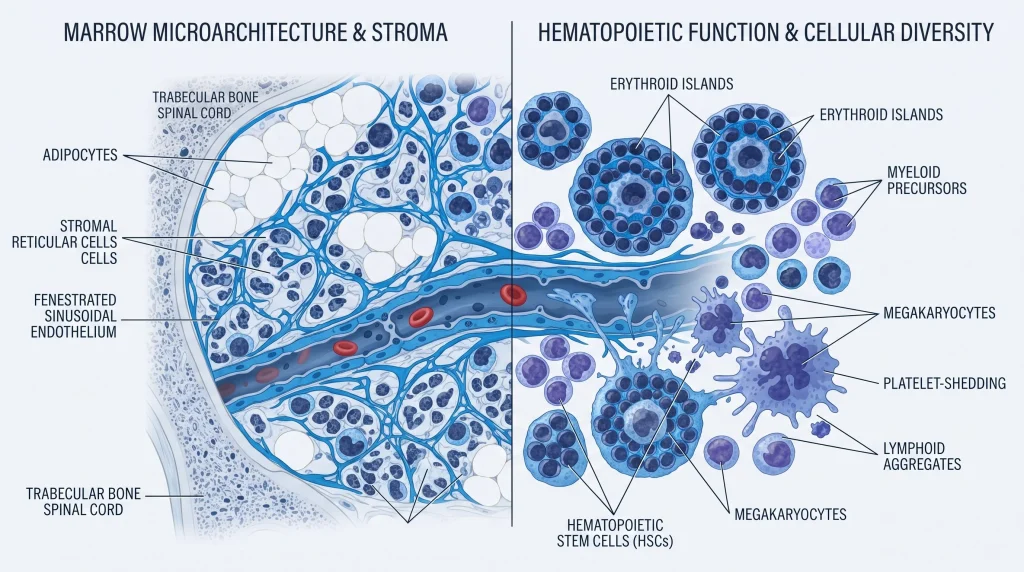
Bone marrow is a soft tissue inside bones. It holds stem cells called hematopoietic stem cells (HSCs). These HSCs make blood cells in a process called hematopoiesis (blood cell production). Short peptides are studied for how they change gene markers in HSCs and their offspring cells.
Offspring cells include red blood cells, platelets, and immune cells. Each type of blood cell starts as an HSC. The HSC then follows a path of cell division and change. Peptide research tracks what changes when a short amino acid chain is added to the cell culture.
How Is Humanin Studied in Blood Cell Models?
Humanin is a 21-amino acid peptide. It is encoded in the 16S rRNA region of mitochondrial DNA. It is found in many tissues in animal models. It is studied for effects on cell survival in blood-forming cell lines.
Humanin binds to receptors on the cell surface and also enters cells to act on mitochondria. Inside mitochondria, it affects survival signals through the Bax pathway. Bax is a protein that triggers cell death, and humanin was shown to reduce its activity in cell models.
According to Muzumdar et al. (2009) (PMID 19633672), humanin protected stem-like cells from apoptosis in cell models. Apoptosis is the programmed cell death pathway. Bax markers decreased in treated cells vs. control cells. These are in vitro findings only.
Humanin is available at Next Level Pharm as a COA-verified research compound. Every lot is tested by HPLC and mass spec. Each vial ships with a COA and lot number.
What Is MOTS-c and How Does It Work?
MOTS-c is a 16-amino acid peptide. It is also encoded in mitochondrial DNA. It is found in blood, muscle, and bone marrow tissue in animal models. It is studied for metabolic effects in blood-forming cells.
MOTS-c activates AMPK (adenosine monophosphate kinase), an enzyme that senses energy levels in cells. When AMPK is active, the cell shifts how it uses glucose and fat. This affects how much fuel the blood-forming cell has for division and growth.
According to Lee et al. (2015) (PMID 25843487), MOTS-c activated AMPK in metabolic cell models and glucose uptake markers shifted in treated cells. These are in vitro findings only and do not reflect results in living subjects.
MOTS-c is available as a COA-verified research compound. Every lot is tested to ≥99% purity by HPLC and mass spec.
How Does Thymalin Affect Blood Cell Research?
Thymalin is a bioregulator linked to the thymus gland, an organ near the heart that trains T-cells. T-cells are white blood cells and a core part of the immune system.
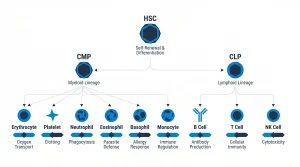
Blood-forming cells in the marrow give rise to immune cells, including pre-T cells that leave the marrow and travel to the thymus. The thymus trains these pre-T cells to become mature T-cells, and thymalin is studied for effects on this training process in animal models.
Animal models track T-cell count and maturation markers in thymalin-treated groups. Cell assays measure gene expression in thymus-derived cells after thymalin exposure. Both types of findings are cited in bioregulator research.
How Do Blood-Forming Cells Differ From Other Stem Cells?
Stem cells can make many types of cells, but blood-forming stem cells (HSCs) only produce blood cells. Mesenchymal stem cells, by contrast, produce bone, fat, and cartilage instead of blood cells.
HSCs are found in the bone marrow and make up about 1 in 10,000 bone marrow cells. Scientists identify HSCs by surface markers called CD34 and CD38.
Research on bone marrow bioregulators targets HSCs and progenitor cells. Progenitor cells are one step below HSCs. They are already committed to one blood cell type. Short peptides are added to cell cultures to see how they change gene activity in these cell types.
| Cell Type | Origin | Blood Cells Produced |
| HSC (CD34+, CD38-) | Bone marrow | All blood cell types |
| Myeloid progenitor | Bone marrow (from HSC) | Red cells, platelets, granulocytes |
| Lymphoid progenitor | Bone marrow (from HSC) | T-cells, B-cells, NK cells |
| Pre-T cell | Bone marrow, matures in thymus | T-cells |
| Pre-B cell | Bone marrow | B-cells |
What Assays Are Used in Bone Marrow Research?
Bone marrow research uses several assay types. Colony-forming assays measure how many stem cells can divide and grow in a gel. More colonies mean more active stem cells.
Flow cytometry measures surface markers on cells. It identifies cell types by the proteins on their surface. CD34 marks stem cells. CD3 marks T-cells. CD19 marks B-cells. Scientists use this method to count each cell type after peptide exposure.
Gene expression assays measure RNA levels inside cells. RNA is the first step in protein production. High RNA for a gene means that gene is active. Researchers track changes in survival, growth, and division gene markers.
Frequently Asked Questions
What Are Bone Marrow Bioregulators?
Bone marrow bioregulators are short peptides studied in cell and animal models for effects on blood cell gene activity. Key examples include Humanin (21-amino acid, cell survival assays), MOTS-c (16-amino acid, AMPK activation), and Thymalin (thymus-linked, T-cell models). Each targets a distinct step in blood cell biology. All data come from cell and animal studies. They are for lab research use only. Not intended for human use.
What Is Humanin?
Humanin is a 21-amino acid peptide. It is encoded in the 16S rRNA gene region of mitochondrial DNA. It is found in many tissues in animal models. In cell assays, it binds to receptors that control cell survival. It also enters mitochondria and reduces Bax-driven cell death signals. In blood-forming cell models, humanin changed cell survival markers. All data come from in vitro and animal models. For lab research use only.
What Is a Hematopoietic Stem Cell?
A hematopoietic stem cell (HSC) is a blood-forming stem cell found in bone marrow. HSCs make all red blood cells, white blood cells, and platelets. They are identified by surface markers CD34 and CD38. They are rare, making up about 1 in 10,000 bone marrow cells. They divide and give rise to progenitor cells. Progenitor cells then become specific blood cell types. Peptide research tracks gene changes in HSCs in culture models.
How Is MOTS-c Studied in Blood Cell Models?
MOTS-c is studied in cell models for effects on glucose metabolism. Scientists add MOTS-c to blood-forming cell cultures. They then measure AMPK activity and glucose uptake. AMPK is an enzyme that senses energy levels. When AMPK is active, cells shift how they use fuel. In treated cells, glucose uptake markers increased. These are in vitro findings only. MOTS-c is for lab research use only.
What Is Thymalin?
Thymalin is a bioregulator linked to the thymus gland. The thymus trains T-cells from pre-T cells that come from bone marrow. Thymalin is studied for effects on T-cell and B-cell maturation in animal models. Scientists measure changes in immune cell markers after treatment. Cell assays also show changes in thymus gene expression. All data come from in vitro and animal models. Thymalin is for lab research use only.
How Does Mitochondrial Function Affect Blood Cell Production?
Mitochondria make energy in cells. They are the organelles that produce ATP. Blood-forming stem cells need ATP for cell division and gene activity. When mitochondria work well, stem cells divide and produce blood cells at a normal rate. Peptides like Humanin and MOTS-c are studied for effects on mitochondrial function in blood cell models. Both come from mitochondrial DNA. All data come from cell and animal models.
What Is the Difference Between Humanin and MOTS-c?
Both Humanin and MOTS-c are encoded in mitochondrial DNA. Humanin is 21 amino acids long. MOTS-c is 16 amino acids long. Humanin is studied for cell survival signals, mainly the Bax apoptosis pathway. MOTS-c is studied for metabolic signals, mainly AMPK and glucose uptake. They act on different pathways. They should not be used as substitutes in research protocols. Both are for lab research use only.
Are These Compounds Synthetic?
Yes. Modern research compounds are lab-synthesized. Humanin (21 amino acids) and MOTS-c (16 amino acids) are both made by chemical synthesis. This ensures exact amino acid sequences. It also removes the risk of biological contamination. Research-grade compounds must meet ≥99% HPLC purity standards. Mass spec confirms the exact molecular weight before shipping.
How Are These Compounds Verified for Research Use?
Research-grade bone marrow peptides are tested by HPLC and mass spec per batch. HPLC confirms ≥99% purity for the target compound. Mass spec confirms molecular weight matches the expected sequence. A COA with lot number is provided per batch. All compounds ship with batch documentation. All are for lab research use only.
What Cell Models Are Used in Bone Marrow Research?
Common cell models include CD34+ stem cell lines, pre-B cell lines, and mouse bone marrow cultures. Scientists grow these cells in lab dishes and add the test compound. They then measure gene expression and surface marker changes. Animal models include mouse models where bone marrow cells are tracked over time. Flow cytometry, colony assays, and gene expression kits are used for measurement. All cited data in this article come from these cell and animal model sources.
Summary
Bone marrow bioregulators are short peptides studied in cell and animal models for effects on blood cell gene activity. Key compounds include Humanin (21 amino acids, cell survival, Bax pathway), MOTS-c (16 amino acids, AMPK and glucose), and Thymalin (thymus-linked, T-cell models).
Blood-forming stem cells in the marrow divide and produce all blood cell types. Short peptides change gene activity in these cells in culture models. All cited findings come from cell and animal research. These compounds are for lab research use only.
What Should You Do Next?
Researchers studying bone marrow and blood cell biology should source verified compounds for lab protocols. Before any study, confirm HPLC purity is ≥99% and mass spec matches the expected molecular weight. Record the lot number from the COA for batch traceability.
Shop research peptides. Humanin, MOTS-c, and Thymalin are available with HPLC and mass spec data on every COA.
People Also Read
- Recovery Peptides Comparison: BPC-157, TB-500, KPV, GHK-Cu
- Humanin Research: Mitochondria-Derived Peptide and Cell Signaling Studies
About the Author
Next Level Pharm Research Team
Alex M covers peer-reviewed findings in peptide science for Next Level Pharm, a US-based supplier of research-grade peptides verified to ≥99% purity via HPLC and mass spectrometry on every batch.
Disclaimer: The information provided on this page is for educational and research purposes only. Next Level Pharm products are intended for laboratory research use only. They are not intended for human consumption, diagnostic, therapeutic, or medicinal purposes. This content does not constitute medical advice. Always consult a licensed healthcare professional before making any health-related decisions.