MOTS-c vs Humanin: Mitochondrial Research

Last updated: July 2026
A MOTS-c vs Humanin research comparison is a review of two distinct peptides encoded by mitochondrial DNA. Both come from tiny structures inside cells called mitochondria (the cell’s energy centers). Each peptide acts on a different cell pathway. MOTS-c acts on energy pathways inside the cell. Humanin acts on cell survival signals at the cell surface. According to NCBI (2015), MOTS-c activates the AMPK pathway in preclinical models. Both are batch-tested and COA-verified for lab research.
Next Level Pharm supplies both MOTS-c and Humanin as research-grade peptides for lab use. Average purity across the last 100 batches is 99.4%. Every vial is tested by HPLC (high-performance liquid chromatography) and mass spectrometry. Each order ships with a COA (certificate of analysis) and full lot traceability records. Both peptides are lyophilized (freeze-dried) for stable room-temperature shipping.
Research teams use these peptides to study how mitochondria signal to the rest of the cell. The sections below compare their origins, pathways, and research roles. A table is included to highlight key differences at a glance.
Key Takeaways
- Mitochondrial Source: Both peptides come from mitochondrial DNA. MOTS-c is from the 12S rRNA gene, while Humanin is from the 16S rRNA gene.
- Distinct Pathways: MOTS-c activates the AMPK pathway. Humanin binds the gp130 receptor complex and activates STAT3.
- Research Roles: MOTS-c is studied for metabolic and insulin signaling, while Humanin is studied for cell survival and anti-apoptotic signals.
- Molecular Size: MOTS-c has 16 amino acids, while Humanin has 24 amino acids. This size difference shapes how each peptide binds its target.
- Shared Function: Both peptides are studied for their role in protecting cells from stress.
- Research Grade: Both compounds are available as COA-verified, HPLC-tested research peptides for lab use.
The following sections provide detail on each of these points. Data come from peer-reviewed journals and controlled preclinical studies.
What Are Mitochondrial-Derived Peptides?
Mitochondrial-derived peptides (MDPs) are small signaling molecules. They are encoded by open reading frames (ORFs) inside the mitochondrial genome (mtDNA). MDPs help mitochondria communicate with the nucleus and other cells. They act as internal signals that adjust how cells manage energy and stress. MOTS-c and Humanin are two well-studied MDPs. Both are encoded within the mitochondrial genome and studied for their cell-protective roles.
MDPs were found when researchers looked for short sequences in the mitochondrial genome that could make proteins. These sequences are called open reading frames. They were once thought to only make structural proteins for ribosomes. But studies showed they also produce signaling peptides. According to PubMed (2013), MDPs act as hormone-like signals that link mitochondrial status to the rest of the cell. This finding changed the view of mitochondria as only energy factories.
What Is the Genetic Origin of Each Peptide?
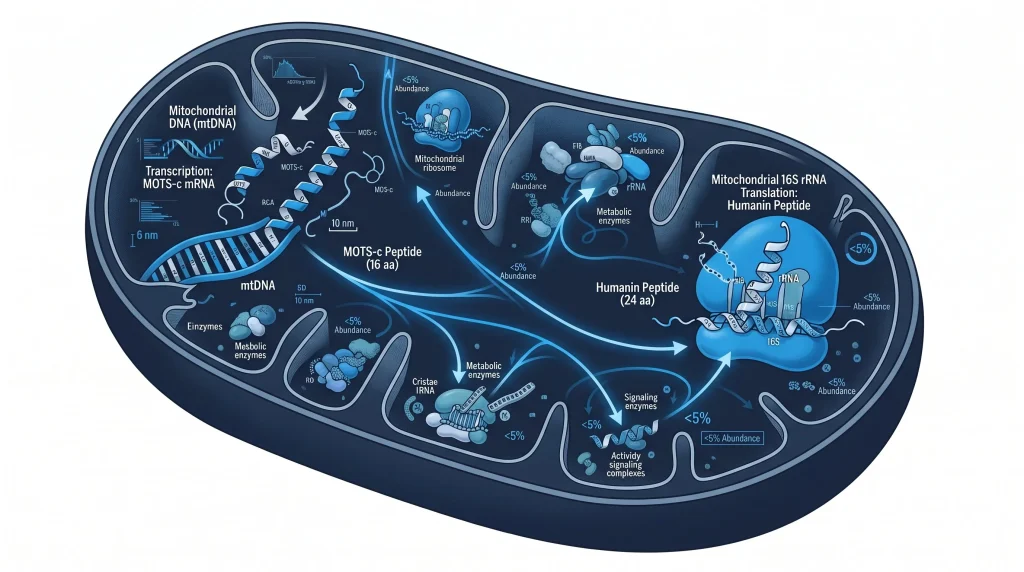
MOTS-c and Humanin both come from the mitochondrial genome. But they are encoded at different sites. MOTS-c is encoded within the 12S ribosomal RNA (rRNA) gene. Humanin is encoded within the 16S rRNA gene. These gene regions were once linked only to ribosome structure. Research now shows they also produce bioactive peptides with cell signaling roles.
The discovery that rRNA genes can produce signaling peptides was a key finding. These genes were thought to only make structural RNA for the ribosome. Finding peptide-coding sequences inside them showed the mitochondrial genome has more coding capacity than expected. MOTS-c and Humanin are prime examples of this expanded role. According to PubMed (2001), Humanin was first identified from the mitochondrial 16S rRNA gene. Its identification opened the field of MDP research.
How Do Their Signaling Pathways Differ?
MOTS-c acts inside the cell. It activates the AMPK pathway (adenosine monophosphate-activated protein kinase). This pathway controls how cells balance energy use. Humanin acts at the cell surface. It binds a receptor complex that includes gp130 and WSX-1. Binding this complex activates the STAT3 pathway, which controls cell survival signals. The two pathways serve different functions in cell biology.
AMPK is a master switch for cell energy, and when MOTS-c activates it, the cell shifts how it uses glucose. STAT3 is a survival signal, and when Humanin binds its receptor, cells are less likely to undergo apoptosis (programmed cell death). According to NCBI (2015), MOTS-c-driven AMPK activation has been studied in metabolic models. Both peptides are available as COA-verified, HPLC-tested research compounds.
Shop research peptides at Next Level Pharm
What Are Their Distinct Research Roles?
MOTS-c is studied mainly for metabolic roles. Research links it to insulin signaling and glucose use in skeletal muscle models. Humanin is studied mainly for its cell-protective role. It has been linked to anti-apoptotic effects in neuron and endothelial cell models. The two peptides target different tissues and different research questions.
Lab teams use MOTS-c to study how mitochondrial signals control metabolic rates. Some studies look at its role in preclinical exercise models. Humanin research focuses on how cells stay alive under stress. Studies test its ability to protect cells from oxidative damage and metabolic pressure. According to the Journal of Peptide Science (2020), both peptides have been studied for their role in keeping cells healthy under stress. Each fills a distinct slot in mitochondrial peptide research.
Do MOTS-c and Humanin Share Any Functions?
Yes. Both peptides are studied for their cytoprotective role. Cytoprotection means protecting cells from damage. Both MOTS-c and Humanin have been tested in models exposed to oxidative stress. They also share a link to mitochondrial stability. Studies show both peptides help keep mitochondrial function intact under adverse lab conditions.
The overlap in function makes these peptides useful to compare in side-by-side studies. Labs can test whether the shared protection comes from the same source or different pathways. MOTS-c appears to protect cells by controlling energy pathways. Humanin protects cells by blocking apoptosis signals. Both outcomes preserve cell viability. The SS-31, MOTS-c and Humanin research overview provides a broader look at how these MDPs interact in stress models.
How Do Their Molecular Structures Compare?
MOTS-c is a 16-amino acid peptide. Humanin is a 24-amino acid peptide. The difference in length affects how each peptide folds and how it binds its target. A shorter peptide may reach intracellular targets more directly. A longer peptide may need a cell surface receptor to act. These structural traits shape each peptide’s research application.
Amino acid length and sequence determine a peptide’s three-dimensional shape. This shape controls receptor binding. MOTS-c’s 16-amino acid sequence allows it to enter cells and act on the AMPK pathway directly. Humanin’s 24-amino acid chain binds the gp130 and WSX-1 receptor complex on the cell surface. Each structure is tailored to its target. Scientists use structural data to design lab assays and confirm binding specificity in controlled cell models.
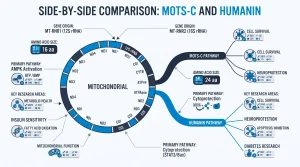
| Feature | MOTS-c | Humanin |
| Source | Mitochondrial 12S rRNA gene | Mitochondrial 16S rRNA gene |
| Size | 16 amino acids | 24 amino acids |
| Primary pathway | AMPK | gp130/STAT3 |
| Half-life | Short (model-dependent) | Short (model-dependent) |
| Primary research area | Metabolic and insulin signaling | Cell survival and anti-apoptosis |
| Key distinction | Intracellular AMPK activator | Cell-surface receptor activator |
Frequently Asked Questions
What is the difference between MOTS-c and Humanin peptides?
MOTS-c and Humanin are both mitochondrial-derived peptides. They differ in size and function. MOTS-c has 16 amino acids and activates the AMPK pathway inside the cell. Humanin has 24 amino acids and binds a gp130 receptor complex on the cell surface. MOTS-c research focuses on metabolic pathways. Humanin research focuses on cell survival and anti-apoptotic signaling. Both are studied in preclinical lab models.
Are both peptides encoded in mitochondrial DNA?
Yes, both MOTS-c and Humanin are encoded within the mitochondrial genome. MOTS-c is encoded in the 12S rRNA gene, while Humanin is encoded in the 16S rRNA gene. These gene regions were once thought to only make structural RNA for ribosomes. Research now shows they also produce short peptides with cell signaling roles. This dual function shows the mitochondrial genome has more coding capacity than expected.
What signaling pathway does MOTS-c activate?
MOTS-c activates the AMPK pathway, which stands for adenosine monophosphate-activated protein kinase. AMPK is a key regulator of cell energy balance. When MOTS-c activates AMPK, the cell adjusts how it uses glucose and other energy substrates. This pathway is studied in metabolic research models, including skeletal muscle cell lines. According to NCBI (2015), MOTS-c-driven AMPK activation has been linked to changes in metabolic signaling in preclinical studies.
How does Humanin promote cell survival in lab models?
Humanin binds a tripartite receptor complex on the cell surface. This complex includes gp130, WSX-1, and the CNTF receptor. Binding this complex activates the STAT3 signaling pathway. STAT3 sends pro-survival signals inside the cell that block apoptosis (programmed cell death). According to PubMed (2001), Humanin inhibits apoptosis in neural cell models. Lab teams use Humanin to study how STAT3 controls cell viability under oxidative or metabolic stress.
How do MOTS-c and Humanin differ in molecular size?
MOTS-c is a peptide with 16 amino acids. Humanin is a peptide with 24 amino acids. This size difference shapes how each peptide folds and binds. MOTS-c is small enough to act inside the cell on the AMPK pathway. Humanin uses its longer chain to bind a cell-surface receptor complex. Researchers track these structural differences to understand how each peptide targets its specific signaling node in lab models.
What is apoptosis and why does Humanin research study it?
Apoptosis is programmed cell death. It is a normal process that removes old or damaged cells. But in some research models, excess apoptosis can harm tissue viability. Humanin has been studied for its ability to block apoptosis in neural and endothelial cell models. By binding the gp130 receptor complex, Humanin activates survival signals. This makes it a useful tool for studying how cells maintain viability under stress in controlled lab settings.
Are MOTS-c and Humanin studied in age-related cell models?
Both peptides are subjects of interest in age-related cell studies. Evidence shows that activity of both MOTS-c and Humanin drops in older preclinical models. Current studies explore whether restoring the availability of these peptides helps preserve cell function. Researchers use lab models to test how each peptide affects markers of cellular aging. According to PubMed (2013), both MDPs play a role in keeping cells healthy during periods of biological stress.
How are these research peptides stored and shipped?
Both MOTS-c and Humanin are supplied as lyophilized (freeze-dried) powders. Lyophilized peptides are stable at room temperature during shipping. No cold chain is required. This stable form keeps the peptide sequence intact until the researcher is ready to work with the material. Labs store these powders in a dry, stable environment. This storage method simplifies logistics for labs that handle multiple peptide compounds. Both ship with a COA and full lot records.
What makes mitochondrial-derived peptides unique?
Mitochondrial-derived peptides are unique because they come from the mitochondrial genome, not the nuclear genome. This gives them a distinct origin and structure. They act as internal signals that link mitochondrial status to the cell. Most peptides are encoded in the nucleus. MDPs like MOTS-c and Humanin show that the mitochondrial genome has a broader role in cell signaling than once thought. This makes them a distinct and growing class of research tools.
How is quality verified for these research peptides?
Every batch of MOTS-c and Humanin is tested by HPLC and mass spectrometry before dispatch. HPLC separates the peptide from impurities. Mass spectrometry confirms the molecular identity and purity level. Average purity across the last 100 batches is 99.4%. Each vial ships with a COA that lists the lot number and purity data. Researchers can look up their lot online for full batch records and independent verification.
Summary
MOTS-c and Humanin are two mitochondrial-derived peptides with distinct roles. MOTS-c comes from the 12S rRNA gene and activates the AMPK pathway. Humanin comes from the 16S rRNA gene and binds the gp130 receptor complex. MOTS-c research focuses on metabolic and insulin signaling. Humanin research focuses on cell survival signals.
Both peptides share a cytoprotective role. Both are studied for how they help cells handle stress. Next Level Pharm supplies both as COA-verified, research-grade compounds. Every batch is HPLC and mass spec tested. Average purity is 99.4% across the last 100 batches.
What Should You Do Next?
Researchers should choose between the AMPK pathway linked to MOTS-c and the gp130 or STAT3 pathway linked to Humanin. Compare structural data and assay conditions before selecting the cell model. Review the online COA and record purity, identity, and lot information before ordering. Researchers sourcing these lab peptides can shop research peptides with full COA and lot traceability.
People Also Read
- MOTS-c Research: What Studies Show About This Mitochondrial Peptide
- Humanin Research: Mitochondria-Derived Peptide and Cell Signaling Studies
About the Author
Next Level Pharm Research Team
Alex M covers peer-reviewed findings in peptide science for Next Level Pharm, a US-based supplier of research-grade peptides verified to ≥99% purity via HPLC and mass spectrometry on every batch.
Disclaimer: For research purposes only. Not intended for human consumption. Next Level Pharm products are not intended for diagnostic, therapeutic, or medicinal use. This content does not constitute medical advice. Always consult a licensed healthcare professional before making any health-related decisions.