
Insulin Syringe Units in Peptide Research Explained

Last updated: August 2026
A syringe unit is a volume marking on a U-100 insulin syringe. A U-100 syringe holds 1 milliliter (mL) at 100 units. Each unit equals 0.01 mL. This scale lets researchers measure small liquid volumes with precision. According to Skov et al. (2014), precise volume measurement is a standard requirement in published peptide research protocols.
Next Level Pharm supplies research-grade peptides with ≥99% purity. Average purity across the last 100 batches is 99.4%. Every lot is verified by HPLC and mass spectrometry. Each order includes a Certificate of Analysis (COA) with the exact peptide mass. All compounds ship as lyophilized solids, stable at room temperature without cold-chain logistics.
Precise syringe technique is a standard part of peptide research. Small volume errors become large percentage errors at low draw amounts. Understanding the unit scale, needle gauge, and dead space reduces measurement variance across sessions.
Key Takeaways
- U-100 Scale: A U-100 syringe holds 1 mL at 100 units. Each unit equals 0.01 mL.
- Concentration Math: Divide the solution concentration (mcg/mL) by 100 to find the amount per unit drawn.
- Needle Gauge: Higher gauge numbers mean a narrower diameter. Research labs use 29-31 gauge needles for small-volume precision.
- Dead Space: Dead space is liquid trapped in the needle hub. It causes a fixed volume loss at each draw.
- Small-Draw Risk: A fixed dead space error is a larger fraction of small draws. Decimal errors cause the most variance at small volumes.
The sections below explain each topic in detail and cover the most common measurement errors in peptide research.
What Is a U-100 Insulin Syringe?
A U-100 syringe holds 1 mL at 100 units. Each unit equals 0.01 mL. The calibration is constant across all barrel sizes. Research labs use this scale for precise small-volume liquid measurement.
The U-100 designation sets the ratio: 100 units per 1 mL. This ratio is constant across all U-100 syringes. A 0.3 mL barrel holds 30 units. A 0.5 mL barrel holds 50 units. A 1 mL barrel holds 100 units. Each unit mark is the same 0.01 mL on all three sizes.
Common barrel sizes are 0.3 mL, 0.5 mL, and 1 mL. The 0.3 mL and 0.5 mL versions offer tighter scale resolution for very small volumes. According to Huff et al. (2004), consistent measurement technique is a key factor in data quality across peptide research sessions.
How Do Syringe Units Convert to Milliliters?
Divide the unit count by 100 to get mL. One unit equals 0.01 mL. To find mass per unit, divide the concentration (mcg/mL) by 100.
The math is direct. One hundred units equals 1 mL, so one unit is 0.01 mL. To find the mass per unit, divide the concentration by 100. For a 5,000 mcg/mL solution, each unit holds 50 mcg. Always do this calculation before starting a draw session.
| Syringe Units | Volume (mL) | At 5,000 mcg/mL | At 10,000 mcg/mL |
| 5 units | 0.05 mL | 250 mcg | 500 mcg |
| 10 units | 0.10 mL | 500 mcg | 1,000 mcg |
| 20 units | 0.20 mL | 1,000 mcg | 2,000 mcg |
| 50 units | 0.50 mL | 2,500 mcg | 5,000 mcg |
| 100 units | 1.00 mL | 5,000 mcg | 10,000 mcg |
Next Level Pharm provides exact peptide mass data on every COA. Average purity across 100 recent batches is 99.4%. Confirmed mass data is required for accurate unit-to-amount calculations.
Why Are 29-31 Gauge Needles Used in Research?
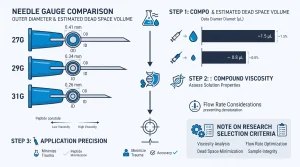
Needle gauge is the outer diameter. Higher gauge means a narrower needle. Research labs use 29-31 gauge needles because they reduce dead space and allow precise liquid dispensing at small volumes.
The gauge scale runs inversely: 31-gauge is narrower than 27-gauge. Narrower needles reduce dead space in the hub and tip. They also allow more controlled dispensing. The 29-31 range balances diameter and plunger friction for small-volume work.
Very narrow needles (32+) increase plunger friction, making precise drawing harder. Very wide needles (25 and below) hold more dead space, raising measurement error. According to Smart et al. (2007), standardized needle specifications are a component of reproducible protocol design in small-volume research.
How Does Dead Space Affect Measured Volume?
Dead space is liquid trapped in the needle hub after the plunger reaches zero. It causes a consistent volume loss at each draw. At 5,000 mcg/mL, a 29-gauge dead space of 4-10 mcL equals 20-50 mcg lost per draw.
Every needle has a small internal volume that stays filled after the plunger reaches zero. This is dead space. A 29-gauge needle holds roughly 4-10 microliters (mcL). At 5,000 mcg/mL, that is 20-50 mcg of material lost per draw.
Dead space matters most at small draw volumes. If a researcher draws 0.05 mL (5 units) but 0.005 mL stays in the needle, the actual volume is 0.045 mL. That is a 10% error. At 0.5 mL, the same dead space is only a 1% error.
Browse BPC-157 and BAC water product pages for lot-specific concentration data to factor into dead space calculations.
What Volume Errors Occur at Small Volumes?
Three main errors affect small-volume precision: decimal mistakes, unit misreads, and dead space. All three are larger percentage errors at small volumes. Double-checking each step reduces variance.
Decimal errors happen when 0.05 mL is read as 0.5 mL, causing a 10x error. Unit misreads happen when 5 units is confused with 50 units on the barrel scale. Dead space causes a fixed volume loss that is a bigger fraction of small draws.
To reduce errors: calculate the expected mcg before drawing. Double-check the unit reading. Remove air bubbles before reading the final volume. Record draw volume, concentration, and lot number in the lab notebook. These steps protect data quality and support reproducibility across sessions.
COA-verified research peptides and BAC water with lot-level concentration data are available from Next Level Pharm.
Frequently Asked Questions
What is a syringe unit in peptide research?
A syringe unit is a volume marking on a U-100 insulin syringe. One unit equals 0.01 mL. A full 1 mL syringe holds 100 units. The 0.5 mL barrel holds 50 units, and the 0.3 mL barrel holds 30 units. Researchers use unit markings to draw small, precise volumes of reconstituted peptide solutions. Consistent technique at each draw reduces measurement error across sessions. All products are for laboratory research use only.
How do you convert syringe units to milliliters?
Divide the unit count by 100 to get volume in mL. Ten units equals 0.10 mL. Fifty units equals 0.50 mL. One hundred units equals 1.00 mL. To get mass per unit, divide the solution concentration (mcg/mL) by 100. At 5,000 mcg/mL, each unit holds 50 mcg. Always confirm the concentration from the COA before any calculation. Record the conversion in the lab notebook before each draw session starts.
What does gauge mean for a syringe needle?
Gauge refers to the outer diameter of the needle. Higher numbers mean a narrower diameter. A 31-gauge needle is narrower than a 27-gauge needle. Narrower needles reduce dead space in the hub and tip. Research labs use 29-31 gauge needles for precise small-volume work. Very narrow needles above 32 gauge increase plunger friction. Very wide needles at 25 gauge and below hold more dead space. The 29-31 range balances both factors well.
What is dead space in a syringe?
Dead space is the liquid trapped in the needle hub and tip after the plunger reaches zero. A 29-gauge needle holds roughly 4-10 microliters of dead space per draw. At 5,000 mcg/mL, this equals 20-50 mcg of material lost at each draw. Dead space is a larger percentage error at small draw volumes. At 0.05 mL, a 5 mcL dead space is a 10% error. At 0.50 mL, the same dead space is only 1%. Using low-dead-space needles reduces this effect.
How accurate is a U-100 syringe for peptide research?
A 1 mL U-100 syringe has 1-unit precision, equal to 0.01 mL per unit. At very small volumes, reading error and dead space both add variance. A 0.3 mL or 0.5 mL barrel improves scale resolution for very small draws. Consistent technique and double-checking the unit reading improves accuracy from session to session. Recording draw volume, concentration, and lot number in the lab notebook supports reproducibility. Calibrated syringes from known manufacturers offer the most reliable markings.
Can a 0.5 mL syringe be used instead of a 1 mL syringe?
Yes. A 0.5 mL U-100 syringe holds 50 units and offers finer scale resolution at small volumes. The unit-to-mL conversion stays the same: one unit equals 0.01 mL on any U-100 barrel. A smaller barrel limits the total draw range but improves precision at very low volumes. The 0.3 mL barrel goes even smaller and suits protocols needing less than 30 units at a time. Choose the barrel size that closely matches the target draw volume for the specific protocol.
What happens if you confuse units and milliliters?
Confusing units and mL causes a 100x volume error. Treating the 10-unit mark as 10 mL means drawing 100 times the intended volume. This is one of the most common and serious measurement errors in lab work. Always confirm whether the target is stated in units or mL before drawing. Label conversions clearly in the lab notebook for each session. Double-check the unit mark against the calculated target volume before recording the final draw.
What does CC mean on a syringe?
CC stands for cubic centimeter. One CC equals one mL. On a syringe, 1 CC and 1 mL represent the same volume. Older syringe labels use CC while newer ones use mL, but the measurement is identical in both cases. Knowing they are equal avoids confusion when switching between different syringe manufacturers. A syringe labeled 1 CC holds the same volume as one labeled 1 mL. Always check the unit label on a new syringe before any draw.
How do you account for dead space in calculations?
Find the dead space volume for the specific needle gauge used. Subtract it from the target draw to get the net volume. For 4 mcL dead space at 5,000 mcg/mL, the loss is 20 mcg per draw. If the assay is sensitive to this, draw slightly more and discard the extra. Record the dead space correction in the lab protocol for reproducibility.
Why is removing air bubbles important for volume accuracy?
Air bubbles occupy space in the barrel that would otherwise hold liquid. When bubbles are present, the unit reading overestimates the actual liquid volume in the syringe. A bubble at the 20-unit mark could mean only 18 units of liquid is actually present. Tapping the barrel and venting through the needle removes air before taking the final reading. Removing all visible air is a standard verification step before recording any draw. This small check reduces systematic measurement error across a full session.
Summary
Insulin syringe units map volume to a fixed scale: one unit equals 0.01 mL on any U-100 syringe. Converting units to mcg requires knowing the concentration and the unit count. Both steps should be done before each draw session.
Dead space in the needle hub causes a consistent volume loss per draw. At small volumes, this loss is a significant fraction of the total. The 29-31 gauge range minimizes dead space while keeping plunger friction manageable.
Next Level Pharm verifies every peptide lot by HPLC and mass spectrometry. Average purity across the last 100 batches is 99.4%. Full COA data is available for every compound in the catalog.
What Should You Do Next?
Researchers should confirm peptide concentration from the COA before any volume calculation. Calculate the expected mcg per unit before drawing. Remove air bubbles before reading the final volume. Record all draw data in the lab notebook. Shop research peptides with full COA and lot-level traceability.
People Also Read
- What Is BAC Water? Bacteriostatic Water in Peptide Research
- How to Store Research Peptides: Temperature and Stability
About the Author
Next Level Pharm Research Team
The Next Level Pharm research team is composed of biochemists and laboratory scientists dedicated to providing researchers with the highest-purity research peptides from independently verified batches. Every batch is HPLC and mass spec verified before dispatch.
Disclaimer: The information provided on this page is for educational and research purposes only. Next Level Pharm’s products are intended for laboratory research use only. They are not intended for human consumption, diagnostic, therapeutic, or medicinal purposes. This content does not constitute medical advice. Always consult a licensed healthcare professional before making any health-related decisions.