BAC Water vs Sterile Water: Peptide Research Guide

Last updated: August 2026
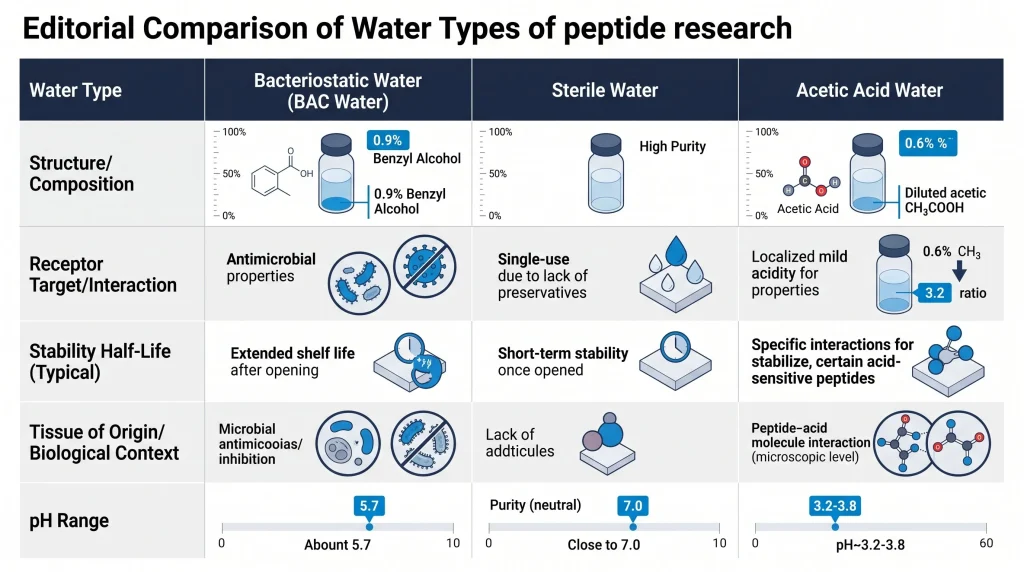
Bacteriostatic water (BAC water) is a sterile liquid that contains 0.9% benzyl alcohol as a preservative. This agent limits bacteria growth in a vial during repeated use. Sterile water contains no additives and must be discarded after a single draw. According to NCBI (2020), aqueous preparations benefit from preservative agents to maintain stability across multi-use sessions.
Next Level Pharm provides high-purity compounds for laboratory research. Average purity across the last 100 batches is 99.4%. Every vial is verified by HPLC and mass spectrometry. All compounds ship as freeze-dried solids sealed under an inert atmosphere. No cold chain is required during transit.
Choosing the right diluent affects sample stability and data quality. The sections below explain how each diluent works, when each is preferred, and where acetic acid water fits in.
Key Takeaways
- Preservative Difference: BAC water has 0.9% benzyl alcohol to limit bacteria growth. Sterile water has no preservative.
- Multi-Use Window: BAC water vials stay stable for up to 28 days after opening under refrigeration. Sterile water must be discarded after the first draw.
- Benzyl Alcohol Mechanism: Benzyl alcohol disrupts bacteria cell walls, stopping their growth. It does not sterilize the vial on contact.
- Compatibility Check: Some peptides react to benzyl alcohol or to the acidic pH of BAC water. Check the compound data sheet before selecting a diluent.
- Acetic Acid Water: Used for water-repelling or basic peptides that do not dissolve in neutral water. A 0.6% acetic acid solution lowers pH enough to help dissolve.
Next Level Pharm maintains purity standards that support clean, repeatable research data. The sections below detail the key differences and use cases for each diluent.
What Is the Difference Between BAC and Sterile Water?
BAC water has 0.9% benzyl alcohol as a preservative. Sterile water has no additives. BAC water suits multi-use vials. Sterile water is for single-use protocols only.
BAC water contains benzyl alcohol. This agent limits bacteria growth across multiple draws. Without it, bacteria or fungal growth can start after any draw.
Sterile water is pure. It has no salts, no preservatives, and no additives. This makes it good where additives could affect the assay. Without a protective agent, it cannot stay sterile after the first draw. It must be used at once or discarded. The choice depends on the protocol: multi-use vial or single-use batch.
How Does Benzyl Alcohol Preserve a Solution?
Benzyl alcohol disrupts bacteria cell walls, stopping their growth. It does not kill all bacteria on contact. It stays active across multiple draws over days or weeks.
Benzyl alcohol works by disrupting the outer layer of bacteria cells. This stops their growth. It does not kill all organisms at once. The result is a stable environment in the vial.
The agent stays active in the vial. It does not break down quickly under refrigeration. According to Molecules (MDPI) (2020), solvent environment is a main factor in structural stability of complex molecules. This lets researchers draw from the same vial for up to 28 days.
When Is Sterile Water Preferred in Research?
Sterile water is preferred when additives could affect the assay or when the full vial volume is used at once. Some cell culture tests cannot tolerate benzyl alcohol.
Sterile water is the correct choice in two cases. First, when the protocol needs a preservative-free solvent. Some assays and cell culture tests react to benzyl alcohol. Second, when the full reconstituted volume is used in one session. No preservative is needed when there are no future draws.
Some peptides react to benzyl alcohol or to the acidic pH of BAC water. In these cases, sterile water is a better fit. Any vial of sterile water must be used promptly. According to NCBI (2011), solvent selection is a key variable in maintaining compound structure throughout the testing period.
Does Diluent Choice Affect Peptide Stability?
Yes. Each peptide has a unique structure that dictates its fit with different solvents. The wrong diluent can cause clumping, solid formation, or breakdown that ruins the sample.
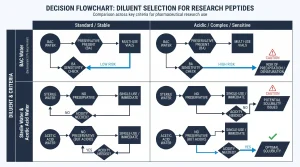
Diluent choice affects peptide dissolving, clumping risk, and stability. Some peptides break down in the acidic pH of BAC water. Others react poorly to benzyl alcohol. Researchers check the compound data sheet to confirm fit before selecting a diluent.
The wrong solvent causes visible clumps in some cases. In others, breakdown proceeds without any visible sign. Either outcome ruins the research batch. Using the correct solvent keeps the peptide in a stable, dissolved form. Browse BAC water and Acetic Acid Water product pages for lot COA data and diluent compatibility information.
What Is Acetic Acid Water and When Is It Used?
Acetic acid water is a mild acid diluent used for water-repelling or basic peptides that do not dissolve in neutral water. A 0.6% acetic acid solution lowers pH enough to help dissolve without harming the compound.
Some peptides carry a positive charge at neutral pH. Others have regions that repel water. These traits make them hard to dissolve in BAC water or sterile water. A mild acetic acid solution adjusts the pH. This helps the peptide enter the solution.
Many growth hormone peptides and other basic compounds need acetic acid water to dissolve fully. Without it, the solution may stay cloudy or form chunks. A 0.6% concentration is standard for most of these compounds.
What Is the Shelf Life After Reconstitution?
BAC water solutions can be held for up to 28 days under refrigeration. Sterile water solutions must be used right away. Stability windows vary by peptide sequence.
BAC water solutions stay stable for up to 28 days at 2-8 degrees C. This reflects cold temperature and the benzyl alcohol agent. Sterile water has no preservative and no extended window. They must be used in the same session.
Peptide stability also varies by sequence. Some sequences break down faster in liquid regardless of the diluent. Researchers base storage timelines on the compound data sheet.
Frequently Asked Questions
What is the difference between BAC and sterile water?
BAC water contains 0.9% benzyl alcohol. Sterile water contains only pure water. Benzyl alcohol limits bacteria growth during repeated vial access. Sterile water has no protective agent and must be discarded after one draw. The choice depends on whether the protocol needs a multi-use vial across several sessions or a single-use batch used all at once.
How does benzyl alcohol preserve a solution?
Benzyl alcohol disrupts the outer layer of bacteria cells. This stops them from growing. The agent stays active throughout the vial life under refrigeration. It maintains a stable, bacteria-limited environment across multiple draws. It does not sterilize on contact. According to NCBI (2020), preservative agents help maintain stability in multi-use preparations over extended periods.
When is sterile water preferred in research?
Sterile water is preferred for single-use protocols and for procedures where additives could affect the assay. Some cell culture work cannot tolerate benzyl alcohol. If the full volume is used in one session, no preservative is needed. Sterile water must be discarded after the first draw. It does not suit multi-draw protocols over days or weeks.
Does diluent choice affect peptide stability?
Yes. Each peptide has a structure that determines its fit with common solvents. Some peptides break down when exposed to benzyl alcohol or the acidic pH of BAC water. The wrong diluent can cause visible clumping or invisible structural breakdown. Researchers check the compound data sheet to confirm fit before choosing a diluent.
What does acetic acid water solve that BAC and sterile water do not?
Acetic acid water is used for basic or water-repelling peptides that do not dissolve in neutral water. The mildly acidic pH breaks down charge-based forces that keep these peptides from entering solution. Without it, the mixture may stay cloudy or form clumps. A 0.6% concentration is standard for most of these compounds.
How long can you store reconstituted peptides with BAC water?
Peptides mixed in BAC water typically remain stable for up to 28 days at 2-8 degrees C. Beyond this window, chemical breakdown and clumping risk increases. Researchers track the preparation date and confirm the timeline with the COA before each draw. Aliquoting into single-use portions further reduces repeated thermal cycling.
Is bacteriostatic water the same as saline solution?
No. BAC water is pure water with 0.9% benzyl alcohol. Saline is a mix of water and 0.9% sodium chloride. Saline is rarely used for initial reconstitution. The salt content can affect dissolving and structure of some peptide sequences. The two diluents serve different functions in a research lab.
What is the typical pH of bacteriostatic water?
The pH of BAC water typically falls between 4.5 and 7.0, depending on the batch. Benzyl alcohol slightly lowers the pH from neutral. This range works for most peptides. Researchers confirm pH when working with pH-sensitive sequences. A slightly acidic pH can affect some compounds more than others.
Can you make bacteriostatic water in a standard lab?
Producing BAC water requires precise concentration control and sterile conditions. Most facilities order verified lab-grade supplies. Using homemade BAC water risks inaccurate benzyl alcohol concentration and contamination in the final solution. Verified BAC water from a known supplier provides consistent results and full COA records for each batch.
Why must sterile water be discarded after a single use?
Sterile water contains no preservatives. Once the vial seal breaks, air and potential microbes can enter. Reusing a sterile water vial raises the risk of introducing contamination into research samples. All preservative-free liquids should be treated as single-use items in lab protocols. This is a standard sterility control across all research settings.
Summary
BAC water and sterile water serve different purposes. BAC water supports multi-use vials because its benzyl alcohol limits bacteria growth across multiple draws. Sterile water is preservative-free and suitable only for single-use applications.
Diluent compatibility with the specific peptide sequence is critical. Check benzyl alcohol sensitivity and pH compatibility before selection. Acetic acid water fills the gap for basic or water-repelling peptides that do not dissolve in neutral solvents.
Next Level Pharm supports research with high-purity compounds and COA-verified BAC water and Acetic Acid Water for every protocol type.
What Should You Do Next?
Researchers should confirm diluent fit with the specific peptide before mixing. Check the COA for lot-specific data. Shop research peptides and diluents with full lot traceability from Next Level Pharm.
People Also Read
- What Is BAC Water? Bacteriostatic Water in Peptide Research
- What Is Lyophilization? How Freeze-Drying Preserves Peptide Integrity
About the Author
Next Level Pharm Research Team
The Next Level Pharm research team is composed of biochemists and laboratory scientists dedicated to providing researchers with the highest-purity research peptides from independently verified batches. Every batch is HPLC and mass spec verified before dispatch.
Disclaimer: The information provided on this page is for educational and research purposes only. Next Level Pharm’s products are intended for laboratory research use only. They are not intended for human consumption, diagnostic, therapeutic, or medicinal purposes. This content does not constitute medical advice. Always consult a licensed healthcare professional before making any health-related decisions.