
Pinealon Research: Neuroprotective Bioregulator Studies

Last updated: August 2026
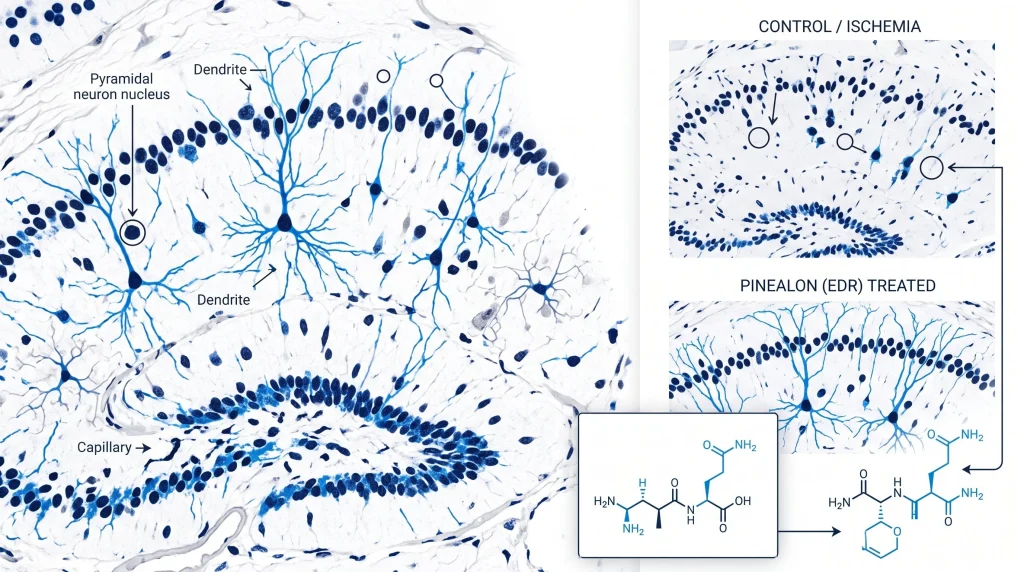
A pinealon research study examines a synthetic tripeptide called EDR (glutamic acid, aspartic acid, arginine). Researchers write the sequence as Glu-Asp-Arg. The compound was isolated from bovine pineal gland fractions and is now made by direct synthesis for lab use. Published lab studies have looked at its effects on neural cell survival and gene expression. This article summarizes those findings.
Next Level Pharm supplies research-grade pinealone at ≥99% purity. Every batch is HPLC and mass spec verified before dispatch. COA records ship with each order, and outside-lab results are available on request.
Short peptide bioregulators are defined by their small size. Three to five amino acid sequences from specific organ tissues make up this class. Pinealon’s EDR sequence was identified from pineal gland protein fractions. This places it in a series developed by the Khavinson group over many years.
Key Takeaways
- Sequence: Pinealon is a synthetic tripeptide. Its sequence is EDR: glutamic acid, aspartic acid, and arginine.
- Origin: EDR was derived from bovine pineal gland extract as part of the Khavinson research program.
- Research focus: Published studies have studied pinealon in nerve protection, antihypoxic response, and gene expression in lab tests.
- Mechanism hypothesis: Data suggest EDR binds DNA control regions in neural cells and alters gene expression.
- Purity standard: Research-grade pinealon requires ≥99% purity, confirmed by HPLC, mass spec, and residue analysis per lot.
Pinealon belongs to a class of short peptide bioregulators that interact with cells at the gene-expression level. This sets it apart from receptor-based peptides such as growth hormone secretagogues. The sections below outline what published research has found about this compound and the systems used to study it.
What Is Pinealon?
Pinealon is a synthetic tripeptide compound with three amino acids: Glu, Asp, and Arg. Researchers list these as Glu-Asp-Arg or use the single-letter code EDR. The compound comes from a Russian research program that extracted bioactive fractions from organ tissue. Synthetic production replaced gland-derived material to allow consistent purity and defined chemical identity.
The Khavinson series includes compounds from the thymus, pineal gland, brain cortex, and liver. Each compound is defined by a short amino acid sequence from that tissue source. Pinealon (EDR) is the pineal gland entry in that series. Lab-grade pinealon today is made by step-by-step solid-phase synthesis, a method that builds the sequence one amino acid at a time. Full sequence verification by mass spec follows synthesis before the compound is released for research use.
How Do Short Peptide Bioregulators Work?
Short peptides are thought to interact directly with DNA or histone proteins in the cell nucleus. This differs from receptor-mediated signaling. Most peptides bind to a surface receptor and trigger a follow-on cascade. Short peptides, by contrast, may enter the nucleus and act on DNA control regions directly. This mechanism applies only to small peptides.
According to Khavinson et al. (2020), the EDR peptide interacts with gene expression and protein synthesis pathways in neural cells. Their study found that EDR changed the activity of gene control regions linked to neural stress response. These results came from cell culture only. No clinical data exist. The authors proposed that short peptide-DNA binding may represent a shared gene-control mechanism in neural tissue.
What Do Neuroprotection Studies Show?
Nerve protection research tests whether a compound can support neural cell survival under stress. Common stress models in lab settings include oxygen loss (hypoxia), oxidative agents, and neurotoxin exposure. Researchers measure cell survival, protein output, and gene expression changes before and after peptide treatment. Results indicate whether the compound alters the cell’s response to the stressor.
According to Umnov et al. (2013), short peptides including EDR-class compounds showed nerve-protective effects in lab models across different age groups. Their work found that younger and older model subjects responded differently to peptide bioregulator treatment. The differences suggest age-dependent variation in how cells process these short sequences. All results came from lab models. Clinical evaluation has not been published for pinealon.
Three stress models appear in pinealon research. Hypoxic chambers use defined oxygen levels. Oxidative stress models use hydrogen peroxide or ROS agents. A high-glutamate challenge tests neural cell survival.
Looking for COA-verified research peptides?
Browse the brain and neural research peptide catalog at Next Level Pharm. Each product ships with per-lot HPLC and mass spec data. Shop research peptides to view COA records for current stock.
What Do Antihypoxic Studies Show?
Antihypoxic research tests whether a compound reduces cell damage during low-oxygen conditions. Brain cells are highly sensitive to hypoxia. Even short oxygen loss events can alter gene expression and reduce viability in neural tissue. Researchers use standard hypoxia protocols in cell culture or rodent models to test peptide effects under these conditions.
According to Kozina et al. (2008), short peptides show antihypoxic properties in lab tests. Their study used standard hypoxia methods and measured multiple cell endpoints. EDR peptides changed how cells responded to the hypoxic event, affecting cell energy markers and gene expression levels. These findings apply only to the specific model systems tested. They do not describe effects in humans.
How Does Pinealon Differ From Epithalon?
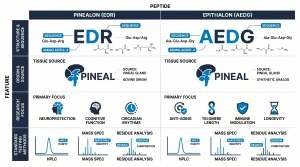
Pinealon and Epithalon both come from the Khavinson research program and both come from pineal gland tissue. Their sequences are different. Epithalon is a tetrapeptide with the sequence AEDG (Ala-Glu-Asp-Gly). Pinealon is a tripeptide with the sequence EDR (Glu-Asp-Arg). The two compounds have different masses, different proposed mechanisms, and different primary research topics.
Epithalon research has focused on telomere biology and circadian rhythm effects in aging models. Pinealon research has focused more on nerve protection and gene expression in neural tissue under stress. Both have been studied in rodent models and cell culture. Researchers in longevity peptide research often study both as part of the same experimental series. For labs comparing these compounds, research-grade Epithalon is also available at ≥99% purity with full COA records.
| Feature | Pinealon (EDR) | Epithalon (AEDG) |
| Sequence | Glu-Asp-Arg | Ala-Glu-Asp-Gly |
| Length | Tripeptide (3 AA) | Tetrapeptide (4 AA) |
| Tissue source | Pineal gland | Pineal gland |
| Research area | Nerve protection, gene expression | Telomere biology, circadian rhythm |
| Study models | Rodent, cell culture | Rodent, cell culture |
| Purity standard | ≥99% | ≥99% |
What Model Systems Are Used in Pinealon Research?
Preclinical peptide research uses two main model types: cell culture and animal models. Cell culture lets researchers isolate a specific pathway. A single cell line is exposed to the peptide and measured for defined outcomes. This approach is precise but limited in scope. Animal studies, typically using rodents, allow tissue-level and behavioral measurement after peptide exposure over a defined period.
Pinealon studies have used both model types. Cell culture experiments studied gene expression in neural cell lines after EDR treatment. Rodent studies looked at tissue outcomes in brain regions after defined exposure. Standard lab protocols were followed in both cases. These data inform future work for future work. All such data apply only to the model organism or cell line used.
How Is Research-Grade Pinealon Characterized?
Characterization of a research peptide begins with identity confirmation. Mass spec checks that the mass matches the EDR sequence (389.36 Da). HPLC measures purity by comparing the target peak to all others. Residue analysis confirms the correct residue composition. All three methods complete a complete testing record.
Each batch is sent to outside labs for testing. Results are recorded in a per-lot COA for short. HPLC purity targets ≥99%. Mass spec confirms the 389.36 Da mass. Each lot gets a unique number for traceability.
Each vial ships with its lot number printed on the label. Researchers match the number to the COA at delivery.
Frequently Asked Questions
What Is the EDR Sequence in Pinealon?
EDR is the single-letter code for glutamic acid, aspartic acid, and arginine. These three form pinealon’s complete sequence (Glu-Asp-Arg). Researchers use both forms in published literature. Identity is confirmed by mass spec, which measures the compound’s mass and compares it to the expected value for EDR (389.36 Da). Residue testing confirms the right ratio.
Is Pinealon the Same as Epithalon?
No. Pinealon and Epithalon have different sequences and lengths. Pinealon is a tripeptide (EDR). Epithalon is a tetrapeptide (AEDG). Both come from the Khavinson research program and both come from pineal gland tissue. Their research areas and data sets are separate. They are sometimes studied in parallel as comparison compounds in the same experiment. They are not the same compound and cannot be swapped.
What Is a Short Peptide Peptide?
A short peptide is a short amino acid sequence derived from organ or tissue extract. The concept was developed by the Khavinson group in Russia beginning in the 1970s. The hypothesis is that short sequences from specific organs keep gene-control activity from that tissue. They may interact with gene expression pathways in target cells. Pinealon (EDR) is one of several short peptides in the series. Others include Epithalon (AEDG), Cortagen (brain cortex), and Thymalin (thymus).
What Studies Have Been Published on Pinealon?
Published pinealon studies appear in journals covering peptide research and gerontology. Key journals include Doklady Biochemistry, Peptides, and the Journal of Peptide Science. Research topics include nerve protection, antihypoxic effects, gene expression in neural cells, and circadian biology. The Khavinson group in Russia has led much of this work. PubMed indexes a portion of the published output.
What Does Nerve-protective Mean in a Research Context?
Nerve-protective describes a compound’s observed ability to support neural cell survival under stress in lab tests. It does not describe any clinical benefit or human health effect. In research, nerve-protective effects are measured by cell survival assays, protein expression levels, or gene expression changes after stress exposure. This label applies only to effects shown in lab tests. This is a research classification, not a medical or clinical claim.
Why Is ≥99% Purity Important?
Purity matters because impurities add noise to results. A 95% pure sample has 5% unknown material. That material could bind receptors, alter cell function, or block the study pathway. Scientists working with ≥99% purity can attribute observed effects to the compound more clearly. HPLC confirms purity level and mass spec confirms compound ID. Both methods together meet the standard for research-grade testing.
How Is Research-Grade Pinealon Stored?
Lyophilized pinealon is stable at room temperature during shipping. Refrigeration at 2-8°C suits longer storage. Freezing at -20°C works for long-term storage. Keep the vial sealed until the protocol calls for it. Follow the COA storage guidance for each lot.
What Is the Difference Between Synthetic Pinealon and Gland Extract?
Synthetic pinealon is a defined compound with a set sequence (EDR), confirmed by mass spec and HPLC before release. Pineal gland extract is a raw preparation containing many undefined compounds. For research purposes, synthetic pinealon offers consistency. Researchers can describe their compound in clear terms. Extract-based preparations cannot be tested the same way. Most research since the 1990s has used synthetic pinealon.
Summary
Pinealon is a synthetic tripeptide compound with the sequence Glu-Asp-Arg, derived from pineal gland research and made by direct synthesis. Published lab studies have studied it in nerve protection, antihypoxic response, and gene expression contexts. All findings come from cell culture and animal studies. No clinical data exist. The lab supplies research-grade pinealon at ≥99% purity with full COA records per lot. Each batch is HPLC and mass spec verified before dispatch.
What Should You Do Next?
Published pinealon studies are indexed on PubMed. Search terms: “EDR peptide,” “pinealon nerve protection,” and “Khavinson short peptides.” To procure, shop research peptides at Next Level Pharm. Each order includes per-lot HPLC and mass spec results. Browse the brain and neural research peptide catalog for related compounds: Epithalon, Cerebrolysin, and Cortagen.
People Also Read
- Epithalon Research Explained: What Current Studies Show
- What Are Longevity Peptides? A Complete Research Review
About the Author
Next Level Pharm Research Team
The Next Level Pharm research team is composed of biochemists and lab scientists who provide researchers with the highest-purity, COA-verified research peptides available. Every batch is HPLC and mass spec verified before dispatch.
Disclaimer: The information provided on this page is for educational and research purposes only. Next Level Pharm’s products are intended for lab research use only. They are not intended for human consumption, diagnostic, therapeutic, or medicinal purposes. This content does not constitute medical advice. Always consult a licensed healthcare professional before making any health-related decisions.