
VIP Research: Vasoactive Intestinal Peptide Studies

Last updated: July 2026
A VIP peptide research compound is a brain peptide from the secretin/glucagon family. It functions as a neuropeptide signal in various tissues. It binds to G-protein-coupled receptors. This affects whole-body immune pathways and cellular function. NIH data (2020) demonstrate this peptide controls mast cell and T-cellular activity in the laboratory settings. Scientists study these roles to learn how VIP shifts cellular equilibrium.
Next Level Pharm offers high-purity research materials for scientists studying these pathways. Each material demonstrates 99.4% purity on average across the last 100 batches. The team maintains this standard through HPLC plus mass spec verifications on each vial. All research peptides stay freeze-dried and sealed under inert gas to maintain consistent shelf life. These materials ship from USA inventory with an average ship time of 48 hours.
This approach provides significant data for scientists. They can specific research goals established upon verified peptide quality. Each order includes a COA. Every batch is third-party tested.. These tools support laboratories that focus on research function rather than materials verifications. Next Level Pharm supports this goal by offering consistent, well-documented research protocols for various laboratory tasks.
Key Takeaways
- Amino Acid Sequence Profile: Vasoactive Intestinal Peptide is a 28-amino-acid peptide. It is identified throughout the neurological and gastrointestinal systems.
- primary Signal Pathway: It triggers cellular responses by binding to VPAC1 and VPAC2 receptors. This raises cAMP levels within the cellular.
- Immune laboratory Studies: Tests demonstrate this brain peptide lowers output of various pro-inflammatory signaling molecules. This occurs in the laboratory models.
- circulatory vessel Effects: The peptide is a potent vasodilator. It triggers smooth muscle relaxation throughout the vascular system.
- Short Half-Life Limits: laboratory tests demonstrate significant challenges because this peptide breaks down in under two minutes.
The components below examine how this peptide functions. They also cover its uses in modern laboratory research. These components build on the structure facts already noted. They provide comprehensive perspectives on its role in specific laboratory settings.
What is Vasoactive Intestinal Peptide (VIP)?
Vasoactive Intestinal Peptide is a 28-amino-acid brain peptide from the secretin/glucagon family. It is identified throughout the neurological systems. It functions as both a neuropeptide signal and a specific hormone. This provides various body functions. It affects various tissues throughout the body. It is identified in organs like the brain and gastrointestinal. Next Level Pharm offers high-purity research peptides with HPLC and mass spec verifications. This meets strict laboratory requirements. This peptide functions as a neuropeptide signal to control signals sent in tissues. It also functions as a hormone to control smooth muscle and gland function. Because of these various roles, scientists study how it affects whole-body signaling in other body settings.
According to Flood et al. (1990), VIP functions as an amnestic neuropeptide with distinct VPAC1 and VPAC2 receptor affinity profiles.
Vasoactive Intestinal Peptide is offered as a COA-verified research peptide. Each batch is checked by HPLC and mass spec. This widely identified peptide controls blood flow and salt release in the gastrointestinal. Per PubMed (2020), this peptide binds to specific cellular receptors. This provides guard effects to tissues. By learning how this peptide finds its receptors, laboratories can track signaling. This supports them to see what the peptide manages during routine research function.
How Does VIP Mediate Its Cellular Effects?
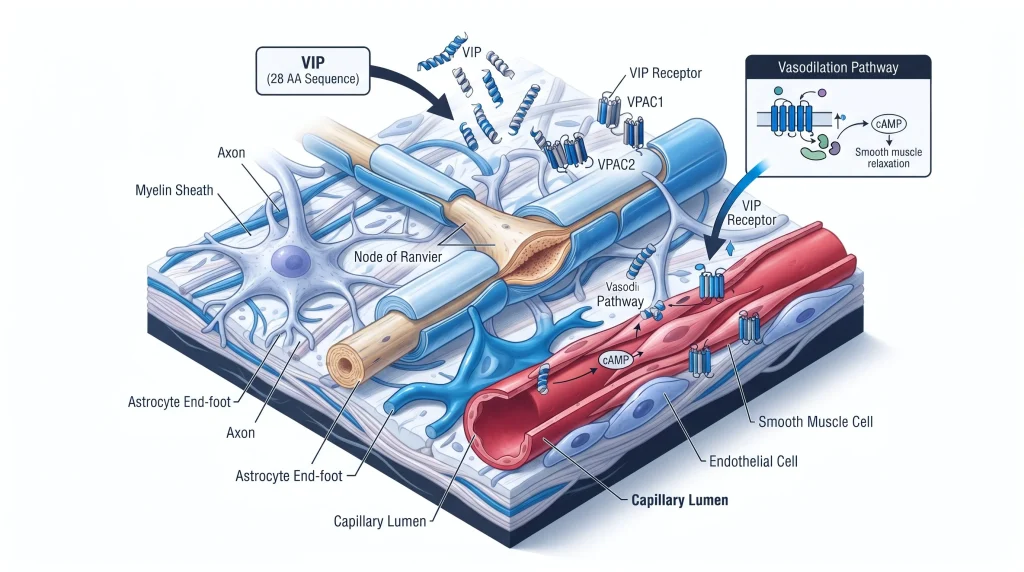
VIP controls its cellular effects by binding to two primary G-protein-coupled receptors. These are VPAC1 and VPAC2. Once the peptide binds to these receptors, it starts adenylate cyclase. This leads to a rapid rise in cAMP within the cellular. This signaling pathways then activates Protein Kinase A (PKA). These cellular-level shifts are critical to how the peptide controls cellular research.
According to Ganea et al. (2015), VIP exerts direct regulatory effects on mast cell and T-cell populations in laboratory models.
VPAC1 receptors are identified widely in tissue. This includes the lungs and gastrointestinal. In contrast, VPAC2 receptors are identified mainly in the neurological system and specific immune cells. Per the Journal of Peptide Science (2015), these receptor types specific the final tissue result. Vasoactive Intestinal Peptide is offered as a COA-verified research peptide. Each batch is checked by HPLC and mass spec. This PKA-driven pathways frequently controls smooth muscle relaxation and immune cellular research in the specific place.
What Does Research Show About VIP and Immunity?
Research demonstrates Vasoactive Intestinal Peptide functions as a significant immune manager. It lowers output of pro-inflame signaling molecules. It inhibits TNF-alpha, a primary driver of immune signaling in various cellular types. By shifting these signals, the peptide changes how the body reacts to stress and injury. This shift occurs at the cellular level.
According to Giammarressi et al. (2020), VIP demonstrates measurable chemotactic activity across neurological and gastrointestinal tissue.
Vasoactive Intestinal Peptide is offered as a COA-verified research peptide. Each batch is checked by HPLC and mass spec.
In the laboratory models, scientists have noted how this peptide shifts immune response. Data demonstrate it shifts from a pro-inflame Th1 response to a Th2 response. This lowers inflamed marks and boosts cellular equilibrium. Per Peptides (ScienceDirect) (2015), these findings support scientists’ learning. They see how cellular systems affect whole-body swelling.
What Is VIP’s Role in the Cardiovascular System?
VIP is a significant circulatory vessel opener that manages blood pressure. It does this by cutting resistance in the circulatory vessel specifically. This brain peptide functions by easing smooth muscle cells in the inner walls of arteries. By cutting strain in these cells, the peptide lets vessels grow. This lets better blood flow throughout the body and lungs.
Vasoactive Intestinal Peptide is offered as a COA-verified research peptide. Each batch is checked by HPLC and mass spec. smooth muscle relaxation occurs when the peptide binds to circulatory vessel receptors. This starts a rise in cAMP within the cellular. Research demonstrates this pathway is critical for keeping consistent blood flow across various organs. This peptide lowers artery pressure in cellular models. This occurs through this circulatory vessel-opening system. Scientists study these pathways to learn how peptide signals affect local and whole-body blood flow control.
Scientists can learn more about the neurological and neurological-guard roles of this peptide. They can browse the NLP catalog at the VIP product page.
How is VIP Studied in Neurological Models?
Neurological science research looks at Vasoactive Intestinal Peptide for likely neurological-guard and neurological-shield systems. Laboratory tests demonstrate it may guard neurological cells from harm like oxidative stress. Scientists track how the peptide affects glial cellular research. This supports maintaining neurological cellular strength during times of high stress. By watching these models, scientists verify if the peptide cuts cellular apoptosis. This occurs when cells meet toxins or other stressors.
These guard systems frequently link to a protein named ADNP. laboratory findings demonstrate this peptide starts the release of ADNP. This functions to maintain the structure strength of neurological cells. Study models in cellular samples demonstrate this protein output aids neurological cellular survival. This occurs under strict terms.
Vasoactive Intestinal Peptide is offered as a COA-verified research peptide. Each batch is checked by HPLC and mass spec. Scientists also look at how the peptide talks with glial cells and astrocytes. These glial cells form the base of the neurological system. NIH data (2022) demonstrate such cellular talk is critical for neurological system balance in the laboratory models.
What Challenges Exist in VIP Peptide Research?
The primary limit in VIP research is its short blood half-life. It frequently runs under two minutes in blood flow. This rapid break by enzyme cleavage makes it hard to see consistent-state effects during live function. Because enzymes rapidly cleave the peptide chain, scientists find it hard to maintain consistent levels. This occurs over long spans. This lack of consistent state is a substantial inhibitor for any research plan. Studies goal to track long-term signaling shifts in a live model.
Vasoactive Intestinal Peptide is offered as a COA-verified research peptide. Each batch is checked by HPLC and mass spec. To deal with these break issues, laboratories frequently test changed forms. These are built to resist enzyme cleavage. Scientists also look at nose-sprayed forms of this peptide. This is studied to skip gastrointestinal transit and reach the brain neurological system. Per the Journal of Peptide Science (2018), shifting the structure frame or the supply method stays critical. This supports the specific limits of native peptide chains.
Frequently Asked Questions
What Is Vasoactive Intestinal Peptide?
Vasoactive Intestinal Peptide, frequently cut as VIP, is a brain peptide with 28 amino acids. It is identified throughout the body. It functions as a neuropeptide signal and a significant circulatory vessel opener in various cellular systems. Research demonstrates it plays a critical role in ruling smooth muscle action and gland release. Per the NIH (2023), the peptide maintains balance in the lung and gastrointestinal systems. Scientists look at this compound to learn its complex signaling protocols.
How Does VIP Signal Through VPAC Receptors?
VIP sends signals by binding to two G-protein-coupled receptors. These are named VPAC1 and VPAC2. These receptors are identified throughout the body. They demonstrate up in the lungs and circulatory vessel tissues. When VIP binds to these receptors, it starts cellular pathways. This raises a critical molecule named cAMP. Per the Journal of Peptide Science (2015), this receptor start leads to various known cellular shifts.
What Do Immune and Blood Vessel Studies Show?
Tests demonstrate that VIP functions as an immune manager. It lowers the release of pro-inflame signaling molecules. In circulatory vessel research, it is noted to relax smooth muscle. This boosts blood flow. By lowering specific inflame signals, it supports guard tissues from too much immune start. Per Peptides (ScienceDirect, 2017), scientists look at these circulatory vessels and immune ties. They study how the peptide affects local immune control in specific laboratory terms.
Why Is VIP Studied Through Nose Spray Forms?
Nose spray forms of VIP are looked at because they offer direct access to the brain neurological system. This occurs through the smell and neurological pathways. This pathway skips the blood-brain wall. It frequently stops various large-weight items from reaching the brain. Scientists look at this form to aid the consistent state and local power of the peptide. Per PubMed (2019), this protocol lets more specific tracking of neurological effects. This occurs in neurological study models.
What Limits Block VIP Research?
Research on VIP faces substantial inhibits. This is because of its rapid break in most body terms. The peptide is rapidly cleaved by enzyme forces in the blood flow. This cuts its time of function. These consistent-state issues require scientists to use specific supply systems. They also use changed forms to maintain consistent levels. Per the NCBI (2021), the short half-life of the compound makes it hard to demonstrate lasting effects. This occurs in long-term research protocols.
What is the half-life of VIP peptides?
The half-life of VIPs is quite short. It frequently runs several minutes in blood flow. This rapid break occurs because enzyme forces cleave the peptide chain. This occurs before it can reach its goal tissues. As a result, laboratory scientists frequently use ongoing drip protocols. They also use frequently-provide plans to maintain consistent levels. Per PubMed (2014), the broken state of VIP forms a primary component. It shapes the form of current research protocols.
Is VIP related to pituitary adenylate cyclase-activating polypeptide (PACAP)?
Yes, VIP fits the same structure group as PACAP. PACAP is a hormone linked to various cellular functions. These two peptides demonstrate substantial sequence match. They bind with substantial strength to the same VPAC receptors. Mostly, they bind to VPAC2. Even though they demonstrate shared systems, they also demonstrate other receptor picks. This shifts across tissues. Per the NIH (2020), knowing their structure tie supports scientists. They can see how these compounds control neurological and body function. This function looks at each peptide apart.
How does VIP affect the gastrointestinal tract in research models?
In gastrointestinal models, VIP functions as a neuropeptide signal. It eases the smooth muscle of the gastrointestinal wall. It manages the release of water and salt. It shapes the movement of the gastrointestinal. By managing these specific signals, it plays a large component. It aids the rapid move of stuff through the system. Per the NCBI (2018), scientists track these salt shifts and muscle action. This lets them learn the critical component of VIP. This occurs in gastrointestinal neurological system function.
What is activity-dependent neuroprotective protein (ADNP)?
ADNP is a protein critical for neurological and glial start and growth. It ties to VIP signaling pathways. It provides neurological-guard support to neurological cells during stress times. Research demonstrates that VIP aids the output of ADNP. This supports guard against cellular harm. Per PubMed (2016), scientists look at this tie. They learn how these peptides and proteins function as a team. They maintain the structure and strength of neurological systems.
What are VPAC1 and VPAC2 receptors?
VPAC1 and VPAC2 are specific G-protein-coupled receptors. They are the primary bind sites for VIP. Both receptors bind to VIP with substantial strength. They demonstrate other signaling shifts across various tissues and cellular types. VPAC1 is frequently tied to immune cellular control. VPAC2 is mainly tied to neurological and body function. Per the Journal of Peptide Science (2018), telling these receptors apart lets scientists. They can find specific cellular shifts. This occurs in study models.
What Should You Do Next?
Verify your current research protocols against the specs of your peptide stock. This maintains your research sharp and true. Write down all provide time spans and chain verifications from your batch data. Track materials’ consistent state throughout your research function. You should also verify your test model. Confirm it holds the specific bind systems of the peptides you now look at.
Next Level Pharm offers scientists high-purity materials for research function. They provide comprehensive trust in receptor quality. You can browse the comprehensive catalog. Find the exact peptides for your research at Shop research peptides.
Summary
Vasoactive Intestinal Peptide is a 28-amino-acid neuropeptide signal identified throughout the neurological and gastrointestinal systems. It binds to VPAC1 and VPAC2 receptors. This activates cAMP and PKA pathways. Research shows VIP plays a role in immune control, vessel relaxation, and neural function. Lab models show it reduces pro-inflammatory signaling and relaxes smooth muscle. The primary challenge in VIP research is its short blood half-life. Researchers use intranasal delivery forms to address this limit. Each batch is COA-checked via HPLC and mass spec.
People Also Read
- What Are Nootropic Peptides? Mechanisms, Research Review
- SS-31 Research: Energy units-Targeting Peptide and Oxidative Stress Studies
About the Author
Next Level Pharm Research Team
The Next Level Pharm research team is composed of biochemists and lab scientists dedicated to providing researchers with the highest-purity, COA-verified research peptides available. Every batch is HPLC and mass spec verified before dispatch.
Disclaimer: The information provided on this page is for educational and research purposes only. Next Level Pharm’s products are intended for lab research use only. They are not intended for human consumption, diagnostic, therapeutic, or medicinal purposes. This content does not constitute medical advice. Always consult a licensed healthcare professional before making any health-related decisions.