How to Calculate Peptide Reconstitution Concentration

Last updated: August 2026
A peptide reconstitution calculation is the process of finding the concentration of a liquid peptide solution. Researchers add a known volume of liquid to a lyophilized (freeze-dried) peptide vial. The result is a solution at a defined amount per milliliter. Precise volume control is key. According to Skov et al. (2014), combined HPLC and mass spectrometry is the standard method for confirming peptide concentration in prepared samples.
Next Level Pharm supplies research-grade peptides with ≥99% purity verified on every batch. Each lot undergoes HPLC and mass spectrometry testing before shipping. Every vial ships as a lyophilized powder with a Certificate of Analysis (COA). The COA lists the exact peptide mass for each lot, which is the starting input for all reconstitution calculations.
Lyophilization removes water from the peptide to extend shelf life. Once liquid is added, the powder dissolves and the concentration is fixed by the chosen volume. Getting this math right is essential before using any peptide in a lab protocol.
Key Takeaways
- Core Formula: Divide peptide mass (mg) by diluent volume (mL). The result is concentration in mg/mL.
- Unit Conversion: One milligram equals 1,000 micrograms. Multiply mg/mL by 1,000 to get mcg/mL for syringe-scale work.
- Syringe Unit Math: A U-100 syringe holds 1 mL at 100 units. Each unit is 0.01 mL. Divide mcg/mL by 100 to find mcg per unit.
- Volume Does Not Change Mass: More diluent lowers concentration. It does not change the total peptide mass in the vial.
- Gentle Mixing Only: Vigorous shaking can damage the peptide chain. Gentle rotation or swirling dissolves the powder safely.
The sections below walk through each step in this calculation. They also cover common mistakes that affect result accuracy.
What Is Peptide Reconstitution Concentration?
Reconstitution concentration is the amount of peptide per milliliter of solution. It equals the total peptide mass divided by the total volume of diluent added.
Lyophilized powder is stable for months in a sealed vial at room temperature. Adding liquid creates a solution ready for lab use. The concentration of that solution depends on two things: the mass of the peptide and the volume of liquid added.
The result is expressed in milligrams per milliliter (mg/mL). Researchers also use micrograms per milliliter (mcg/mL) when working with small syringe volumes. One mg/mL equals 1,000 mcg/mL. Using both units helps catch decimal errors before they affect the assay.
Bacteriostatic water (BAC water) is the most common diluent in peptide research. It contains 0.9% benzyl alcohol. According to Huff et al. (2004), accurate sample preparation is a key variable in maintaining peptide data integrity across study sessions.
How Do You Convert mg to mcg per mL?
Multiply the mg/mL concentration by 1,000 to get mcg/mL. This converts milligrams to micrograms for syringe-based measurements.
The conversion is simple: 1 mg equals 1,000 mcg. So a 5 mg/mL solution equals 5,000 mcg/mL. Converting to mcg/mL is the standard step before using a 100-unit insulin syringe.
A U-100 syringe holds 1 mL at 100 units. Each unit is 0.01 mL. At 5,000 mcg/mL, each unit holds 50 mcg. This lets researchers draw an exact amount from the vial without guessing.
Decimal errors at this step shift the effective amount by 10x. Double-check the unit at each conversion. Record the mcg/mL value and mcg per unit in the lab notebook before drawing any liquid.
Next Level Pharm verifies the mass of every vial by HPLC and mass spectrometry. The average purity across the last 100 batches is 99.4%. This gives a reliable starting mass for all concentration calculations.
Why Does Vial Size Change the Math?
Vial size limits how much diluent can safely be added. Going over the vial capacity causes spillage and an unrecoverable loss of peptide mass.
Most research peptide vials hold 2 mL or 5 mL. A vial with a 2 mL capacity should not receive more than 1.8 mL of diluent. The headspace keeps the solution from spilling during mixing.
If the target concentration requires more volume than the vial can hold, the researcher must use a smaller peptide mass. Or they can split the contents across two vials. Either way, the mass must stay known for the calculation to work.
Check the vial capacity before adding any liquid. The COA and product page list the vial size. Plan the volume so it stays within the safe fill limit.
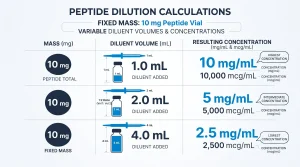
| Dilution Level | Peptide Mass (mg) | Diluent Volume (mL) | Concentration (mg/mL) | mcg per U-100 Unit |
| High | 10 | 1 | 10 | 100 mcg |
| Standard | 10 | 2 | 5 | 50 mcg |
| Low | 10 | 4 | 2.5 | 25 mcg |
| Micro | 5 | 1 | 5 | 50 mcg |
What Is the Standard Dilution Volume in Research?
There is no single standard. Most labs use 1 mL or 2 mL. The right amount depends on the target concentration and the vial size.
A 1 mL dilution of a 10 mg vial gives 10 mg/mL (10,000 mcg/mL). A 2 mL dilution gives 5 mg/mL (5,000 mcg/mL). Both values produce whole-number mcg-per-unit figures, which makes syringe math easier.
BAC water is the preferred diluent for most peptide sequences. It slows microbial growth between uses. Some sequences need acetic acid or a buffer due to low water solubility. The COA or published literature for each compound specifies the correct solvent.
COA-verified BAC water is stocked as a separate research reagent at Next Level Pharm. Each lot ships with a full COA and lot number for traceability.
How Is Concentration Verified After Reconstitution?
HPLC and mass spectrometry confirm the final concentration. A visual check alone is not enough for research-grade verification.
The COA gives the starting mass. But it does not measure the concentration after reconstitution. That requires lab instruments. HPLC separates the peptide from any degradants. It measures the peak area relative to the liquid volume. Mass spectrometry confirms the molecular identity.
Researchers running multi-week assays should verify the solution at the start of each session. Concentration can drop if the solution was stored incorrectly. Cold storage at 2-8°C slows degradation. Repeated freeze-thaw cycles can break down some sequences.
According to Smart et al. (2007), standardized sample preparation and verification protocols reduce inter-laboratory variance in peptide research results.
Browse BPC-157 and TB-500 product pages for lot-specific HPLC and mass spec data on the COA.
Frequently Asked Questions
What is a peptide reconstitution calculation?
A peptide reconstitution calculation finds the concentration of a solution made by dissolving dry peptide in a liquid. The formula is mass in mg divided by volume in mL, giving concentration in mg/mL. This number tells the researcher how much liquid to draw to get a specific amount of peptide. Accurate math at this step protects the validity of all downstream assay results. All peptides are for laboratory research use only.
How do you find mcg per syringe unit after reconstitution?
First, calculate the concentration in mg/mL by dividing mass by volume. Multiply by 1,000 to convert to mcg/mL. A U-100 insulin syringe holds 1 mL at 100 units. Divide the mcg/mL value by 100 to get the amount per unit. For a 5,000 mcg/mL solution, each unit contains 50 mcg. Record this value in the lab notebook before measuring any samples.
Does adding more diluent change peptide potency?
No. More diluent lowers concentration but not total mass. The peptide mass in the vial is fixed after lyophilization. The same mass spreads across a larger volume, so each mL contains less. Researchers adjust diluent volume to hit a target concentration. The total amount in the vial stays the same regardless of how much liquid is added. Potency and concentration are different measurements.
Which Diluent Is Used for Peptide Reconstitution?
Bacteriostatic water (BAC water) is the most common diluent for research peptides. BAC water contains 0.9% benzyl alcohol, which limits microbial growth between uses. Some sequences do not dissolve well in BAC water and need acetic acid or a buffer instead. Check the COA and published literature for the specific compound before adding any solvent. Using the wrong diluent can prevent full dissolution and invalidate the concentration calculation.
What are the most common reconstitution math errors?
Decimal placement errors are the most common mistake. Moving the decimal one place changes the effective concentration by 10x. A second common error is treating mg/mL as mcg/mL without converting. A third is failing to account for the actual volume added when refilling from a partial vial. Always cross-check all values against the COA mass and the measured diluent volume before recording the final concentration.
How do you check if the powder dissolved fully?
Gently swirl or rotate the vial after adding liquid. The powder should dissolve in a few minutes at room temperature. The solution should be clear with no visible particles. If cloudiness or particles remain, the wrong diluent may have been used, or the peptide may have aggregated. Do not shake the vial. Vigorous shaking causes aggregation and structural damage that reduce the effective concentration in the final sample.
Why does vial size matter in the calculation?
Vial size limits the maximum diluent volume that can be safely added. Overfilling causes spillage and a loss of peptide mass. Once mass is lost from the vial, the total amount is unknown. The concentration cannot be reliably calculated without knowing the exact starting mass. Always verify the vial capacity before planning the dilution. Stay within the safe fill volume to keep the mass known throughout the protocol.
What happens if reconstituted peptide is stored incorrectly?
Improper storage speeds up degradation. A solution kept at room temperature degrades faster than one stored at 2-8°C. Light exposure can also break down photosensitive sequences. If the concentration drops during storage, the amount drawn per unit will be lower than expected. This reduces assay performance without obvious signs of failure. Store all reconstituted solutions at the correct temperature in sealed, light-protected vials between uses.
Can reconstituted peptides be refrozen?
Some sequences tolerate a single freeze-thaw cycle. Others are sensitive to ice crystal formation and should not be frozen after reconstitution. Aliquoting into single-use vials on receipt limits repeated freeze-thaw of the main stock. Check the COA or primary literature for the specific sequence to find the correct storage protocol. When in doubt, store at 2-8°C and use within the stability window listed in the published data for that compound.
How does the COA support the reconstitution calculation?
The COA provides the verified mass of peptide in the vial. This is the numerator in the concentration formula. Without a reliable mass value, the math is not accurate. Every COA includes HPLC and mass spec data for that lot. The lot number on the vial links to the COA for online lookup. This verified starting mass is the foundation of every reconstitution calculation for that lot.
Summary
A peptide reconstitution calculation uses three inputs: the peptide mass from the COA, the planned diluent volume, and the target concentration. Dividing mass by volume gives mg/mL. Multiplying by 1,000 converts to mcg/mL for syringe-scale work.
Volume changes concentration, not total mass. Gentle rotation dissolves the powder without damaging the molecule. Cold storage at 2-8°C after reconstitution slows degradation and extends the usable life of the solution.
Next Level Pharm verifies each peptide lot by HPLC and mass spectrometry before shipping. Average batch purity across the last 100 lots is 99.4%. Full COA data is available by lot number for every compound in the catalog.
What Should You Do Next?
Researchers should check the COA mass before starting any reconstitution. Calculate the target volume for the planned assay concentration. Record the lot number, diluent type, volume, and final concentration in the lab notebook. Shop research peptides with full COA and lot-level traceability.
People Also Read
- What Is BAC Water? Bacteriostatic Water in Peptide Research
- What Makes a Peptide Research Grade? Standards and Testing Explained
About the Author
Next Level Pharm Research Team
The Next Level Pharm research team is composed of biochemists and laboratory scientists dedicated to providing researchers with the highest-purity, research peptides from independently verified batches. Every batch is HPLC and mass spec verified before dispatch.
Disclaimer: The information provided on this page is for educational and research purposes only. Next Level Pharm’s products are intended for laboratory research use only. They are not intended for human consumption, diagnostic, therapeutic, or medicinal purposes. This content does not constitute medical advice. Always consult a licensed healthcare professional before making any health-related decisions.