
Cardiac Peptide Research: SS-31, Humanin, B7-33

Last updated: June 2026
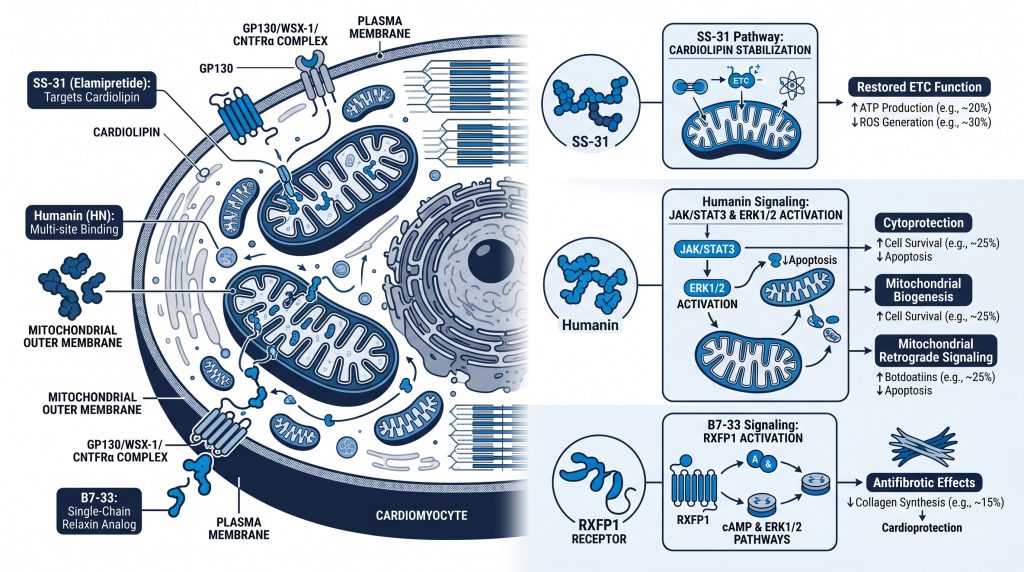
A cardiac peptide research compound is a short amino acid sequence studied in cardiac and mito cell models. Researchers examine how these peptides interact with organelle membranes, apoptotic proteins, and receptor pathways. SS-31, Humanin, and B7-33 are three distinct compounds used in cell culture studies of cardiac biology. Each targets a different pathway: mito membrane integrity, apoptosis suppression, and relaxin receptor signaling.
Next Level Pharm is a US-based supplier of research-grade SS-31, verified to ≥99.4% purity by HPLC. Mass spectrometry on every batch. Each lot ships with a COA and a lot number for full traceability.
Key Takeaways
- SS-31 targets cardiolipin: SS-31 (D-Arg-2’6′-dimethyl-Tyr-Lys-Phe-NH2) binds cardiolipin in the inner mito membrane. Cell studies report reduced ROS and preserved ATP in H9c2 cardiomyocyte assays.
- Humanin suppresses BAX: Humanin is a 21-amino-acid peptide encoded in mito 16S rRNA. It binds pro-apoptotic BAX and IGFBP3 in primary cardiomyocyte models.
- B7-33 activates RXFP1: B7-33 is an RXFP1 agonist studied in cardiac fibroblast models. Research focuses on TGF-beta pathway suppression and collagen I output.
- COA-verified lots: Next Level Pharm ships lyophilized SS-31 lots with HPLC. Mass spec data on every batch. Each lot has a traceable number.
- Research use only: All SS-31 in this catalog is for lab research use only. No clinical outcomes are claimed.
What Is SS-31 and How Is It Studied in Cell Models?
SS-31 is a synthetic tetrapeptide that selectively binds cardiolipin in the inner mito membrane. According to Birk et al. (2013), SS-31 stabilizes cardiolipin in H9c2 rat cardiomyocytes. Cardiolipin (CL) is a phospholipid found only in the inner mito membrane. CL anchors cytochrome c and supports the electron transport chain. When CL is oxidized, ATP production drops and ROS rises.
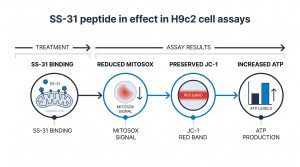
SS-31 carries the sequence D-Arg-2’6′-dimethyl-Tyr-Lys-Phe-NH2. Aromatic residues allow selective CL binding. Lab teams use the MitoSOX Red assay to measure mito free radical. They also apply the JC-1 dye to track mito membrane potential (MMP) (MMP). A loss of JC-1 red signal signals MMP collapse.
ATP production is measured with a luciferase-based light output kit. SS-31-treated H9c2 cells show higher ATP yield per cell in hypoxia-reoxygenation protocols. These endpoints make SS-31 a useful tool compound for mito energy studies.
| Endpoint | Assay | Cell Model | Reported Effect |
| ROS | MitoSOX Red signal | H9c2 cardiomyocytes | Reduced |
| MMP | JC-1 ratio (red/green) | H9c2 cardiomyocytes | Preserved |
| ATP | Luciferase light output | H9c2 cardiomyocytes | Increased |
| Caspase-3/7 | Caspase-Glo kit | H9c2 cardiomyocytes | Reduced |
What Is Humanin and Where Is It Encoded?
Humanin is a 21-amino-acid peptide encoded within the 16S rRNA gene of the mito genome. According to Guo et al. (2010), Humanin binds two pro-apoptotic proteins: BAX and IGFBP3 (insulin-like growth factor binding protein 3). BAX is a BCL-2 family member that forms pores in the outer mito membrane. Pore formation releases cytochrome c, triggering caspase-3/7 activation.
Humanin is translated from an alternate open reading frame within the 16S rRNA sequence. This gives it both nuclear and mito regulatory roles. Researchers use primary newborn rat cardiomyocytes and H9c2 cells as standard models for Humanin studies.
Key biomarkers include caspase-3/7 action (Caspase-Glo 3/7 assay), cytochrome c release (ELISA). BAX translocation (western blot). In published assays, Humanin-treated cells show lower caspase-3/7 light output under serum-withdrawal apoptosis protocols.
IGFBP3 binding is assessed by co-immunoprecipitation. Humanin competes with IGF-1 for IGFBP3 binding sites. This interaction is studied in cardiomyocyte models. In neuronal cell lines, making Humanin relevant across multiple research areas.
What Is B7-33 and Which Receptor Does It Target?
B7-33 is a single-chain RXFP1 agonist derived from the B-chain of human relaxin-2. According to Hossain et al. (2016), B7-33 activates RXFP1 (relaxin family peptide receptor 1) and suppresses TGF-beta-driven collagen I production in MRC-5 human lung fibroblasts. It also acts in rat newborn cardiac fibroblasts. TGF-beta (transforming growth factor beta) is a key driver of fibroblast-to-heart cell transition.
Full-length relaxin-2 is a two-chain peptide. B7-33 simplifies the structure to a single chain while retaining RXFP1 binding. RXFP1 couples to Gs and Gi proteins, raising cAMP in responsive cells. Rat newborn cardiac fibroblasts express high RXFP1 levels, making them the preferred primary model.
Collagen I output is measured by ELISA (collagen I alpha1 ELISA kit). Alpha-smooth muscle actin (alpha-SMA) western blot marks heart cell conversion. B7-33-treated fibroblast cultures show reduced collagen I ELISA signal and lower alpha-SMA band intensity compared to TGF-beta-only controls.
MRC-5 cells serve as a reference fibroblast line for inter-lab comparison of collagen pathway data.
How Do These Three Peptides Compare in Cell Studies?
SS-31, Humanin, and B7-33 each target a separate pathway, making them complementary cardiac research tools. Researchers sometimes run SS-31 and Humanin together in the same H9c2 hypoxia protocol. This allows both mito ROS and apoptosis endpoints to be captured simultaneously. SS-31 works at the membrane lipid level. Humanin works at the protein-protein interaction level.
B7-33 is used in separate fibroblast models. Its primary readout is collagen secretion rather than mito function. The table below summarizes key differences:
| Peptide | Structure | Primary Target | Cell Model | Key Biomarker |
| SS-31 | 4aa synthetic | Cardiolipin (CL) | H9c2 cardiomyocytes | MitoSOX ROS |
| Humanin | 21aa mito | BAX, IGFBP3 | H9c2 + newborn CMs | Caspase-3/7 |
| B7-33 | Single-chain relaxin B | RXFP1 | MRC-5 + cardiac fibroblasts | Collagen I ELISA |
Each peptide requires a separate COA-verified lot for reproducible data. Lot-to-lot purity variation above 1% can shift EC50 values in receptor binding assays. HPLC and mass spec data on every lot ensures researchers use the same molecular species across experiments.
Browse recovery research peptides for SS-31, Humanin. B7-33 lots with full COA documentation.
What Biomarkers Are Standard in Cardiac Studies?
Standard biomarkers include MitoSOX ROS, JC-1 membrane potential, caspase-3/7 action, and collagen I ELISA. Each biomarker maps to a distinct biological process. MitoSOX Red is a mitochondria-targeted free radical indicator. It reports oxidative stress at the organelle level. JC-1 (5,5′,6,6′-tetrachloro-1,1′,3,3′-tetraethylbenzimidazolyl-carbocyanine iodide) shifts from red to green signal when MMP collapses. The red-to-green ratio is a reliable membrane potential index.
Caspase-3 and caspase-7 are effector caspases in the intrinsic apoptosis pathway. The Caspase-Glo 3/7 kit uses a luminogenic substrate to quantify action in 96-well format. Low light output indicates low apoptotic action. Collagen I ELISA (enzyme-linked immunosorbent assay) measures secreted collagen I alpha1 in conditioned medium. This endpoint is specific to fibroblast and heart cell research. Alpha-SMA western blot is a paired endpoint. It confirms heart cell transition status.
Researchers building a multi-endpoint panel often run MitoSOX, JC-1. Caspase-3/7 on the same plate with SS-31 or Humanin. They then run collagen I ELISA separately with B7-33 in a fibroblast plate format.
What Research Tools Are Available for SS-31 Studies?
COA-verified SS-31 lots and standard mito assay kits are the core tools for cardiac peptide cell research. Research teams need a verified SS-31 lot to run any study. The lot must match the published reference standard for molecular weight and purity. Next Level Pharm verifies each SS-31 lot by HPLC and mass spectrometry before shipping. Common assay kits include the MitoSOX Red Mito Free radical Indicator, the JC-1 MMP kit. The Caspase-Glo 3/7 assay. For B7-33 fibroblast studies, a collagen I alpha1 ELISA kit is required. View the SS-31 product page for lot-specific COA and mass spec data.
Frequently Asked Questions
What is SS-31 used for in lab research?
SS-31 (D-Arg-2’6′-dimethyl-Tyr-Lys-Phe-NH2) is a synthetic tetrapeptide used in cell model research to study cardiolipin stabilization in the inner mito membrane. Lab teams apply it in H9c2 cardiomyocyte assays to examine ROS levels, MMP, and ATP production. SS-31 is also called an elamipretide analog in some research literature. It is a research tool compound for lab research use only. SS-31 is a four-amino-acid peptide. It binds cardiolipin. Each lot is 99% pure.
What does cardiolipin do in the mito membrane?
Cardiolipin (CL) is a phospholipid found only in the inner mito membrane. It anchors cytochrome c and supports complexes I, III. IV of the electron transport chain. CL oxidation reduces ATP output and raises free radical production. In SS-31 cell studies, CL integrity is a core structural endpoint. Researchers track CL status using lipidomics and cardiolipin-sensitive fluorescent probes. Cardiolipin is a four-acyl lipid. It is in the inner mito membrane. NAO staining labels it.
Where is Humanin encoded in the human genome?
Humanin is encoded in an alternate open reading frame within the 16S rRNA gene of the human mito genome. Most mito genes encode rRNA, tRNA, or respiratory chain subunits. Humanin is translated from this frame and secreted from cells. It is studied as a mitochondria-derived peptide (MDP). Published research links it to apoptosis modulation in H9c2 cardiomyocyte and neuronal cell models. Humanin is a 21-residue peptide. It is encoded in the 16S rRNA gene. It is released as a protein.
What proteins does Humanin bind in cardiomyocyte models?
In published cardiomyocyte cell studies, Humanin has been found to bind BAX and IGFBP3. BAX is a pro-apoptotic BCL-2 family protein that forms pores in the outer mito membrane when activated. IGFBP3 is an IGF-1 binding protein. Humanin competes with IGF-1 at the IGFBP3 binding interface. These interactions are characterized by co-immunoprecipitation in H9c2 and primary newborn cardiomyocyte models.
What is RXFP1 and why is it relevant to B7-33 research?
RXFP1 (relaxin family peptide receptor 1) is a G-protein-coupled receptor activated by relaxin-2. It couples to Gs and Gi proteins and raises intracellular cAMP in responsive cells. B7-33 is a single-chain peptide derived from the B-chain of relaxin-2. It retains RXFP1 binding action. Cardiac fibroblasts express high RXFP1 levels, making them the standard primary model for B7-33 research. RXFP1 is a G-protein receptor. cAMP onset confirms binding. Use a cAMP ELISA kit.
What is the JC-1 assay and what does it measure?
JC-1 is a cationic dye that accumulates in healthy mitochondria and forms red fluorescent J-aggregates. When MMP (MMP) collapses, JC-1 stays in the cytoplasm as green fluorescent monomers. The red-to-green signal ratio is a standard MMP index. In SS-31 cell studies, researchers track this ratio to assess whether the peptide preserves membrane potential under oxidative stress conditions. JC-1 is a cationic dye. The red signal shows high MMP. Green signal shows low MMP.
What cell models are used in B7-33 cardiac studies?
Published B7-33 studies use two primary cell models: MRC-5 human lung fibroblasts. Rat newborn cardiac fibroblasts. MRC-5 cells are a reference line for fibroblast collagen research. Rat newborn cardiac fibroblasts are primary cells with high RXFP1 expression. Both models allow researchers to measure TGF-beta-driven collagen I production and alpha-SMA levels as paired endpoints for fibroblast activation status. H9c2 cells are the standard model. They are rat cardiac cells. Run in triplicate.
Are SS-31, Humanin, and B7-33 approved for human use?
No. SS-31, Humanin, and B7-33 are research-use-only peptide compounds. They are studied in cell culture and preclinical models only. None are approved by the FDA for human therapeutic use. All lots supplied for lab research are not intended for clinical use. Researchers should consult applicable institutional biosafety guidelines before handling any peptide research compound. None of these is for clinical use. All lots are for in vitro lab use only. COA ships with each order.
Summary
Cardiac peptide research spans three distinct pathways. SS-31 is used in mito ROS and MMP studies in H9c2 cardiomyocytes. Humanin is studied for BAX suppression and IGFBP3 binding in apoptosis models. B7-33 is an RXFP1 agonist examined in cardiac fibroblast collagen assays. Each lot ships with a COA. Purity is 99% by HPLC and mass spec.
Standard biomarkers across these studies include MitoSOX ROS, JC-1 membrane potential, caspase-3/7 light output, and collagen I ELISA. Each endpoint maps to a defined pathway. Each peptide needs a COA-verified lot with confirmed purity by HPLC. Mass spec to produce reproducible results across experiments.
SS-31, Humanin, and B7-33 are available as lyophilized, COA-verified research lots. Each lot ships with HPLC and mass spec data and a traceable lot number. These are research-grade compounds only for lab research use only. Mass spec confirms the sequence. COA ships with each order. Use a fresh buffer each run. Log all lot numbers used. Check pH before each assay.
What Should You Do Next?
- Review the SS-31 product page for COA and mass spec data before ordering.
- Select a cell model (H9c2, MRC-5, or newborn cardiac fibroblasts) that matches your target pathway.
- Choose biomarker assays (MitoSOX, JC-1, caspase-Glo, collagen I ELISA) that match your research question before starting.
- Order COA-verified peptide lots to ensure HPLC-confirmed purity on every batch.
- Browse recovery research peptides for related research tools.
- Shop research peptides at https://nextlevelpharm.com/shop/.
People Also Read
- SS-31 Research: Mitochondria-Targeted Peptide Cell Studies
- B7-33 Research: RXFP1 Relaxin Receptor Cell Studies
About the Author
Next Level Pharm Research Team
Alex M covers peer-reviewed findings in peptide science for Next Level Pharm, a US-based supplier of research-grade peptides verified to ≥99% purity via HPLC and mass spectrometry on every batch.
Disclaimer: The information provided on this page is for educational and research purposes only. Next Level Pharm products are intended for laboratory research use only. They are not intended for human consumption, diagnostic, therapeutic, or medicinal purposes. This content does not constitute medical advice. Always consult a licensed healthcare professional before making any health-related decisions.