How to Store Research Peptides: Temperature and Stability

Last updated: June 2026
A peptide storage research protocol sets the conditions for keeping compounds intact from shipment to study. Peptides are short chains of amino acids. They break down when exposed to heat, light, water, or oxygen over time. According to research published in PubMed (2021), lyophilized peptides maintained over 95% purity after 24 months at -20 degrees C in sealed vials. Proper storage preserves the purity value shown on each COA.
Next Level Pharm ships all research peptides as lyophilized powders. Each batch is tested to >=99% purity via HPLC and mass spectrometry before dispatch. HPLC is a lab method that measures compound purity. Mass spectrometry confirms the exact mass of the compound. A COA, or purity report, ships with every lot. The average purity across the last 100 batches is 99.4%.
Researchers use different storage conditions based on how long they plan to hold a compound before use. Lyophilized peptides in a sealed vial behave differently than peptides in solution. Knowing the right storage path for each form avoids waste and keeps lot data reliable.
Key Takeaways
- Room temperature: Lyophilized peptides are stable at room temperature for short transit, under two weeks. They should not be stored at room temperature long-term.
- Cold storage (4 degrees C): A standard fridge at 4 degrees C is safe for lyophilized peptides used within 3 to 6 months. This range fits most active research schedules.
- Frozen storage (-20 degrees C): Freezing at -20 degrees C extends stability to 12 to 24 months for most lyophilized peptides in sealed, dark vials.
- Light control: UV and visible light break chemical bonds in peptides. Amber vials and dark storage reduce this risk.
- Moisture control: Water causes peptide breakdown by hydrolysis. Sealed vials with moisture absorbers prevent water from entering during storage.
- Peptides in solution: Peptides dissolved in water degrade faster than freeze-dried forms. Refrigerate and use within days to weeks, based on the compound.
Storing research peptides under the right conditions keeps each lot consistent with its COA data. Deviation from recommended storage causes purity loss. This means the compound used in a study no longer matches the lot record. This affects data quality and study results.
How Should Lyophilized Peptides Be Stored?
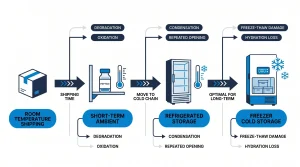
Lyophilized peptides are freeze-dried powders. The drying process removes water from the compound. This brings water content below 1%. Low water content stops most chemical breakdown. Lyophilized peptides can ship at room temperature for short transit. For research labs, they should move to cold storage on arrival.
A fridge at 4 degrees C is the standard for active lots used within months. A freezer at -20 degrees C works well for long-term storage. Vials should stay sealed and in the dark. Researchers should not open a vial until ready to work with the compound. Opening a vial lets moisture and air in, which start the breakdown process. Researchers can browse fitness and GH peptides that ship lyophilized and are ready for cold storage on receipt.
What Temperature Works for Long-Term Peptide Storage?
Long-term storage of lyophilized peptides is most stable at -20 degrees C. This slows all chemical reactions that break down peptide bonds. At this temperature, most lyophilized peptides stay stable for 12 to 24 months. Some short, simple peptides may hold longer.
Fridge storage at 4 degrees C works for lots used within 3 to 6 months. Room temperature is only safe for short transit windows, under two weeks. Heat above 30 degrees C causes faster breakdown, in particular for compounds with disulfide bonds or free amine groups. Researchers should review each lot’s COA for specific stability notes.
How Does Light Affect Peptide Stability in Research?
Light, in particular UV light, carries energy that breaks chemical bonds in peptides. Certain amino acids found in some peptides are more sensitive to light than others. Even brief, repeated exposure to strong light can reduce purity over time.
Research storage protocols use amber glass vials to block UV exposure. Dark storage cabinets add a second layer of protection. According to research in the Journal of Peptide Science (2019), light-protected storage maintained peptide purity over test periods where unprotected samples showed measurable loss. Researchers should avoid clear vials or benchtop exposure under lab lights for compounds stored more than a few days.
Why Does Moisture Damage Peptide Samples?
Water causes peptide breakdown through hydrolysis. Hydrolysis is when water molecules split peptide bonds. This produces fragments of the original compound. The process is slow in dry conditions but speeds up as moisture rises. Freeze-dried peptides held below 1% water content are largely protected.
Moisture enters vials when they are opened, stored in humid rooms, or sealed with poor caps. Moisture absorbers placed in storage containers absorb ambient water vapor. Sealed vials with lined caps offer better protection than push-fit caps. According to NCBI stability data (2020), peptide samples stored with moisture absorbers showed less water-driven breakdown than controls without them across a 6-month test. Researchers handling GHK-Cu or other copper-bound peptides should use plastic labware to avoid metal surface reactions.
How Long Can a Reconstituted Peptide Stay Stable?
Reconstituted peptides, that is, peptides dissolved in water or buffer, are less stable than freeze-dried forms. Once dissolved, water contact starts hydrolysis. The rate depends on compound structure, pH, temperature, and whether a preservative is present.
Most reconstituted research peptides are stable for days to a few weeks at 4 degrees C. At -20 degrees C, they may hold for 1 to 3 months. Freeze-thaw cycles reduce stability further. Each freeze-thaw can cause clumping, where peptide chains lose their active form. Researchers should split solutions into single-use volumes before freezing to avoid repeated cycles.
How Do Peptide Storage Conditions Compare?
| Storage Condition | Form | Stable Duration | Key Risk |
| Room temperature (20-25 degrees C) | Freeze-dried | 1 to 2 weeks | Heat, light, moisture |
| Fridge (4 degrees C) | Freeze-dried | 3 to 6 months | Moisture on opening |
| Freezer (-20 degrees C) | Freeze-dried | 12 to 24 months | Repeated freeze-thaw |
| Fridge (4 degrees C) | In solution | Days to weeks | Hydrolysis |
| Freezer (-20 degrees C) | In solution | 1 to 3 months | Clumping on thaw |
What Makes Freeze-Dried Peptides More Stable for Shipping?
Freeze-drying removes water from a compound while keeping its structure intact. The process first freezes the material, then removes ice by letting it turn to vapor under low pressure. The result is a dry powder with the same structure as the original compound. This dry form resists heat, moisture, and light better than a liquid form.
For shipping, freeze-dried peptides can travel at ambient temperature for up to two weeks without purity loss. No cold chain is required. This makes them practical for USA-wide delivery. Researchers can shop research peptides that ship freeze-dried from USA storage. Freeze-drying avoids cold-chain cost and the risk of temperature failure in transit.
Frequently Asked Questions
What storage method works well for research peptides?
Freeze-dried research peptides store well in a sealed, dark vial at -20 degrees C for long-term use. For active use within 3 to 6 months, a fridge at 4 degrees C is safe. Reconstituted peptides in solution should be kept cold and used within days to weeks. Split solutions before freezing to stop repeated freeze-thaw cycles. Light and moisture are the main risks in all storage settings.
What happens if research peptides are not stored properly?
Improper storage causes peptide breakdown. Heat, light, and moisture all break peptide bonds or cause the compound to clump. The result is purity loss. A compound that starts at 99% purity can fall below usable levels if stored at room temperature in a clear vial for weeks. Purity loss reduces the reliability of research data tied to that lot.
How long can a reconstituted peptide be stored in solution?
Most reconstituted peptides are stable at 4 degrees C for days to a few weeks. At -20 degrees C, they may last 1 to 3 months. Stability varies by compound structure. Researchers should split into single-use volumes before freezing to prevent purity loss from repeated freeze-thaw cycles. Published stability data for each compound gives the right storage limits.
What is freeze-drying and why does it matter for stability?
Freeze-drying removes water from a compound under low pressure after freezing. The result is a dry powder with water content below 1%. This low water level stops hydrolysis and slows other breakdown reactions. Freeze-dried peptides are more stable during shipping and storage than solution-form compounds. All research peptides from Next Level Pharm are shipped in freeze-dried form with COA verification.
How does light exposure affect peptide purity?
UV light and visible light carry energy that breaks peptide bonds in some compounds. Certain amino acids absorb UV light and can break down or oxidize. Research storage protocols use amber vials to block UV exposure. Stored vials should be kept in dark cabinets or covered boxes. Even lab bench lighting can reduce purity over time in clear vials left exposed during a study.
Does pH affect peptide stability in storage?
pH affects peptide stability in solution. Most peptides are most stable at a pH near 7.0. High or low pH speeds up hydrolysis and can change compound structure. Freeze-dried peptides in dry form are largely free of pH-driven breakdown. Once in solution, the buffer choice and pH level are important for keeping the compound stable across the study.
What is a COA and how does it relate to storage?
A COA is a certificate of analysis. It records the purity, identity, and lot data for a batch of research compound. A COA purity reading reflects the compound at the time of testing. Proper storage maintains purity at or near the COA value through the study. Poor storage causes purity to drop below the COA baseline, reducing the value of the research data tied to that lot.
How should researchers handle peptide vials to protect purity?
Researchers should open vials only when ready to use the compound. Let vials reach room temperature before opening to prevent condensation. Seal vials at once after use. Store in a dark, low-humidity space. Use clean, dry labware when handling compounds. Each handling step affects how closely the final sample matches the COA-verified lot data.
Summary
Peptide storage research shows that temperature, light, and moisture are the three key variables that affect compound stability. Freeze-dried peptides are the most stable form for long-term storage and shipping. Frozen storage at -20 degrees C works well for lots held more than 3 months. Fridge storage at 4 degrees C is safe for active use within 3 to 6 months.
Reconstituted peptides in solution degrade faster and need careful handling. Splitting into single-use volumes stops repeated freeze-thaw cycles. Amber vials and dark storage reduce light-driven breakdown. Moisture absorbers in storage containers control water exposure.
All research peptides should be tracked by lot number with a COA on file. Good storage practices maintain that purity through the full research period.
What Should You Do Next?
Review the peptide stability data at PubMed (PMID 33781593) for the lyophilized stability dataset. Check the moisture control data at NCBI (PMID 32186386) for the full desiccant study results. When ready to source research compounds, shop research peptides and confirm the COA on every lot before storage or study.
Related research: lyophilization and freeze-drying, bacteriostatic (BAC) water in research, and peptide half-life and stability.
People Also Read
About the Author
Next Level Pharm Research Team
Alex M covers peer-reviewed findings in peptide science for Next Level Pharm, a US-based supplier of research-grade peptides verified to >=99% purity via HPLC and mass spectrometry on every batch.
Disclaimer: The information provided on this page is for educational and research purposes only. Next Level Pharm’s products are intended for laboratory research use only. They are not intended for human consumption, diagnostic, therapeutic, or medicinal purposes. This content does not constitute medical advice. Always consult a licensed healthcare professional before making any health-related decisions.