
What Is Peptide Half-Life? Stability and Research Studies

Last updated: June 2026
Peptide half-life (t½) is the time for plasma concentration to drop by 50% in a test system. In animal model research, t½ is measured by serial blood draws at set time points after administration. The plasma sample is then analyzed by HPLC or mass spec to track the peptide level over time. Understanding t½ helps researchers plan study protocols.
Next Level Pharm supplies research-grade peptides with HPLC and mass spec verification on every lot. Purity is ≥99% per batch. COA data are available for each lot number. The average purity across the last 100 batches is 99.4%.
In cell and animal model research, a peptide with a short t½ may be cleared before it can reach its target receptor. A longer t½ allows sustained receptor coverage. Researchers use t½ data to set dosing intervals in animal study protocols. This is a key pharmacokinetic (PK) metric in peptide research.
Key Takeaways
- Half-Life Measures Plasma Clearance Rate: Half-life (t½) is the time for plasma concentration to drop by half. A peptide with a t½ of 2 hours is at 50% of its peak level 2 hours after administration in animal models.
- Proteolysis Is the Main Route of Clearance: Proteolysis (enzyme cleavage by peptidases) is the primary way peptides are cleared from plasma. DPP-4 and NEP are two key enzymes that cleave short peptides at specific positions.
- Structural Changes Can Extend t½: PEGylation, fatty acid conjugation, and cyclization extend t½ in animal models. D-amino acid substitution also alters peptide stability.
- Albumin Binding Slows Renal Clearance: Fatty acid chains at specific amino acid residues allow peptides to bind plasma albumin. This slows kidney filtration and extends the plasma t½ in rodent models.
- All t½ Data Must Be Species-Specific: t½ in rodents does not directly predict t½ in humans. Rodent plasma has higher enzyme activity for some peptidases. PK data must be read in the context of the species used in the study.
Many research peptides have short native t½ values due to rapid enzyme cleavage. Modified versions with PEGylation or fatty acid tails are studied to extend their time in circulation. This affects study design and endpoint selection.
Why Do Peptides Have Short Half-Lives?
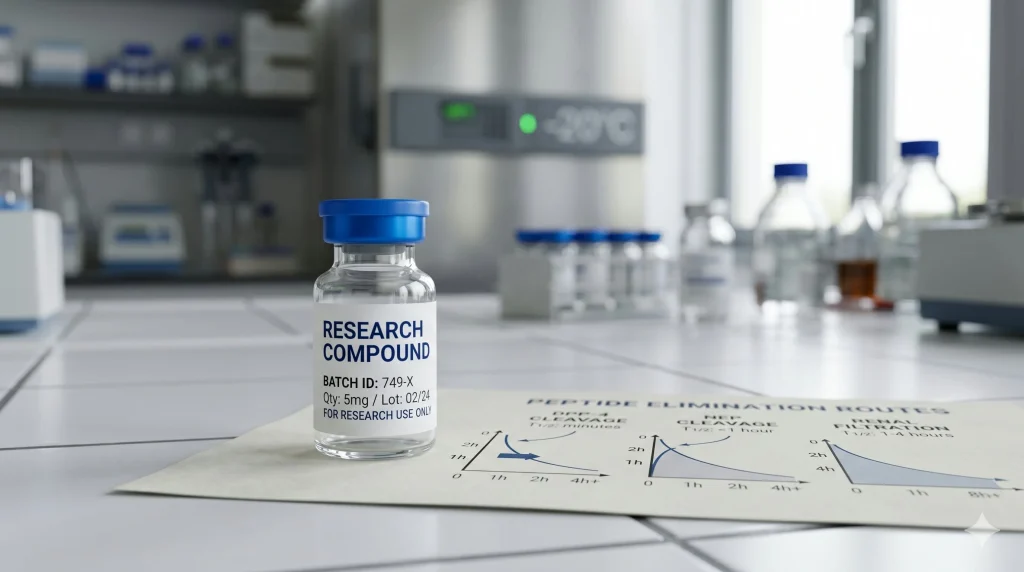
Most native peptides are rapidly cleared from plasma by proteolytic enzymes (peptidases). DPP-4 (dipeptidyl peptidase-4) cleaves peptides at the N-terminal position 2. NEP (neutral endopeptidase) cleaves at internal hydrophobic residues. Renal filtration also clears small peptides via the kidneys. Together, these three routes keep native peptide t½ short, often under 10 minutes in plasma.
In cell assays, researchers measure peptide half-life by incubating the peptide in plasma at 37°C and sampling at set time points. The remaining peptide is measured by HPLC. The decay curve gives the half-life. In animal models, serial blood draws are used for the same purpose.
According to NCBI (2018), peptide plasma stability is found by proteolytic cleavage rates, renal filtration, and receptor binding in cell and animal models. DPP-4 cleavage is a primary clearance route for GLP-1 class peptides. These are cell and animal model data.
How Is Half-Life Measured in Animal Studies?
In rodent models, t½ is measured by serial blood sampling. Blood draws are taken at set intervals (e.g., 0, 15, 30, 60, 120, 240 minutes) after the compound is administered. Each sample is processed to isolate plasma. The plasma peptide level is then measured by HPLC or mass spec.
The concentration values at each time point are plotted on a log-linear graph. The slope of the decay curve gives the elimination rate constant (k). t½ = 0.693 / k. This is the first-order decay model, which applies to most peptides in plasma at low concentrations.
According to NCBI (2018), first-order elimination kinetics apply to most peptides in animal plasma at sub-saturating concentrations. The log-linear plasma decay curve gives a reliable t½ estimate in rodent PK studies. These are animal model data.
What Extends Peptide Half-Life in Research Models?
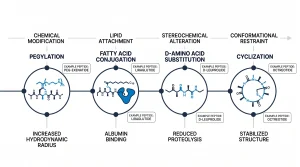
Four main structural changes are studied for their ability to extend peptide t½:
- PEGylation: adding polyethylene glycol (PEG) chains to the peptide. PEG chains are large and water-soluble. They increase the hydrodynamic volume of the peptide, slowing renal filtration. PEG-MGF is an example of a PEGylated research peptide.
- Fatty acid conjugation: adding a C16, C18, or C20 fatty acid chain to a lysine residue. The fatty acid binds to plasma albumin. This large complex is too big to be filtered by the kidney. Some long-acting peptides use C18 and C20 fatty acid chains for this purpose.
- D-amino acid substitution: replacing L-amino acids with D-amino acids at key positions. Peptidases are stereospecific: most cleave only L-amino acid bonds. A D-amino acid at the cleavage site blocks the enzyme. SS-31 uses D-Arg at position 1 for this reason.
- Cyclization: forming a ring structure within the peptide. This can be done via a disulfide bridge (S-S bond) or a lactam bond. Cyclic peptides resist enzymatic cleavage because the enzyme cannot access the backbone easily.
| Change | Mechanism | t½ Effect | Example Peptide |
| PEGylation | Increases size, slows renal filtration | Extends t½ 10-100× | PEG-MGF |
| Fatty acid chain (C18-C20) | Albumin binding, slows filtration | ~7-day t½ in animal models | Long-acting analogues |
| D-amino acid at cleavage site | Blocks peptidase cleavage | Variable, enzyme-specific | SS-31 (D-Arg at pos 1) |
| Cyclization (S-S or lactam) | Shields peptide backbone | Extends stability 2-10× | BPC-157 (ring-like motif) |
| Albumin binding peptide tag | Binds plasma albumin directly | Extends t½ 10-20× | CJC-1295 with DAC |
CJC-1295 with DAC has the longest lab-reported t½ of the compounds in this comparison. It is available as a COA-verified research peptide.
How Does Renal Filtration Affect Peptide t½?
Small peptides (below ~50 kDa) are filtered by the kidney’s glomerulus. The glomerular filtration barrier removes small molecules from plasma as blood passes through. Peptides below this size threshold are excreted in urine unless they are bound to a large carrier.
Albumin (molecular weight ~66 kDa) is too large to be filtered. When a peptide binds albumin via a fatty acid tail, the complex is also too large to be filtered. This is the mechanism by which fatty acid conjugation extends t½ in animal models. The peptide dissociates from albumin at the receptor site.
In rodent PK studies, renal clearance is measured by comparing plasma t½ with urine peptide levels. A peptide with high renal clearance shows a short plasma t½ and high urine levels. A peptide bound to albumin shows the opposite pattern.
How Are DPP-4 and NEP Different in Peptide Studies?
DPP-4 (dipeptidyl peptidase-4) is a serine protease that cleaves at position 2 from the N-terminus. It targets peptides with proline or alanine at position 2. GLP-1 and GIP are the main natural substrates. DPP-4 cleaves these in under 2 minutes in plasma.
NEP (neutral endopeptidase, also called neprilysin) cleaves at hydrophobic residues within the peptide chain. It targets a different site from DPP-4. Both enzymes are present in rodent and human plasma. In rodent plasma, DPP-4 activity is higher than in human plasma.
According to doi.org (2016), peptide plasma stability is limited by DPP-4, NEP, and renal filtration in animal models. The study compared t½ values for a range of peptide analogs with and without DPP-4 resistance changes. Structural changes at position 2 (Aib substitution) blocked DPP-4 cleavage in cell and plasma assays.
Frequently Asked Questions
What Is Peptide Half-Life?
Peptide half-life (t½) is the time for plasma concentration to drop by 50% in a biological system. It is measured in animal models by serial blood sampling and HPLC or mass spec analysis. A peptide with a 2-hour t½ is at 50% of its peak level 2 hours after administration. t½ varies by species, route of administration, and peptide structure.
What Is Proteolysis?
Proteolysis is the enzyme-driven cleavage of peptide bonds. Peptidases (also called proteases) cleave peptides at specific positions. DPP-4 cleaves at position 2 from the N-terminus. NEP cleaves at internal hydrophobic residues. Proteolysis is the primary clearance route for most short peptides in plasma. It is why native GLP-1 has a t½ of under 2 minutes in plasma.
What Is PEGylation?
PEGylation is the addition of polyethylene glycol (PEG) chains to a peptide. PEG is a water-soluble polymer. It increases the hydrodynamic size of the peptide, slowing renal filtration and reducing peptidase access to the backbone. In animal models, PEGylation has been studied for its ability to extend peptide t½ by 10- to 100-fold. PEG-MGF is an example.
How Does Albumin Binding Extend t½?
Albumin is a plasma protein with a molecular weight of ~66 kDa. It is too large to be filtered by the kidney. When a peptide has a fatty acid tail at a lysine residue, the fatty acid binds non-covalently to albumin. The peptide-albumin complex is too large for renal filtration. This extends the plasma t½ in animal models. Some long-acting peptides use this mechanism.
What Are D-Amino Acids in Research Peptides?
D-amino acids are the mirror-image form of standard L-amino acids. Most peptidases are stereospecific: they can only cleave L-amino acid bonds. Inserting a D-amino acid at the cleavage site blocks the enzyme. This slows proteolysis and extends t½. SS-31 uses D-Arg at position 1 to block DPP-4 cleavage at the N-terminus.
Why Is t½ Different in Rodents vs Humans?
Rodent plasma has higher activity for some peptidases than human plasma. The kidney filtration rate (GFR) also differs between species. As a result, t½ measured in a rodent model cannot be directly applied to human predictions. All PK data cited in research papers should be read in the context of the species and model used.
What Is the DAC in CJC-1295 With DAC?
DAC stands for Drug Affinity Complex. It is a reactive ester group that allows the peptide to form a covalent bond with albumin lysine residues in plasma. This is different from the non-covalent albumin binding used by fatty acid tails. The covalent bond is more stable and gives CJC-1295 with DAC a much longer t½ in animal models (days vs hours for CJC-1295 without DAC).
How Is Half-Life Confirmed for Research Peptides?
Half-life data for research peptides come from published animal model studies. The data are not clinical data. Researchers at Next Level Pharm should refer to the primary literature for species-specific PK data. COAs confirm purity and identity. They do not report t½. Researchers must source t½ data from peer-reviewed animal model studies.
Can Half-Life Be Measured In Vitro?
Yes. Peptide plasma stability can be tested in vitro by incubating the peptide in human or rodent plasma at 37°C. Samples are taken at set time points and analyzed by HPLC. The decay curve gives an cell stability estimate. This is faster than animal dosing studies. In-vitro data should be confirmed in animal models before use in complex study designs.
Summary
Peptide half-life (t½) is a core PK metric in animal model research. It is measured by serial blood sampling and HPLC analysis. Proteolysis by DPP-4 and NEP, plus renal filtration, are the main clearance routes. PEGylation, fatty acid conjugation, D-amino acid substitution, and cyclization are the main structural changes studied to extend t½.
All t½ data are from cell and animal model studies. They are not clinical data. For research purposes only.
What Should You Do Next?
Researchers sourcing peptides for stability studies should confirm HPLC purity and mass spec identity from the COA on each lot. t½ data should be sourced from primary animal model literature matched to the species used in the study. Lot numbers should match the COA on file.
Shop research peptides. COA-verified on every batch.
People Also Read
- What Is a Peptide? Building Blocks and Research Applications
- Peptide Synthesis Explained: How Research-Grade Peptides Are Made
About the Author
Next Level Pharm Research Team
Alex M covers peer-reviewed findings in peptide science for Next Level Pharm, a US-based supplier of research-grade peptides verified to ≥99% purity via HPLC and mass spectrometry on every batch.
Disclaimer: The information provided on this page is for educational and research purposes only. Next Level Pharm products are intended for lab research use only. They are not intended for human consumption, diagnostic, therapeutic, or medicinal purposes. This content does not constitute medical advice. Always consult a licensed healthcare professional before making any health-related decisions.