
B12 Research Peptide: Methylcobalamin Nerve Cell Studies

Last updated: June 2026
A B12 research compound is a cobalamin (vitamin B12) form studied in neurological cell models. Methylcobalamin is the active B12 form. It differs from cyanocobalamin (the synthetic B12 form) and hydroxocobalamin. Active B12 is the form the body uses directly. Researchers study it in SH-SY5Y human nerve cells and rat DRG (dorsal root ganglion) neurons. They measure homocysteine (an amino acid linked to nerve health) by ELISA and MMA (methylmalonic acid) by assay kit.
Next Level Pharm is a US-based supplier of research-grade B12, verified to ≥99.4% purity by HPLC and mass spectrometry on every batch. Each lot ships with a COA and a lot number for full traceability.
Key Takeaways
- Active B12 converts homocysteine: Active B12 (methylcobalamin) works via methionine synthase. This enzyme converts homocysteine to methionine in nerve cell models.
- SH-SY5Y cell model use: Researchers apply active B12 to SH-SY5Y cells. They measure homocysteine ELISA and MMA (methylmalonic acid) as readouts.
- Three B12 forms compared: Methylcobalamin, cyanocobalamin, and hydroxocobalamin differ in cell uptake and enzyme activity in nerve cell assays.
- COA-verified lots: Next Level Pharm ships lyophilized B12 lots with HPLC and mass spec data on every batch. Each lot has a traceable number.
- Research use only: All B12 in this catalog is for laboratory research use only. No clinical outcomes are claimed.
What Is B12 and Why Is It Studied?
B12 is a cobalamin studied in nerve cell models for homocysteine and MMA conversion assays. B12 is also called cobalamin. It comes in three main forms. Methylcobalamin is the active B12 form. Cyanocobalamin is the synthetic form. Hydroxocobalamin is a third form. Each form is taken up by cells at different rates. Researchers test active B12 in nerve cell cultures. They look at two key markers. These are homocysteine and MMA (methylmalonic acid). Homocysteine is an amino acid. It is linked to nerve cell health in assay models. MMA is a metabolite. It rises when B12 enzyme activity is low. According to Obeid et al. (2015), cobalamin forms differ in nerve cell uptake. All results come from cell models only.
How Does Active B12 Work in Nerve Cells?
Active B12 works via methionine synthase to convert homocysteine to methionine in nerve cells. Methionine synthase is an enzyme. It converts homocysteine to methionine. Homocysteine is an amino acid. High homocysteine levels stress nerve cells in culture. Methionine is another amino acid. It is needed for cell growth. Active B12 is a cofactor for methionine synthase. A cofactor is a helper molecule for an enzyme. Researchers confirm this by measuring homocysteine ELISA results. Treated cells show lower homocysteine than untreated cells. This difference is the primary assay readout. According to Green et al. (2017), active B12 supports methionine synthase activity. No outcome claims are made from this data.
Which Cell Models Are Used for B12 Research?
SH-SY5Y human nerve cells and rat DRG neurons are the main models for active B12 research. SH-SY5Y cells are a human nerve cell line. They grow in lab dishes. They respond to B12 forms at measurable rates. Researchers treat these cells with cobalamin forms at set concentrations. They collect cell culture medium after treatment. They measure homocysteine and MMA levels in the medium. Rat DRG neurons are cells from the dorsal root ganglion (DRG). The DRG is a nerve cell cluster near the spine. Both models let researchers measure homocysteine and MMA. According to Spence et al. (2016), DRG neurons are valid B12 assay models. No clinical claims are made from these studies.
How Do the Three B12 Forms Compare in Studies?
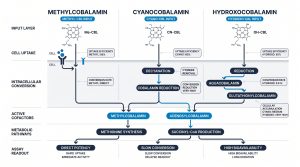
Methylcobalamin, cyanocobalamin, and hydroxocobalamin are compared by cell uptake and enzyme assay results. Each B12 form has a different structure. This affects how cells absorb it. Active B12 does not need conversion inside the cell. Cyanocobalamin needs two conversion steps. Hydroxocobalamin needs one step. Researchers run parallel assay arms for each form. They compare homocysteine ELISA results across arms. They also compare MMA levels between groups.
| B12 Form | Conversion Steps | Cell Model | Homocysteine ELISA | MMA Assay |
| Methylcobalamin (active B12) | 0 (ready to use) | SH-SY5Y, rat DRG | Yes | Yes |
| Cyanocobalamin | 2 (must be converted) | SH-SY5Y | Yes | Yes |
| Hydroxocobalamin | 1 | SH-SY5Y | Yes | Yes |
Shop research peptides for COA-verified lots with HPLC and mass spec data.
How Do Researchers Measure B12 Cell Effects?
Homocysteine ELISA and MMA assay kits are the standard readouts for B12 nerve cell studies. Homocysteine ELISA is a plate-based test. It measures homocysteine in the cell culture medium. Researchers collect mediums at set time points. They compare treated and untreated wells. Lower homocysteine in treated wells confirms active B12 function. MMA assay kits measure methylmalonic acid. MMA rises when B12 enzyme function is low. Higher MMA in treated wells signals poor B12 uptake. Researchers also check cell health with viability assays. These confirm the B12 compound does not harm cells. Viability above 90% is the standard cutoff for valid assay data. All assays need COA-verified lots. Purity above 99% is required for reliable results.
What Research Tools Are Available for B12 Studies?
COA-verified B12 lots are required starting materials for homocysteine ELISA and MMA nerve cell assays. Research teams need a verified B12 lot to run any study. The lot must match the published reference standard for molecular weight and purity. Next Level Pharm verifies each B12 lot by HPLC and mass spectrometry before shipping. Homocysteine ELISA kits and MMA assay kits are available from major life-science suppliers. Cell viability kits for SH-SY5Y cultures are standard add-ons for B12 nerve cell work. View the B12 product page for lot-specific COA and mass spec data.
Frequently Asked Questions
What is B12 research?
B12 research studies cobalamin forms in nerve cell models. Researchers apply methylcobalamin, cyanocobalamin, or hydroxocobalamin to SH-SY5Y cells or rat DRG neurons. They measure homocysteine and MMA as assay readouts. Homocysteine is measured by ELISA. MMA is measured by an assay kit. This work is in laboratory settings for scientific study only. It is not clinical research. No outcomes for human health are implied by these studies.
What is the difference between methylcobalamin and cyanocobalamin?
Methylcobalamin is the active B12 form. Cells can use it directly with no conversion steps. Cyanocobalamin is the synthetic form. It must go through two conversion steps inside the cell. Hydroxocobalamin needs only one conversion step. These differences affect cell uptake rates and enzyme assay results. Researchers compare all three forms in parallel assay arms. They measure homocysteine and MMA readouts for each form.
What is methionine synthase and why does it matter?
Methionine synthase is an enzyme in nerve cells. It converts homocysteine to methionine. Active B12 is a required cofactor for this enzyme. A cofactor is a helper molecule the enzyme needs to work. Without enough active B12, homocysteine builds up in cell culture. Researchers measure methionine synthase activity by tracking homocysteine. Homocysteine ELISA is the key readout in B12 nerve cell assays.
What are SH-SY5Y cells used for in B12 research?
SH-SY5Y cells are a human nerve cell line grown in lab dishes. They are the standard model for B12 nerve cell assays. Researchers apply active B12 or other cobalamin forms to these cells. They measure homocysteine by ELISA and MMA by assay kit. SH-SY5Y cells express the enzymes that respond to B12 forms. This makes them a reliable model for cobalamin uptake studies.
What is homocysteine ELISA?
Homocysteine ELISA is a plate-based test used in B12 nerve cell research. ELISA stands for enzyme-linked immunosorbent assay. The test measures homocysteine in cell culture medium. Researchers collect medium at set time points after B12 treatment. They compare homocysteine levels between treated and untreated wells. This shows how well the active B12 lot supports methionine synthase in the nerve cell model.
What is MMA and why is it measured?
MMA stands for methylmalonic acid. It is a metabolite that rises when B12 enzyme function is low. MMA builds up in cell culture when B12 cofactor support is low. The enzyme methylmalonyl-CoA mutase (MCM) needs B12 to work. When MCM has low cofactor support, MMA accumulates. Researchers measure MMA with assay kits as a secondary readout. High MMA in treated wells signals poor B12 lot uptake. MMA complements the homocysteine ELISA readout.
What are rat DRG neurons?
Rat DRG neurons are nerve cells from the dorsal root ganglion (DRG). The DRG is a cluster of nerve cell bodies near the spine. These cells are grown in lab cultures. They serve as a secondary nerve cell model for B12 assays. Researchers apply cobalamin forms to DRG cultures. They measure homocysteine and MMA levels as readouts. DRG neurons complement SH-SY5Y data in B12 nerve cell studies.
Why does peptide form matter for B12 nerve cell assays?
Each B12 form enters cells at a different rate. Active B12 (methylcobalamin) needs no conversion steps. Cyanocobalamin needs two steps before acting as a cofactor. Hydroxocobalamin needs one step. These differences affect enzyme activity levels in the assay. A form with more conversion steps shows slower enzyme activity. This can look like lower B12 function in the assay data. Running parallel arms for each form lets researchers compare homocysteine ELISA and MMA results side by side.
Why does B12 lot purity matter for cell studies?
Impurities in a B12 lot can shift the homocysteine baseline in cell culture. Even small contaminants can affect ELISA readings. This makes results unreliable across assay runs. Lots verified to 99% purity by HPLC and mass spectrometry reduce this risk. A COA (certificate of analysis) confirms purity and molecular weight. COA data is required before any nerve cell assay to ensure results match published reference standards.
Summary
Active B12 (methylcobalamin) has been studied in SH-SY5Y human nerve cells and rat DRG neurons. It works via methionine synthase. This enzyme converts homocysteine to methionine. Cyanocobalamin and hydroxocobalamin are also tested in parallel assays.
The main readouts are homocysteine ELISA and MMA assay kits. Each B12 form differs in its conversion steps and cell uptake rate. Purity above 99% is needed for reliable assay results.
All studies cited here are in cell and animal models. No clinical outcomes are implied.
What Should You Do Next?
- Confirm B12 lot purity at 99% or above before any nerve cell assay.
- Use SH-SY5Y cells for homocysteine ELISA work and rat DRG neurons for supplementary nerve studies.
- Run parallel arms for each B12 form (active B12, cyanocobalamin, hydroxocobalamin) to compare assay results.
- Request HPLC and mass spec COA data for each B12 lot before use.
- Browse beauty research compounds for related research tools.
- Shop research peptides at https://nextlevelpharm.com/shop/.
People Also Read
- Glutathione Research: Antioxidant Tripeptide Cell Studies
- GHK-Cu Research: Copper Peptide and Skin Biology Studies
About the Author
Next Level Pharm Research Team
Alex M covers peer-reviewed findings in peptide science for Next Level Pharm, a US-based supplier of research-grade peptides verified to ≥99% purity via HPLC and mass spectrometry on every batch.
Disclaimer: The information provided on this page is for educational and research purposes only. Next Level Pharm products are intended for laboratory research use only. They are not intended for human consumption, diagnostic, therapeutic, or medicinal purposes. This content does not constitute medical advice. Always consult a licensed healthcare professional before making any health-related decisions.