
5-Amino-1MQ Research: NNMT Inhibitor Mechanism

Last updated: June 2026
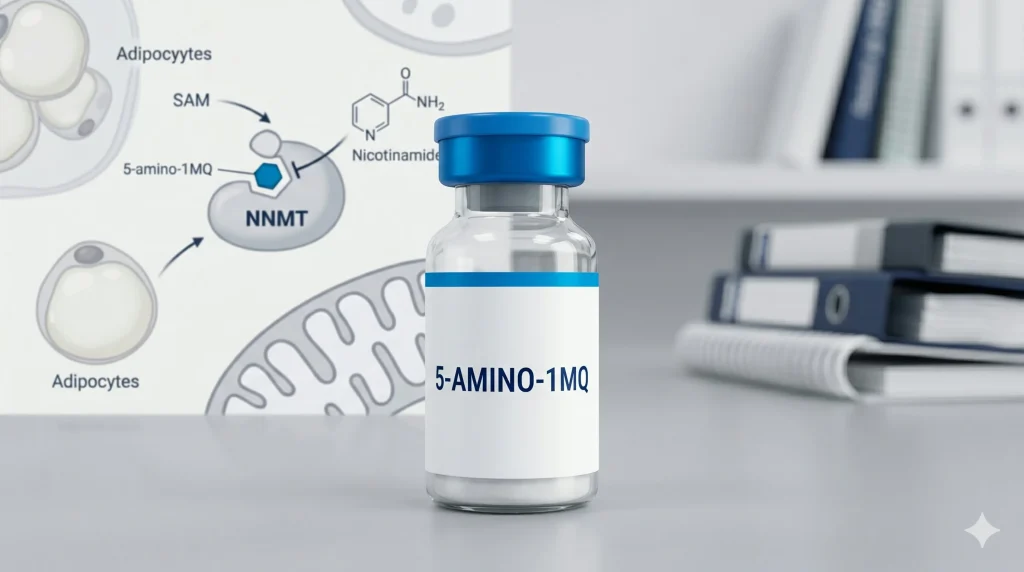
5-Amino-1MQ is a synthetic small molecule studied in lab models for its role as an NNMT (nicotinamide N-methyltransferase) inhibitor. NNMT stands for nicotinamide N-methyltransferase (nicotinamide-methyl enzyme). It transfers methyl groups from SAM (S-adenosylmethionine) to nicotinamide. Lab studies in rodent models have examined how blocking NNMT affects metabolic markers. Research-grade 5-amino-1MQ must reach ≥99% purity, confirmed by HPLC and mass spec, before any lab study.
Next Level Pharm is a US-based supplier of research-grade small molecules and peptides verified to ≥99% purity. Each 5-amino-1MQ vial ships with a COA (certificate of analysis) that includes HPLC and mass spec data and a lot number.
Understanding NNMT enzyme activity helps researchers evaluate 5-amino-1MQ lab studies. The enzyme uses SAM as a methyl donor. When NNMT is blocked, SAM levels change. This shifts NAD+ metabolism in the cell. Lab findings from rodent models form the basis of current research on this compound.
Researchers studying GLP-1 receptor mechanisms may also find eloralintide relevant — it is a research-grade GIP/GLP-1 co-agonist analog available as a COA-verified, lyophilized research peptide.
Key Takeaways
- 5-Amino-1MQ Blocks NNMT: NNMT is the enzyme that transfers methyl groups from SAM to nicotinamide. 5-Amino-1MQ blocks this transfer in rodent and cell-based lab models.
- SAM Levels Shift When NNMT Is Blocked: SAM (S-adenosylmethionine) is the methyl donor for NNMT. Blocking NNMT reduces how fast SAM is consumed by this enzyme.
- Lab Studies Have Used Rodent Models: Animal research on 5-amino-1MQ has used mouse and rat models. These are lab studies only, not human clinical trials.
- NAD+ Pathways Link to NNMT Activity: NNMT uses nicotinamide as a substrate. Blocking NNMT may affect nicotinamide levels available for NAD+ production in the cell.
- Research-Grade Purity Is Required: ≥99% purity confirmed by HPLC and mass spec is the minimum standard for any valid 5-amino-1MQ lab study.
Researchers who source 5-amino-1MQ for lab use should verify the COA before any protocol. HPLC and mass spec data together confirm both purity and molecular identity.
What Is 5-Amino-1MQ and How Is It Classified?
5-Amino-1MQ is a synthetic small molecule. Its full name is 5-amino-1-methylquinolinium. It is classified as a selective NNMT inhibitor. It is not a peptide and not an FDA-approved drug. Its use is limited to basic science lab research.
NNMT was first identified as a liver enzyme. Later research found it in fat tissue and other cell types. 5-Amino-1MQ was developed to study the effects of blocking NNMT in cell and animal models.
According to a study in Biochemistry (2018), selective NNMT inhibitors like 5-amino-1MQ are studied to understand the enzyme’s role in cell metabolism. The compound binds the active site of NNMT and stops SAM from transferring its methyl group to nicotinamide.
How Does NNMT Enzyme Inhibition Work?
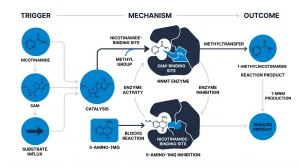
NNMT catalyzes one reaction. It takes a methyl group from SAM and adds it to nicotinamide. The products are 1-methylnicotinamide and SAH (S-adenosylhomocysteine). 5-Amino-1MQ enters the active site of NNMT. It blocks the enzyme from completing this reaction.
When the reaction is blocked, SAM is not consumed by NNMT. SAM levels can rise in the cell. SAM is used in many other methylation reactions. This makes NNMT inhibition a point of interest in metabolic research.
According to a review in PubMed (2021), the NNMT active site has a nicotinamide-binding pocket and a SAM-binding pocket. Small-molecule inhibitors target one or both pockets to block the reaction. 5-Amino-1MQ targets the nicotinamide-binding pocket in lab models.
What Is SAM and Why Does It Matter in NNMT Research?
SAM (S-adenosylmethionine) is the primary methyl donor in most mammalian cells. It supplies the methyl group for dozens of reactions. NNMT is one enzyme that uses SAM. When NNMT is blocked, SAM is not consumed for that specific reaction.
This excess SAM can be used by other methyltransferases. These include enzymes that add methyl groups to DNA, histones, and other proteins. Researchers study this shift to understand how NNMT inhibition changes cell function
SAM levels are measured in lab models as a way to confirm NNMT inhibition. A rise in SAM after 5-amino-1MQ treatment suggests the compound has blocked NNMT in that model system.
What Do Lab Studies Show About 5-Amino-1MQ?
Lab research on 5-amino-1MQ has used mouse and rat models. Studies have examined changes in body composition, adipose tissue, and metabolic markers in treated animals. All findings are from animal models only.
According to a study in Scientific Reports (2021), rodent models showed changes in white adipose tissue. Related metabolic markers also shifted following 5-amino-1MQ treatment. Researchers noted shifts in SAM levels and NAD+ precursor availability. No human trial data is published.
Next Level Pharm supplies 5-Amino-1MQ at ≥99% purity, COA-verified for research use. View the 5-AMINO-1MQ product page. Each batch comes with a COA that includes HPLC purity and mass spec molecular weight data.
How Does 5-Amino-1MQ Compare to Other Metabolic Compounds?
Several compounds are studied in metabolic and enzyme research. 5-Amino-1MQ targets NNMT directly. AICAR targets AMP-activated protein kinase (AMPK) pathways. These are distinct mechanisms. The table below shows key differences for research reference.
| Compound | Target | Mechanism | Research Model |
| 5-Amino-1MQ | NNMT enzyme | Blocks SAM methyl transfer to nicotinamide | Rodent, cell-based |
| AICAR | AMPK pathway | Mimics AMP to activate AMPK | Rodent, cell-based |
| Tesamorelin | GHRH receptor | GHRH analog that stimulates GH release | Human clinical trials |
| AOD-9604 | Fat metabolism | GH fragment studied for lipid effects | Rodent models |
5-Amino-1MQ is distinct in targeting an enzyme in the methylation pathway. AICAR and AOD-9604 target energy regulation pathways. Tesamorelin differs as a peptide hormone analog with human trial data.
How Is Research-Grade 5-Amino-1MQ Verified?
Research-grade 5-amino-1MQ is verified by HPLC and mass spectrometry. HPLC confirms that 5-amino-1MQ accounts for ≥99% of the batch. Mass spec confirms the molecular weight matches 5-amino-1-methylquinolinium exactly.
Each 5-amino-1MQ batch is verified by both HPLC and mass spec before release. The COA includes the chromatogram trace and the observed versus expected mass. Batches below ≥99% purity are rejected before shipping.
5-Amino-1MQ ships as a lyophilized (freeze-dried) powder. This form is stable at room temperature during transit. For lab storage, vials should be kept at -20°C. Each vial is lot-numbered for full traceability.
Frequently Asked Questions
What Is 5-Amino-1MQ?
5-Amino-1MQ is a synthetic small molecule studied in basic science lab settings. Its full name is 5-amino-1-methylquinolinium. It acts as an NNMT inhibitor. NNMT stands for nicotinamide N-methyltransferase, an enzyme that adds methyl groups to nicotinamide using SAM. 5-Amino-1MQ blocks this reaction in rodent and cell-based models. It is not FDA-approved and is not for human use. It is sold as a research compound only.
What Is NNMT and What Does It Do?
NNMT is an enzyme found in liver and fat tissue. Its full name is nicotinamide N-methyltransferase. It uses SAM (S-adenosylmethionine) as a methyl donor and transfers that methyl group to nicotinamide. This produces 1-methylnicotinamide and releases SAH (S-adenosylhomocysteine). NNMT activity affects how much nicotinamide is available for NAD+ production in the cell. High NNMT activity has been noted in fat tissue in several animal model studies.
How Does 5-Amino-1MQ Inhibit NNMT?
5-Amino-1MQ enters the active site of NNMT and blocks the nicotinamide-binding pocket. This stops the methyl transfer from SAM to nicotinamide. Without NNMT activity, SAM is not consumed by this specific reaction. SAM levels can rise in the cell as a result. Researchers measure SAM levels in treated models to confirm that the compound has blocked NNMT activity as expected.
What Lab Research Has Been Done on 5-Amino-1MQ?
Published research on 5-amino-1MQ includes rodent studies examining changes in body composition and metabolic markers. Studies have measured SAM levels, adipose tissue changes, and NAD+ precursor availability after treatment. All data comes from mouse and rat models. No human clinical trial data is published in peer-reviewed literature. Researchers should access original studies for full methodology and outcome context before designing any protocol.
What Is SAM and Why Does It Matter?
SAM (S-adenosylmethionine) is the primary methyl donor in most mammalian cells. It supplies methyl groups for dozens of enzymatic reactions. NNMT is one enzyme that consumes SAM. When NNMT is blocked, SAM is not used for that specific reaction. This may allow more SAM to be available for DNA, histone, and protein methylation. Lab studies measure SAM as a marker of NNMT inhibition.
How Are NNMT and NAD+ Connected?
NNMT uses nicotinamide as a substrate and converts it to 1-methylnicotinamide. Nicotinamide is also a precursor for NAD+ (nicotinamide adenine dinucleotide) production via the salvage pathway. When NNMT is blocked by 5-amino-1MQ, more nicotinamide may remain available for NAD+ synthesis. Researchers study this relationship to understand how NNMT inhibition changes energy metabolism at the cellular level in animal lab models.
What Is 5-Amino-1MQ Purity Verified By?
Research-grade 5-amino-1MQ is verified by HPLC and mass spectrometry. HPLC confirms the compound accounts for ≥99% of the batch by purity percentage. Mass spec confirms the exact molecular weight matches 5-amino-1-methylquinolinium. Any batch with impurities above the 1% threshold or a wrong molecular weight is rejected. Both HPLC and mass spec results appear on the COA that ships with every research vial.
How Is Research-Grade 5-Amino-1MQ Stored and Shipped?
Research-grade 5-amino-1MQ ships as a lyophilized (freeze-dried) powder that is stable at room temperature during transit. For long-term lab storage, vials should be kept at -20°C. Each vial is sealed under inert conditions to limit oxidation. A COA with HPLC and mass spec data is included with every order. Lot numbers allow researchers to trace each vial to its production batch.
What Are Other Compounds Studied in Metabolic Research?
Several compounds are examined in metabolic lab research. AICAR activates AMPK energy regulation pathways in rodent and cell-based models. AOD-9604 is a GH fragment studied for lipid effects in animal models. Tesamorelin is a GHRH analog with published human clinical data. 5-Amino-1MQ differs from these compounds by targeting the NNMT methylation enzyme rather than a receptor or energy-sensing kinase pathway.
What Is a COA for Research Compounds?
A COA (certificate of analysis) is a document that records test results for a specific production batch. For 5-amino-1MQ, it includes HPLC purity percentage, mass spec molecular weight data, lot number, and storage conditions. The lot number lets researchers trace any vial to its in-house production records. A valid COA with both HPLC and mass spec data is the minimum standard for research-grade quality.
Summary
5-Amino-1MQ is a synthetic small-molecule NNMT inhibitor studied in rodent and cell-based lab models. It blocks the transfer of methyl groups from SAM to nicotinamide by binding the active site of NNMT. This shifts SAM availability and may affect NAD+ precursor pools in the cell.
All published data comes from animal models. No human clinical trial data is available. For lab use, ≥99% purity confirmed by HPLC and mass spec is required.
What Should You Do Next?
Researchers sourcing 5-amino-1MQ for lab study should verify three items on every COA. First, confirm HPLC purity of ≥99%. Second, confirm the mass spec result matches 5-amino-1-methylquinolinium. Third, check that the lot number is traceable to production records.
Shop research compounds at Next Level Pharm. Every 5-amino-1MQ batch ships with HPLC and mass spec results and a traceable lot number.
People Also Read
- AICAR Research: AMPK Activation and Metabolic Studies
- AOD-9604 Research: What Studies Show About This HGH Fragment
About the Author
Next Level Pharm Research Team
Alex M covers peer-reviewed findings in peptide science for Next Level Pharm, a US-based supplier of research-grade peptides verified to ≥99% purity via HPLC and mass spectrometry on every batch.
Disclaimer: The information provided on this page is for educational and research purposes only. Next Level Pharm products are intended for laboratory research use only. They are not intended for human consumption, diagnostic, therapeutic, or medicinal purposes. This content does not constitute medical advice. Always consult a licensed healthcare professional before making any health-related decisions.