
What Is GHRH? Growth Hormone-Releasing Hormone Research

Last updated: July 2026
GHRH (growth hormone-releasing hormone) is a peptide made in the hypothalamus, a brain region that controls hormone output. It signals the pituitary gland to release growth hormone into the blood. This process is central to how the body keeps hormone balance. Scientists track GHRH plasma levels to observe feedback loops within the brain-pituitary axis. According to NCBI (2020), this peptide affects the pulse rate of growth hormone release in lab models.
Next Level Pharm provides this peptide as a high-purity research compound for lab use. Each batch gets dual checks via HPLC and mass spectrometry to confirm accuracy. The brand holds a 99.4% average purity score across its last 100 batches. This openness lets researchers run studies with controlled variables. Products are packaged in lyophilized, sealed form, so no cold-chain storage is needed during transit.
This focus on lab precision supports the study of GHRH in controlled settings. Researchers examine how this sequence interacts with specific receptors to start cell signal chains. By holding strict material standards, it becomes possible to isolate the effects of standard peptide sequences in test environments.
Key Takeaways
- Hypothalamic Origin: GHRH is a peptide made in the hypothalamus. It signals the pituitary to release growth hormone.
- Primary Regulator: This peptide is the main driver for growth hormone synthesis and release. It works against the blocking hormone somatostatin (SST).
- Pulse-Based Secretion: The body creates pulse-based patterns of growth hormone release. This reflects the balance between GHRH and SST activity.
- Research Analogs: Synthetic analogs such as sermorelin and CJC-1295 offer more stable options for research. These modified peptides replicate natural signals in lab models.
- Distinct Pathway: GHRH interacts with a specific receptor to trigger hormone pathways. This process remains separate from the ghrelin receptor pathway used by GHRPs.
These insights provide a base for examining how synthetic analogs interact with lab models. The sections below look at receptor binding and the behavior of common research peptides.
How does GHRH regulate growth hormone?
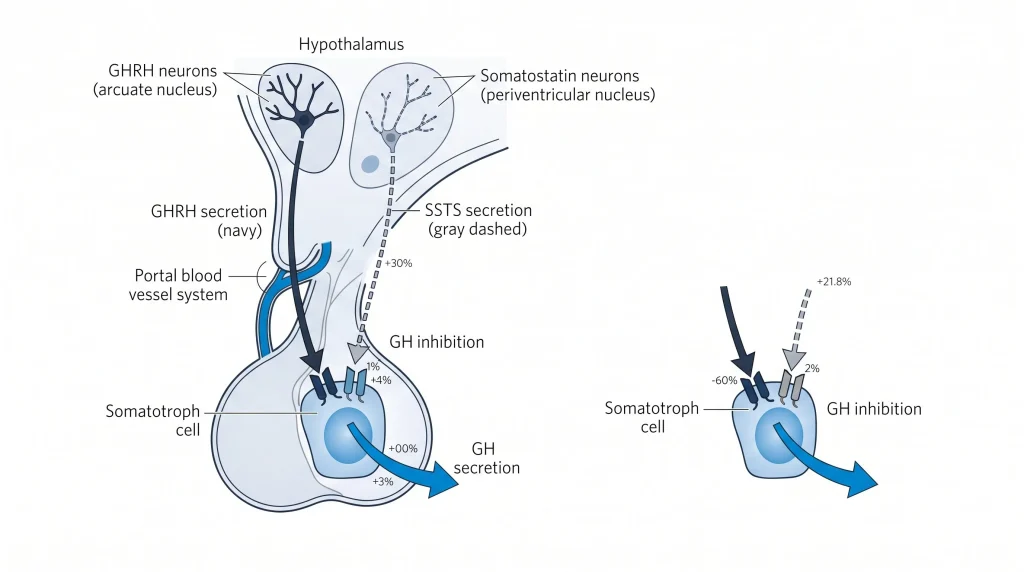
GHRH regulates growth hormone by traveling from the brain through a portal vessel system to the pituitary gland. Upon arrival, GHRH binds to the GHRH receptor (GHRHR) on GH cells. This binding starts the release of growth hormone into the blood.
Following this binding, a cell signal chain starts inside the GH cell. Receptor action triggers adenylyl cyclase, a key cell enzyme. This boosts cyclic AMP (cAMP) levels. cAMP then activates protein kinase A. This step promotes growth hormone gene activity and triggers release of stored hormone from small pockets.
Fitness and GH Peptides are available as COA-confirmed research compounds. Every lot is verified by HPLC and mass spec. According to PubMed (2019), this pathway is the main natural process for controlling growth hormone output.
What is the regulatory role of somatostatin?
Somatostatin (SST) is the main blocking hormone that counteracts GHRH. It acts as a natural brake by stopping growth hormone release from the pituitary. According to PubMed (2017), SST keeps balance within the brain-pituitary axis through constant signal control.
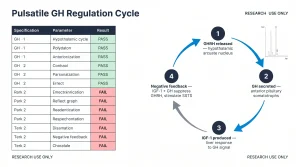
The pulse-based release of growth hormone relies on the rhythmic interplay between GHRH and SST. When SST drops, growth hormone is released in bursts. When SST rises, it stops the release at the gland. This cycle creates the observed pulses of growth hormone in plasma samples. Researchers study these patterns to observe how the hormone system stays balanced. Fitness and GH Peptides are available as COA-confirmed research compounds. Every lot is verified by HPLC and mass spec.
Why are GHRH analogs studied in research?
GHRH analogs are studied to overcome the short half-life of native GHRH, which lasts only a few minutes. This short lifespan results from rapid enzyme breakdown by dipeptidyl peptidase-4 (DPP-IV). By modifying the peptide sequence, researchers can create stable analogs that last long enough for observation.
Synthetic options like sermorelin or CJC-1295 use structural changes to resist breakdown. One common change is the Drug Affinity Complex (DAC), a modification that lets the peptide bind to blood proteins. This bond shields the analog from enzymes, keeping it present in study models. CJC-1295 is available as a COA-confirmed research compound. Every lot is verified by HPLC and mass spec. These changes make studies more steady. The peptides remain active in the lab far longer than the native hormone.
Every vial ships with a Certificate of Analysis (COA) and full lot tracking for precise data collection.
What distinguishes GHRH from GHRPs?
GHRH and its synthetic analogs interact directly with the GHRH receptor on GH cells to trigger release. In contrast, Growth Hormone-Releasing Peptides (GHRPs) such as ipamorelin act through the growth hormone secretagogue receptor (GHSR). This receptor, often called the ghrelin receptor, sits on a distinct cell site from the GHRH receptor. Both classes trigger growth hormone release, but they use separate pathways.
Ipamorelin is available as a COA-confirmed research compound. Every lot is verified by HPLC and mass spec. Scientists often examine these classes together to observe their combined effect on growth hormone release. Research shows that combining a GHRH analog with a GHRP can produce this combined result. It is often greater than using either class alone, as shown in the Journal of Peptide Science (2018).
What do preclinical studies on GHRH show?
Preclinical studies on GHRH show that this peptide plays a vital role in triggering cell growth and hormone output. Research using animal models shows that this process targets GH cells to maintain cell structure across a lifespan. By assessing these interactions, scientists observe how GHRH affects body markers tied to hormone health.
In animal models, extended peptide exposure has been studied for its ability to offset age-related drops in hormone output. Researchers use these models to check if GHRH can improve hormone pulses and support lean tissue health. According to the Journal of Peptide Science (2018), such studies help preserve hormone function in aging populations.
Sermorelin is available as a COA-confirmed research compound. Every lot is verified by HPLC and mass spec.
How is GHRH research purity verified?
GHRH research purity is verified through a two-step lab process using HPLC and mass spectrometry (MS). HPLC separates the target peptide from any impurities to determine the purity percentage. MS then confirms the precise molecular weight to ensure it matches the expected profile. This dual-method approach gives a clear metric for checking the sample is free from contaminants.
Researchers receive a COA for each batch to maintain high lab standards. The COA details purity levels and the methods used on the specific lot. Accurate ID checks are needed for lot-to-lot consistency and steady research results. Confirming the chemical identity of the material blocks errors during lab trials.
Frequently Asked Questions
What does GHRH stand for and where is it produced?
GHRH stands for Growth Hormone-Releasing Hormone. It is a peptide made in the arcuate nucleus of the hypothalamus, a brain region that manages hormone output. The peptide travels through a portal vessel system to reach the pituitary gland. There, it acts on GH cells to shift hormone balance, according to PubMed (1982).
How does GHRH stimulate growth hormone secretion from the pituitary?
GHRH starts the process by binding to GHRH receptors on GH cells in the gland. This binding triggers adenylyl cyclase, a cell enzyme, which raises cyclic AMP (cAMP) levels inside the cell. This chain activates protein kinase A and releases stored growth hormone from small pockets. This step marks the main pathway for pituitary hormone output, according to PubMed (2019).
What is the structure of GHRH?
GHRH is a 44-amino acid peptide chain. Its sequence gives it a high affinity for the pituitary GHRH receptor. Scientists have studied shorter versions, such as the 29-amino acid segment known as sermorelin, which retains full lab activity. The amino acid sequence lets the peptide bind to its specific receptor. This is documented in foundational studies on PubMed (1982).
What is the difference between GHRH and GHRP peptides?
GHRH and Growth Hormone-Releasing Peptides (GHRPs) trigger the gland through distinct pathways. GHRH binds to its own GHRH receptor, while GHRPs act on the ghrelin receptor, also known as the growth hormone secretagogue receptor (GHS-R). Research data suggest these two classes show a combined effect when used together in the lab. This is documented in studies archived by PubMed (2018).
Which research peptides are analogs of GHRH?
Common research analogs of GHRH include sermorelin, CJC-1295, and MOD GRF 1-29. These synthetic versions were built to improve on the short half-life of the natural hormone. Sermorelin is a truncated version, while CJC-1295 has changes to resist enzyme breakdown. By altering the chemical structure, these analogs last longer in lab models, as shown in the Journal of Peptide Science (2018).
What is the function of the GHRH receptor?
The GHRH receptor is a G-protein receptor found on GH cells in the pituitary. Its main role is to recognize and bind natural GHRH to start hormone signaling. Once the ligand binds, the receptor changes shape. This triggers cell signal chains needed for hormone output. This receptor is the main control point for growth hormone synthesis and release, according to PubMed (2019).
How does GHRH interact with somatostatin?
GHRH and SST have an opposing relationship within the brain-pituitary axis. GHRH is the main signal that triggers growth hormone release. SST is the main blocking regulator. Their alternating activity produces the natural pulse-based pattern of hormone release in lab models. Research into these feedback loops helps explain how the gland keeps hormone balance, with data in the Journal of Peptide Science (2018).
How is the purity of research-grade GHRH verified?
The purity of research-grade GHRH is verified through HPLC and mass spectrometry (MS). HPLC measures chemical purity while MS confirms the molecular weight of the compound. These two methods give a data-backed quality check, ensuring the sample matches its expected profile. These lab protocols are standard for high-quality peptide synthesis, according to PubMed (2020).
Summary
GHRH is a brain-region peptide that acts as the main trigger for growth hormone release from the pituitary gland. It binds to the GHRH receptor on GH cells, starting a cAMP signal chain that leads to hormone synthesis and secretion. SST acts as the opposing blocker, and the interplay between these two hormones creates pulse-based growth hormone release. Synthetic GHRH analogs like sermorelin and CJC-1295 were designed to overcome the short half-life of native GHRH. They offer extended signaling in research models.
What Should You Do Next?
Review current peer-reviewed literature on PubMed or NCBI to define your lab targets. Verify specific purity requirements against the provided lot records for your chosen peptides. These steps ensure that your study design aligns with the precise standards needed for chemical analysis.
View the range of COA-confirmed research compounds at Next Level Pharm to match the required specs for your experimental work.
People Also Read
- CJC-1295 Research: How This GHRH Analog Works in Lab Models
- Sermorelin vs CJC-1295: What Research Shows About Each GHRH Analog
About the Author
Next Level Pharm Research Team
Alex M covers peer-reviewed findings in peptide science for Next Level Pharm, a US-based supplier of research-grade peptides verified to ≥99% purity via HPLC and mass spectrometry on every batch.
Disclaimer: For research purposes only. Not intended for human consumption. Next Level Pharm products are not intended for diagnostic, therapeutic, or medicinal use. This content does not constitute medical advice. Always consult a licensed healthcare professional before making any health-related decisions.