Peptide Solubility: What Researchers Need to Know

Last updated: July 2026
A peptide solubility research protocol is a set of lab steps used to dissolve a lyophilized peptide in a suitable buffer. Solubility depends on the peptide’s amino acid sequence, net charge, and hydrophobicity. Some peptides dissolve well in water. Others need a pH adjustment or a co-solvent. According to Smart et al. (2007), peptide charge at a given pH is the main factor in aqueous solubility.
Next Level Pharm is a US-based supplier of research-grade peptides, verified to ≥99.4% purity by HPLC and mass spectrometry on every batch. Each lot ships are lyophilized with a COA and a lot number for full traceability.
Understanding solubility is key before running any peptide assay. A peptide that does not fully dissolve can produce inconsistent results. This guide covers the main factors that affect how peptides dissolve in lab settings.
Key Takeaways
- Charge drives solubility: Peptides with more positive or negative charges dissolve more easily in water.
- pH matters: Adjusting the buffer pH shifts the net charge of a peptide and changes its solubility.
- Co-solvents help non-polar peptides: DMSO or acetonitrile can help dissolve peptides that resist water.
- COA-verified lots: Next Level Pharm ships dried peptide lots with HPLC and mass spec data on every batch. Each lot has a traceable number.
- Research use only: All peptides in this catalog are for laboratory research use only. No clinical outcomes are claimed.
What Controls Peptide Solubility in Water?
Peptide solubility in water depends on net charge, amino acid hydrophobicity, and the buffer pH.
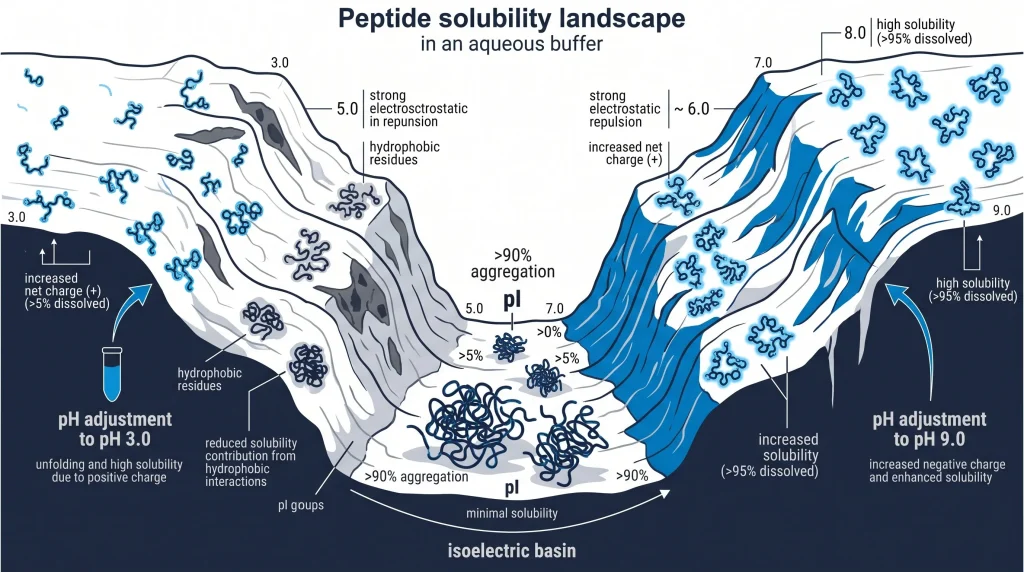
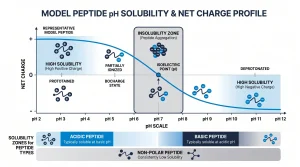
Net charge is the single biggest factor. Peptides with three or more charged residues (Arg, Lys, Asp, Glu) tend to dissolve well in neutral water. Peptides with mostly non-polar residues (Leu, Ile, Val, Phe) resist water. The isoelectric point (pI) is the pH where a peptide has zero net charge. At pI, solubility is lowest. Moving pH above or below pI adds charge and raises solubility.
Hydrophobic peptides often need a co-solvent to dissolve fully. DMSO (dimethyl sulfoxide) is the most common choice. Researchers use 5-20% DMSO in water as a starting solvent. Then they add a buffer to reach the working concentration. A cloudy solution means the peptide is not fully dissolved. Researchers should not spin down undissolved peptides and assume the solution is ready.
According to Huff et al. (2004), peptide solubility in aqueous buffers is linked to residue composition and net charge at normal cell pH. Longer peptides are generally harder to dissolve than short sequences.
How Does pH Affect Peptide Dissolution?
Adjusting pH shifts the peptide’s net charge, which directly changes how well it dissolves in water.
Every amino acid residue has a pKa value. At pH values above pKa, acidic groups (Asp, Glu, the C-terminus) carry a negative charge. At pH values below pKa, basic groups (Arg, Lys, His, the N-terminus) carry a positive charge. The total of all charges gives the peptide its net charge at that pH.
For a basic peptide (rich in Arg and Lys), acidic conditions (low pH) add more positive charge and improve solubility. For an acidic peptide (rich in Asp and Glu), basic conditions (high pH) add more negative charge and improve solubility. Neutral peptides at their pI have zero charge and dissolve poorly.
| Peptide Type | Dominant Residues | Preferred Solubility pH | Suggested Starting Solvent |
| Basic | Arg, Lys, His | pH 4-6 (acidic) | Dilute acetic acid or water |
| Acidic | Asp, Glu | pH 7-9 (basic) | Dilute ammonium hydroxide |
| Hydrophobic | Leu, Ile, Val, Phe | Any, needs co-solvent | 10-20% DMSO, then add buffer |
| Neutral | Mixed | pH near pI is worst | Try water first, then adjust |
What Co-Solvents Are Used in Peptide Solubility Research?
DMSO, acetonitrile, and dilute acids or bases are the main co-solvents for non-polar peptides.
DMSO is the most common co-solvent for non-polar peptides. It is miscible with water and with most aqueous buffers. Researchers dissolve the peptide in a small volume of neat DMSO first. They then dilute into the target buffer. The final DMSO percentage in the assay should be below 1% to avoid affecting cell or receptor behavior.
Acetonitrile is another option for peptides that do not dissolve in DMSO. It is often used for HPLC stock solutions but is too volatile for long-term storage. Dilute acetic acid (0.1%) works well for basic peptides. Dilute ammonium hydroxide (0.1%) works for acidic peptides. Researchers should make fresh solutions from dried stock each time. Stock solutions stored in solvent can degrade faster than dry powder.
According to Skov et al. (2014), co-solvent selection for synthetic peptides must account for downstream assay fit. DMSO above 0.5% can block some enzyme assays and alter membrane permeability in cell models.
How Is Solubility Tested in a Lab Setting?
Visual inspection, UV absorbance, and light scattering are the three main methods to test peptide dissolving.
Visual inspection is the first step. A fully dissolved peptide solution is clear. A cloudy or turbid solution has undissolved particles. Researchers should examine the solution against a bright background. Mild warming (not above 37°C) can help dissolve stubborn peptides. Sonication in a water bath for 5-10 minutes also helps.
UV absorbance at 280 nm measures Trp and Tyr residues if present. The absorbance reading can estimate concentration and confirm dissolving. Light scattering (dynamic light scattering, or DLS) detects clumped particles in a sample. If DLS shows large particles, the peptide is not fully dissolved. Researchers should not use a cloudy stock solution in any binding or cell assay.
Browse BPC-157 and TB-500 product pages for lot-specific COA data and solubility guidance from batch documentation.
What Happens to Peptide Structure During Dissolution?
Peptides can clump or change shape during dissolving if pH or solvent conditions are wrong.
Aggregation is the main risk during peptide dissolving. Aggregated peptides form non-covalent clusters that can look like a dissolved solution under poor lighting. Aggregated peptides do not bind receptors or interact with cell membranes in the same way as monomeric peptides. This leads to underestimation of active compound concentration.
Some peptides form folded shapes (helices or sheets) in certain solvents. These structures affect receptor binding and assay readability. CD spectroscopy can detect folded shape formation in solution. Researchers running mechanistic studies may need to characterize the peptide in solution before use.
Lyophilized peptides have better stability than solution stocks. Starting from fresh dried powder for each study avoids build-up of broken-down products. This is especially important for peptides with Met, Cys, or Trp residues, which are prone to oxidation.
What Research Tools Support Peptide Solubility Research?
COA-verified dried lots, a pH meter, and DLS instrumentation are the core tools for peptide solubility studies.
Research teams need a verified peptide lot to run any solubility study. The lot must match the published reference standard for molecular weight and purity. Next Level Pharm verifies each peptide lot by HPLC and mass spectrometry before shipping. Standard tools include a calibrated pH meter and a 0.22 um syringe filter. Also needed: a UV-Vis reader (280 nm), a DLS instrument for particle size, and fresh buffer at the target pH. View the research peptide catalog for lot-specific COA and mass spec data.
Frequently Asked Questions
What is peptide solubility in research?
Peptide solubility in research refers to how well a dried peptide dissolves in an aqueous buffer for lab assays. Solubility depends on the peptide’s amino acid sequence, net charge at the working pH, and hydrophobicity. Basic peptides (rich in Arg, Lys) dissolve in water or dilute acid. Hydrophobic peptides need a co-solvent like DMSO. Poor solubility leads to inconsistent assay results. Confirming full dissolution before starting any study is a required step.
Why do some peptides not dissolve in water?
Peptides with many non-polar amino acids (Leu, Ile, Val, Phe) resist water because these residues repel polar solvents. At the isoelectric point (pI), a peptide also has zero net charge, which reduces aqueous solubility. Peptides with no charged residues in their sequence are often insoluble in water alone. A co-solvent such as DMSO or a pH adjustment is needed to dissolve these compounds. Checking the amino acid composition before choosing a solvent saves time.
What is DMSO and why is it used to dissolve peptides?
DMSO (dimethyl sulfoxide) is a polar aprotic solvent used to dissolve non-polar peptides that resist water. It mixes well with aqueous buffers. Researchers dissolve the peptide in a small volume of neat DMSO first. They then add a buffer to the working volume. The final DMSO content in the assay should be below 1% to avoid blocking with receptors or cells. DMSO is not suitable for all assays, so researchers should check compatibility before use.
How does pH affect peptide solubility?
pH affects solubility by changing the net charge of the peptide. At low pH, basic residues (Arg, Lys, His) become positively charged and increase solubility. At high pH, acidic residues (Asp, Glu) become negatively charged and increase solubility. At the isoelectric point (pI), net charge is zero and solubility is at its lowest. Dissolving a basic peptide in dilute acetic acid (pH 4-5) and an acidic peptide in dilute ammonium hydroxide (pH 8-9) are standard approaches.
What is the pI of a peptide?
The isoelectric point (pI) is the pH at which a peptide has zero net charge. At this pH, positive and negative charges cancel out. Solubility is lowest at the pI because the peptide has no charge repulsion to keep it in solution. Aggregation is most likely at pH near the pI. Researchers calculate pI from the amino acid sequence using online tools. Avoiding buffer pH near the pI is a key step in solubility planning.
How can clumping be detected in a peptide solution?
Aggregation in a peptide solution can be detected by visual inspection (cloudiness), light scattering, or UV absorbance. Dynamic light scattering (DLS) is the most sensitive method. It detects particles in the nanometer range that are invisible to the naked eye. Centrifugation at low speed can also cause pellet clumps, after which the supernatant is analyzed for soluble peptides. If DLS shows particles larger than the expected peptide monomer, the solution is not fully dissolved.
What is the difference between solubility and stability for peptides?
Solubility refers to how much peptide can dissolve in a given volume of solvent. Stability refers to how long the dissolved peptide retains its chemical structure. A peptide can be soluble but unstable. Oxidation, deamidation, and peptide bond cleavage all reduce stability without affecting the appearance of the solution. Lyophilized (freeze-dried) peptides are more stable than solution stocks. Cold storage and protection from light extend stability after dissolving.
How should dried peptides be dissolved for research?
Start with a small volume of the right solvent. For basic peptides, try water or dilute acetic acid first. For non-polar peptides, dissolve in neat DMSO first, then dilute with a buffer. Mix gently. Let the mix dissolve at room temp. Do not heat above 37°C. Filter through a 0.22 um syringe filter if the solution will contact cells. Confirm dissolving by visual inspection and UV absorbance before starting the assay.
What concentration is used in peptide solubility testing?
Peptide solubility is typically tested at 1-10 mg/mL in the target buffer or solvent. This range is high enough to challenge the peptide and low enough to detect partial dissolving. For assays, working levels are usually much lower (nanomolar to micromolar range). Researchers make a concentrated stock solution first and dilute the working concentration. The stock should be tested for solubility before storing. Aliquoting the stock avoids repeated freeze-thaw cycles.
Do dried peptides need cold storage?
Lyophilized peptides are stable at room temperature during shipping. After receipt, cold storage at minus 20°C or minus 80°C extends shelf life. This is especially important for peptides containing Met, Cys, or Trp residues. These residues are prone to oxidation over time. Peptides stored in solution degrade faster than dry powder. Reconstituting fresh from dried stock for each study is the recommended approach for sensitive assays.
Summary
Peptide solubility in research settings depends on three main factors: net charge, amino acid hydrophobicity, and buffer pH. Basic peptides dissolve in dilute acid. Acidic peptides dissolve in a dilute base. Hydrophobic peptides need a co-solvent like DMSO.
Confirming full dissolving before any assay is a required step. Visual inspection, UV absorbance, and DLS testing are the tools used to verify a clear, particle-free solution. Aggregated peptides produce unreliable assay data.
Next Level Pharm provides dried peptide lots with lot-specific COA data that includes molecular weight confirmation. This helps researchers match the starting material to the theoretical sequence before running solubility protocols.
What Should You Do Next?
Researchers should calculate peptide charge and isoelectric point before choosing a lab solvent. Match the solvent and buffer to the sequence and planned assay. Confirm full dissolution and record the compound lot, solvent, and preparation conditions in the lab log. Researchers sourcing these lab peptides can shop research peptides with full COA and lot traceability.
People Also Read
About the Author
Next Level Pharm Research Team
Alex M covers peer-reviewed findings in peptide science for Next Level Pharm, a US-based supplier of research-grade peptides verified to ≥99% purity via HPLC and mass spectrometry on every batch.
Disclaimer: For research purposes only. Not intended for human consumption. Next Level Pharm products are not intended for diagnostic, therapeutic, or medicinal use. This content does not constitute medical advice. Always consult a licensed healthcare professional before making any health-related decisions.