
Sermorelin vs Tesamorelin: GHRH Analog Research Comparison

Last updated: July 2026
A sermorelin vs tesamorelin comparison examines two synthetic analogs of growth hormone-releasing hormone (GHRH). GHRH is a peptide that signals the pituitary gland to release growth hormone. Research on these analogs often focuses on metabolic markers and structural profiles. According to PubMed (2011), tesamorelin reduced visceral fat tissue in study subjects after 26 weeks. Scientists study these compounds to observe their signal paths within the hormone system.
Next Level Pharm maintains strict quality standards for all catalog offerings. Each batch gets HPLC and mass spec checks to confirm purity. Average purity across the last 100 batches is 99.4%. Every order includes a certificate of analysis (COA). Lot data can be checked online. All products ship as freeze-dried powders sealed under an inert atmosphere for stability.
Labs rely on stable, high-purity compounds to get reliable research results. This commitment to transparency supports the study of growth hormone signals with greater confidence in the material. Test data backs the integrity of every vial. These materials stay stable at room temperature and need no cold chain.
Key Takeaways
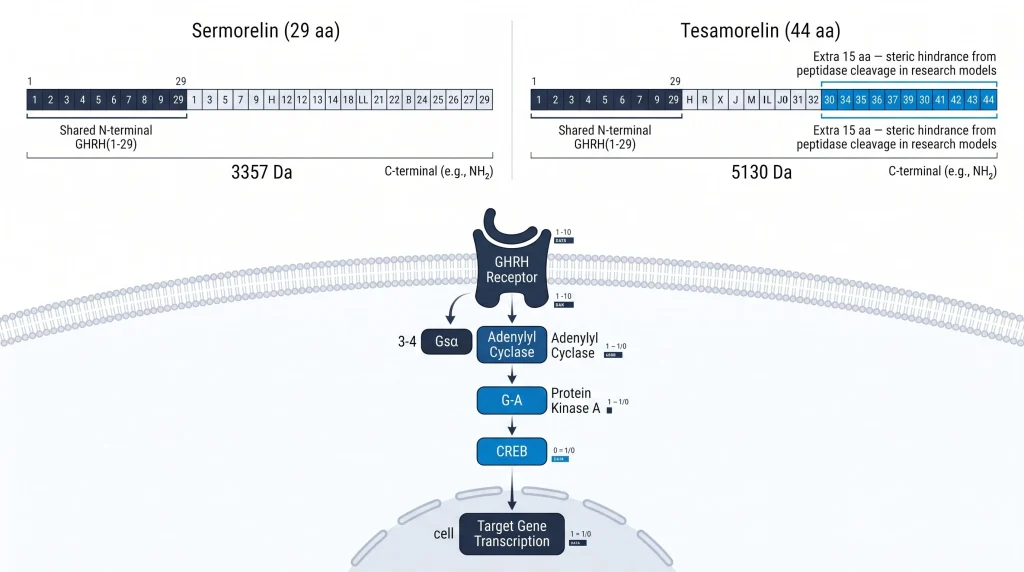
- Structure Differences: Sermorelin is a 29-amino acid segment of GHRH. Tesamorelin is a synthetic 44-amino acid structure.
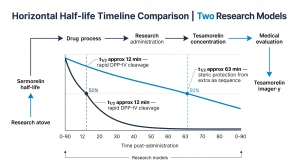
- Half-Life Range: Serum stability differs due to a chemical change at the N-terminus. Tesamorelin stays active for 63 minutes. Sermorelin lasts about 12 minutes.
- Shared Mechanism: Both peptides bind to GHRH receptors on pituitary cells. This binding starts growth hormone release.
- Enzyme Resistance: Tesamorelin resists breakdown by the DPP-IV enzyme. This enzyme quickly degrades sermorelin chains. This structural change alters how long each peptide lasts.
- Research Focus: Tesamorelin is often studied for effects on fat deposits. This focus sets it apart from sermorelin studies.
The next sections analyze the precise structures and processes that guide different research uses. These findings offer context for comparing peptide life span and receptor binding in lab settings.
What is sermorelin’s molecular structure?
Sermorelin is the 1-29 amino acid fragment of GHRH. This sequence is the shortest fully active segment of the parent peptide. It acts as a direct analog of the active domain in natural GHRH. The 29-amino acid chain retains the binding sites needed to interact with the pituitary gland. By mirroring this target site, the sequence triggers natural pituitary signals. Labs focus on this fragment for its role in mapping GH release patterns in tissue models.
This chain length allows the peptide to mirror the action of the full 44-amino acid version in controlled assays. Because the molecule keeps the key GHRH(1-29) properties, it is often preferred for precise signal studies. Sermorelin ships as a COA-confirmed research compound. Every lot is checked by HPLC and mass spec. This model allows for study of response paths in isolated systems.
What is tesamorelin’s molecular structure?
Tesamorelin is a synthetic 44-amino acid peptide that acts as a GHRH analog. Its structure matches the full length of natural human GHRH. Labs study this peptide for its design changes that improve stability over the native hormone. It resists rapid breakdown in the lab environment.
The key change is the attachment of a trans-3-hexenoyl group to the N-terminus of the peptide chain. This addition shields the peptide from enzyme breakdown. It blocks DPP-IV, the enzyme that normally clears GHRH from the system. By stopping this cleavage, the change extends the half-life of the molecule in test models. Tesamorelin ships as a COA-confirmed research compound. Every lot is checked by HPLC and mass spec. This structural profile makes it a common subject for kinetic property studies in labs.
How do their mechanisms of action differ?
Sermorelin and tesamorelin both act as agonists at the GHRH receptor on the pituitary gland. By binding to these receptors, they trigger the release of growth hormone from GH cells. While their primary targets are the same, the difference in effect comes from their stability levels. Tesamorelin has a structural change that affects how it interacts with natural enzymes. This results in a longer signal at the GHRHR compared to sermorelin.
Tesamorelin and Sermorelin each ship as COA-confirmed research compounds. Every lot is checked by HPLC and mass spec. The design gap between the two peptides determines how long their signals last. Binding time and receptor contact are the two main factors that set these compounds apart. Future studies may look at how these profiles affect GH receptor density in tissue models.
Which has a longer half-life?
Tesamorelin has a much longer half-life of 60 to 70 minutes compared to the short 10 to 12 minutes seen with sermorelin. This gap shapes how labs design studies with these GHRH analogs. Tesamorelin ships as a COA-confirmed research compound. Every lot is checked by HPLC and mass spec. The extended duration allows for distinct observation windows in lab assays.
Sermorelin clears quickly due to its response to DPP-IV enzyme cleavage. This enzyme cuts specific peptide sequences on contact. To extend longevity, tesamorelin includes a trans-3-hexenoyl group. This chemical addition stops the enzyme from binding to the peptide chain. The result is better stability and uptake. These structural details allow for longer signal output in precise hormone studies.
Sermorelin and Tesamorelin suit comparative lab assessments.
What is the main difference in research focus?
Tesamorelin research centers on its role in reducing visceral adipose tissue (VAT) in study models. Sermorelin has a broader history as a testing agent. While both peptides start GH axis signals and raise IGF-1 levels, their primary research goals differ based on structural design. Tesamorelin studies often focus on metabolic output and fat shift. Research into HIV-linked fat disorder highlights this fat-targeting role, according to PubMed (2011).
Sermorelin is often used to map pituitary function rather than target fat reduction. Its history as a testing agent supports its use in tracking hormone response patterns. Tesamorelin and Sermorelin each ship as COA-confirmed research compounds. Every lot is checked by HPLC and mass spec. This difference allows labs to choose the peptide that fits their specific study goals.
Are their safety profiles similar in studies?
Research studies for both GHRH analogs report similar types of effects. These are mainly related to injection site reactions and the effects of increased growth hormone levels. Study papers list local pain, such as redness, swelling, and itching, as common findings. These local reactions occur at the site of delivery. Research framing shows these events are often brief and fade without other issues.
Systemic findings also appear in clinical records when labs monitor high GH and IGF-1 levels. Reports include joint pain and fluid retention. These systemic markers are consistent with the known effects of GHRH-triggered hormone action. Labs monitor these events to contrast the strength of different analogs. Tesamorelin and Sermorelin ship as COA-confirmed research compounds. Every lot is checked by HPLC and mass spec. According to NIH (2010), these signs arise as the pituitary responds to the signal peptide. These findings remain a key area of focus for safe lab assay design.
How do sermorelin and tesamorelin compare in research?
| Feature | Sermorelin | Tesamorelin |
| Amino acid length | 29 aa | 44 aa |
| Half-life | ~12 minutes | ~60-70 minutes |
| Structural change | None (native fragment) | Trans-3-hexenoyl group |
| DPP-IV resistance | No | Yes |
| Primary research focus | GH axis mapping | Visceral adipose tissue |
| Stability | Lower | Higher |
Frequently Asked Questions
What is the difference between sermorelin and tesamorelin?
Sermorelin consists of the first 29 amino acids of GHRH, while tesamorelin is a synthetic 44-amino acid analog. The structural difference extends to their stability, as tesamorelin includes a trans-3-hexenoic acid change. This addition alters how the peptides interact with metabolic enzymes. Research shows these structural variations create distinct profiles when measuring growth hormone release and duration in a controlled lab setting.
Which GHRH analog is more potent?
Determining potency depends on the goal of the study and specific receptor binding. Tesamorelin is noted for extended stability and a longer half-life in blood samples than the shorter sermorelin fragment. Studies show the modified structure of tesamorelin resists rapid enzyme breakdown. This allows labs to observe sustained growth hormone signal patterns that are often less clear in shorter, unmodified peptide sequences.
How does tesamorelin reduce visceral fat in research compared to sermorelin?
Tesamorelin has been studied for its role in adipose tissue change, specifically visceral adipose tissue (VAT) in models with hormone issues. Research shows the peptide raises serum IGF-1 levels, which links to changes in fat mass distribution, according to PubMed (2011). Sermorelin also targets growth hormone release, but specific data on its visceral fat effects are less well documented than those for tesamorelin.
What are the half-life differences between sermorelin and tesamorelin?
The half-life of sermorelin is about 12 minutes before breakdown occurs. Tesamorelin features a modified structure that resists breakdown by the DPP-IV enzyme, giving a half-life of about 63 minutes. Labs note this difference when designing studies that need varying durations of peptide presence. A longer half-life allows for more stable signal windows during the review of hormone responses in a lab.
Is sermorelin considered a GHRH or a GHRP?
Sermorelin acts as a GHRH, or growth hormone-releasing hormone analog. It targets GHRH receptors on the pituitary gland to trigger growth hormone release. Unlike a GHRP (growth hormone-releasing peptide), which typically starts release through the ghrelin receptor, sermorelin mimics the native GHRH molecule. This distinction matters for researchers who study distinct hormone signal paths in controlled peptide assays. These two paths produce different data in lab models.
How does the pituitary gland respond to GHRH analogs?
When GHRH analogs bind to receptors on GH cells of the pituitary, they start a signal chain. This chain leads to the production and release of growth hormone. This process relies on cAMP (a key cell signal) inside the cells. Research shows that the binding strength of the analog determines the size of this response. Labs use this feedback to adjust the amount of hormone released in tissue models.
What is visceral adipose tissue?
Visceral adipose tissue (VAT) refers to body fat stored deep within the abdominal cavity. This tissue surrounds key organs, including the liver, pancreas, and intestines. Research shows that VAT activity is different in function from surface fat. Studies on metabolic signals and GHRH analogs often focus on VAT. This focus reflects key links to immune markers and hormone signal paths.
Can sermorelin and tesamorelin be studied in the same research protocol?
Sermorelin and tesamorelin could be included in the same protocol if the goal requires comparing different peptide signal durations or binding strengths. Labs must account for receptor overlap to prevent false data. Because both compounds act as GHRH analogs, the timing of delivery is key to maintaining a valid lab study. Careful study design ensures that each peptide acts as a separate variable within the trial.
Summary
Sermorelin and tesamorelin are synthetic GHRH analogs studied in hormone research. Sermorelin is the 29-amino acid fragment of natural GHRH with a half-life of about 12 minutes. Tesamorelin is a 44-amino acid analog with a trans-3-hexenoyl group that resists DPP-IV breakdown, giving it a half-life of about 63 minutes. Both peptides bind to the GHRH receptor on the pituitary gland to trigger growth hormone release. Their structural differences determine how long their signals last and which research applications they suit well.
What Should You Do Next?
Review the HPLC and mass spec data for your peptide lot to confirm purity. Compare these findings against your current research design and lab model. Every batch is third-party tested..
Researchers sourcing sermorelin or tesamorelin can browse the growth hormone category at Next Level Pharm. Every vial ships with a COA and full lot tracking data.
People Also Read
- Sermorelin vs CJC-1295: What Research Shows About Each GHRH Analog
- CJC-1295 Research: How This GHRH Analog Works in Lab Models
About the Author
Next Level Pharm Research Team
Alex M covers peer-reviewed findings in peptide science for Next Level Pharm, a US-based supplier of research-grade peptides verified to ≥99% purity via HPLC and mass spectrometry on every batch.
Disclaimer: For research purposes only. Not intended for human consumption. Next Level Pharm products are not intended for diagnostic, therapeutic, or medicinal use. This content does not constitute medical advice. Always consult a licensed healthcare professional before making any health-related decisions.