
Peptide Purity vs Potency: Why They Differ

Last updated: August 2026
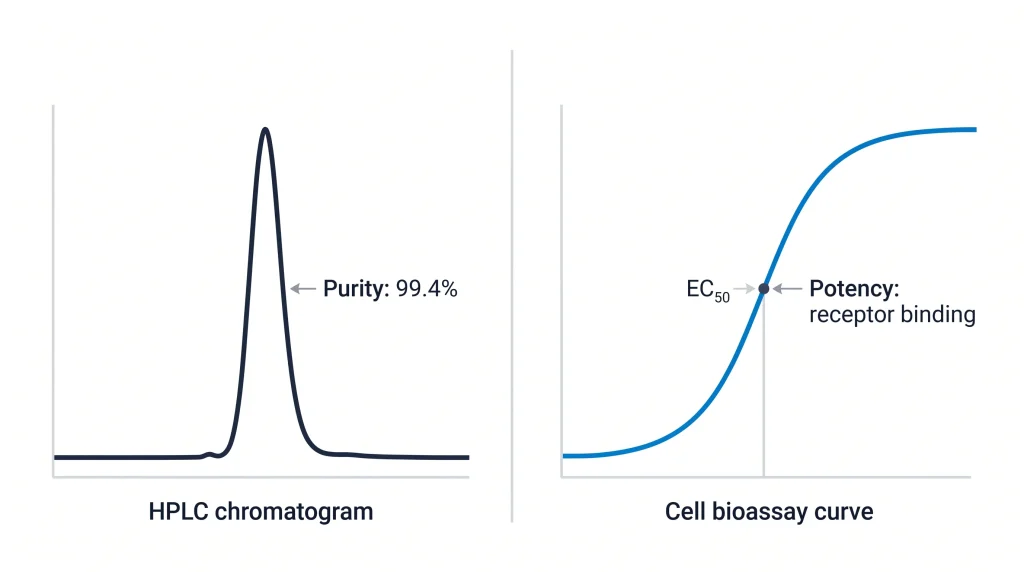
Peptide purity is the percentage of the target compound in a sample. Potency measures the biological activity of that compound at a set concentration. According to Journal of Peptide Science (2018), HPLC is the standard method for measuring purity in synthetic peptide lots. Purity and potency are not the same measure. A sample can be 99% pure but still show low potency if the peptide’s three-dimensional shape is damaged. Both measures are needed to fully characterize a research batch.
Next Level Pharm tests every vial with HPLC and mass spec (MS). Average purity runs at 99.4% across the last 100 batches. A Certificate of Analysis (COA) ships with every order. Researchers can look up a lot of data online by lot number.
Researchers who understand both measures can better evaluate their COA data and choose materials that meet their study needs.
Key Takeaways
- Purity vs Potency: Purity measures chemical cleanliness. Potency measures how well the peptide triggers a biological response in an assay.
- HPLC Measures Purity: HPLC separates the target compound from impurities and reports a purity percent by peak area.
- Bioassays Measure Potency: A bioassay tracks the functional output of a peptide in a cell system. HPLC cannot detect this.
- Pure Does Not Mean Potent: A 99% pure peptide can have low potency if oxidation or folding errors block its active site.
- COA Must Show Both: A complete COA includes HPLC purity data and MS identity data. Potency data from a bioassay is separate.
These two measures come from different test methods. Each answers a different question about the peptide sample.
What Does Peptide Purity Measure?
Purity measures the percentage of the target peptide in a sample relative to all other compounds. Contaminants often come from truncated chains that form when synthesis reactions fail to complete. Deletion sequences form when the chain is missing one or more amino acids. Both types of impurity are counted as part of the non-target content. BPC-157 lot purity data is listed on every COA with HPLC peak area results.
HPLC separates the sample in a liquid column. Each compound exits at a set time based on its chemical traits. The main peak area is compared to all peak areas to get the purity percent. A higher purity percent means less of the sample is made up of impurities. According to Journal of Peptide Science (2018), HPLC purity data is the standard measure for synthetic peptide batch release.
What Does Peptide Potency Measure?
Potency measures how well a peptide triggers a biological response at a given concentration. This is often reported as the EC50 (half maximal effective concentration). A lower EC50 means the peptide is more potent. Less compound is needed to reach half the maximum effect. A higher EC50 means the peptide is less potent. More compound is needed to reach the same effect.
Bioassays track the functional output of a peptide in a cell or enzyme system. The assay records how the peptide interacts with its target and quantifies the response. According to NCBI (2020), functional cell-based assays are the standard method for confirming the signaling properties of research compounds. HPLC cannot measure potency. Potency data comes only from biological testing.
Why Can a 99% Pure Peptide Be Low Potency?
A peptide can pass HPLC purity checks at 99% and still show low potency in a bioassay. Purity only confirms the chemical sequence is present. It does not confirm the three-dimensional shape needed for receptor binding. A damaged structure cannot bind correctly even if the amino acid chain is intact. BPC-157 potency depends on proper folding and storage from the point of manufacture to the lab.
Two common causes of lost potency are oxidation and improper freeze-drying. Oxidation changes side chains of sensitive amino acids. This blocks the active site and renders the peptide biologically inactive. Improper freeze-drying leaves residual moisture in the vial. That moisture drives hydrolysis, which breaks peptide bonds and creates shorter, inactive fragments. Both forms of damage can appear as a single peak on HPLC. Only a bioassay can detect the lost function.
How Do HPLC and MS Measure Purity?
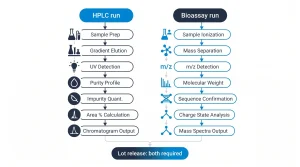
HPLC separates peptide components by how they move through a liquid column. Each component exits at a set time (retention time). The area of the main peak, compared to all peaks, gives the purity percent. MS then confirms the molecular weight by measuring the mass-to-charge ratio of the main peak. Both tests confirm what the sample is and how clean it is.
| Feature | HPLC | Mass Spectrometry (MS) |
| What it measures | Purity (area percent) | Molecular weight (m/z) |
| Can I confirm my identity? | Partial (retention time) | Yes (exact mass) |
| Detects impurities? | Yes (by peak area) | Yes (unexpected masses) |
| Detects potency loss? | No | No |
| Standard use | Purity release | Identity release |
Browse COA-verified research peptides with HPLC purity and MS identity data on every lot.
How Does Storage Affect Peptide Quality?
Freeze-dried peptides are stable for shipping at room temperature in sealed vials under an inert atmosphere. Long-term storage in a lab requires cool, dry conditions to keep the material intact. Heat, light, and moisture all drive degradation. Oxidation changes side chains of individual amino acids and reduces potency over time. TB-500 vials should be stored in a cool, dark place until ready for use in a research study.
Moisture is the primary driver of hydrolysis in stored peptide samples. Hydrolysis breaks peptide bonds. This produces shorter, inactive fragments. Once a peptide is dissolved in solution, it is far less stable than in dry form. Reconstituted samples should be kept cold and used within the timeframe noted in the study protocol. Dry storage at the recommended temperature maintains both purity and structure until use.
What Does a COA Show About Purity and Potency?
A COA is the primary verification document for a research peptide lot. It shows the HPLC purity percent, the MS m/z value (molecular weight), and the lot number. These data points confirm that the sample meets the purity standard for research use. The lot number on the COA must match the lot number on the vial. A COA that lacks either the HPLC purity or the MS m/z data is incomplete.
COAs do not usually include potency data. Potency testing requires a bioassay, which is not part of standard batch release. Researchers who need potency data must request it as a separate test or use a third-party lab. The COA documents what the sample is and how pure it is. Potency is a separate measure that must be evaluated in the context of each specific study model.
Frequently Asked Questions
What Does Peptide Purity Measure?
Purity measures the percentage of the target peptide in a sample relative to all other compounds. Labs use HPLC to separate the target compound from truncated chains and synthesis byproducts. The area of the main peak is compared to all peak areas to calculate the final percent. According to Journal of Peptide Science (2018), HPLC purity data is the standard for synthetic peptide batch release. A COA with only a single purity number without HPLC data is not sufficient proof.
What Does Potency Measure?
Potency measures how well a peptide triggers a biological response at a set concentration. It is reported as the EC50, which is the concentration needed to produce half the maximum effect. A lower EC50 means higher potency. Potency is measured in a bioassay that tracks a specific cellular or receptor response. According to NCBI (2020), functional cell-based assays confirm the signaling properties of research compounds. HPLC cannot measure potency. Bioassay results are separate from COA data.
Why Can a 99% Pure Peptide Be Low Potency?
A peptide can pass HPLC purity checks and still have low potency if its structure is damaged. HPLC confirms the amino acid chain is present but not whether the chain holds the correct shape. Oxidation changes sensitive side chains, which blocks the active site. Improper freeze-drying leaves moisture that drives hydrolysis and breaks the peptide bonds. Both forms of damage show up as a single peak on HPLC. Only a bioassay can detect the lost functional activity.
How Do Bioassays Assess Potency?
A bioassay exposes cells or enzyme systems to a peptide and records the functional output. The output is compared to a reference standard to quantify potency. According to Molecules MDPI (2019), bioassay data provides a direct measure of how well the peptide functions in a controlled setting. Results are expressed as EC50 values. Lower EC50 values mean the peptide is more potent at lower concentrations. Bioassay data is not part of a standard COA but can be a separate request.
Which Figure Belongs on a COA?
A valid COA includes the HPLC purity percent and the MS molecular weight (m/z value). HPLC data confirms how much of the sample is the target compound. MS confirms the right molecule. Both are needed for a complete lot record. The lot number on the COA must match the lot number on the vial. A COA missing either HPLC data or MS data does not confirm the full quality profile. Potency data requires a separate bioassay report.
Does Higher Purity Mean a Peptide Works Better in Research?
Higher purity reduces the chance of impurities interfering with test results. It ensures the observed effects come from the target compound. But purity does not confirm potency. A high-purity sample with a damaged three-dimensional structure will not activate its receptor correctly. Both purity and structural integrity are needed for valid research data. Researchers should verify purity from the COA and assess potency through a bioassay when their study protocol requires it.
How Does HPLC Differ from MS for Peptide Testing?
HPLC separates peptide components in a liquid column and compares peak areas to measure purity. It gives a percent that shows how much of the sample is the target compound. MS measures the mass-to-charge ratio of the sample and compares it to the expected value for the target sequence. MS confirms what the compound is. HPLC confirms how pure it is. Together, they cover both identity and purity in a single batch release workflow. Neither confirms potency.
How Long Do Freeze-Dried Peptides Last in Storage?
Freeze-dried peptides are stable at room temperature in a sealed, dry vial under inert conditions. Long-term lab storage requires cool, dark, dry conditions. The exact shelf life depends on the specific peptide and its side chains. According to NCBI (2020), moisture is the primary driver of hydrolysis and degradation. Once dissolved in solution, a peptide is far less stable than in dry form. Reconstituted samples should be stored cold and used within the timeframe specified in the study protocol.
Can Potency Be Tested Without a Lab?
Standardized potency testing requires lab equipment and a controlled biological system. Bioassays need cell culture tools and analytical sensors to record live responses. These are not available outside a lab. Home settings cannot produce the consistent baseline data needed for valid results. Potency data from a professional third-party lab is the only reliable source for functional activity data. Results from informal tests are not valid for research use.
What Is Considered High Purity for Research Peptides?
High purity for research is generally 98% or above. Many research labs set 99% as the minimum for studies that require precise response curve data. At 99.4% average purity across the last 100 batches, lot-to-lot consistency supports reproducible outcomes. Impurities below 1% can still introduce background noise in sensitive assays. Purity should be confirmed from the HPLC data on the COA. Any lot below 95% should be reviewed before use in a controlled study.
Summary
Peptide purity and potency are separate measures. Purity is the percentage of the target compound in a sample. It is confirmed by HPLC and MS. Potency is the ability of that compound to trigger a biological response. It is measured in a bioassay. High purity does not guarantee potency. Oxidation and freeze-drying errors can damage the peptide structure and reduce its function. A complete COA shows HPLC purity and MS identity data. Potency data requires a separate bioassay report from a professional lab.
What Should You Do Next?
Review the HPLC purity data and MS m/z value on the COA before starting any study. Confirm the lot number on the COA matches the vial label. Store freeze-dried peptides in a cool, dark, dry place until use. If your study requires potency confirmation, request a separate bioassay report from a third-party lab.
Browse COA-verified research peptides with HPLC and MS data on every lot at Next Level Pharm.
People Also Read
- What Makes a Peptide Research Grade? Standards and Testing Explained
- BPC-157 vs TB-500: A Detailed Research Comparison Guide
About the Author
Next Level Pharm Research Team
The Next Level Pharm research team is composed of biochemists and laboratory scientists dedicated to providing researchers with the highest-purity, COA-verified research peptides available. Every batch is HPLC and mass spec verified before dispatch.
Disclaimer: The information provided on this page is for educational and research purposes only. Next Level Pharm’s products are intended for laboratory research use only. They are not intended for human consumption, diagnostic, therapeutic, or medicinal purposes. This content does not constitute medical advice. Always consult a licensed healthcare professional before making any health-related decisions.