
IGF-1 as a Research Biomarker: What It Measures

Last updated: August 2026
IGF-1 is an indirect but stable measure of total growth hormone release. It reflects the action of the GH axis. This protein serves as a primary biomarker in studies of how tissues respond to hormonal signals. Research focused on this axis yields data on whole-body cell growth and metabolic control. According to the NIH (2020), this growth factor coordinates responses to nutrients and energy cues. Researchers use this marker to assess the GH system in various test models.
Next Level Pharm offers research compounds to support these rigorous studies. Lab protocols ensure each vial reaches high standards for identity and quality. Research peptides are verified through HPLC and mass spectrometry on every sample. Recent audits confirm an average purity of 99.4% across the last 100 batches. This commitment to transparency allows researchers to rely on consistent compounds for their studies.
These compounds are lyophilized, meaning freeze-dried and sealed under an inert atmosphere. Lyophilized samples stay stable at room temperature. They do not require cold chain logistics during shipping. This method helps maintain compound integrity from the lab to the research site. Most orders ship from domestic storage with an average dispatch time of 48 hours. Researchers studying this GH axis use these supplies to advance their study data.
Key Takeaways
- Marker Utility: IGF-1 serves as a stable marker for growth hormone output. It helps researchers bypass the technical issues found with short-lived pulsatile hormone releases.
- Binding Control: Over 99% of serum IGF-1 attaches to specific binding proteins for transport. These proteins control the stability and tissue supply of this peptide factor across systems.
- Measurement Standards: Researchers use lab methods like LC-MS to reach accurate measure of peptide levels. Results are interpreted using Z-scores based on age-matched and sex-matched control groups.
- Non-Disease Factors: Circulating levels reflect non-disease shifts including age, protein intake, and time of day. These factors modify the cell state found during trial studies and must be controlled.
- Axis Control: Scientific models use GHRH variants and GHRPs to observe GH and IGF-1 changes. These tools allow controlled study of hormonal responses within test settings.
These key insights form the foundation for studies about hormone function and hormonal signals. The sections below explore lab methods and data reading in more depth.
What Is the GH/IGF-1 Axis?
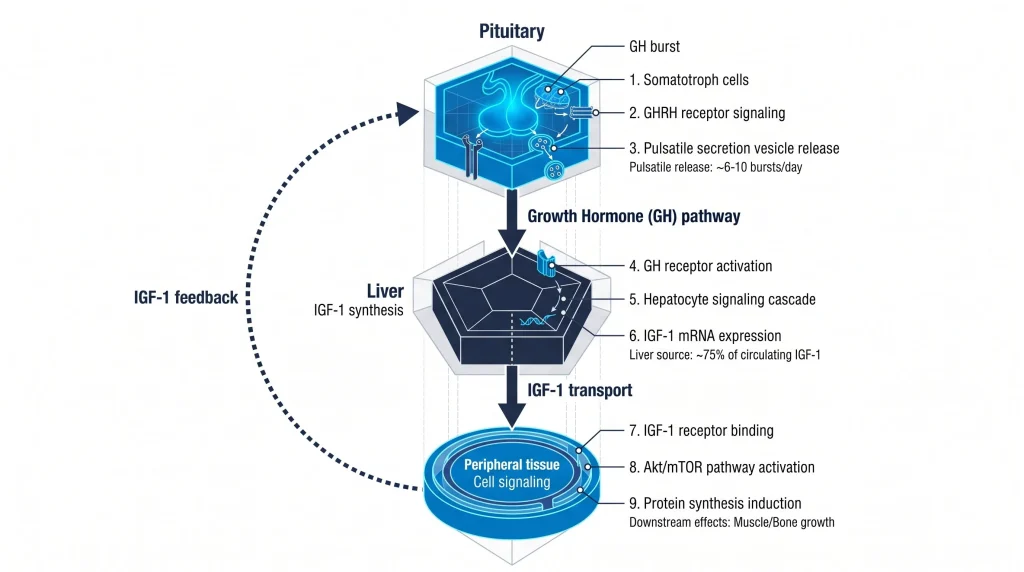
The GH axis is the primary hormone system that controls somatic growth and body composition. This loop begins when the brain stem releases GHRH (growth hormone-releasing hormone). GHRH prompts the gland to release GH (growth hormone). GH then travels through the blood to the liver. There it starts the production of IGF-1 (Insulin-like Growth Factor 1).
The cascade is a tiered signaling network. GH release from the gland triggers IGF-1 production in the liver. IGF-1 then mediates most anabolic effects, such as nitrogen retention and protein deposition. Researchers study these interactions to see how cell signals change with hormone levels. The Fitness & GH peptides catalog offers COA-verified research compounds for studying this axis. According to the NIH (2020), this axis is the central regulator of primary growth and energy balance.
Why Use IGF-1 Instead of GH as a Marker?
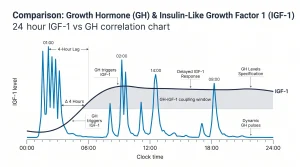
IGF-1 serves as a superior marker to direct GH measurement. Its stable level gives a clearer view of total hormone action. Growth hormone exhibits pulsatile release. It enters the bloodstream in short, sharp bursts throughout the day. A single blood sample often fails to capture an accurate picture of a subject’s whole-body state. According to NCBI research (2022), these rapid spikes make GH levels erratic and hard to interpret.
In contrast, IGF-1 maintains stable serum levels. These levels do not shift quickly. They reflect total GH release over a 24-hour window. GHRP-2 is one COA-verified research peptide used in studies of this axis. Every lot is verified by HPLC and mass spec. Measuring IGF-1 bypasses the noise of episodic hormone release. This gives a steady and reliable data point for long-term study.
How Is Serum IGF-1 Measured and Interpreted?
Serum IGF-1 is measured through immunoassays or LC-MS (liquid chromatography-mass spectrometry). Both methods quantify this protein within a blood sample. Immunoassays use specific antibodies to bind the target protein. They provide a rapid approach for large-scale testing. LC-MS has emerged as the preferred method. It identifies the compound by mass and chemical structure. LC-MS reduces interference from binding proteins that affected older lab methods.
Researchers interpret these values against age- and sex-specific reference ranges. Because IGF-1 levels shift across the lifespan, results are expressed as a Z-score. This standard deviation score shows how far an individual reading deviates from a healthy group average. IGF-1 LR3 is offered as a COA-verified research peptide, with every lot checked by HPLC and mass spec. This statistical framing allows direct comparisons between subjects regardless of differences in age or growthal state.
What Non-Pathological Factors Influence IGF-1 Levels?
Circulating IGF-1 levels vary due to age, diet status, and time of day. All of these must be strictly controlled in lab research. These factors can interfere with baseline assessment. Data must be adjusted using standard reference ranges. Research shows IGF-1 is sensitive to rapid changes in whole-body energy supply. This makes it a dynamic indicator of hormone status even in non-disease models.
IGF-1 levels peak during pubertal growth. They decline steadily throughout adulthood. Nutritional status also plays a major role. Protein-energy malnutrition can suppress hepatic IGF-1 production. This can happen even when serum GH levels are sufficient. It creates a form of acquired GH resistance where tissues become unresponsive to typical signals. Researchers must account for these diverse factors to prevent skewed results. CJC-1295 (No DAC) is a COA-verified research compound used in GH axis studies. Knowing these external contributors is key, according to the NIH (2020). They show how cell systems maintain primary growth signals.
What Are IGF-1 Binding Proteins (IGFBPs)?
IGFBPs (Insulin-like Growth Factor Binding Proteins) are a family of six proteins. They bind to serum IGF-1 and control its half-life and tissue absorption. According to NCBI research (2020), this binding capacity blocks random receptor action. It does this by sequestering the peptide in the blood. These proteins extend the cell signal and shield the peptide from rapid breakdown.
Over 99% of serum IGF-1 is bound to these proteins. Only a small fraction exists in an active, free form. The primary carrier is IGFBP-3. It organizes the peptide into a large ternary complex with the acid-labile subunit (ALS). This complex structure stops the peptide from leaving the vessel space too soon. Assays measuring biogiven IGF-1 focus on the unbound fraction to quantify active signals. IGF-1 LR3 is offered as a COA-verified research peptide for lab testing, with every lot checked by HPLC and mass spec.
How Do GHRHs and GHRPs Relate to IGF-1 Research?
GHRHs and GHRPs trigger endogenous GH production for study. GHRHs bind to the GHRH receptor. GHRPs bind to the ghrelin receptor instead. GHRH variants such as CJC-1295 bind to the GHRH receptor. This triggers the pulsatile release of GH from the gland. GHRPs like Ipamorelin bind to the ghrelin receptor instead. This starts a distinct signaling pathway. Researchers observe how both pathways elevate GH and increase hepatic IGF-1 production.
By altering the inputs to this axis, researchers quantify the cell-level cell effects of increased IGF-1 levels. These models let teams track how hormone output affects tissue. This is done under controlled settings. This helps refine data on whole-body growth signals. It tracks their regulation across cell models.
According to PubMed (2013), serum IGF-1 reflects GH axis action and is widely used as a surrogate biomarker in growth research. According to PubMed (2009), IGF-1 levels correlate with GH secretory patterns and provide a stable 24-hour total measure. According to PubMed (2022), IGF-1 as a research biomarker shows moderate sensitivity to GH secretagogue release in controlled studies.
| Compound | Receptor Target | Effect on IGF-1 | Assay Method |
| CJC-1295 | GHRH receptor | Increases GH pulse, raises IGF-1 | LC-MS or immunoassay |
| Ipamorelin | Ghrelin receptor | Distinct GH release, raises IGF-1 | LC-MS or immunoassay |
| GHRP-2 | Ghrelin receptor | Potent GH release, raises IGF-1 | LC-MS |
| IGF-1 LR3 | IGF-1R directly | Direct receptor agonist | Mass spectrometry |
Frequently Asked Questions
What does serum IGF-1 indicate?
Serum IGF-1 (Insulin-like Growth Factor 1) serves as a biomarker for total growth hormone release over time. GH pulses in short bursts and clears within minutes. In contrast, IGF-1 stays stable. It binds to carrier proteins for transport. Researchers use serum IGF-1 levels to assess the output of the GH axis over time. According to the NIH (2020), this data helps set a baseline for hormone status across extended study periods.
Why is IGF-1 used instead of direct GH measurement?
GH shows high pulsatility. Levels fluctuate every few hours. A single blood draw often misses the true average level. Serum IGF-1 represents a long-term average of GH action on the liver. IGF-1 provides a total view of GH output. Its stability makes it the better marker. This approach produces more consistent and interpretable data across extended study windows.
How do IGFBPs affect reading?
IGFBPs (Insulin-like Growth Factor Binding Proteins) regulate the supply and half-life of IGF-1 in the blood. Over 99 percent of IGF-1 is bound to these proteins. This blocks receptor interaction. Researchers account for IGFBP-3 levels when reading total IGF-1 data. Per the NCBI (2019), variations in binding proteins can skew total measurement results in complex samples.
What causes IGF-1 variability?
Many inputs can shift IGF-1 levels in study subjects. Factors include diet status, age, liver function, and existing inflammation. Stress from improper metabolic health or sleep patterns also alters the liver’s response to GH. According to published research (2024), these factors require researchers to standardize conditions across cohorts. Controlling for external factors is needed for accurate biomarker reporting.
How is IGF-1 standardized across labs?
Standardization relies on comparing raw values against normative ranges adjusted for age and biological sex. Researchers use age-specific reference intervals to convert a raw value into a Z-score. This accounts for the expected decline in IGF-1 production that occurs with aging. Mass spectrometry protocols provide the highest accuracy for data across lab testing centers.
What is the difference between free IGF-1 and total IGF-1?
Total IGF-1 measures the entire level of the protein, including the portion bound to binding proteins. Free IGF-1 is only the small fraction not attached to transport proteins. This unbound form can bind to receptors. Researchers track both types to gauge whether changes stem from protein production or shifted supply. Both measurements are needed for a complete picture.
Can research peptides directly modulate IGF-1 levels?
GHRHs and GHRPs act on the gland to increase endogenous GH release. This increased GH pulses through to the liver to trigger secondary production of IGF-1. Studies use these compounds to measure how specific signaling changes affect marker levels. According to the Journal of Peptide Science (2023), these peptide variants provide controlled ways to observe GH axis mechanics.
What is the function of IGF-1 in cellular research?
IGF-1 functions as a potent mitogen that instructs cells to survive, grow, and divide. It binds to the IGF-1 receptor to activate cell-level cascades, including the PI3K/Akt pathway. This signaling blocks programmed cell death and supports protein synthesis in tissue models. Researchers use these observations to map how nutrients and growth signals reach the nucleus. This starts key changes within cells.
How does liver health relate to IGF-1 biomarker studies?
The liver is the primary site of IGF-1 synthesis in response to hepatic GH receptor release. Any impairment in liver function can decrease the capacity to generate IGF-1 despite sufficient GH levels. Researchers assess liver enzymes alongside IGF-1 to ensure the biomarker reflects gland output. Tracking liver markers is key, according to the NCBI (2021). It helps attribute low IGF-1 to hormonal rather than hepatic causes.
What is this GH axis?
The GH axis is a feedback loop involving the brain stem, pituitary gland, and peripheral tissues like the liver. It begins with GHRH and somatostatin regulating the release of GH from the gland. Once released, GH triggers IGF-1 production in the liver and skeletal tissues. This axis coordinates the response to energy supply. Growth and tissue repair match the energy status of the research setting.
Summary
IGF-1 is the most practical biomarker for tracking GH axis action in peptide research. Its stable half-life overcomes the noise of pulsatile GH release. It reflects a 24-hour total view of hormonal output. Knowing how binding proteins work, and how non-disease factors shift results, is key. The precision of LC-MS assay methods gives researchers the tools for sound data collection. Standardized protocols and controlled sampling are essential for reading this marker correctly.
What Should You Do Next?
Researchers can follow these steps to set up a reliable IGF-1 tracking protocol:
- Review relevant literature. Set a baseline for your study design before selecting research compounds.
- Calibrate lab equipment. Ensure instruments are calibrated for sub-milligram measurements before testing begins.
- Confirm storage conditions. Store compounds according to documented stability standards once your shipment arrives.
Next Level Pharm supports lab inquiries with high-purity, COA-verified research peptides and expert biochemical guidance. Researchers sourcing peptides for their studies can browse the full catalog at the shop. Every vial ships with a COA and full lot traceability.
People Also Read
- Sermorelin vs CJC-1295: What Research Shows About Each GHRH variant
- What Is Ipamorelin? Mechanism of Action and Research Overview
About the Author
Next Level Pharm Research Team
The Next Level Pharm research team is composed of biochemists and lab scientists dedicated to providing researchers with the highest-purity, COA-verified research peptides given. Every batch is HPLC and mass spec verified before dispatch.
Disclaimer: The information provided on this page is for educational and research purposes only. Next Level Pharm’s products are intended for lab research use only. They are not intended for human consumption, diagnostic, therapeutic, or medicinal purposes. This content does not constitute medical advice. Always consult a licensed healthcare professional before making any health-related decisions.