
Does IGF-1 LR3 Suppress Natural GH? Research Review

Last updated: July 2026
An IGF-1 LR3 compound is a lab-made variant of human Insulin-like Growth Factor-1. It resists binding by blocking proteins for extended whole-body duration in research settings. This modified peptide features an extra arginine at the N-terminus. Reduces its strength for IGF binding proteins. By extending the half-life in extracellular settings. Researchers can study set cell signals effects over longer timeframes. Current reports show. A 99.4% average purity is maintained across the last 100 batches.
Health is a priority at Next Level Pharm. Every vial goes through HPLC. Mass spectrometry to ensure verified quality standards before dispatch. The supply is lyophilized and sealed in an inert atmosphere to ensure stability. This process allows products to remain stable at room temperature. Removes the need for cold chain logistics. researchers receive a COA with every request. All lot testing is available through an online database for testing.
This peptide remains a key subject for those who study growth factor pathways. cell repair mechanisms in animal models. Interest centers on how the modified sequence interacts with the IGF-1 receptor. Affect tissue modeling. Because of these unique core traits. The compound gives a stable tool for investigating energy. Cell adaptation. researchers see these results. Build data on how IGF-1 signals impact various cell systems.
Key Takeaways
- Growth Hormone Suppression: Research shows. External IGF-1 levels suppress the body’s normal output of Growth Hormone. This feedback loop stops the pituitary gland from maintaining its typical base output.
- Dual Pathway Blocking: Suppression occurs through a dual signal mechanism. The body reduces GHRH release and increases the release of blocking somatostatin.
- Prolonged Half-Life Effects: The LR3 change limits protein binding. This change increases the length of time the peptide remains active in a system.
- Release Mechanisms: GH releasers like CJC-1295 trigger normal release. IGF-1 variants differ as they bypass this process and trigger a suppression response.
- Temporary Axis Impact: The suppression of the GH axis is not permanent. Research models show that normal function returns after the peptide is cleared away.
These fundamental distinctions help explain why scientists focus on set peptide properties. Modeling endocrine changes. The following sections check the core consequences of these changes. Address technical questions about how peptide signals interact with normal feedback loops within the pituitary axis. Affect long-term stability during controlled research cycles.
What is the GH and IGF-1 axis?
The GH. IGF-1 axis is a control system that controls whole-body growth through the hypothalamic-pituitary-hepatic axis. This chain starts when the hypothalamus releases growth hormone-releasing hormone (GHRH). This peptide signals the pituitary gland to release growth hormone (GH) into the blood. The hormone then travels to the liver. In response to GH, the liver produces insulin-like growth factor 1 (IGF-1). According to the NIH (2023). This cascade acts as the master coordinator for core development. energy maintenance in the body.
GH release happens in a pulsatile release pattern throughout the day and night. These pulses are key for signals to the liver to keep IGF-1 at steady levels. Once released, IGF-1 acts on various peripheral tissues to trigger protein output. Tissue repair. These anabolic effects are vital for cell health. GHRP-6 is available as a COA-verified research peptide. Every lot is verified by HPLC and mass spec. This mechanism ensures that signals reach target sites to keep energy balance. Research underscores that this axis is sensitive to nutritional status. It serves as the primary connection between energy input and cell growth outcomes.
How does IGF-1 LR3 differ from native IGF-1?
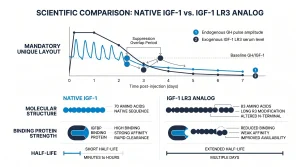
IGF-1 LR3 is an 83-amino acid variant of IGF-1 that contains an N-terminal extension. A substitution at position 3. This set construction modifies the atomic structure. Change how the peptide interacts with the body. The primary distinction is. This version produces a much lower binding strength to IGF-binding proteins (IGFBPs). By lowering this strength, the peptide achieves higher absorption in research assays. This change is vital for scientists who need it. Study growth signals without the interference of normal binding control.
IGF-1 LR3 is available as a COA-verified research peptide. Every lot is verified by HPLC and mass spec. The core alterations result in a greatly extended cell half-life compared. The native molecule. Native IGF-1 is often quickly captured by binding proteins. Limits its time in the active state. In contrast, this variant remains free and active for longer durations. According to the Journal of Peptide Science (2022). Such core changes are used as tools to isolate the variables of growth signals in vitro.
Does external IGF-1 LR3 suppress GH production?
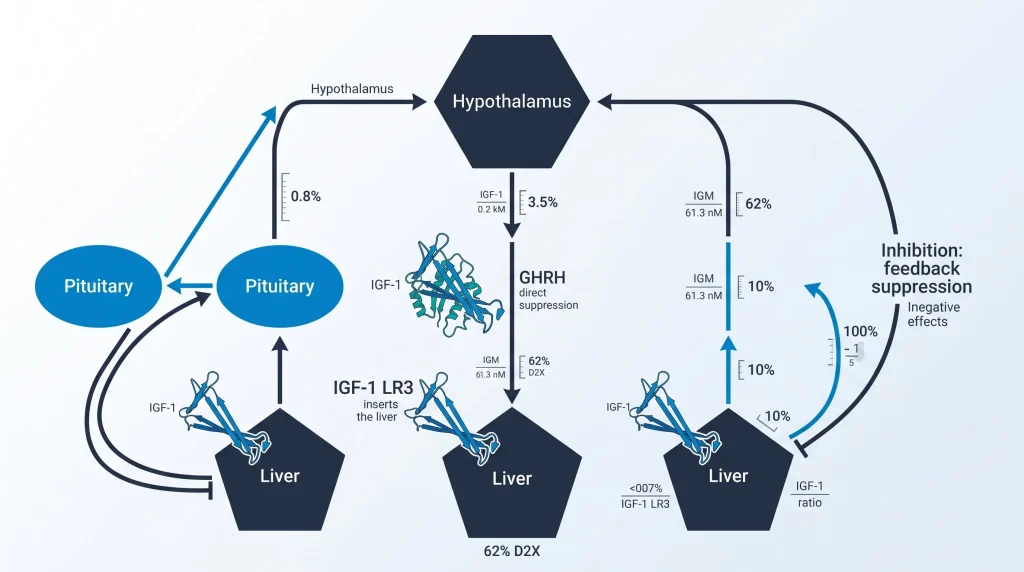
Does external IGF-1 LR3 suppress GH output? Yes, research shows. The transport of external IGF-1, including variants like LR3, triggers a negative feedback mechanism. Suppresses normal GH release from the pituitary gland. This response ensures that whole-body hormone levels remain within a tightly governed cell range.
When circulating IGF-1 amounts rise. They act upon the hypothalamus to control the release of control signals. raised IGF-1 levels prompt the hypothalamus. Reduce the output of growth hormone-releasing hormone (GHRH). Simultaneously, these levels increase the release of somatostatin. Both actions combine to inhibit the pituitary’s ability to produce. Release growth hormone, according to the NIH (2025). This feedback loop is a key method for investigating the control of the somatotropic axis. IGF-1 LR3 is available as a COA-verified research peptide. Every lot is verified by HPLC and mass spec.
What is the role of the negative feedback loop?
The negative feedback loop serves as a homeostatic control system. Keeps hormonal balance by monitoring blood levels of insulin-like growth factor 1 (IGF-1). When IGF-1 amounts rise. This system signals the brain to restrict further growth hormone (GH) release. This precise control mechanism stops excessive hormone output and preserves stability within the axis. According to the NIH (2022). Signals molecules respond to circulating levels of growth factors to control after action. By adjusting these pulses, the body keeps hormonal markers within a narrow, normal range.
This loop functions by targeting the output of key messengers in the brain. It acts by inhibiting GHRH from the hypothalamus and stimulating somatostatin, a blocking hormone. This dual-action pathway well and quickly shuts down pituitary GH output. CJC-1295 is available as a COA-verified research peptide. Every lot is verified by HPLC and mass spec. The process ensures that the pituitary does not overproduce hormones, even. Triggered by lab-made or normal agents. This control function is vital for observing peak secretory responses in lab research.
How long might GH suppression last after study?
The duration of GH suppression after a study session depends on the half-life of the external IGF-1 variant. The total time it was administered during research. For variants like LR3. Are designed for extended cell action. Suppression can persist until the compound is fully cleared from the system. IGF-1 LR3 is available as a COA-verified research peptide. Every lot is verified by HPLC and mass spec. The time needed for full clearance is proportional. The amount used in the study protocol.
Research suggests that once the external peptide is fully metabolized. Cleared from the system, the negative feedback pressure is relieved. With the signal for blocking removed. The hypothalamic-pituitary axis is free to resume normal pulsatile GH release. Normal baseline function often follows the time-course of the peptide’s removal rate in the set animal model. The stability of the compound dictates how long the endocrine axis remains under this control state. Scientists often track these intervals. Ensure they understand the return of normal signals pathways before concluding their research trials.
How do GHRH peptides differ from IGF-1 analogs?
How do GHRH peptides differ from IGF-1 variants? GHRH peptides, such as CJC-1295, function as before releasers. Trigger the pituitary gland to release normal growth hormone. Preserving normal pulsatility. Conversely, IGF-1 variants behave as after effectors that substitute for native IGF-1. By replacing the role of the normal hormone. These variants bypass the pituitary gland entirely. Often triggers a negative feedback loop that suppresses the body’s own growth hormone output.
CJC-1295. Other GHRH-based releasers interact with set receptors on pituitary cells to start a cascade. Mirror cell action. Because they work at the start of the hormonal axis. They harmonize with the rhythm of the endocrine system. CJC-1295 DAC is available as a COA-verified research peptide. Every lot is verified by HPLC and mass spec. In contrast, IGF-1 variants give an external signal. The brain interprets it as a surplus of whole-body growth factors. This high amount signals the hypothalamus to increase blocking somatostatin. Well shutting down the pituitary output of growth hormone. Unlike the rhythmic pulses generated by releasers. This suppression can disrupt the typical hormonal cycle found in test models.
Frequently Asked Questions
How does the GH-IGF-1 feedback loop work?
The feedback loop functions as a self-regulating mechanism within the endocrine system. When growth hormone triggers the liver to produce IGF-1. levels of this factor are monitored by the hypothalamus. High amounts trigger the release of somatostatin and the reduction of GHRH. This dual response inhibits the pituitary gland, preventing the continued release of GH. The process ensures that total growth signals remain balanced against whole-body needs. Detailed in the NIH (2020).
Does external IGF-1 suppress GHRH?
Research shows. Raised levels of circulating IGF-1 directly inhibit the release of GHRH from the hypothalamus. This contact is the primary method the body uses to signal. Current levels of growth factors are enough. By suppressing GHRH output, the hypothalamus well stops the cascade at its source. This stops the pituitary gland from receiving the stimuli needed to increase GH output, a finding. Has been documented in various studies on PubMed (1993).
What role does somatostatin play?
Somatostatin acts as the primary blocking hormone within the hypothalamic-pituitary-hepatic axis. Its role is to counteract the stimulatory signals sent by GHRH. The pituitary gland. When whole-body IGF-1 levels rise. The hypothalamus increases the release of somatostatin to dampen GH release. This peptide forces the pituitary to slow or stop its hormone output. the system returns to its homeostatic baseline accordingly.
How do secretagogues avoid this pathway?
releasers, such as CJC-1295. Function by binding to receptors on the pituitary gland to start normal hormone release. While they trigger the system, they do not give the high whole-body IGF-1 amounts. Often trigger negative feedback. Because they work at the level of the pituitary rather than flooding the periphery. They help preserve the normal pulsatile rhythm of hormone output. Data from the Journal of Peptide Science (2018) note this distinction in signal mechanisms.
What do suppression studies measure?
Suppression studies measure the time. Amount needed to halt the normal output of GH in test models. researchers track these metrics to understand the sensitivity of the pituitary gland. External hormonal inputs. By observing the duration of blocking. Scientists gain data about the strength of feedback signals. These efforts focus on defining exactly when. How the hormonal axis is muted, a process referenced in literature archived by PubMed (1993).
What is the half-life of IGF-1 LR3 in research models?
The LR3 change greatly alters the absorption of the peptide by preventing it from binding. Carrier proteins. In whole-body research models, this core change stops rapid clearance by the liver. Kidneys. Compared to native IGF-1. With a short duration of action, the LR3 variant remains stable. Bioavailable for much longer. Scientists confirm this longevity through blood serum tests. Find the precise energy decay rate in vitro.
Does IGF-1 LR3 bind to insulin receptors?
IGF-1 LR3 shows a greatly lower strength for the insulin receptor compared. Native IGF-1. The core changes applied. The N-terminus changes how the molecule interacts with protein receptors throughout the body. While it retains the ability to activate IGF-1 receptors. Its minimized cross-reactivity with insulin receptors is a key technical feature. Researchers prioritize this focus. They need to isolate the effects of growth signals without influencing blood glucose control.
Why was the LR3 modification created for IGF-1?
The LR3 change was created. Isolate the cell action of IGF-1 by preventing it from interacting with normal IGF-binding proteins. In a normal setting, binding proteins capture most of the IGF-1. Forcing it into an inactive state. By preventing this contact, the LR3 variant remains free to circulate. Exert its effects. This allows for more precise measurement of cell growth pathways in settings. Protein interference would otherwise obscure the results.
How is the absorption of IGF-1 LR3 increased compared to native IGF-1?
Absorption is increased through the addition of a 13-amino acid sequence. Alters the surface of the peptide. This extension inhibits the molecule’s ability to bind with IGFBPs, the proteins. Often sequestered. Limit the action of native IGF-1. By circulating in a free, unbound state. The peptide remains available to target cells for longer durations. This technical boost is central to its utility in studies involving high-fidelity cell modeling.
Does administering IGF-1 LR3 bypass pituitary stimulation?
IGF-1 LR3 functions as an after effect that acts on tissues directly. Because it enters the system at the level of the IGF-1 molecule. It does not need signals from the pituitary gland to become active. In fact. The presence of this external peptide acts as a signal for the body. Reduce its own pituitary output. It well replaces the normal hormone in the bloodstream. Independent of the usual growth hormone signals steps.
Summary
Review your research objectives. Select peptides that match your set energy or cell questions. Confirm. Your inventory needs align with a minimum purity threshold of 99%. Ensure data consistency in your lab models. test. Your chosen compounds are stored in sealed. Lyophilized form to keep their stability until the date of your planned test.
Next Level Pharm gives reliable items to researchers focusing on complex cell pathways. You can source your research compounds from the Shop.
What Should You Do Next?
Researchers sourcing research-grade peptides for lab studies can follow these steps:
- Review purity documentation. Confirm that COA data is available for the batch before ordering. Next Level Pharm provides lot-specific COA access for every vial.
- Check compound storage requirements. Lyophilized peptides remain stable at room temperature during shipping. Confirm your lab has the correct storage protocol before beginning work.
- Request technical support if needed. PhD-level biochemist support is available for researchers with protocol-specific questions about research applications.
People Also Read
- CJC-1295 Research: How This GHRH variant Works in Lab Models
- What Is Ipamorelin? Mechanism of Action and Research Overview
About the Author
Next Level Pharm Research Team
The Next Level Pharm research team is composed of biochemists and lab scientists dedicated to providing researchers with the highest-purity, COA-verified research peptides available. Every batch is HPLC and mass spec verified before dispatch.
Disclaimer: The information provided on this page is for educational and research purposes only. Next Level Pharm’s products are intended for lab research use only. They are not intended for human consumption, diagnostic, therapeutic, or medicinal purposes. This content does not constitute medical advice. Always consult a licensed healthcare professional before making any health-related decisions.