
Peptide Gel Formulation Research: Hydrogel Delivery Studies


Last updated: October 2026
A peptide hydrogel formulation is a gel built from short peptide chains that link up on their own to form strong fiber networks. Scientists study how these gels hold active compounds and release them over time in controlled lab settings. Tests track how heat, acid level (pH), and salt content shift the way these gels act and respond.
Next Level Pharm gives labs the research compounds they need for high-purity study work. Every batch is tested by HPLC (high performance liquid chromatography) and mass spec to check purity. The mean purity across the last 100 batches is 99.4%, which clears the standard 99% bar.
Each compound stays freeze-dried and sealed under inert gas for a long shelf life. This storage cuts the need for cold chain shipping. Gel studies focus on how peptides move within a gel mesh and release compounds over a set time span.
Good data in this field needs high-purity inputs that lead to steady, clear results.
Key Takeaways
- Self-Assembly Basics: Peptide gels form through weak bonds between small units. This creates a strong fiber network that traps water.
- Tunable Traits: Labs adjust stiffness and release speed by changing the amino acid order and peptide amount.
- Gel Forming Process: Gels form when dissolved freeze-dried peptides respond to triggers like pH or salt level shifts.
- Key Metrics: Rheology (flow testing) tracks how stiff the gel is. Spectroscopy (light-based analysis) tracks how fast compounds leave the gel.
- Lab Uses: Common study areas include controlled release, 3D cell culture scaffolds, and tissue models.
These core ideas shape the framework for making useful gel matrices in modern lab work. The sections below look at how design choices and test methods affect how these gels behave.
What Are Self-Assembling Peptide Hydrogels?
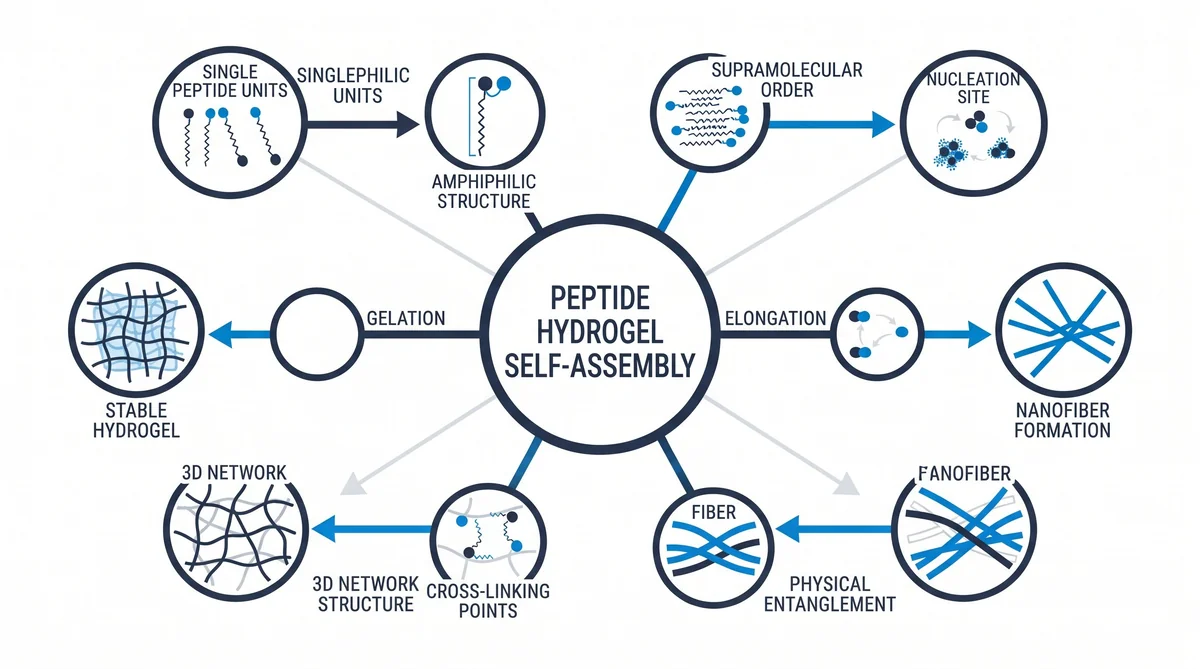
Self-assembling peptides (SAPs) are short amino acid chains that form tiny fibers on their own when triggered. According to the Journal of Peptide Science (2018), this shift happens when the peptide amount hits a set point. It leads to ordered, strong fiber networks.
This process relies on weak bonds such as hydrogen bonds, charge-based forces, and effects where water-shy parts group together. These bonds let single peptide units join into long, thin fibers. Once fibers form, they trap large amounts of water to create a firm gel.
Triggers like pH shifts, salt changes, or heat shifts start this process. By changing these settings, labs control the traits of the final gel. The tiny fiber shapes often mimic the mesh found outside cells in living tissue.
How Are Peptide Hydrogels Formulated in Research?
Gels are made by dissolving freeze-dried peptide powder in a water-based solution. Then a set trigger is applied. This forces the chains to link up into a web that traps the liquid inside.
Labs control the peptide amount to set the stiffness and density of the final gel. The choice of solution also shapes the bonds between chains. Rheology (the study of flow) tracks how fast the gel sets.
A second trigger, such as a pH shift or added salts, starts the change from liquid to solid-like gel. Next Level Pharm gives labs COA-checked peptides for these studies. Every lot is tested by HPLC and mass spec.
What Properties Define Hydrogel Performance?
Gel performance rests on two factors: stiffness and release speed. These metrics describe how a gel keeps its shape and works with its payload over time. Labs use a rheometer (a tool that measures flow traits) to check these factors.
The storage modulus (G’) measures how elastic the gel is and how much energy it stores without lasting change. The loss modulus (G”) reflects the liquid-like nature of the gel and shows how much energy is lost as heat. Together, these values show how a gel will hold up under stress.
| Metric | What It Measures | Why It Matters |
|---|---|---|
| Storage modulus (G’) | Elastic behavior | Shows gel stiffness |
| Loss modulus (G”) | Viscous behavior | Shows energy loss |
| Release rate | Compound diffusion speed | Controls timing of release |
| Mesh size | Pore width in network | Limits what can pass through |
Spectroscopy tracks how fast compounds leave the mesh. The speed depends on network density and the bonds between the peptide and its cargo.
What Is the Role of Amino Acid Sequence?
The amino acid sequence controls how each chain folds into a working shape. The order of residues defines which parts repel water and which parts draw it in. This drives beta-sheet forming, which is needed for strong fibers.
Without this precise order, peptides would not form the networks needed for a working gel. The sequence acts as the blueprint for the final traits seen in the lab. RADA16 is a well-known peptide that uses this rule.
Its design relies on switching between water-shy and water-loving residues. Labs change this sequence to tune gel traits. Swapping residues can alter fiber density or stiffness for a given study.
How Is Compound Release from Hydrogels Studied?
Compound release is studied through in vitro (lab-based) release tests. A loaded gel is placed in a buffer and sampled over time. According to PubMed (2024), these tests show how fast the payload leaves the gel mesh.
Labs place the gel with a model compound in a fixed amount of liquid. They pull small samples at set time points to measure what has left the gel. The release profile depends on the gel mesh size, which acts as a barrier to flow.
Bonds between the peptide scaffold and the trapped compound also set the release speed. Math models then explain how gel breakdown controls the total release flow.
What Are Future Directions for Hydrogel Research?
Future work centers on gels that respond to cues like pH, heat, or enzyme presence. According to NIH (2022), these smart gels give labs a high degree of control over the local setting in tests.
These gels aim to copy the mesh found outside cells (ECM) in living tissue. By doing so, they let cells grow in conditions close to a living system. This helps labs see cell traits often lost in flat, 2D models.
The main focus is 3D cell culture and gels that can be placed at a target site. Next Level Pharm provides research-grade peptides for these studies. These tools give new insights into how cells act in man-made settings.
Frequently Asked Questions
What is the gelation mechanism of peptide hydrogels?
Peptide gels form when short chains self-assemble into long, stable tiny fibers through weak bonds like hydrogen bonds, charge-based forces, and water-shy effects. When these forces reach a balance, the peptides organize into structured webs that trap liquid inside the mesh. The result is a semi-solid that acts like a solid but holds a high water content, making it useful for many types of lab work.
What amino acid sequences form self-assembling peptide gels?
Studies point to sequences with alternating water-loving and water-shy amino acids as top picks for self-assembly into beta-sheet shapes that stack into fibers. A common example is the RADA16 sequence, made of arginine, alanine, aspartate, and alanine repeats that organize into ordered structures. These peptides form strands when exposed to set salt or pH levels, which lets labs create gel scaffolds in controlled settings.
How is hydrogel stiffness characterized for research applications?
Gel stiffness is measured using tests such as oscillatory rheology or atomic force microscopy, which apply force to the material and record its response. By checking how much the gel resists bending, labs can predict how it will perform in a given study model. These values help labs compare different formulas and confirm that the material gives the right support for specific study needs.
What rheological properties are measured for peptide hydrogels?
Rheology tests check the gel’s mixed solid-liquid nature by measuring the storage modulus (elastic part) and the loss modulus (viscous part). Labs also track how the material thins under stress to see if it can be placed at a target site through a needle. These tests show how a gel keeps its shape under the conditions needed for a specific study.
How does peptide concentration affect hydrogel mechanical properties?
Raising the peptide amount in a formula often increases both the density and stiffness of the fiber network. Higher amounts link to greater storage modulus values, and this trend is linear until the network fills up and can hold no more fibers. This control lets labs tune gel traits such as stiffness and release rate to fit a given test without changing the base chemistry.
Can peptide hydrogels be sterilized for cell culture studies?
Sterilization is possible, but the method must not harm the fibers, so labs often use filtration before assembly or gamma ray treatment. Labs check success by comparing fiber shape and strength before and after the process to confirm nothing was lost. Care must be taken to ensure the peptides do not break down or fall apart, and each batch is tested after the step.
What is the difference between a hydrogel and a regular gel?
A hydrogel is a gel defined by its high water content held in a 3D chain network, while standard gels may also hold water. The term hydrogel applies only when the network is made of water-loving chains that let small molecules pass through it. This trait makes hydrogels useful in studies that involve compound release, nutrient flow, or cell-based tests in the lab.
Are peptide hydrogels biodegradable in research models?
Most peptide gels are made of natural amino acid chains, which makes them prone to enzyme breakdown, a plus when slow decay is wanted. The decay rate can be set by changing the amino acid order or fiber packing to match the study needs. As the gel breaks down, the freed peptides are processed by the setting around them, which helps in long-term release work.
How are peptide hydrogels used in controlled drug delivery studies?
Labs use peptide gels as matrices to hold and slowly release active compounds over time by placing them within the fiber network. The release rate is set by how fast the compound spreads through the mesh and how fast the gel breaks down around it. This approach keeps a stable level of a compound at a target site while guarding it from early decay in the test setting.
What triggers cause peptides to self-assemble into a gel?
Self-assembly often starts when conditions around the peptide solution change, with common triggers including shifts in pH, heat, or salt levels. These shifts disrupt the charge balance or how well the peptides dissolve, which prompts a change from a random state to an ordered fiber-like form. The specific trigger depends on the design of the peptide sequence, which lets labs start gel forming at set times during a study.
Summary
Peptide hydrogel formulation research studies how short peptide chains link up on their own to form gel networks. These gels hold and release active compounds over time. Key factors include the amino acid sequence, peptide amount, and triggers like pH or salt levels.
Next Level Pharm supports this work with COA-checked, HPLC-tested peptides at 99.4% average purity. Precise inputs lead to precise results in gel studies.
What Should You Do Next?
Check your current protocol to find which peptide sequences fit your study needs. Review the lot-specific COA (certificate of analysis) for each vial to check purity before starting lab work. These documents verify the mass spec data for every batch.
Browse recovery peptides for COA-verified research compounds.
Browse research peptides for COA-verified research compounds.
Browse fitness peptides for COA-verified research compounds.
People Also Read
- Liposomal Peptide Encapsulation Research: Bilayer Studies
- PLGA Nanoparticle Peptide Research: Controlled Release
About the Author
Next Level Pharm Research Team
The Next Level Pharm research team is composed of biochemists and laboratory scientists dedicated to providing researchers with the highest-purity, independently verified compounds available. Every batch is HPLC and mass spec verified before dispatch.
Disclaimer: The information provided on this page is for educational and research purposes only. Next Level Pharm’s products are intended for laboratory research use only. They are not intended for human consumption, diagnostic, therapeutic, or medicinal purposes. This content does not constitute medical advice. Always consult a licensed healthcare professional before making any health-related decisions.