
PLGA Nanoparticle Peptide Research: Controlled Release

Last updated: October 2026
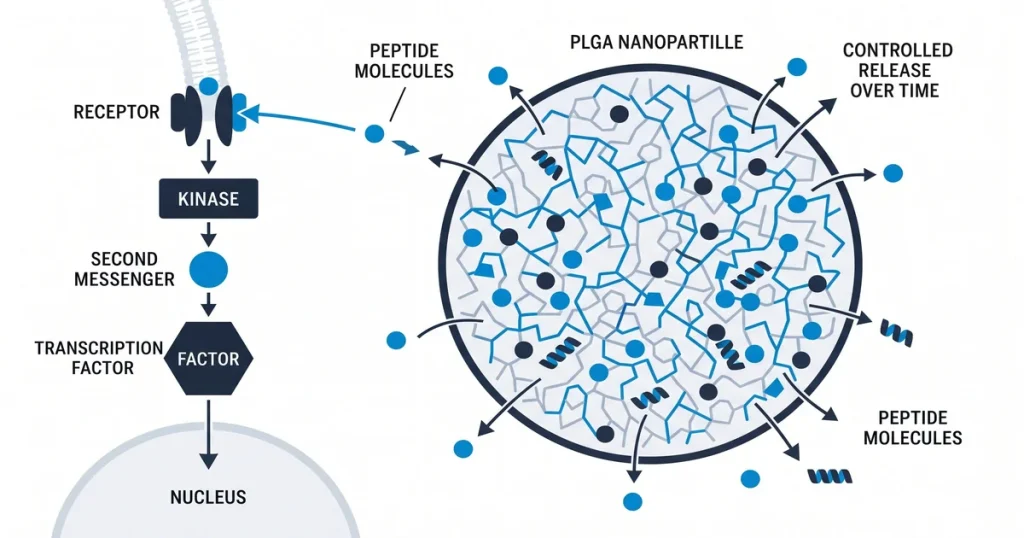
A PLGA nanoparticle peptide release research is the study of how polymer particles carry and release peptide compounds in a lab. PLGA stands for poly(lactic-co-glycolic acid), a copolymer that breaks down slowly in water. This slow breakdown controls when and how fast the peptide enters the test medium after contact with buffer.
Next Level Pharm provides lab-tested research peptides for controlled delivery studies, with an average purity of 99.4 percent across its last 100 batches. Each vial is verified by HPLC and mass spectrometry before dispatch. Peptides are lyophilized for stable room-temperature shipping.
PLGA particles give labs a way to study how a compound releases over a defined time window. The lactide-to-glycolide ratio sets the pace of breakdown. Adjusting this ratio is a standard tool for tuning release length.
TLDR: PLGA nanoparticle peptide release research studies how biodegradable polymer particles carry and release peptides in lab settings. The double emulsion method is the standard way to load water-loving peptides into PLGA. Labs measure particle size, surface charge, and release profiles to check batch quality.
Key Takeaways
- Biocompatible Polymer Matrix: PLGA is a breakable copolymer made from lactic and glycolic acid monomers.
- Tunable Release Duration: The lactide-to-glycolide ratio controls the rate of breakdown and peptide release.
- Double Emulsion Encapsulation: The water-in-oil-in-water method is the standard way to trap water-loving peptides in PLGA.
- Biphasic Release Profile: Batches show a short burst phase at the surface followed by a slower erosion-driven release.
- Critical Quality Parameters: Labs measure particle size, zeta potential, and polydispersity to verify batch consistency.
These five factors define the design space for PLGA peptide delivery systems. The sections below cover each one in detail.
What is PLGA in peptide delivery research?
PLGA is a cell-safe copolymer of lactic acid and glycolic acid that breaks down in water through hydrolysis of its ester bonds. According to the NIH (2023), this breakdown produces non-toxic metabolites that clear through normal body paths. These traits make PLGA a preferred matrix for long-term peptide delivery work in lab models.
The lactide-to-glycolide ratio controls how fast the polymer breaks down. More glycolide in the mix speeds breakdown because it absorbs water more readily than lactide does. Labs select a specific ratio to set the release window.
BPC-157 is one peptide studied in PLGA delivery work, along with other recovery compounds available at Next Level Pharm.
Labs pick PLGA because it is cheap to make and easy to scale for small test batches. The dried polymer ships and stores well in sealed vials at room temperature. This lets labs keep a stock ready for fast test runs without any cold storage.
Labs can blend two PLGA grades to make a two-step release curve in one batch. A fast-grade batch clears the first half of the load in two weeks. A slow-grade batch then takes over and holds the rest for four to eight more weeks.
Labs store PLGA in sealed vials with low moisture to keep it from breaking down on the shelf. A dry, cool store site keeps the polymer stable for a year or more. This long shelf life means labs can buy in bulk and cut the cost per run.
How are peptides encapsulated in PLGA?
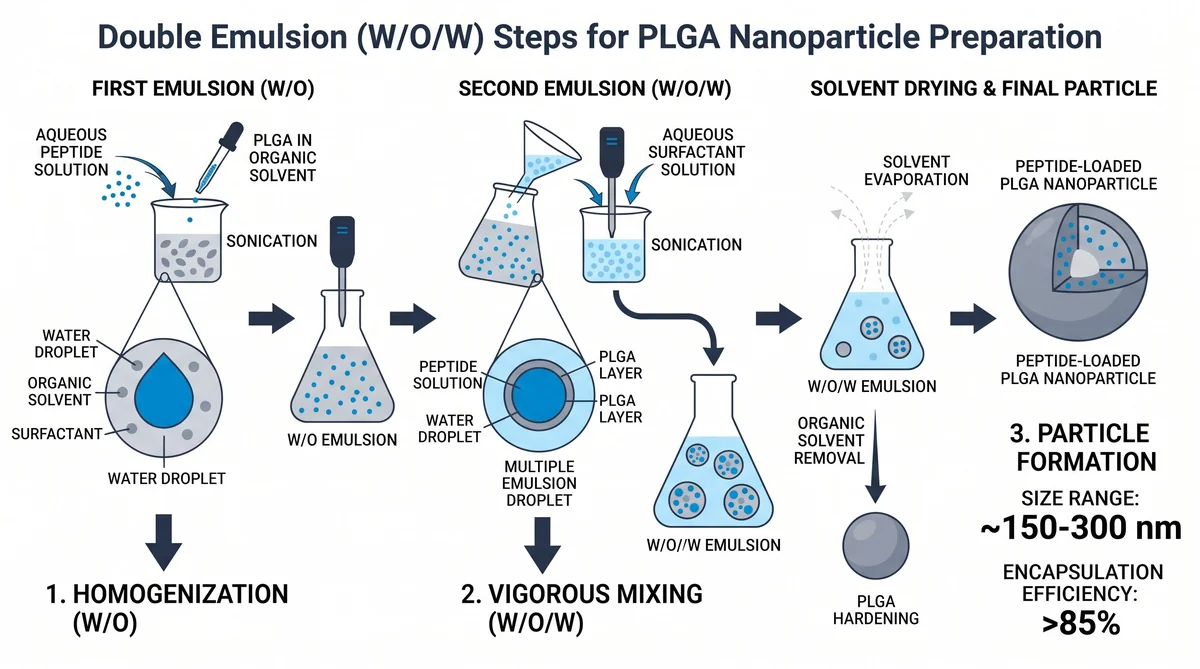
Peptides are encapsulated in PLGA using the double emulsion (water-in-oil-in-water) solvent evaporation method. Labs first dissolve the peptide in a small amount of water to form the inner water phase. This phase is then mixed into an organic solvent holding the dissolved PLGA to form a first emulsion.
The first emulsion is added to a larger water phase holding a surfactant such as PVA. High-speed mixing makes small droplets, and the surfactant stops them from merging. Drying off the solvent causes the PLGA to harden around the peptide.
According to Molecules (MDPI) (2021), this last step sets the final loading yield and particle size.
The size of the first inner drop sets how much peptide stays trapped inside. A small first drop gives a high yield because less peptide escapes to the outer phase. Labs use probe sonication for 30 to 60 seconds to keep the first drop tight.
The ratio of peptide to PLGA sets how much load fits in each batch. A high ratio can raise yield, but it may also increase the burst phase. Labs test three to four ratios to find a good fit for each compound.
What governs PLGA peptide release kinetics?
PLGA peptide release follows a two-phase pattern common to solid polymer matrices. The first phase is a short burst as surface peptide dissolves fast into the medium upon contact with water. The second phase is slower and driven by matrix erosion and diffusion through the pores of the breaking-down polymer.
According to Journal of Peptide Science (2018), the phase sizes depend on how much peptide sticks to the outer surface during batch prep. Labs study this ratio to understand how each variable affects delivery timing.
Temperature and pH of the incubation medium also affect how fast the polymer breaks down.
Labs track the release by pulling a sample from the test buffer at set time points. Each sample gets a UV absorbance read to give the peptide level at that point in time. Plotting these points shows the full release shape for the batch.
A flat curve at 24 hours means the burst phase was low. A steep rise in the first six hours means most of the peptide was on the surface. Labs log both the shape and the total percent released at each time point.
A batch with a low burst rate loses less than ten per cent in the first 24 hours. This tells the lab that most of the peptide sits deep in the matrix, not on the surface.
A high burst rate points to too much peptide on the outer wall of the particle. Labs trim the peptide-to-PLGA ratio to fix a high burst rate before the next run. This small change can cut the burst from 25 to ten per cent.
Researchers sourcing peptides for PLGA studies can view the full catalog at Next Level Pharm.
How is nanoparticle size and stability measured?
Dynamic light scattering (DLS) measures the diameter and PDI of PLGA particles in a liquid sample. A PDI below 0.2 signals a narrow and consistent size spread. Scanning electron microscopy (SEM) gives a direct visual check of shape and surface.
Zeta potential is the key stability metric for PLGA colloidal systems. A value above 25 mV or below -25 mV signals strong repulsion between particles. This repulsion stops clumping during storage and experimental use.
According to NCBI (2024), low zeta values link to poor dispersion in water-based buffers.
Labs run a size check on fresh batches and again after one week at 4 degrees C. A stable batch shows the same size and PDI both times. A size rise after storage points to particle merge or early breakdown.
Labs run each batch three times to check the data. A repeat that matches within five per cent shows the run was clean. This step helps the lab trust the data before it logs the results.
| Parameter | Typical Range | Tool |
|---|---|---|
| Particle Diameter | 100-500 nm | Dynamic light scattering |
| Polydispersity Index | 0.05-0.20 | DLS |
| Surface Charge | -30 to -15 mV | Electrophoretic assay |
| Encapsulation Yield | 40-80% | UV absorbance |
| Release Duration | 2-12 weeks | In vitro dialysis |
What challenges arise in PLGA formulations?
Key challenges in PLGA peptide batches include low encapsulation yield, peptide damage during production, and an uncontrolled burst phase. During the double emulsion process, peptide molecules can move from the inner water phase to the outer water phase. High shear from mixing also adds stress to the peptide chain.
PLGA breakdown creates a local acid zone inside the particle. Lactic and glycolic acid build up as the matrix erodes. This drop in pH can cause peptide clumping and chemical change.
According to Molecules (MDPI) (2021), adding a buffer agent to the inner water phase can reduce this pH drop during long-term release studies.
Labs add a base to the inner phase to slow the acid build-up during erosion. This protects the peptide chain from the local pH drop. Some groups add zinc ions as an extra pH buffer inside the matrix.
High probe power can also break the peptide chain during the first emulsion step. Labs use a pulse cycle of 2 seconds on and 2 seconds off to limit heat. This cut in heat keeps the peptide intact from the first step to the last.
What do future PLGA research directions show?
Future PLGA research focuses on surface-modified particles for targeted delivery to specific cell types. Labs link ligands or antibodies to the outer polymer surface to direct particles toward receptor-bearing cells. This cuts off-target spread during lab viewing.
According to Journal of Peptide Science (2024), surface-modified PLGA shows higher cell targeting in assays compared to plain particles. Multi-peptide co-loading is also an active area of study. Labs load two or more compounds into one particle to study joint effects in cell models.
Stimuli-responsive systems that release cargo at a target pH or temperature are under active study.
Lab teams also test PLGA blends with PEG to slow rapid cell uptake. The PEG coat makes the outer surface more water-loving and cuts binding by immune cells in culture models. These blends give finer control over how long the particle stays in the well before uptake.
Labs are also testing co-loaded PLGA batches with two peptides at once. The two loads can be set to release at different rates within the same particle. This design lets the lab study the effect of early and late release in one run.
Frequently Asked Questions
What is PLGA and why is it used for peptide research?
PLGA is a copolymer of lactic and glycolic acid that breaks down in water through hydrolysis. It produces non-toxic byproducts that clear through normal body paths at a steady rate.
This breakdown profile makes it a safe matrix for sustained peptide delivery in cell models. According to the NIH (2023), the cell-safe nature of PLGA reduces unwanted variables in controlled delivery experiments.
How is peptide encapsulation in PLGA performed in the lab?
The double emulsion method is the standard approach for trapping water-loving peptides in PLGA. Labs mix an aqueous peptide solution with dissolved PLGA in an organic solvent, then add a surfactant outer phase.
Drying off the solvent hardens the particles around the peptide and locks in the load. According to Molecules (MDPI) (2021), this process produces consistent round particles with defined size and yield data.
What release kinetics are typical for PLGA peptide batches?
PLGA batches show a clear two-phase release profile with a short burst phase followed by a slower matrix erosion phase. The burst occurs as surface peptide dissolves quickly into the medium upon first contact with the aqueous buffer. According to Journal of Peptide Science (2018), the erosion phase depends on the lactide-to-glycolide ratio and PLGA chain weight in the batch.
How is PLGA nanoparticle size characterized in research?
Labs use dynamic light scattering (DLS) to measure the diameter and PDI of the particle population in each batch. Transmission electron microscopy gives a direct visual check of particle size, surface, and round shape in each batch run. According to NCBI (2024), consistent size data are key for cell uptake studies because particle diameter affects how cells contact the outer surface.
What degradation mechanism governs PLGA peptide release?
PLGA breaks down when water enters the matrix and splits the ester bonds in the polymer chain. This yields lactic and glycolic acid monomers as byproducts.
According to Journal of Peptide Science (2018), this process is self-accelerating because the acidic byproducts speed up the remaining breakdown. The loaded peptide then releases gradually as the matrix loses its solid structure over time.
How does the lactide-to-glycolide ratio affect peptide release?
A higher glycolide share speeds water uptake and breakdown because glycolide is less fat-loving than lactide. This faster breakdown leads to a shorter total release window for the whole peptide load.
A higher lactide share slows the process and extends release duration. According to Molecules (MDPI) (2021), labs pick specific ratios to match the release window to the study’s timing needs.
What is the difference between PLGA particles and liposomes?
PLGA particles consist of a solid breakable polymer matrix, while liposomes are made from lipid bilayers. PLGA gives a denser matrix that limits early leakage and supports multi-week release profiles.
Liposomes offer faster cargo delivery through membrane fusion. According to Journal of Peptide Science (2018), the choice between these two carriers depends on the release duration needed for the study.
Can PLGA particles be functionalized for targeted delivery?
Yes, labs can modify PLGA surfaces with ligands or antibodies to direct particles toward specific cell types. These surface groups bind to receptors on target cells to improve targeting in the assay.
According to NCBI (2024), surface-modified PLGA particles show higher binding rates in receptor-bearing cell lines than plain particles. Surface engineering is an active area of lab research for improving delivery precision.
Summary
PLGA nanoparticle peptide release research offers labs a controlled way to study how breakable polymer matrices carry and release peptide compounds. The lactide-to-glycolide ratio sets the rate of breakdown and the length of the release window.
Key methods are the double emulsion technique for trapping peptides and DLS for particle sizing. Labs track encapsulation yield, surface charge, and release profiles to verify batch quality. Challenges such as peptide damage and acidic inner pH are active areas of work.
Future directions include surface-modified particles and stimuli-responsive systems for more precise delivery in cell models.
Labs that use COA-verified, high-purity peptides get a clean baseline for these models from the first run. Clean inputs mean that any shift in release data is tied to the batch, not to a purity gap. This makes the data easier to read and easier to share.
What Should You Do Next?
Review current lab protocols to confirm that polymer handling and storage conditions match the batch specs for each compound. Note the lactide-to-glycolide ratio and chain weight for each batch, as these two specs set the release length for the whole run. Check the COA for each lot before starting a formulation run.
Researchers who need lab-tested peptides for PLGA studies can browse the full catalog at Next Level Pharm.
People Also Read
- Liposomal Peptide Encapsulation Research: Bilayer Studies
- Transdermal Peptide Delivery Research: Skin Permeability
About the Author
Next Level Pharm Research Team
The Next Level Pharm research team is composed of biochemists and lab scientists dedicated to providing researchers with the highest-purity, COA-tested peptides available. Every batch is HPLC and mass spec confirmed before dispatch.
Disclaimer: The information provided on this page is for educational and research purposes only. Next Level Pharm’s products are intended for lab research use only. They are not intended for human consumption, diagnostic, therapeutic, or medicinal purposes. This content does not constitute medical advice. Always consult a licensed healthcare professional before making any health-related decisions.